Content Cadence and Publishing Velocity Impact on Attributed Revenue
Steady, citation-ready publishing drives revenue; raw volume does not.
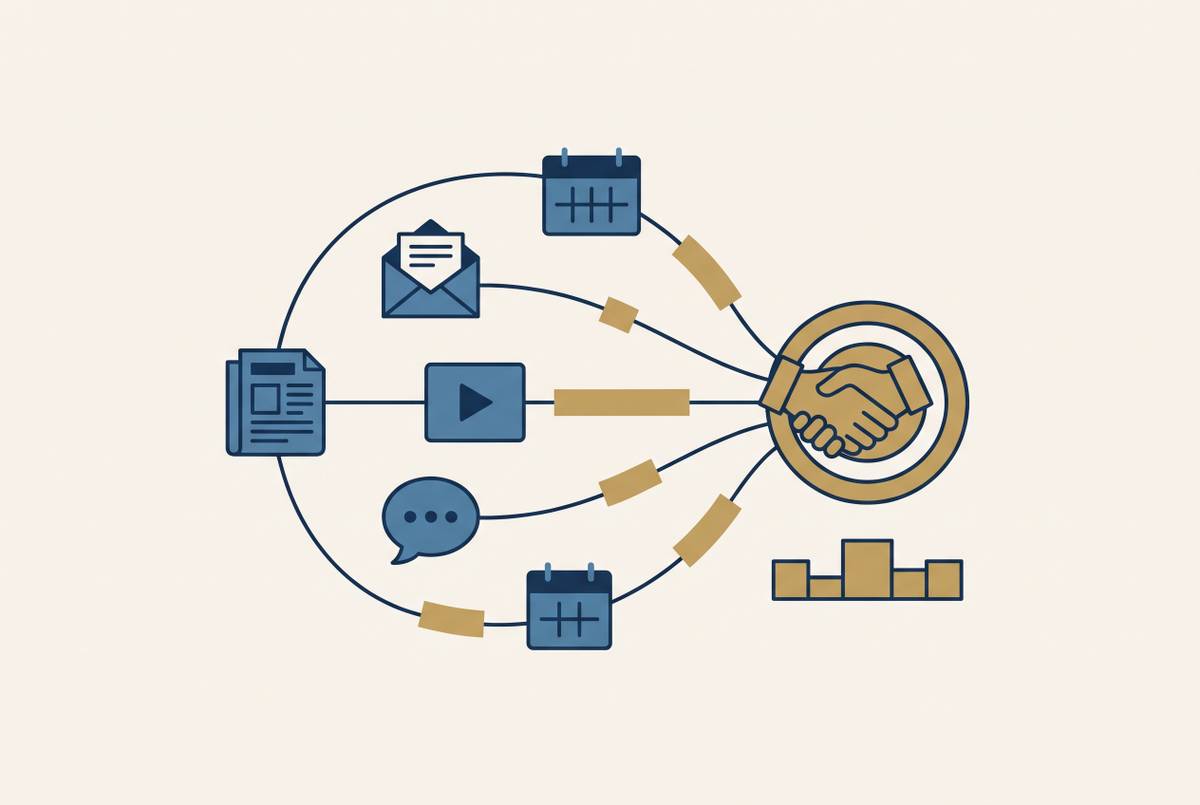
Publishing cadence affects attributed revenue only when it builds lasting topical authority, earns discovery across search and AI, and connects to pipeline measurement. A team should ask how steadily it can publish content that helps buyers progress, then measure that contribution even when the journey begins outside its website.
Why raw publishing speed no longer predicts attributed revenue
Consider a team that doubles publishing output and watches pipeline flatten. Its calendar looks full, but qualified sessions barely move. This is the failure hidden inside the assumption that more URLs produce more revenue. Shipping is only the first step toward discovery, and discovery does not automatically become a qualified buying signal.
Three changes weaken that assumed connection. AI answer engines can satisfy informational queries before a buyer reaches search results, while Google's helpful-content posture favors depth and consolidation over many thin pages. At the same time, finance expects evidence of pipeline and deal-velocity impact. These are different tests of content's usefulness. A larger publishing count answers none of them by itself.
The better unit is the rate at which a team ships assets that become indexed, rank, serve a revenue outcome, and remain legible to search engines and AI systems. That shifts attention from production alone to what happens after publication.
How compounding topical authority actually works, and where cadence fits into it
Pieces on related topics can build up a topic cluster rather than compete with one another as separate URLs. As coverage deepens, the portfolio signals expertise, and internal links reinforce the relationships between its pages. Cadence helps build the cluster by adding to its coverage at a steady pace instead of leaving it unfinished after a burst of publishing.
Four pieces one month followed by none the next does not provide the same sustained development as two pieces every month over many months. Consistency alone is not sufficient, however. Each new piece still needs to answer a real buyer question in enough depth to build on the work around it.
Tenspeed's 2026 framework separates publishing frequency, coverage speed, and response time to emerging trends. A team can publish frequently while taking too long to cover its priority cluster, or move quickly on trends while neglecting established buyer questions. The useful pace depends on existing authority, coverage, query value, and production capacity. Because those inputs can be assessed, the right number can be determined for each team.
Calibrating cadence against cluster, funnel stage, and production capacity
To turn those inputs into a publishing plan, a team should first examine its cluster coverage gap. How many priority terms already have indexed, ranking pages? Thin coverage favors net-new work, while strong coverage shifts the need toward refreshes and depth. Existing domain authority gives that assessment context. An established portfolio and a new entrant should not receive the same volume target.
The second input is funnel-stage allocation. The same framework argues that bottom-of-funnel pages can produce disproportionate revenue impact per piece. A comparison page with a higher conversion rate may deserve production time ahead of another awareness article. That does not make awareness content worthless. The publishing slate needs a deliberate relationship to buyer progress.
The third input is sustainable production capacity. As the team puts out more work, it must still research in depth, bring original ideas, and use sources. The fourth input is a refresh and retirement budget, with monthly work divided among net-new pages, refreshes, and retirements. New pages can only make up for thin material elsewhere for so long. Publishing faster than a team can get pages indexed, ranked, and updated can dilute portfolio authority, so the resulting velocity target must account for upkeep as well as expansion.
Why AI answer engines intercept the buyer journey before cadence can help
A team can publish at exactly the right cadence for search and still be invisible to the AI answer that sets a buyer's shortlist. That is the gap search-based calibration leaves open. Similarweb's 2026 data found that 35% of U.S. consumers already use AI at the product-discovery stage. The figure describes consumers broadly, without isolating B2B buyers, and shows how far discovery has moved beyond the search results page.
When an answer engine responds directly, a source either appears in that answer or misses that opportunity for visibility. There is no equivalent benefit from sitting on page two. AI-referred visitors can also convert at higher rates than organic search visitors, so fewer clicks need not mean less commercial value. Traffic volume becomes a less dependable proxy for revenue.
Cadence still has a role in this environment. Publishing steadily within a cluster gives content more chances to earn citations, but content architecture affects whether an answer engine can pull out the claim it needs. Opening sections deserve particular attention because many citations draw from them. Visibility also changes across platforms and query runs, so one answer that favors a brand cannot show that it will keep appearing.
What content needs to do differently to earn AI citation
On-domain, or ground-site, changes start with making the evidence behind claims easy to extract. Strong claims belong near the opening, backed by authoritative sources, statistics with dates, and quotations from named experts where these are available. Format also affects citation opportunities. Ranked “best-of” articles are among the frequently cited formats, which makes format selection more than a reader-experience choice. Keyword stuffing, by contrast, can work against visibility.
Machine-readable structure supports that human-readable evidence. FAQPage schema has shown a strong correlation with extraction and citation, though correlation is not a guarantee that adding markup will earn a mention. Structured data helps expose what the page says. llms.txt should not receive the same priority, since the evidence described in the brief finds no statistical correlation with citation, and no major AI lab has officially committed to honoring it.
Off-domain, or phantom-site, presence addresses a different problem. Can an AI system identify the brand and corroborate its claims beyond the owned website? Forums, editorial outlets, review platforms, and communities provide that wider context, including ecosystems such as Reddit, YouTube, and Wikipedia. Entity grounding deserves particular attention, with a Wikidata entry and consistent presence across third-party platforms helping make the brand identifiable. More owned pages cannot substitute for that recognition. Research hidden behind a form wall also loses citation potential because the model cannot retrieve the evidence.
How AI-optimized content pipelines sustain cadence without trading quality for speed
These requirements make production more demanding than drafting alone. A citation-ready article needs a brief that guides the work, claims backed by evidence, an editor's judgment, and machine-readable structure. A multi-stage AI pipeline can remove bottlenecks between those steps without removing the people responsible for quality.
In a mature pipeline, briefs can be templated and AI-fillable, drafting automated, fact-checking tied to sources and validated through continuous integration, and schema generated automatically. Human review sits at defined gates. This gives editors room to focus on judgment calls. Topic clusters the team can build repeatedly, content atomization, and subject-matter-expert pipelines also help it keep publishing over several quarters.
Financial services, healthcare, and pharma need mandatory compliance review that can add days, so their workflows cannot assume the same time savings as unregulated sectors. When production runs on its own, quality can also drift until editors have to step back in. Human gates need to be designed at the outset. Sustainable capacity is the pace that survives those gates without weakening the work.
Why last-click attribution systematically hides content's revenue contribution
Even when a team runs production well, last-click attribution can make its work look as though it has little effect. The final conversion touch gets the credit, while the content that helped shape the shortlist weeks or months earlier gets none. This is not merely an incomplete view of traffic. It assigns revenue to the end of the journey while obscuring the work that made that ending possible.
Consider a buyer who reads a comparison article, sees the brand cited in an AI answer, then searches for the company name before requesting a demo. Last-click reporting counts this as a branded search conversion. The earlier content influence disappears from that account. If the AI answer established the shortlist before any website visit, the gap is larger still because the influential encounter happened outside the owned site.
Multi-touch attribution offers a broader view of content's role across the journey. It can reveal earlier content touches that a final-touch report suppresses, although an off-site AI encounter remains difficult to observe directly. That limitation needs to remain visible in interpretation. Otherwise, flat reported “content revenue” can prompt budget cuts that reduce the cadence and topical authority supporting pipeline. The reporting error then becomes an operating constraint.
Building a measurement system that connects publishing cadence to pipeline signals
A useful measurement system separates visibility, visits, and commercial outcomes rather than expecting one metric to represent all three. AI citation share, or share of model, tracks how often the brand appears in responses to relevant queries. It is a leading indicator. Citation accuracy adds the next test by asking whether the answer names the brand in the right context and makes the right claims.
Because answers vary, teams should monitor them regularly with a set of prompts chosen for use across platforms. Letterstory is one example of an AI content and visibility platform whose publishing pipeline has a human accept or reject every AI suggestion before publication. Its measurement layer tracks whether ChatGPT, Claude, Gemini, and Perplexity name and cite a brand, connecting production with visibility rather than assuming that publication earns discovery.
Referral measurement then needs conversion tracking and explicit attention to missing referrer data. AI-originated visits can appear as direct traffic, so standard analytics alone gives an incomplete account. That gap requires specific configuration and careful interpretation. Citation monitoring and referral conversion tracking answer different questions, and neither should be treated as a substitute for the other.
The commercial layer connects content touches to pipeline, annual recurring revenue, and deal velocity. A practical velocity ROI construct weights indexed pages by their pipeline-mapped conversion rate, then divides by production cost plus coordination overhead. Weekly review makes the findings actionable while the next publishing slate can still change, instead of allowing misallocated effort to accumulate until a quarterly report.
What a mature cadence-to-revenue system looks like in practice
At its weekly review, a mature team plans what to publish next by starting with gaps in its work. The team checks which priority cluster still needs coverage, which ranking pages need deeper answers, and which thin pages it should retire. It weighs those needs against their funnel value and how much work the team has time to review. A refresh can therefore take the place of a new article without looking like a missed production target. The decision follows the portfolio's needs.
Production then follows a repeatable path with evidence, structure, and human review built into it. The team also maintains the third-party presence that helps answer engines recognize and corroborate the brand. Neither activity is judged by sheer volume. Content needs to be found, understood, and used accurately in the places where buyers form their shortlist.
At the next review, the team links those choices to citation share, citation accuracy, referral conversions, and content touches in deals that are moving forward. When citations rise without conversions, the team needs to look into different causes than when a cluster with little coverage converts well. A single missing AI mention does not overturn the plan, because the team watches patterns across repeated measurements. Those signals shape the next allocation among new work, refreshes, and retirements, closing the loop between what gets published and what helps pipeline move.