GEO Measurement Tools for B2B SaaS and Dev-Tool Brands
Five signals reveal where your brand actually appears in AI answers.
GEO measurement tools for B2B SaaS and dev-tool brands need to show more than whether an AI names a company. They need to reveal which engines cite it, for which buyer questions, and from which pages. A single visibility score cannot tell a content team what to change.
Why tracking AI mentions is not the same as measuring GEO performance
A team checks its “AI visibility score,” sees a number, and walks away thinking it understands its position. But what did that number measure? A recommendation, a passing mention, and a link to a product page mean different things. If the dashboard folds them together, the team cannot tell whether buyers are hearing about the brand or whether engines are using its content as evidence.
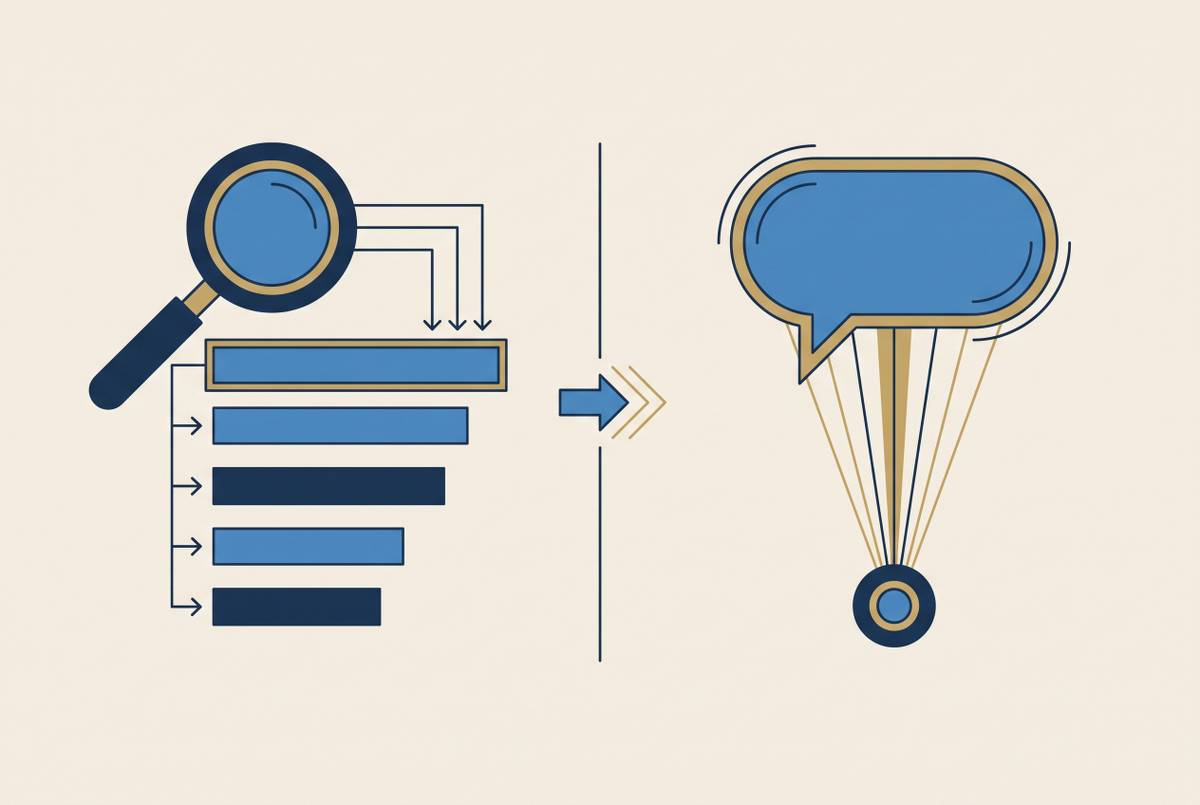
Traditional SEO tools track keyword rankings and backlinks, while GEO tools track whether an AI recommends a brand when a buyer asks a question that fits what it sells. Within that answer, a mention names the brand, whereas a citation links to the domain and page used as evidence. The two do not reliably coincide. A brand can be named without its site being cited, or supply the cited evidence without being named.
This makes mention rate useful but incomplete. If a brand is frequently cited on Perplexity and invisible on Claude, an aggregate score blurs two different conditions. Before deciding what to publish or refresh, the team needs to know which condition it is trying to change.
How each AI engine cites differently, and why that makes per-engine tracking non-optional
ChatGPT, Claude, Gemini, and Perplexity draw from different source types, cite at different rates, and retain citations for different lengths of time. Perplexity has the highest brand citation rate, leans heavily on corporate and third-party content, and includes clickable citations most consistently. Yet those citations can be short-lived. Its median citation half-life is 18 days, so earning a citation does not establish durable presence.
Claude presents a different pattern. It is the most selective citer, averages the highest number of sources per answer, and has the most persistent citations, with a median half-life of 67 days. So the same page can earn a citation on Perplexity even if Claude is too selective to cite it. That contrast shows how the engines differ in what they cite, which an aggregate score cannot explain.
Gemini adds another complication because it cites brands at a much lower rate than Perplexity and has the lowest overlap between mentioned brands and cited domains. That overlap can be as low as 30%. For a B2B buying committee, these engine differences also divide the query surface, since a developer reaching for Claude and a marketing VP using Perplexity may encounter different evidence about the same vendor.
The five signals a credible GEO measurement layer tracks for B2B SaaS
The first signal answers a question about coverage. How often is the brand cited on each engine within each prompt cluster? Category questions, comparison queries, and bottom-of-funnel “best X for Y” prompts represent different buyer needs. A brand may appear in broad category answers but disappear from “alternatives to [competitor]” queries. Prompt-level tracking exposes that gap.
The second signal answers a question about evidence. Which specific URLs and domains does the engine cite, and who owns them? A citation rate may rise just because of third-party review sites, with none of that growth coming from the brand’s published pages. That is a different kind of progress.
The third signal answers a question about competition. What share of citations does the brand earn relative to named competitors within a given prompt cluster? Cluster-level share of voice shows whether the brand appears in the queries that map to its buyers’ purchase journey.
Does the engine describe the product accurately, positively, and in line with its current positioning? An answer that cites deprecated pricing or misattributes a feature creates an accuracy problem. Sentiment and factual alignment each need their own check. More exposure to an incorrect description is not the same as better performance.
Does presence hold across engine updates, model refreshes, and content freshness cycles? A snapshot cannot show whether a citation keeps appearing or shows up briefly and then disappears. Persistence makes that distinction visible. Together, these five signals explain not just whether a brand appears, but where its presence is broad, dependent, inaccurate, or fragile.
What the GEO tool market actually covers in 2026 and where the gaps are
The 2026 market includes monitoring-only, optimization-focused, and full-stack platforms. Monitoring tools track mentions and citations, keep answers, and show where they came from, but do not write or optimize content. They fit around an existing content workflow. Optimization-focused tools add briefing, scoring, or rewriting, while full-stack platforms combine tracking with content generation and, in some cases, off-page work on the third-party surfaces engines cite.
These categories describe different scopes. A team that already has a process for producing content may only need better ways to measure it, while another may find it hard to use what it learns to change what it publishes. Most platforms still stop at analytics. Reporting a citation score leaves the interpretation and optimization work with the internal team, even when the dashboard itself is detailed.
Most tools collect API-based model outputs, which can differ from answers in live consumer products. As a practical due-diligence step, buyers should ask every vendor how it collects its data. Engine coverage also varies, and some platforms sell extra engines as add-ons. The entry price therefore does not necessarily represent the cost of covering ChatGPT, Claude, Gemini, and Perplexity.
Seven GEO tools worth evaluating, and what each one is actually built to do
Botric combines AI visibility tracking, citation analysis, and GEO-optimized content generation across ChatGPT, Google AI Overviews, Perplexity, Gemini, and Claude. Its scope joins measurement and production in one platform. A free plan and paid tiers make it an option for teams seeking a low entry price. Its documented coverage includes all four engines central to this audience, though coverage alone does not establish how well a tool answers every measurement question.
Ziptie shows AI answers next to classic organic search data and lets buyers open the answers and cited sources that a number is based on. That makes its reports inspectable rather than opaque. It prices engines alike instead of treating extra engines as add-ons, but it does not cover Claude. Ziptie also says it has limits in how it helps teams act on monitoring, handle attribution, and meet compliance needs. Its published plan information is dated October 2026, so buyers need to check the current terms.
SE Visible by SE Ranking is a pure measurement layer covering ChatGPT, Gemini, AI Mode, and AI Overviews. It groups buyer prompts by intent and topic, stores unedited answers, displays cited sources, benchmarks competitors by topic cluster, and exports to CSV. Those capabilities support an existing reporting workflow. It does not write or optimize content, and its native coverage omits Claude and Perplexity. A free trial is available, with paid pricing published on the vendor site.
Frase brings GEO scoring into how teams create briefs, draft content, and publish it, and shows which of the brand’s URLs engines cite now. Engine access depends on the plan. Starter covers ChatGPT and Google AI, Professional adds Perplexity, and Scale adds Claude and Gemini. Frase’s Content Guard checks published pages for drops in Google ranking and traffic, and it tracks AI citations through a separate feature. Annual billing and an API on every plan make both plan coverage and workflow fit relevant to evaluation.
Surfer fits teams working on existing pages to close the gap between what engines cite and what the brand wants them to cite. It covers five engines, but which ones a team can use depends on its tier. Standard includes ChatGPT only, with full engine coverage on higher tiers. Its two tiers are billed yearly, and the higher tier includes Content Editor.
LLMrefs offers the broadest engine coverage among these options, including Claude and Grok, and provides prompt volume data for prioritizing query clusters. Those features are a good fit for dev-tool brands whose buyers use many different assistants. Breadth is its distinguishing fit here. Its price was described as limited-time as of the source date, so that description should not be treated as a lasting commercial term.
GetCito is an open-source tracking tool for teams that want to start for free. Its role is narrower in this comparison. The supplied details establish that entry route, but not a comparable account of engine coverage, source attribution, or persistence tracking. It is therefore an option to evaluate for starting measurement, rather than grounds for assuming the same scope as the other platforms.
How the brand's own published content connects to what engines actually cite
If engines cite the brand but rarely link to its pages, publishing more on the same terms may not address the gap. The brand’s site remains a high-leverage asset. Yet the missing link may be how its pages present evidence.
Content structure helps explain that difference. Pages divided into discrete, scannable sections earn more citations than undifferentiated long-form pages, while quantitative, evidence-based claims earn more than qualitative assertions. When citation rates are low despite high domain authority, the way the pages are structured may be the problem. The practical response is to examine whether the content can be parsed and extracted cleanly, rather than treating authority as proof that the page is ready for citation.
At the same time, the majority of AI citations point to pages the brand does not own, including review profiles, editorial media, listicles, and community platforms. Owned content is only part of the picture. When attribution repeatedly identifies those outside sources, measurement reveals a gap in the brand’s off-site presence as well as its website. Organic rank alone cannot answer that because Google rankings and AI citations have little to do with each other.
Recently updated pages are cited at a higher rate than older content, and tracking citation loss can reveal which pages are fading as they age. That creates a prioritized refresh queue. Teams should refresh before automatically publishing something new, because a URL with citation history offers more leverage than a net-new page.
How to tell whether a GEO tool is showing you something actionable
Before committing to a platform, the useful test is whether its output changes a specific content decision. Can the buyer open the actual AI answer behind a reported number? Without that evidence, accuracy is difficult to judge. Does the tool also break citations down by prompt cluster, so that a broad category success does not conceal a comparison-query gap?
Does the tool show the exact cited URLs and which are brand-owned pages and which are third-party sources? Does it cover the engines buyers use, and what does additional coverage cost? Does it get its answers from live consumer products or API-based outputs? The method shapes what the numbers can represent.
The recommended approach is to pick ten to twenty target queries, run them through the relevant engines weekly, record cited pages, and calculate a simple citation rate. That zero-cost sample gives the team something concrete to compare with a paid tool’s reports. It tests whether the reported picture resembles what a person finds in those queries.
From there, the starting point depends on the bottleneck. A useful report should help the team decide what to do next, whether to refresh a cited page, fix product details that are wrong, or look into a missing prompt cluster. That decision needs evidence per engine, per prompt type, and against the brand’s own published content (not just a better-looking score).