Local SEO Content Strategy for Multi-Location Retail Brands
Each location needs its own engagement strategy, not just a copied checklist.

A Seattle location can dominate its local pack while a Denver store in the same chain barely shows up on page one. Same brand, same training, same product line. Google doesn't care. It treats every location as its own entity with its own reputation to earn, and that single fact is the reason most multi-location retail brands run local SEO as a patchwork of one-off fixes instead of a system.
The volume at stake makes the failure expensive rather than cosmetic. Nearly half of all Google searches in 2026 carry local intent, and mobile "near me" searches convert fast: 76% end in a store visit within a day, and 88% turn into a call or visit in that same window. A brand with twenty locations and one weak profile is losing a day's worth of walk-in traffic in a market where the competitor down the street answered its Q&A section and this one didn't. It's losing a day's worth of walk-in traffic in a market where the competitor down the street answered its Q&A section and this one didn't.
Corporate brand equity used to paper over gaps like that. Corporate brand equity used to paper over gaps like that, but it doesn't anymore. Google's local algorithm is popularity-based at the profile level, which means a location has to generate its own engagement, its own reviews, its own clicks, regardless of how well the flagship store three states away is doing. The three signals that have always governed local rank, relevance, distance, and prominence, still hold. What's changed is the bar for prominence: it now depends on engagement data and AI-surface visibility that a basic checklist (build the page, claim the profile, get some citations, wait) was never built to produce.
That checklist approach breaks because it treats each location as a task to finish rather than an entity to maintain. What a real system has to cover instead is three compounding layers at once: traditional local rankings, stability inside the local pack, and visibility on the AI surfaces that are now answering local queries directly. Miss any one layer and the other two can't fully compensate.
How the ranking signal stack works for multi-location brands
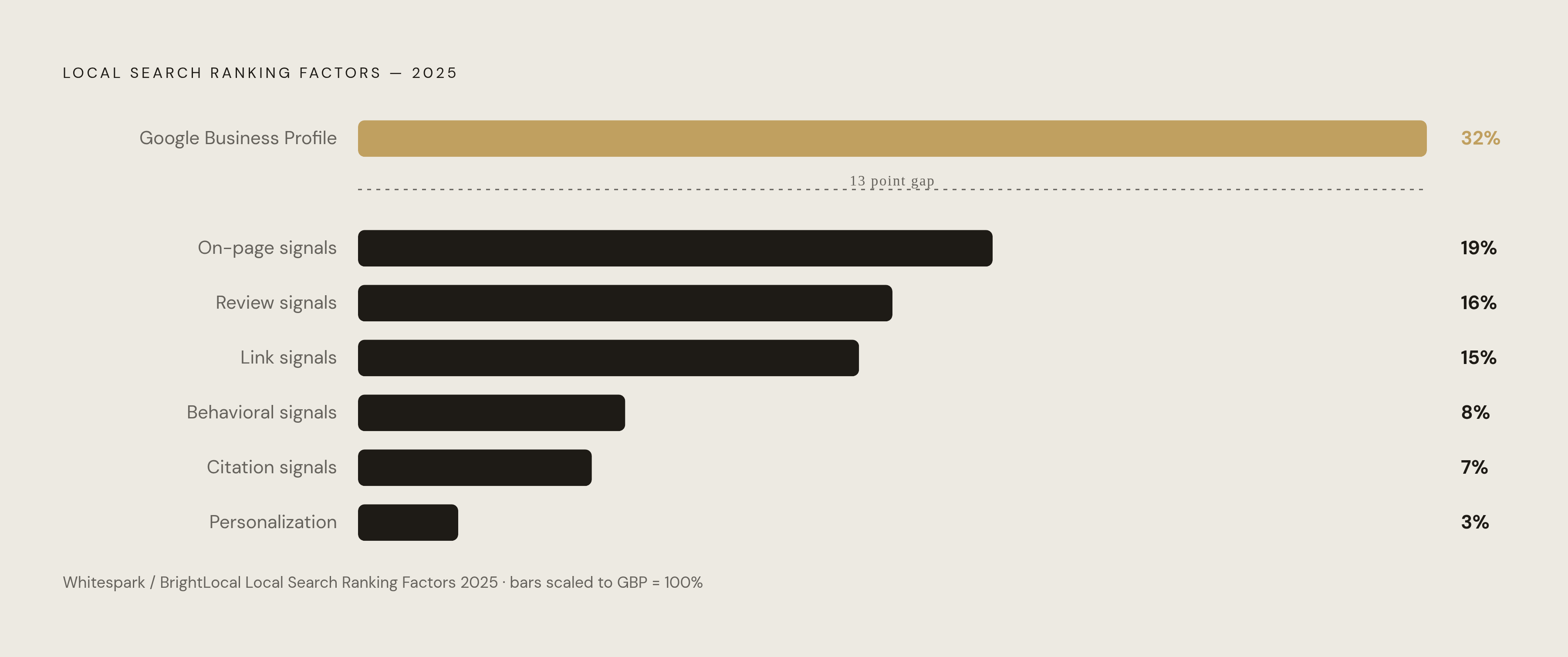
Whitespark and BrightLocal's 2025 Local Search Ranking Factors survey breaks the local ranking stack into seven categories, and the weighting tells you where to spend effort. Google Business Profile signals account for 32%, the single largest factor by a wide margin. On-page signals are 19%, review signals are 16%, link signals are 15%, behavioral signals are 8%, citation signals are 7%, and personalization is 3%.
Put those numbers side by side and GBP alone outweighs everything else, but on-page content and reviews combined roughly match it. No single lever, content or profile or reviews, carries the whole system. A brand that pours resources into blog content while leaving GBP half-finished is optimizing the smaller slice and ignoring the larger one.
Behavioral signals, at just 8%, get skipped constantly, and that's a mistake given that they capture how users actually interact with a listing at the local level, signals that respond directly to how well the content and profile at that specific location are managed. Google tracks all of it, and all of it responds to how good the content and profile management at that specific location actually are.
The operational consequence for a multi-location brand is spillover. One location with stale reviews and a neglected profile doesn't just underperform on its own, it drags down how the brand reads as a whole, because Google and consumers both evaluate the brand partly through its weakest visible location. Because GBP signals dominate the stack and increasingly feed the AI systems layered on top of search, per-location profile management is the operational core of the whole strategy.
Google Business Profile as the operational hub for each location
The gap between a complete profile and an incomplete one isn't marginal. Google's own 2026 data shows complete GBP profiles earning seven times the clicks and 70% more in-store visits than incomplete ones. That's not a ranking edge, that's a demand gap that appears directly in foot traffic.
GBP's job has also expanded past its original purpose. Gemini and Google's AI Overviews now pull from GBP data, which means a profile is no longer just a Maps listing, it's a data source feeding two separate result types: the traditional pack and the AI-generated answer.
Structurally, the way multi-location teams manage this changed in 2025, when the legacy per-profile dashboard was sunset in favor of Business Profile Manager at business.google.com. Location Groups, bulk edits, and staff permissioning now all run through that one interface, which is either a huge efficiency gain or a governance headache depending on how the account is set up.
"Complete" at scale means every location profile carries accurate holiday hours (not just standard weekly hours), correctly chosen service categories and attributes, and a set of unique photos, interior, exterior, and staff, not stock imagery reused across the chain. Photos alone move the needle on direction requests according to the sourced data. NAP (name, address, phone) has to match the location's own website exactly, and posts plus Q&A coverage need to stay current as freshness signals Google can read.
SOCi's figures show why this matters more each year: GBP Maps views grew 61% year over year, and views from one search engine's GBP results grew 28%. That's a profile increasingly functioning as a destination in its own right, not a verification stub buried under the map pin.
The harder problem is governance. Somebody at each location needs the ability to update hours or respond to a review without corporate sign-off, but that same person shouldn't be able to rewrite the business category or delete the primary photo set. Getting that balance wrong either paralyzes local managers or lets brand consistency erode one profile at a time. Solving it is a design decision about permissions, not something a tool hands you automatically.
NAP consistency and the citation layer that holds the whole structure together
Once GBP is locked down, the same data has to hold steady everywhere else the business name appears. Brands with consistent NAP data across directories see engagement run up to twice as high as brands whose listings disagree with each other from site to site.
The failure modes are mundane and everywhere: one directory lists a phone number with dashes, another with parentheses, a third still shows the old number from before a relocation. Duplicate listings pile up when a franchise changes ownership or a location moves half a mile down the road and nobody merges the old profile.
Inconsistent data doesn't crash rankings overnight, which is part of why it gets ignored. It causes something slower and harder to diagnose: rankings that never settle, a location that pops in and out of the local pack week to week, lead flow that varies for no reason anyone can point to on a dashboard.
The AI layer makes this worse, not better. AI models build lasting associations from the data they ingest, so a mismatched address or an outdated category doesn't just sit there as a single error, it gets carried forward into every future answer the model gives about that business. SOCi's 2026 research found that only 68% of business contact information on ChatGPT and Perplexity actually matches the corresponding Google Business Profile data, meaning nearly a third is already wrong. That's not a future risk to plan around. That's the current baseline most multi-location brands are already living with.
The practical takeaway is that citation management can't be a launch task checked off once. Categories, attributes, and local content all need periodic review as search behavior shifts by season and by region, and someone has to own that on an ongoing basis rather than treating the citation audit as a one-time cleanup before a site relaunch.
Why location pages fail and what distinct content requires
Most location pages fail for one reason: they swap in the city name and change nothing else. Google reads that pattern easily, and once it does, the algorithm has no basis for deciding what that particular store does well or why it should outrank a local competitor with a thinner site but sharper relevance.
That sameness produces keyword cannibalization: when twenty location pages all target the same phrase with the same intent, they compete against each other instead of reinforcing the brand. When twenty location pages all target the same phrase with the same intent, they compete against each other instead of reinforcing the brand, and Google may simply decline to index some of them.
Real differentiation happens at the sentence level, not the template level. A location page needs an opening that references the actual neighborhood, not a generic city name drop, plus any services or inventory that genuinely differ at that branch. It needs FAQs phrased the way people in that specific area actually search, and proof elements tied to that location specifically, reviews naming that store, a staff profile, a local partnership or event. The baseline for a page to carry any weight is somewhere around 300 to 500 words of content unique to that location, an embedded map, correct hours, and local schema markup.
Architecture has to support that without inviting duplication. A workable hierarchy runs from core service pages, into a locations hub, down to individual location pages by city or branch, with service-in-city pages added only where real search demand justifies a standalone page. URLs should read clean and hierarchical, something like yourbrand.com/locations/state/city, not a parameter string that looks interchangeable across ten different pages. Internal linking then has to signal which pages are hubs and which locations actually matter most for a given query.
None of this gets rescued by strong content elsewhere on the domain. A well-ranked national article on, say, running shoe fit doesn't lift the Denver store page, because local rankings require local proof: local intent coverage, trust signals tied to that address, evidence the location itself knows its market.
The resolution isn't choosing between templates and free-form pages. Multi-location brands need templates, there's no scaling twenty or two hundred locations otherwise. What the template has to enforce is a set of mandatory local fields (neighborhood context, local FAQ, local proof) rather than leaving those fields optional and watching them get skipped under deadline pressure.
Review strategy as a location-level trust signal, not a brand-level afterthought
Review reliance has grown fast. BrightLocal's Local Consumer Review Survey found 41% of consumers always read reviews before choosing a business, up from 29% just a year prior, and the average consumer now uses six different review platforms.
Volume matters less than pace. Review recency matters, so a consistent pace of incoming reviews over time serves a location better than sporadic bursts followed by long gaps. The operational goal is a consistent cadence of fresh reviews per location, with responses going out promptly.
Reputational spillover appears here too. A customer with a bad experience at one store doesn't file it away as an isolated incident, they generalize it to the whole brand, and a single location with a pile of unanswered one-star reviews can color perception of locations that are actually running well.
Reviews aren't just a ranking input anymore either. AI systems generating local answers draw on the same profile and review data that search engines do, so a review strategy now functions as a signal for AI surfaces at the same time it functions as a trust signal for human shoppers.
The system implication is straightforward: review generation and response can't be left to whichever store manager happens to care about it. It needs a standard process designed centrally, with clear response-time expectations and templated (but not robotic) response language, executed locally by the people who actually know the customer. Behavioral signals are part of the ranking stack too, and a location that neglects reviews will see its ranking fluctuate even when every technical box on its page is checked.
The AI visibility layer that traditional local SEO does not automatically address
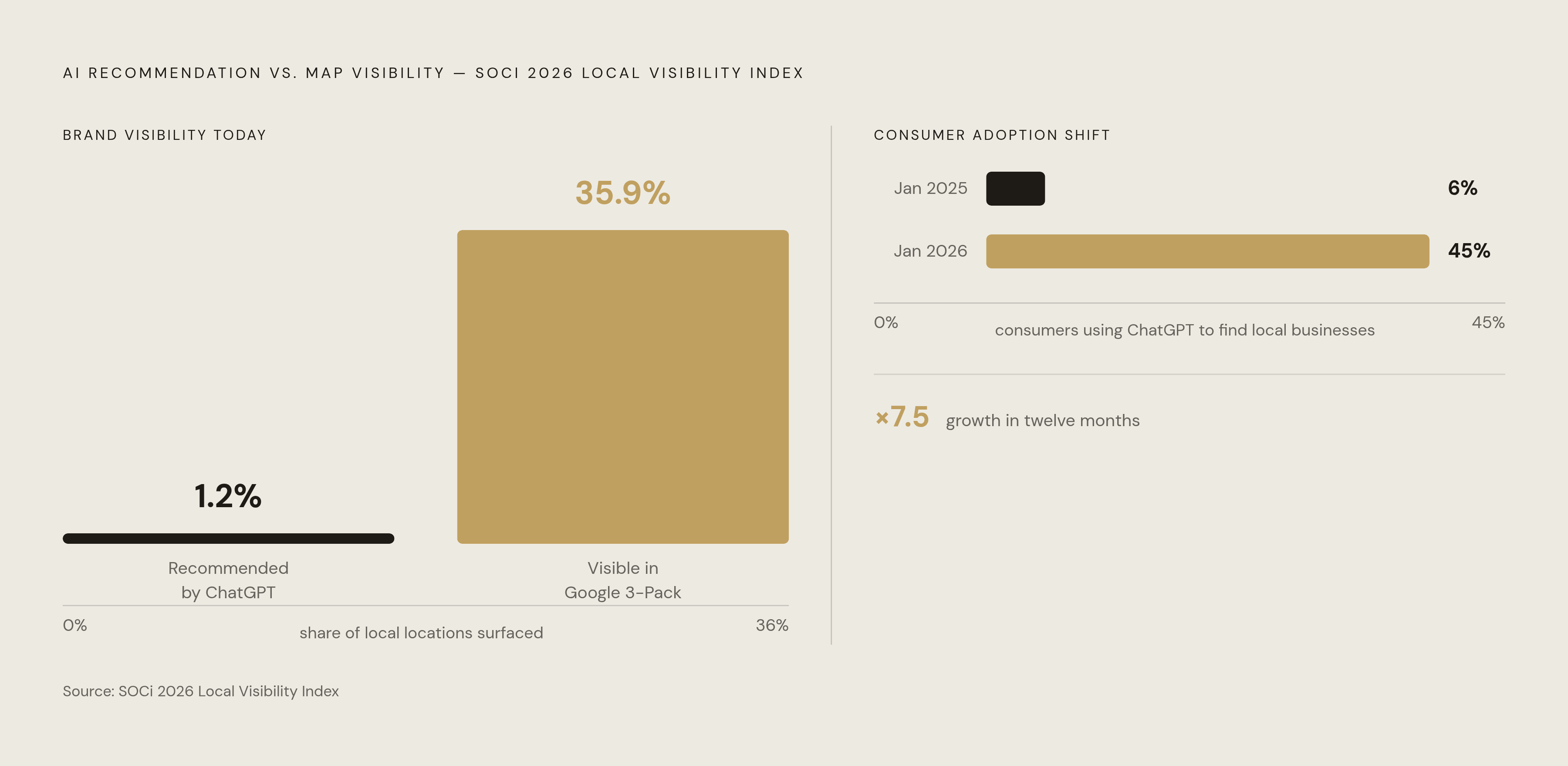
Strong local pack presence and strong AI-surface presence are turning out to be two different things. SOCi's 2026 Local Visibility Index found ChatGPT recommending only 1.2% of local business locations in its sample, against 35.9% visibility for those same brands in Google's 3-pack. A brand can dominate the map results and be almost invisible inside an AI answer.
The urgency comes from where consumers are actually going. BrightLocal's research shows the share of consumers using ChatGPT to find local businesses rising from 6% in January 2025 to 45% in January 2026, a jump of nearly eightfold in twelve months. And a substantial share of local business queries now trigger Google's AI Overviews directly, with the businesses surfaced there not always matching whoever holds the top blue-link position.
Two disciplines have grown up around this gap, and they're not the same thing. AEO, answer engine optimization, is about structuring content so it gets pulled directly into featured snippets and AI Overviews without a click. GEO, generative engine optimization, is about shaping what tools like ChatGPT, Perplexity, and Gemini actually say when a user asks a question, where success looks like a citation or a brand mention inside a generated answer rather than a click.
Ranking first on Google guarantees neither. Holding the featured snippet doesn't guarantee a Perplexity citation, and a strong AI Overview presence doesn't guarantee ChatGPT mentions the brand. The signals overlap, but they don't line up one to one, which is exactly why treating AI visibility as an afterthought to traditional SEO leaves real ground uncovered.
Call it a sixth pillar sitting alongside GBP, on-page content, reviews, links, and citations. Most multi-location programs still treat it as optional, and building the contextual authority AI systems need typically takes three to six months of consistent work before results appear. That timeline argues for starting now rather than waiting for the gap to close on its own, because it won't.
What drives AI citation probability for local brands
The single most useful number in this discipline might be this: brand mentions correlate with AI citation probability at 0.664, against just 0.218 for backlinks. That's the opposite of where most local SEO budgets go, since link building has occupied a bigger share of attention and spend for years than brand mention tracking ever has.
Roughly 85% of brand mentions inside AI answers come from third-party pages, not the brand's own domain. A location page can be optimized perfectly and still not be the thing driving the AI citation, because earned coverage elsewhere is doing that work instead. Third-party mentions run about three times more correlated with AI visibility than traditional backlinks, and digital PR specifically accounts for a quarter of all LLM citations while only 6% of practitioners actually use it, the GEO/AEO traffic optimization report found. That gap between what works and what gets budget is about as wide as this field gets.
Content structure has measurable effects too. The GEO study from Aggarwal and colleagues found that adding quotations from credible sources raised a page's share of AI answers by roughly 41%. Statistics added about 31%, and citations to outside sources added about 28%. And placement matters as much as content: 44.2% of all LLM citations pull from the first 30% of a page, so the opening 200 words of a location page need to answer the core question completely, not spend a paragraph warming up to it.
Different platforms behave differently, and a one-size strategy misreads that. Google's AI Overviews lean on organic ranking strength and pull from well beyond the top ten results. Perplexity rewards freshness and authority signals more heavily. One assistant retrieves from another vendor's index, which means optimizing for that vendor still matters for anyone chasing that assistant's visibility.
Google's own generative AI search guide, published May 15, 2026, closed off a few tactics that were floating around as best practice: structured data isn't required for AI Overviews or AI Mode, no special schema is needed, and llms.txt files along with manual content chunking are explicitly called out as unnecessary. Separately, Google deprecated FAQ rich results on May 7, 2026, so the expandable Q&A snippets no longer display in search. FAQ schema markup can stay on a page without penalty, it just produces nothing visible anymore. Question-based headings inside the actual content still carry value for AI systems, the schema wrapper around them just doesn't do what it used to.
Only 23% of marketers currently measure GEO performance. Most teams running these tactics have no way to know whether any of it is working, which makes measurement as much a part of the strategy as the tactics themselves.
Centralizing brand control while enabling per-location execution
Every layer covered so far, GBP, citations, page content, reviews, AI visibility, points at the same operational tension. Corporate needs consistency: one brand voice, one accurate NAP record, one set of standards for what a complete profile looks like. Each location needs the freedom to run its own reviews, answer its own Q&A, and reflect its own neighborhood in its own content.
A system built for this splits the two cleanly rather than trying to centralize everything or delegate everything. Brand-level control covers NAP accuracy, category selection, schema standards, and the mandatory fields every location page must include. Location-level execution covers the actual review responses, the specific FAQ content, the photos of that specific storefront, and the local partnerships named on that specific page.
Getting that split wrong in either direction produces a predictable failure. Over-centralize, and location pages read identical and Google flags them as duplicated patterns. Over-delegate, and NAP drifts out of sync across fifty locations within a year, feeding the same inconsistency that later appears as mismatched data on ChatGPT and Perplexity.
The brands making this work treat local SEO the way retail operations treats inventory: standardized systems, localized execution, ongoing maintenance rather than a one-time build. That's the actual shift the whole discipline has gone through. What used to be a checklist run once per location is now a maintenance discipline run continuously, across traditional rankings, local pack stability, and an AI layer that didn't even exist as a serious channel a few years back. Brands still treating it as a checklist are the ones showing up strong in Seattle and nowhere in Denver.