Content Refresh Strategy for Recovering Ranking Brand Pages
Recover ranking pages by diagnosing decay patterns before they compound.
Ranking pages don't crash. They erode, one query segment at a time, and the erosion is quiet enough that most teams don't act until the damage is compounding. A page losing 2,000 visits a month drops to 1,400, then 900, then 500, and nobody flags it because no single week looks like an emergency. Running the math shows a pattern: something close to 1.21% of traffic lost per week, which nets out to 20 to 30% of organic clicks gone every six months. By the time a team notices, the page has often shed 40, 50, sometimes 80% of what it used to pull, and the recovery that follows is slower and more expensive than the fix would have been at month two.
Four structural causes recur. Ranking systems carry a preference for freshness that decays static pages by default. Competitors improve their pages while yours sits untouched. Search intent drifts under a query that still looks the same on the surface. And internal cannibalization, where several pages chase overlapping keyword variants, splits authority that should have been consolidated in one place.
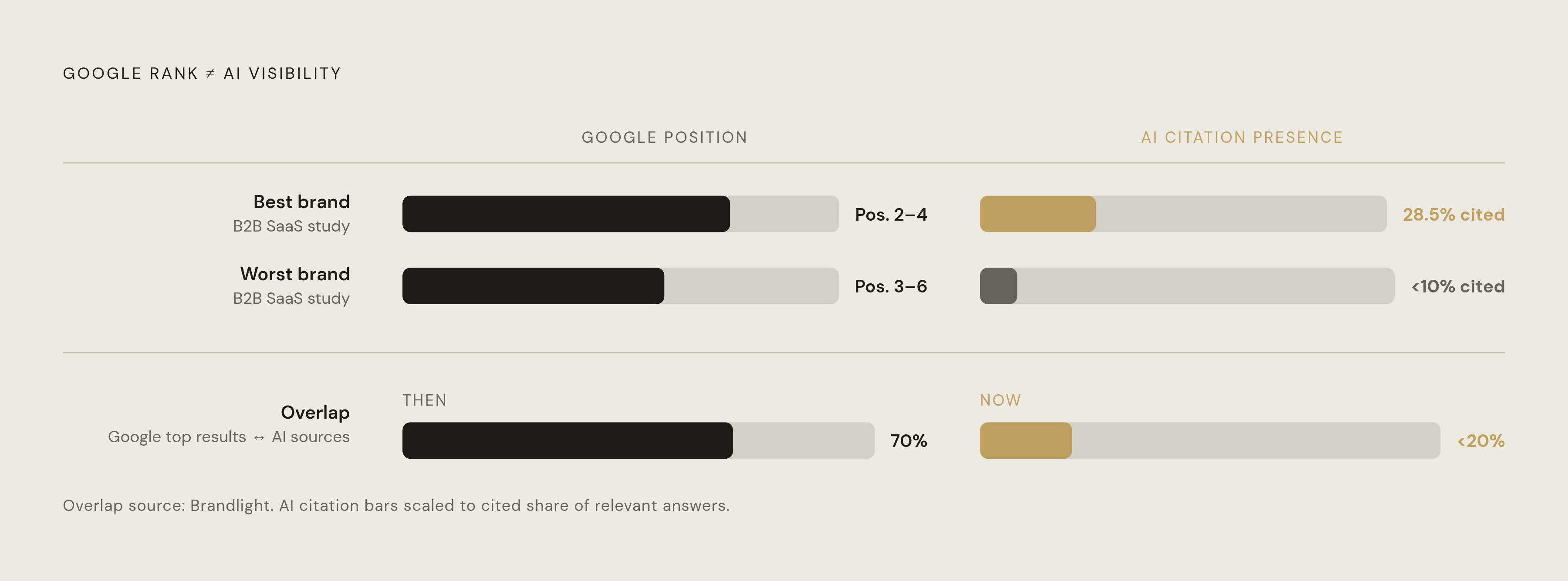
There's a second layer now, separate from organic rank, and it's where most decay actually hides: a page can hold position four on Google and still vanish from what ChatGPT, Perplexity, and AI Overviews tell users. First-party data collected across five B2B SaaS brands in Q1 and Q2 2026 found that even the best-performing brand in the set was absent from 71.5% of relevant AI answers. The worst was missing from more than 90%. AI engines also carry a measurable freshness bias of their own: an Ahrefs analysis of roughly 17 million URLs found that AI-cited pages run 25.7% fresher than the pages that rank organically. And that citation pool moves fast. When Gemini 3 became the default model behind AI Overviews on January 27, 2026, it replaced around 42% of previously cited domains inside a single rollout.
Organic decay and AI-citation decay are two different, measurable problems, and they often need different fixes. Treating them as one number is the most common mistake in a refresh audit, and it's the mistake this piece is built to correct.
Reading the signals of page decay
Start in Google Search Console. Pull the trailing 90 days against the same window a year earlier. Segment by query rather than looking at the page in aggregate. The shape of the drop tells you what's actually wrong.
Four patterns recur. Impressions falling alongside CTR is classic decay, and it calls for a real content refresh. Impressions falling while CTR holds steady or climbs usually means a competitor has outpaced you on freshness or depth. The fix in that case is a targeted update. Impressions holding steady while CTR falls points to something structural: an AI Overview or a featured snippet has taken the space above you, and no amount of rewriting fixes that. Fragmented drops across specific keywords inside one page suggest intent fragmentation, which is often a sign the page should split in two.
A handful of signals should move a page to the front of the queue. A ranking slide from position four to position fourteen over 60 days, with no technical cause behind it, is a strong refresh trigger on its own. High impressions paired with a weak CTR usually means the title tag or meta description has stopped matching what searchers actually want, even if the content itself is fine. Outdated statistics and stale references tell both readers and crawlers that nobody's minding the page. Thin coverage against a query that's grown more competitive since publication is a depth gap, measured against what's currently ranking above you, not against what used to rank there. And a topic with clear demand that's stuck at low traffic for quarters is a page that never earned its place to begin with.
Before scoring anything, run a technical pass: crawlability, page speed, broken links. A page throttled by a bad redirect chain or a blocked resource can look exactly like content decay, and refreshing the copy on a page with a technical problem wastes the effort.
AI-citation health needs its own separate check. Before touching anything, run 20 to 30 prompts relevant to the page across ChatGPT, Perplexity, and AI Overviews. Count whether the brand is cited as a source, not just mentioned in passing. AirOps research found 83% of AI citations came from pages updated within the past 12 months, and more than 60% came from pages refreshed within the last six months. That's a materially shorter freshness window than organic ranking rewards, which is why a page can look stable on Google and still be quietly falling out of AI answers. Measure both tracks independently. A stable rank tells you nothing about AI visibility, and vice versa.
Scoring and ranking your refresh backlog by ROI
Spotting decay is the easy part. Deciding which pages to fix first, and in what order, is where most refresh programs actually lose money, because working the wrong page first burns budget that a higher-value page needed.
A five-factor model gives the backlog structure: decay slope (how fast the page is falling), position band (where it currently sits), intent drift (how far the query's meaning has moved from what the page delivers), conversion value (what recovering the traffic is actually worth), and refresh effort (how much work the fix requires relative to the likely gain).
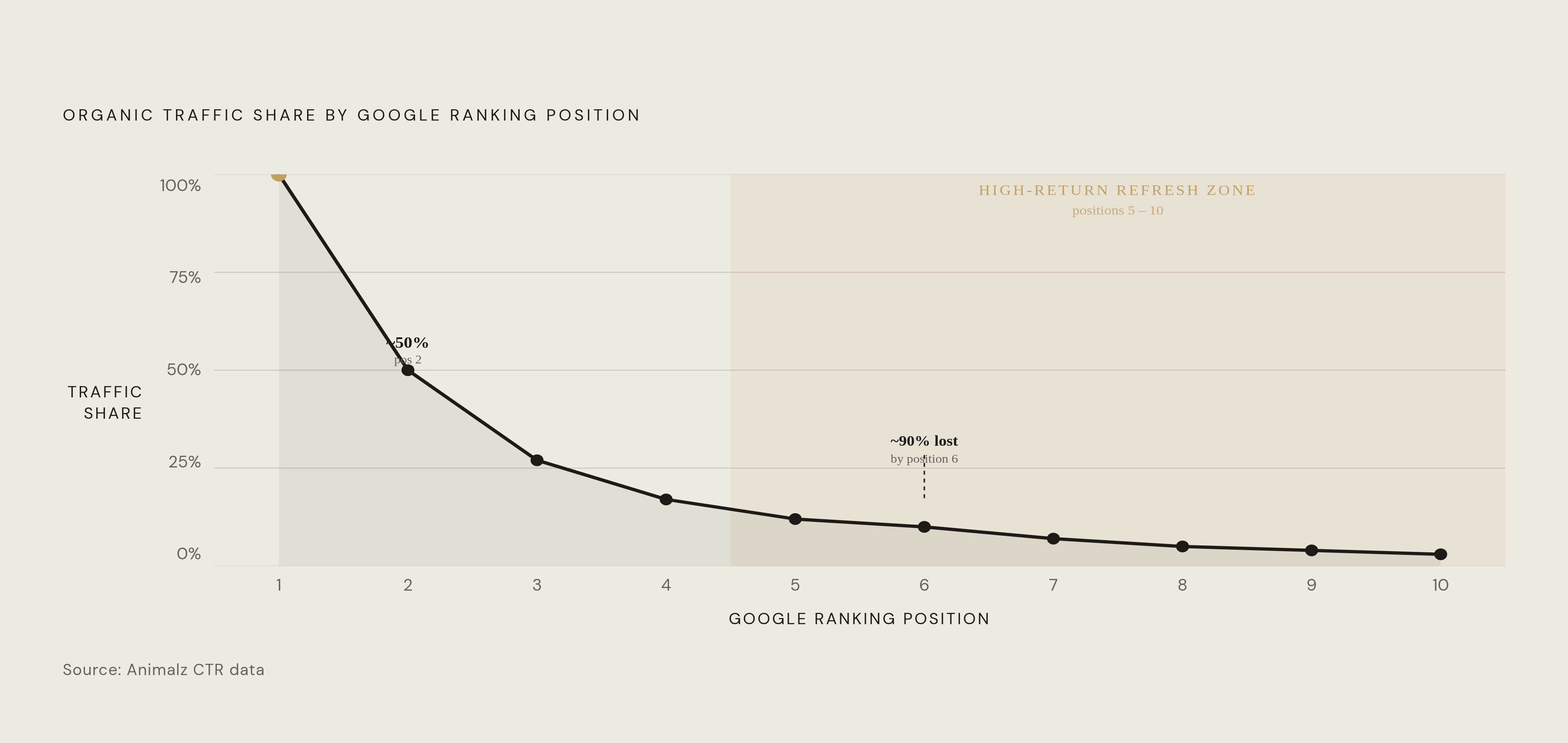
Position band is the single most actionable lever in that list. Pages sitting in positions 5 through 20 carry the highest return because they already have backlinks, indexed history, and topical authority. They're just not converting that authority into first-page clicks yet. The click curve explains why this band matters so much: Animalz's analysis shows that falling from position one to position two can cut traffic by roughly half, and dropping to position six can wipe out around 90% of it. A page at position 8 has a much shorter climb back to meaningful traffic than a page that needs to be built from nothing, and that asymmetry is the whole argument for prioritizing the middle of page one.
Traffic-decay percentage helps size the intervention once a page is flagged. A 20% decline over six months is early-stage and easy to recover. A page that's lost 20 to 50% of its organic sessions in the last 90 days warrants a closer look and targeted intervention. Past 60%, treat it as rescue work: the margin for error narrows, and a full rewrite is often the only thing that moves the needle.
None of these weights come from a validated formula. No published study hands you empirically derived weights for this exact five-factor combination, so treat the model as a starting point to calibrate against your own site's category and competitive set. What it produces, once tuned, is a ranked backlog that replaces gut instinct with sequence: the team works the highest-return pages first, instead of whichever page someone complained about last.
The triage decision: refresh, consolidate, redirect, or prune
Not every decaying page deserves a refresh. Four actions cover the real decision space, and picking the wrong one wastes the scoring work done in the previous step.
Refresh is the right call when a page already holds backlinks and indexed history, the keyword still carries value, and intent is recoverable: the content just needs to catch up. This is the default action for anything sitting in that 5-to-20 position band with clear demand behind it.
Consolidate applies when several posts are chasing overlapping long-tail variants of the same keyword and cannibalizing each other, none of them ranking well individually. Merge them into one authoritative piece and 301-redirect the losing URLs into the survivor. Done well, this builds topical authority instead of just cleaning up clutter.
Redirect fits a page that still carries link equity but whose topic no longer matches the business, or that's been fully superseded by a stronger page elsewhere on the site. Send a 301 to the most relevant surviving URL; the equity transfers.
Prune is for pages that serve no strategic purpose anymore: no traffic, no backlinks for 12 months or more, no reason to keep them live. A 410 or a redirect closes the loop. Thin, orphaned pages sitting on the site dilute overall site quality even when they're not actively costing traffic.
A few heuristics make the decision faster. A page with strong backlinks should be refreshed or consolidated into, never redirected away from without a careful link audit first. A page with no links and no traffic should be pruned or redirected, since a refresh there is effort spent for nothing. And if a rewrite would touch more than roughly 70% of the existing content, treat it as a new piece in practice, even if the URL stays the same because that URL carries equity worth keeping.
The single biggest mistake teams make at this stage is changing the URL. Every URL change risks breaking inbound backlinks, paid campaign destinations, old email links, and whatever indexed signal Google has already accumulated against that address. Keep the original URL whenever the page has any equity worth protecting. AirOps' research puts a number on why this discipline matters: content refresh delivers 3 to 5 times the ROI of creating new content, precisely because it preserves the authority signals a brand-new page would have to earn from zero.
This step should end with a labeled backlog. Every page gets tagged refresh, consolidate, redirect, or prune before anyone opens a draft.
Executing the refresh: what to change, what to protect, and in what order
Open an incognito window before writing a word. Study the current top five results for the target query: what format they use (listicle, step-by-step, comparison table), which subtopics they cover that the existing page doesn't, and which new People Also Ask questions have surfaced since the page was first published. The SERP has already told you what "good" looks like right now.
Some things should change freely. Swap outdated statistics for current figures with clear source attribution. Replace stale examples, screenshots, and product references. Rework section headers that no longer match how the query is actually being asked. Expand thin sections with real depth rather than padding them out with filler. Add internal links to anything published since the original piece went up. Tighten the introduction if it buries the answer or reads like it was written for a different search era.
Some things should be left alone. The URL slug stays put. Core arguments that are still accurate and still pulling in external backlinks stay as they are. And any section anchoring a link from a high-authority referring domain should survive the edit intact, because rewriting it risks breaking the very thing that's earning the page credibility.
Update the publish date only after the substance has actually changed. Google can tell a cosmetic edit apart from a real update, and gaming the freshness signal without improving the underlying content doesn't hold up.
Schema and technical hygiene belong in every refresh, not as an afterthought. Add or update Article schema with accurate publish and modified dates, so AI engines have something concrete to verify freshness against. Add FAQ schema anywhere there's genuine question-and-answer content. And rebuild the internal linking both to and from the page once it's live again.
AI tools can speed up drafting, expanding a section or proposing an example around an expert's point, but they shouldn't be replacing the voice or the judgment behind the piece. Every fact needs verification, every technical claim needs a check, and a subject-matter expert should review the draft before it goes live, because that review is where real authority gets built.
Give the refresh 90 days before judging it. AirOps' data shows that successful refreshes tend to show measurable movement in traffic, rankings, and AI visibility within 30 to 60 days of going live. Track organic traffic, average keyword position, click-through rate, conversion rate, and AI citation counts month over month, and don't declare victory or failure before the window closes.
What makes a refreshed page earn AI citations
Ranking on Google no longer means showing up in AI answers, and the gap between the two has widened fast. Research from the GEO firm Brandlight found that the overlap between top Google results and AI-cited sources has fallen from 70% down to below 20%. A page can hold position two and still be invisible to a user asking ChatGPT the same question.
The most cited academic work on what actually moves AI citation rates comes from the Princeton GEO study (Aggarwal et al., KDD 2024). It found that adding statistics to a page can boost AI visibility by up to 40%, and adding citations and direct quotations can boost it by up to 41%. Structured content, in the same research, earned several times more citations than unstructured equivalents covering the same topic.
Structure isn't a stylistic preference here, it's a retrieval mechanism. Research into AI Overview citation patterns suggests that AI engines tend to draw heavily from the early portions of a page. The opening of every key section needs to carry a direct, 40- to 60-word answer before any elaboration follows. Clear headings, front-loaded answers, and FAQ blocks all make a passage easier for a model to extract cleanly.
Owned content isn't where most of this visibility gets built, either. AirOps' analysis found that roughly 85% of brand mentions in AI search come from third-party pages, not the brand's own site, and that brands are several times more likely to be cited through a third party than through their own domain. Spreading content across a range of outside publications, rather than keeping it confined to the brand's own site, increased AI citations by up to 325% in that same analysis. Similarweb's 2026 Generative AI Brand Visibility Index found brand mentions correlate with AI visibility at roughly three times the strength of backlinks (a 0.664 correlation versus 0.218 for links), which points refresh-adjacent effort toward earned mentions on Reddit, LinkedIn, YouTube, G2, and Quora, all platforms that show up repeatedly in AI-generated answers. A brand discussed accurately and favorably across that surface area has more citation opportunity than one that only maintains its own domain.
None of it matters if the crawler can't reach the page. Cloudflare recently changed its default configuration to block AI Training and Agent bots on ad-supported pages for new domains, while leaving Search crawlers allowed by default. Sites running on Cloudflare may have had AI bot access shut off without anyone noticing. Confirm that's not happening before assuming a citation problem is a content problem.
Google's own position, stated as of May 2026, is that optimizing for AI Overviews and AI Mode is still SEO: useful content, crawlable pages, clear structure, and a trustworthy page experience are the same foundations either way. Google has said explicitly that llms.txt files and AI-specific rewrites of existing content aren't required for its generative features to work.
Building a refresh cadence so decay is caught early, not in crisis
Most content programs pour their effort into launch and early growth, and almost nothing into what happens after a page plateaus or starts to slide. The decline appears in a traffic or pipeline report only after months of ranking equity are already gone, and the fix costs more than it would have at the first sign of trouble.
A cadence built around content type keeps decay from reaching that point. High-traffic cornerstone pages deserve a quarterly review, since they carry the most to lose. Product and feature pages should get updated with every major release, and reviewed quarterly even when nothing's shipped. Blog content in competitive categories needs a check every 90 to 120 days, given how quickly SERPs in crowded spaces reshuffle. Evergreen educational content can hold for longer stretches before requiring a full refresh, unless performance starts slipping sooner than that. And content tied to fast-moving industries needs the tightest cadence of all, since the ground underneath those queries shifts faster than any fixed schedule can fully anticipate.
Refresh work only sustains rankings when it's treated as a recurring discipline rather than a rescue mission. Catching a page at a 20% decline is an easier recovery. Catching the same page at 60% is a rebuild. How early the signal got read entirely determines which of the two outcomes you get.