Brand SERP Audit for Marketing Leaders
Learn what's actually shaping buyer impressions when customers search your brand name.
What a brand SERP contains in 2025–2026 and what each element signals
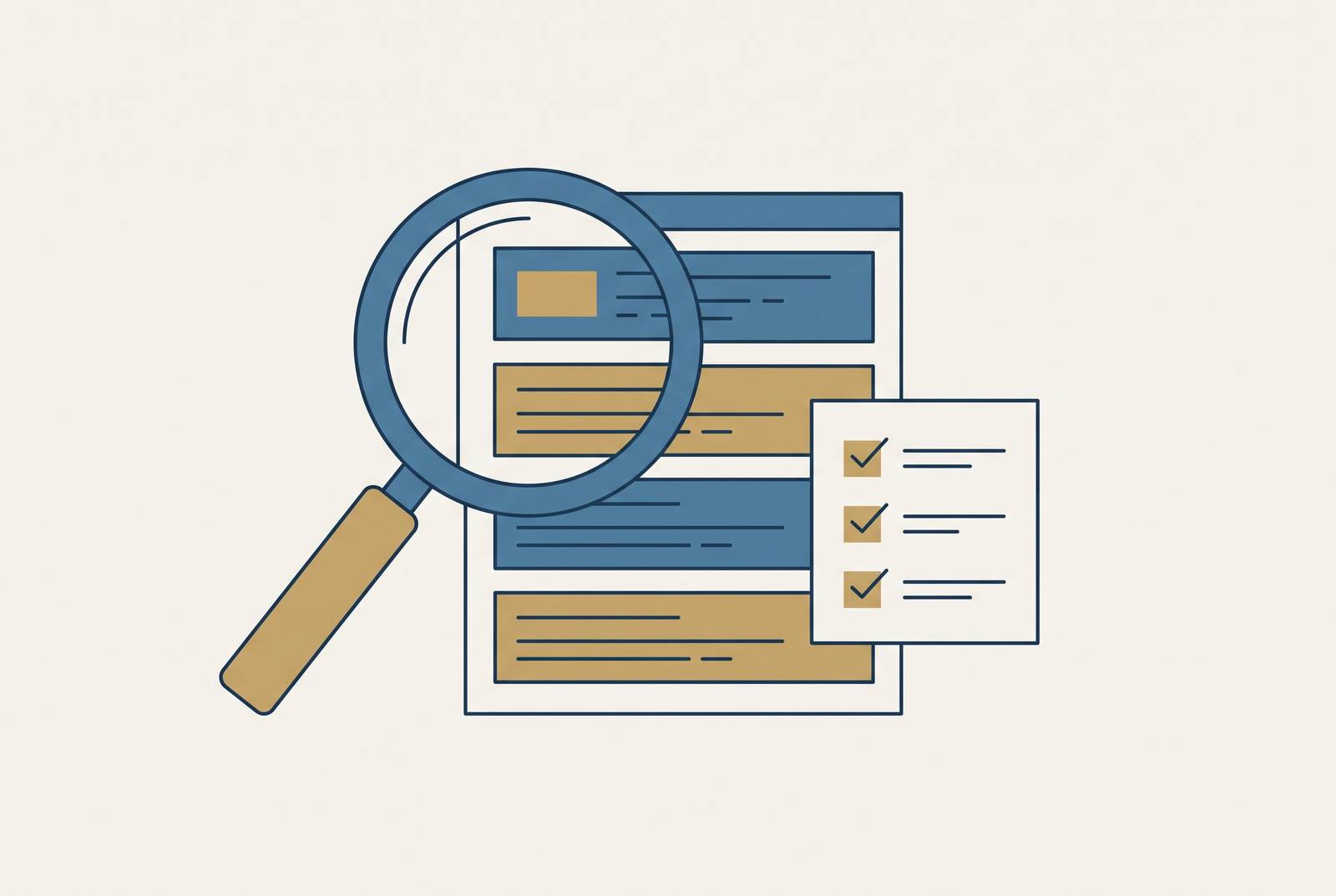
A brand SERP audit checks something more specific than rank position: it checks who or what is actually shaping a buyer's first impression of a company, across every element that now shows up when someone searches a brand name. Marketing leaders who still treat "are we number one?" as the finish line are missing most of the page, and that habit is the single biggest reason brand SERP work gets underfunded. Search is a step somewhere between a third and two-thirds of closed-won deals, depending on category, long before anyone touches a technical detail.
The 10 blue links are gone. Treating a branded search page like a ranking list instead of a mix of AI summaries, entity cards, review carousels, and third-party threads is the fastest way to miss where the real exposure sits. Each piece on the page is either owned, earned, or contested. Almost nothing is left over as neutral space.
An AI Overview sits above the organic results and frames the brand before the reader scrolls to anything the company actually controls. Below that, Google's knowledge panel acts as the entity card for the brand. A missing panel means Google doesn't yet recognize the brand as a clean entity, and a present-but-wrong one is worse than absence, because star ratings and descriptions the brand never approved now sit in full view of every searcher. People Also Ask boxes show the exact questions buyers ask when they're unsure, and most teams never bother reading them even though the questions sit right there in plain view. Featured snippets pull one page, owned or not, and mark it as the definitive answer.
Then there's the visual layer: image and video carousels that might surface an outdated logo or a competitor's YouTube explainer, news placements, review platform results from G2, Trustpilot, or Glassdoor with star ratings visible right in the results, and social profiles where completeness or staleness is obvious at a glance. Reddit threads and community forums carry real authority in Google's eyes, and they often surface user sentiment that's blunt, negative, or comparative, regardless of what the brand would prefer. Competitor ads can bid on the brand's own name and take the top slot before a single organic result loads. App store listings, Wikipedia and Wikidata entries, and directory pages round out the page. Mobile and desktop versions often differ enough that an audit has to capture both separately, not assume one matches the other.
None of this is theoretical. In 2014, a Knowledge Graph error at Greggs in the UK surfaced a fake slogan to anyone who searched the brand name. Starling Bank has dealt with a knowledge panel showing 3.4 stars, low enough to make a searcher pause and check an alternative before going any further. Every element on the page tells a story about the brand, and the audit's job is to figure out who's telling it. For most brands, the honest answer is: not them.
The six areas a structured brand SERP audit must cover
A real audit works across six areas. Skipping any one of them does not make the gap disappear; instead, it waits to appear later as a surprise nobody budgeted for.
The first is what ranks today: every position on page one for the brand name and its variants, including misspellings, product modifiers, "[brand] vs," and "[brand] reviews," each result tagged by owner and flagged if anything negative or copycat has crept in. The second looks at the brand's own site: does the About Us page say anything real, is Organization schema in place, does the site render properly server-side, do key people have actual profile pages. This is the technical groundwork that lets Google treat the brand as a distinct entity instead of a loose pile of pages.
Third comes third-party presence: LinkedIn, social accounts, review platforms, Wikipedia, Wikidata. This is the corroboration layer Google checks against to see whether the brand's own claims about itself hold up elsewhere. Fourth is authority signals: third-party articles actually about the brand, indexed press releases, decent directory listings. Breadth and variety across these sources shape how Google corroborates the brand's claims far more than raw volume does. Fifth is brand protection: is the trademark registered, are impersonator pages floating around, is anyone watching for threats before they spread rather than after. Sixth is the action plan, where every finding gets scored and ranked by urgency, critical issues first, each one tied to a specific next step instead of dumped into a generic list.
Running the audit means working from an incognito window, capturing desktop and mobile as separate passes, and tagging every result as owned, third-party, positive, neutral, or negative, while noting which SERP features show up: AI Overview, knowledge panel, PAA box, image pack, autocomplete suggestions. None of this works as a one-off. Without a scored baseline sitting there for comparison, there's no way to prove remediation did anything.
The four hidden risks that a surface-level brand SERP review misses
A glance at rank position misses four risks that only become visible once someone actually digs into the page, and most brands find out about them the hard way.
The first is over-concentration. When a brand's positive visibility rests on two or three pages, losing any one of them, through a de-ranking, a botched site migration, whatever, flips the whole narrative fast. This is a structural weakness in the SERP footprint itself, not a content quality problem that better writing fixes. The fix is building out more assets that can each hold ground on their own: press coverage, product pages, help-center articles, optimized profiles, so no single piece carries the brand's entire first-page presence.
Second, negative results climb faster than most monitoring catches. As Anthony Will put it in Search Engine Land, one unfavorable Reddit thread can drag down branded results on its own, because forums and community sites carry real domain authority and can rise quickly. Monitoring that only checks traditional news outlets never sees this coming until it's already ranking.
Third, SERP features themselves can amplify content the brand never touched. An AI Overview hands the reader a summary before they reach a single owned link. Knowledge panels and People Also Ask boxes pull from third-party data, and fixing an inaccurate knowledge panel is a much harder problem than editing a webpage, since there's no edit button for it. Even autocomplete suggestions like "[brand] scam" or "[brand] alternatives" count as a first-page impression, whether the brand wants them there or not.
Fourth, citation diversity runs too thin more often than teams realize. A pile of mentions on low-authority sites doesn't substitute for a real mix that includes trusted outlets, solid third-party coverage, and structured references like Wikipedia. Diversity raises the bar a negative story has to clear to take over the page, so a brand leaning on one dominant source sits one bad headline away from a real problem. Adding FAQPage, Organization, and Article schema to key pages helps here too, making content easier to parse correctly and cutting the odds that an AI feature misrepresents the brand. Fireball Whisky shows what happens when none of this gets attention: a SERP that surfaces questions about bans and ingredient concerns, with every risk above visible in that one audit. Every risk above is visible in that one audit.
Why AI Overviews and AI Assistant Answers Have Made the Brand SERP a Second Front
AI assistants are already a major source of brand impressions, and treating them as a side channel while Google gets the real attention is a mistake most audits still make. Similarweb's Generative AI report put AI chatbot referral traffic at 1.1 billion visits, up 357% year over year. Profound found more than 71% of Americans already use AI search to research purchases or check out brands, and 42% of CRM software buyers specifically use AI search as part of their evaluation.
The mechanism works differently than traditional search. An LLM response typically cites somewhere between two and seven domains, nowhere near Google's ten blue links, so getting left out of an AI answer means a total absence from that surface, not a lower position on it. Ahrefs' Brand Radar study, run across 15,000 prompts by Louise Linehan and Xibeijia Guan, found the overlap between AI citations and Google's top 10 is just 12%. For ChatGPT specifically, overlap with Google and Bing drops to 8%. Ranking well organically says almost nothing about whether a brand shows up in AI answers, and any team assuming otherwise is flying blind on half the page. The platforms a brand might be ignoring are often the ones AI keeps pointing to.
Zero-click search adds another layer of pressure. Similarweb's July 2025 numbers show zero-click searches on Google climbed from 56% to 69% in a single year after AI Overviews rolled out widely. When the reader gets an answer straight from the summary, owned content might never get seen. Any brand SERP audit that skips ChatGPT, Gemini, Perplexity, and Copilot alongside Google is only checking half the page that actually matters now.
How volatile AI citation is for continuous monitoring
AI citation doesn't sit still the way organic rankings do, and treating it like a stable metric is the mistake that undoes most monitoring programs before they start. An AirOps study covering 45,000 citations found only 30% of brands stay visible from one AI answer to the next, and just 20% hold visibility across five consecutive runs of the identical query. EMARKETER reported that between 40% and 60% of cited sources shift month to month across Google AI Mode and ChatGPT.
Most teams aren't set up to catch this. A BrightEdge survey of 750 professionals found only 32% of enterprise marketers feel "very confident" they can even diagnose why their brand vanished from an AI answer, let alone fix it. As of September 2025, just 16% of brands track AI search performance in any systematic way. The models rebalance constantly for diversity, freshness, and coverage, so a brand that showed up Monday can disappear Tuesday without a single change on its own site.
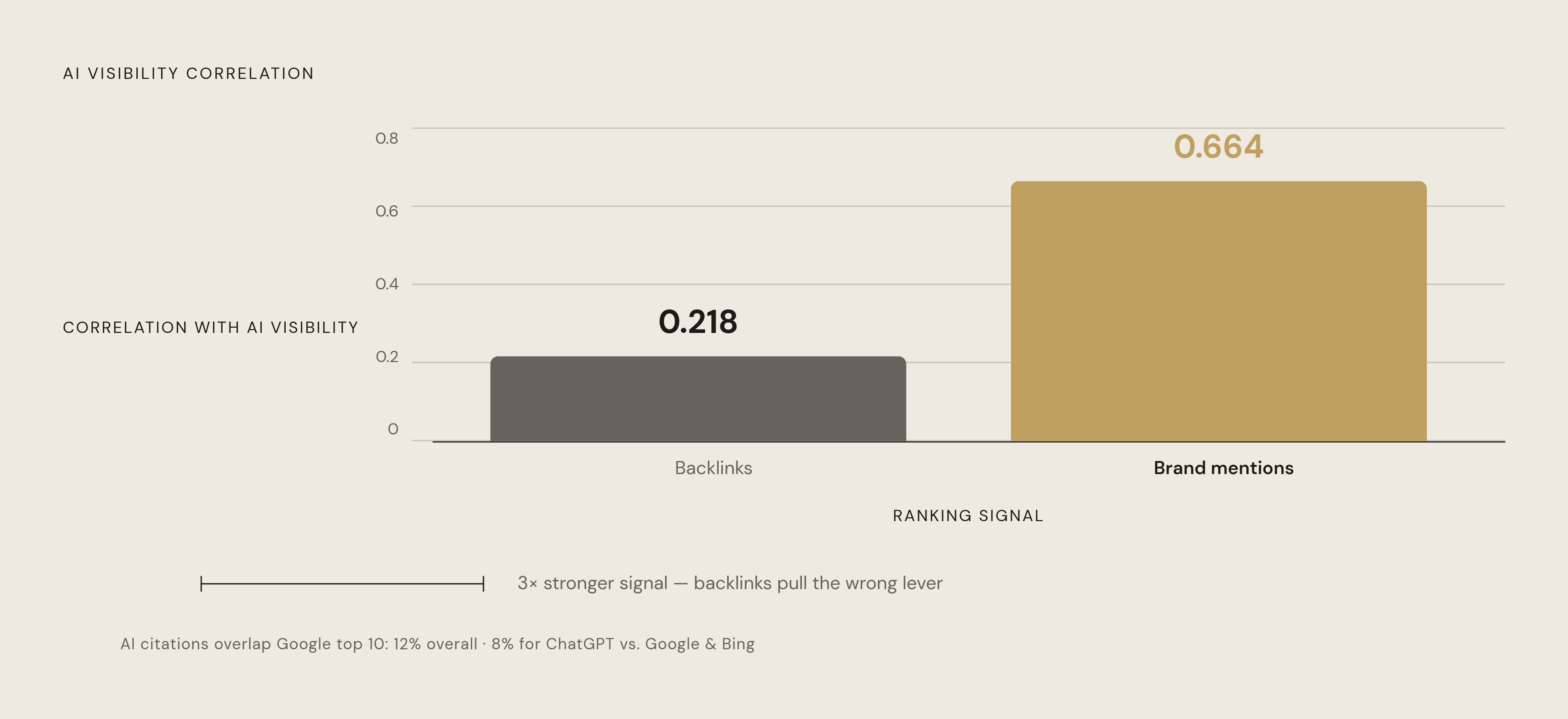
That volatility means a one-time snapshot of AI visibility misrepresents the brand's real exposure, and monitoring has to run on a schedule instead. The input that actually predicts AI visibility isn't what most teams assume, either: an Ahrefs study across 75,000 brands found brand mentions correlate with AI visibility roughly three times more strongly than backlinks do (0.664 versus 0.218). Whatever drives organic ranking and whatever drives AI citation are, evidently, two different mechanisms. Chasing backlinks to fix an AI visibility problem means pulling the wrong lever.
What drives AI citation and how the brand SERP audit surfaces the gaps
Owned content, on its own, doesn't earn AI citations. Any strategy built around publishing more on the brand's own site while ignoring everyone else's coverage is solving the wrong problem. Muck Rack's Generative Pulse 2025 report found 82% of AI citations trace back to earned media: journalism and third-party blogs, not brand-published pages. Journalism alone accounts for roughly 25% of citations. Press releases are climbing fast too: citations from them grew fivefold between July and December 2025, and structured releases now make up as much as 6% of total citations.
Where a brand's content lives matters as much as what it says. Distributing content across a wide range of publications, rather than keeping it confined to the brand's own site, increases AI citations by as much as 325%. The content itself needs substance, not just distribution: research from Princeton found content with verifiable statistics gets 30 to 40% higher AI visibility than content without them, and a joint study from Princeton, Georgia Tech, and IIT Delhi presented at KDD 2024 found adding statistics alone lifts AI visibility by 41%, the single most effective tactic they tested.
This is exactly where the audit earns its keep. Thin third-party coverage, flagged in the authority signals area, means a brand won't get cited in AI answers no matter how strong its own pages are. A missing or half-finished Wikipedia entry means a major corroboration source LLMs lean on simply isn't there. No Organization schema on key pages means AI systems can't reliably extract factual claims about the brand. A pile of mentions concentrated on a handful of low-authority sites means the diversity threshold for citation never gets met. Google's own guidance backs this up: clear technical structure and genuinely useful content remain the foundation for AI search visibility. Google has specifically advised against gimmicks like content chunking or unofficial llms.txt files, pointing instead toward Search Console's Generative AI performance report for actual monitoring. The audit's real output here is a map of where the brand runs thin in exactly the sources AI already trusts, not another ranking report.
Reading the Audit Findings as a Brand Health Picture
Every finding in the audit lands in one of three states. Controlled means the brand owns the story on that surface. Contested means competitors, third parties, or an AI summary are shaping the narrative alongside the brand, or instead of it. Absent means the brand simply isn't there on a surface buyers are already using to make decisions.
Each state calls for a different response, and treating them the same is where most remediation plans go wrong. Controlled surfaces need maintenance: watch for drift, keep schema and entity data current, don't assume today's good result holds next quarter. Contested surfaces need triage first, sorting out whether the contest comes from a competitor's paid ad, an organic comparison page, or an AI Overview pulling from a source the brand doesn't control, because each of those calls for a different fix. Absent surfaces raise an honest decision about whether that gap is even worth closing, since not every platform matters equally to every buyer.
Read this way, the audit works as a picture of brand health rather than a list of technical fixes, the same way a financial audit reads a balance sheet rather than a single transaction. A marketing leader who treats it as a task list will chase individual fixes forever and never get ahead of the next one. One who reads it as a health picture sees where the brand's story is genuinely under its own control, where someone else is writing it, and where nobody has written it.
Sources
- How to audit your brand’s full SERP presence
- Auditing Brand SERP Presence: A Strategic Approach to Elevate Your Online Identity
- Branded Search Results: 4 Hidden Risks and How to Audit Your Brand’s SERP
- searchengineland.com
- emarketer.com
- Branded SEO Guide - AWR SEO Guide
- Brand SERP @TeamKalicube
- Brand SERP: Why Your Name in Google Is Your Real Business Card in 2026