Competitor Brand Name Bidding and Organic Defense Strategies
Competitors bid on your brand name because it's cheap and your customers are already interested.
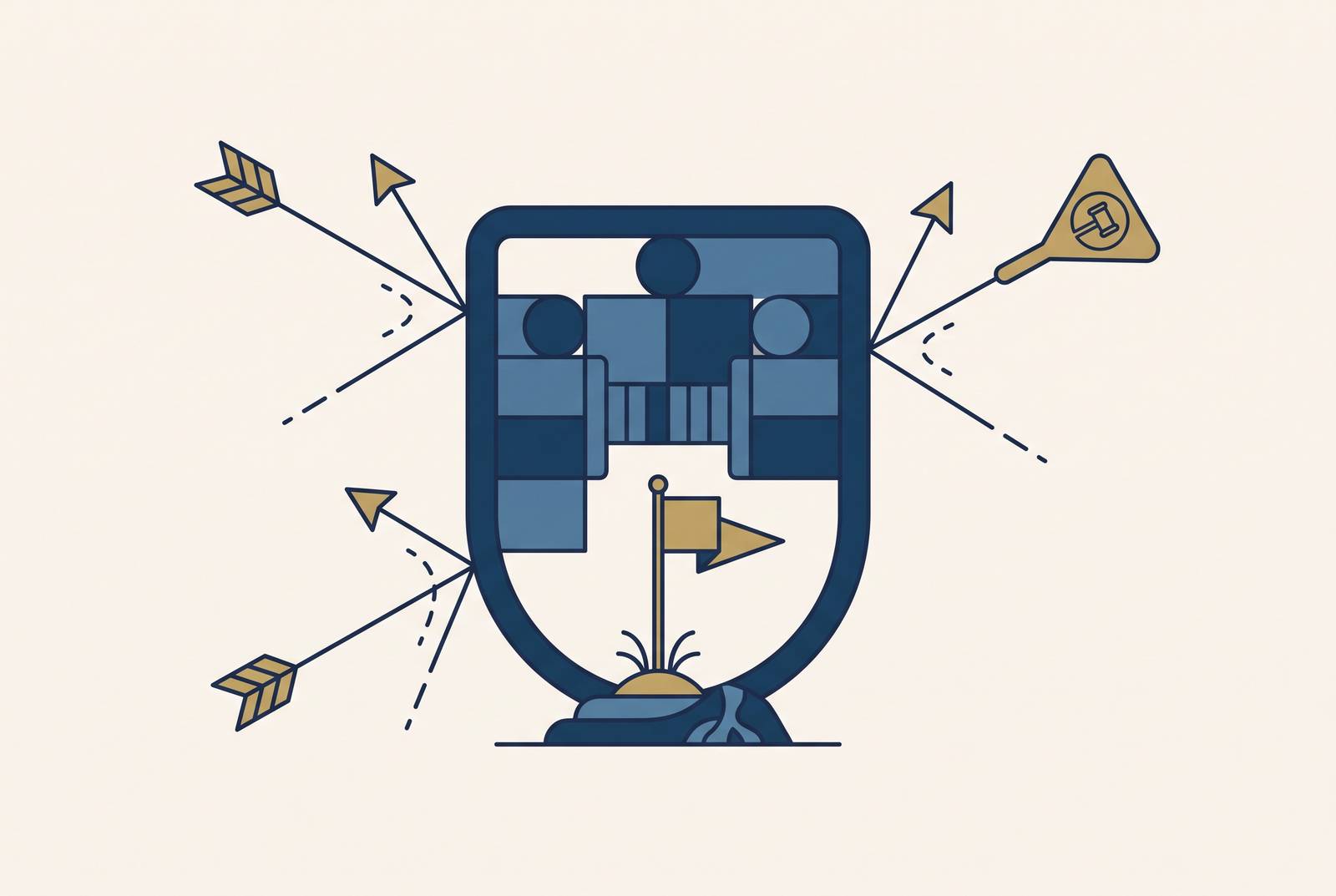
Ranking first for your own brand name on Google tells you almost nothing about what a searcher actually sees. Across 60 mid-market brand audits run between 2024 and early 2026, the median brand controlled or favorably influenced only 4 of the top 10 organic positions for its own name. The rest went to review aggregators, comparison sites, competitor pages, and social profiles that the brand does not own and cannot edit. In 22 of those 60 audits, at least one competitor was actively bidding on the brand's own keyword, and a paid ad sat above the organic result the marketing team had spent years earning. Position one, on its own, does not stop that ad from showing.
Competitor brand bidding and its appeal to the offense
The practice has a name: brand conquesting. It means bidding on a competitor's trademarked name as a keyword inside a paid search auction, and it's permitted because search auctions run on bid price and relevance, not on who owns the trademark. Major search platforms will happily sell a competitor the right to show an ad when someone types in your brand name, provided the ad clears a basic bar: the trademark itself generally can't appear in the visible ad text or the display URL. Liability attaches to confusing ad copy, not to the act of targeting the keyword.
The economics explain why attackers keep doing it. Brand keyword CPCs typically run $3 to $8, a fraction of the $15 to $30-plus a business pays to compete on generic category terms. That gap makes brand conquesting one of the cheapest ways to intercept a high-intent buyer in the entire paid search stack. And the buyer intercepted this way isn't cold. Someone typing a competitor's name into Google already knows what they want, they're close to a decision, and the attacker spent nothing building that demand. The whole play rests on catching a customer at the exact moment another company's marketing, sales, and word-of-mouth did the hard work of earning their attention.
The legal boundary between permitted bidding and actionable infringement
In one country, the relevant law is a specific trademark statute, set out in its federal code, and courts apply what's called a "likelihood of confusion" standard. § 1114 and § 1125, and courts apply what's called a "likelihood of confusion" standard. Keyword-only bidding, where the brand name never appears in the visible ad copy, has generally survived that test in US courts. The EU, UK, and Canada land in roughly the same place: bidding on the keyword itself is allowed, and the real legal exposure occurs only when the trademark appears in the ad text a user actually reads.
That consensus isn't universal anymore. In a Delhi High Court judgment delivered May 22, 2026, Justice Mini Pushkarna ruled in a case brought by a home fittings manufacturer. v. Google LLC (CS(COMM) 591/2017 and CS(COMM) 592/2017) that Google LLC and Google India could not use "HINDWARE" as an advertising keyword at all, and ordered ₹30 lakh in nominal damages. The ruling goes further than any US, EU, or UK precedent on record, because it restrains the keyword itself rather than stopping at the ad copy. That's a meaningful signal about where trademark law could move in some jurisdictions, but it shouldn't be read as a preview of what US, EU, or UK courts will do next. Those legal frameworks, and the remedies available under them, remain distinct from India's.
Building a paid defense on your own brand terms
The single most effective move a brand can make is also the simplest: bid on its own name. A branded campaign built around your own trademark earns the highest Quality Score available for that keyword, because nothing is more relevant to a search for that manufacturer's brand name than an ad from that manufacturer itself. That Quality Score makes your own branded clicks structurally cheap, often just cents, while forcing any competitor trying to conquest that same term to pay a materially higher price for the identical placement. You're not just buying a spot. You're raising the cost of the attack.
Running your own ad next to your own organic listing also claims more physical space on the results page, which crowds out the room a competitor's single text ad would otherwise occupy. That matters more now than it did a few years ago, because Google's AI Overviews have been eating into the real estate above the fold. Brands without a strong paid position risk click-through rate drops in the range of 12 to 15% as AI-generated summaries claim above-the-fold real estate and push results further down the page. The branded campaign, in other words, is defense against the search engine itself shrinking the space available to be seen, not only against a competitor. It's defense against the search engine itself shrinking the space available to be seen.
Ad extensions do a lot of the heavy lifting here. Sitelinks pointing to offers, testimonials, and FAQs, plus callout extensions, structured snippets, and promotion extensions, all stretch a single ad into a much larger visual block. A competitor running one plain text ad against that kind of spread is fighting for a click with a fraction of the surface area.
Organic brand defense: controlling the ten positions that paid bidding cannot buy
No amount of ad spend fixes an organic problem. Whether a page ranks for your own brand name comes down to content relevance, technical fundamentals like site speed and crawlability, and authority built from backlinks and mentions elsewhere on the web working together. A fast, well-structured site with thin content still loses. Deep content on a slow, poorly indexed site still loses.
When a brand doesn't hold those ten organic positions, something else fills them, and it's rarely flattering. Review aggregators, comparison sites built by competitors, unrelated news mentions, and Reddit threads all tend to fill the gap, and every one of them is a surface where the brand has no editorial control over the narrative. A prospect searching a company's name might land on a three-year-old Reddit thread complaining about customer service before they ever reach the company's own site.
The fix is building out owned content deliberately, not accidentally. That means a home page and About page that actually target branded search terms, a press and news hub, case study and testimonial pages, FAQ pages that answer the specific questions people type alongside the brand name, and social profiles, a LinkedIn company page or YouTube channel, strong enough to rank on their own. Each of those is a position a brand can claim outright rather than hope for.
Unlinked brand mentions are a quieter opportunity. Plenty of publications and review sites mention a company by name without linking to it. Finding those mentions and asking for the link converts a passive reference into a ranking signal, which pushes owned pages higher and, indirectly, starves the review and comparison pages currently occupying the space a brand's own site should hold.
How AI search surfaces create a new brand-conquesting front
Gartner's forecast that traditional search engine volume would fall 25% by 2026 has held up. That's not a marginal shift. The entire battlefield on which brand conquesting has historically been fought, the ten blue links, is contracting while a new one opens up inside AI-generated answers.
The two pools don't overlap the way most marketers assume. The share of top Google links that also show up as cited sources in AI answers has fallen from around 70% to below 20%. A brand that has spent years dominating the traditional SERP can be almost invisible inside an AI-generated summary or one model's response answering the exact same question. Ranking well in one system says very little about performance in the other.
This creates a version of brand conquesting that needs no auction. A competitor that gets cited more consistently by AI systems simply displaces a brand from consideration before a user ever runs a traditional search, and there's no ad copy to flag, no keyword bid to contest, no trademark policy to file a complaint against. It happens upstream of the search itself.
It's also unstable in a way paid and organic channels are not. On January 27, 2026, Google switched AI Overviews over to Gemini 3, and roughly 42% of previously cited domains got replaced in that transition. No competitor did anything to cause that. A single model update erased a large share of brand citations overnight. AI visibility isn't something a brand secures once and then leaves alone.
Building AI visibility as a brand defense discipline (GEO/AEO)
The discipline built to address this is called GEO, short for Generative Engine Optimization: structuring a brand's content, its entity presence across the web, and its technical setup so that generative AI systems, ChatGPT, Perplexity, Gemini, Google AI Mode, and AI Overviews among them, actually cite and recommend it when someone asks a relevant question. AEO, or Answer Engine Optimization, is a narrower cousin focused specifically on AI answer platforms. Most agencies use the two terms interchangeably in 2026, though the distinction still matters when a client contract needs to define scope and measure results against something specific.
What separates GEO from traditional SEO is where the work actually happens. GEO runs roughly 80% strategic and only 20% technical; the dominant lever isn't a schema markup fix or a meta tag, it's editorial authority and how present a brand is across the wider information ecosystem the AI model was trained on and continues to pull from.
Earning coverage in publications that AI platforms are known to cite is the primary lever available. Perplexity shows its sources openly, and it leans toward trusted, high-authority outlets: mainstream news organizations, official documentation, reference sites like Wikipedia, and, notably, community platforms like Reddit, which makes up a large share of its citations. A brand that keeps appearing in that kind of coverage, consistently and over time, gets recognized by large language models as an authority in its category. That recognition doesn't come from a single press release. It comes from a pattern the model has learned to trust.
Brand defense management across a client portfolio
Running this three-layer defense, paid, organic, and AI visibility, for one brand is a real undertaking. Running it across a full client portfolio, where every account needs its own branded campaign monitored, its own organic gaps mapped, and its own citation footprint tracked across multiple AI platforms, is a different order of problem. Without a structured operational model that treats brand defense as a standing discipline rather than a project, agencies default to firefighting: whichever client noticed a competitor's ad first, or spotted a bad Reddit thread ranking above their homepage, gets the attention that week, and the other 20 accounts wait their turn. A defense strategy that only activates once a client complains is a response system, and by the time it responds, the competitor's ad has already been running for weeks. It's a response system, and by the time it responds, the competitor's ad has already been running for weeks.