Media Monitoring Tools for Brand Mention Tracking
Brands now need to monitor what AI systems say about them alongside traditional media coverage.
A brand gets mentioned online roughly every 3.2 seconds in 2025, and by year's end more than 2.5 million online publications will exist to do the mentioning. No PR team scrolling manually catches that volume, which is exactly why automated monitoring became standard practice years ago. What's changed is the map. The channels that used to define "coverage", press hits, social chatter, review threads, now sit alongside a newer and less visible one: what AI systems say about a brand when nobody's watching.
What counts as a brand mention across today's channel landscape
Tracking a brand name is the easy part. A real monitoring setup also needs to catch spelling variants, common misspellings, abbreviations, product names, campaign hashtags, and the names of executives who get quoted or tagged alongside the company. Some platforms now catch visual mentions too, a logo sitting in the corner of an Instagram photo or a few seconds of a product on a TikTok clip, which text-only tools simply miss.
The channel list itself has gotten long. Social platforms (X, LinkedIn, Instagram, Reddit, TikTok, Facebook) still carry the fastest-moving sentiment signals. Online news and blogs remain the backbone of earned media, and PR agencies now track coverage across more than 200,000 online news sources plus broadcast outlets and podcasts. Review sites and forums carry unfiltered product feedback, often the first place a defect or a delight gets described in detail. Broadcast, radio, and podcasts matter for brand safety and reach in formats that don't produce a clean text transcript to search.
Then there's the fifth category: AI-generated answers and LLM surfaces. Most monitoring stacks built over the last decade don't touch it at all. That's not a small gap. It's the one this piece spends the most time on, because it's where the ground is actually moving.
Why AI-generated answers are now a brand mention surface that matters
Scale first. ChatGPT fields over 1 billion prompts a day and counts roughly 900 million monthly users; Gemini has passed 650 million monthly users; Google AI Overviews reaches 2.5 billion monthly active users. Those aren't niche tools anymore, they're default entry points for a huge share of everyday search behavior.
The buying behavior backs that up. 71% of Americans already use AI search to research purchases or size up brands, and 58% of B2B buyers say they consult an AI answer engine before they ever land on a vendor's website. A large share of AI Mode sessions end without an external click; the AI's answer is the finish line, not a signpost pointing somewhere else. A brand can get recommended, skipped, or flat-out ignored across millions of these conversations every day, and none of it shows up on a traditional media dashboard.
This is where GEO (Generative Engine Optimization) and AEO (Answer Engine Optimization) enter the picture, though both are optimization disciplines that depend on a monitoring question getting answered first: where does the brand currently show up, and how? GEO is about getting an LLM to include and cite the brand at all. AEO is narrower, making sure that when an answer engine picks one claim or recommendation to surface, it's the brand's claim and not a competitor's.
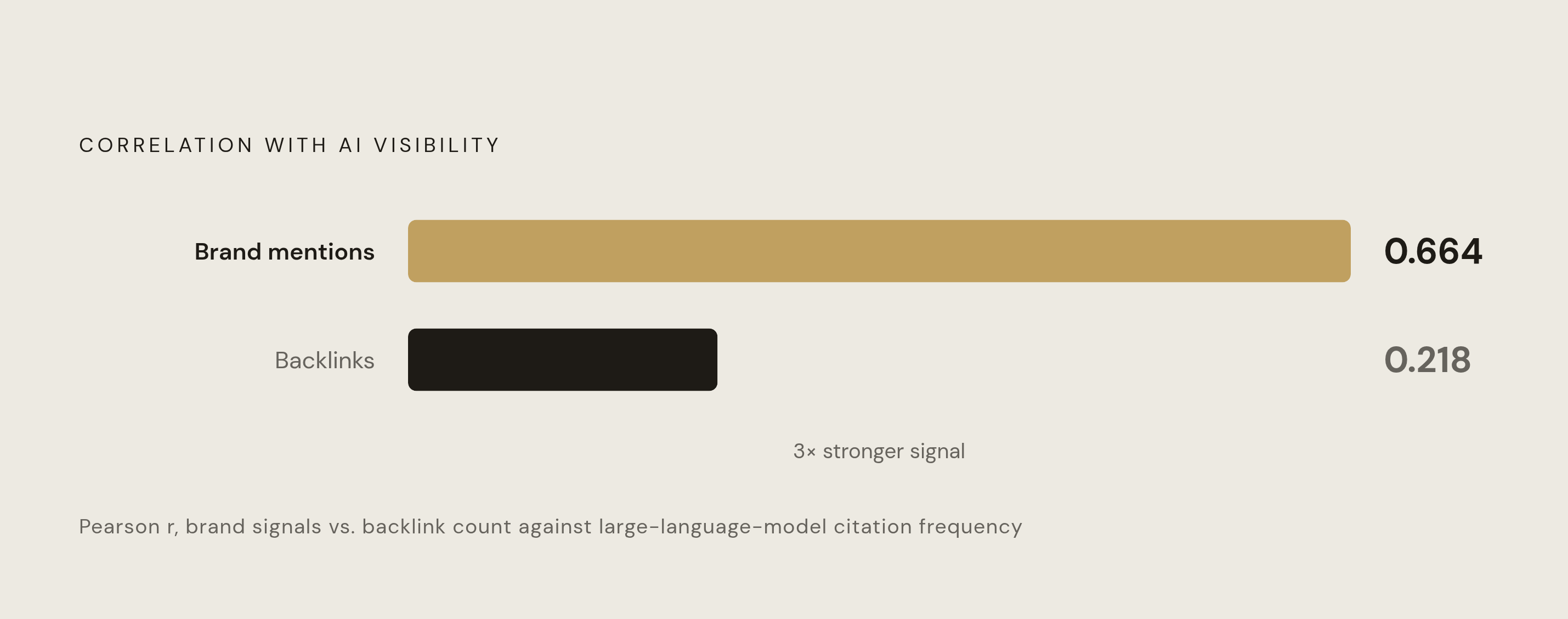
The finding that should reorder how marketers think about all of this: brand mentions correlate roughly three times more strongly with AI visibility than backlinks do (a correlation of 0.664 versus 0.218). Backlinks built the last decade of SEO strategy. They're a weaker signal now than simply being talked about. And 82% of AI citations trace back to earned media, the same coverage media monitoring has tracked all along, journalist writeups, third-party reviews, industry blogs. The stakes of missing a piece of that coverage just got higher, because it's no longer only shaping what a journalist's readers think. It's shaping what an AI tells millions of people who never read the article at all.
Enterprise media monitoring platforms and what they actually cover
Meltwater sits at the top of the enterprise tier, bundling social listening, media intelligence, media relations, consumer intelligence, influencer marketing, sales intelligence, and API access into one platform. It was named a Leader in the IDC MarketScape for both SMB and enterprise influencer marketing for 2025-2026. Contracts start around $15,000 and climb past $150,000 at enterprise scale, according to Vendr's 2026 pricing data (Meltwater doesn't publish rates). On G2, it holds a 4.1 out of 5 across more than 2,600 reviews, with users praising the consolidated data and AI-powered reporting, and pricing cited fairly often as a real barrier for smaller teams.
Brandwatch is the closest enterprise-grade alternative for teams that put consumer intelligence first. It centralizes social listening, audience research, and competitive benchmarking, with AI-powered image and sentiment analysis, per G2's 2025 data. Enterprise contracts start near $36,000 and average around $50,000 based on aggregated buyer data. Brandwatch discontinued its Essentials tier between 2022 and 2026, cutting off the affordable entry point it once offered smaller organizations, so it's now positioned as a pure enterprise play. G2 rates it 4.5 out of 5 across more than 500 reviews.
Talkwalker (now Talkwalker by Hootsuite) covers more than 150 million sources across 30-plus social networks and monitors 239 countries, supporting sentiment analysis and topic detection in more than 180 languages. Its differentiators go beyond raw coverage: AI image and video detection, audio monitoring, a proprietary Blue Silk AI engine for predictive insights, trend forecasting, more than two years of historical data, and multiple saved searches. Dash Social's 2025 analysis names it one of the few platforms that genuinely rivals Meltwater on breadth of media coverage, and it's a strong fit for PR and comms teams that need real-time crisis alerts alongside competitive benchmarks.
All three share the same blind spot. They're strong on earned media and social listening, but none of them natively track what LLMs say about a brand. That's a different tool category, covered further down. Brand24, Meltwater, Sprinklr, Brandwatch, and Talkwalker recorded the highest share of voice among social listening platforms between January and June 2026, according to Meltwater's own analysis.
Mid-market and PR-specific tools for agencies managing multiple clients
Brand24 monitors 25 million online sources spanning social media, news sites, forums, blogs, and podcasts, with automatic sentiment categorization and AI-generated topic analysis for spotting trending conversations. Pricing starts at $79 a month for the Individual plan and $199 a month for Team. For an agency running three to five smaller clients, it's the clearest price-to-performance option under $100 a month for core news tracking.
Muck Rack takes a narrower, PR-specific approach: a journalist database, pitch tracking, and media monitoring in one platform, with journalist profiles that update automatically and alerts when coverage lands. It's built for PR teams that need to find the right reporter and track the resulting story without switching between separate tools. Users on review platforms have noted the accuracy of its media contacts and the straightforwardness of its workflow.
Cision, through its CisionOne platform, takes the generalist route: media monitoring, journalist outreach, press release distribution, and social listening under one roof. In 2025, H.I.G. Capital acquired Cision, separating it from the wider Kantar group.
Mention covers web pages, social platforms (Facebook, X, Instagram, LinkedIn, Reddit), news sites, blogs, forums, and review sites across roughly 1 billion sources, with a 24-month look-back window. As of mid-2025, its pricing consolidated into a single Company plan starting at $599 a month on an annual contract; its older lower-tier plans were discontinued for new customers that July and are no longer sold. What's left includes a set of monitoring and reporting features aimed at communications teams managing brand presence across those channels.
Across this tier, pricing for media monitoring software aimed at communications teams runs from around $29 a month up to six figures a year. For an agency juggling three to five clients, Brand24 at $199 a month or Prowly at roughly $258 a month (billed annually) tends to deliver the strongest combination of sentiment analysis, multi-brand dashboards, and clean client-facing reports. None of these tools, though, track LLM visibility natively. That's the next layer.
Tools built specifically for tracking brand presence in AI-generated answers
Traditional monitoring reads what's already been published. AI visibility tools ask a different question entirely: what is ChatGPT, Perplexity, or Gemini saying about a brand right now, in this conversation, to this user. Those are separate data sources that need separate methods to capture.
A platform in this category typically queries ChatGPT, Perplexity, Gemini, and Google AI Overviews using prompts relevant to the brand's category, then tracks whether and how the brand shows up in the answer. It identifies which sources the LLM is citing when it recommends or describes the brand, measures share of voice against competitors inside those AI conversations, and flags the gaps, topics or query types where the brand simply doesn't appear at all.
There's a concrete reason this matters beyond visibility for its own sake. Distributing content across a wide range of publications, rather than only publishing on a brand's own site, increases AI citations by as much as 325%. But knowing which publications are worth that distribution effort requires monitoring which ones LLMs are already citing, which loops straight back to the monitoring problem. Research from Princeton, Georgia Tech, and IIT Delhi presented at KDD 2024 found that GEO techniques can lift a piece of content's visibility in AI-generated responses by up to 40%, and the single most effective tactic, adding statistics to the content, improved visibility by 41% on its own. None of that optimization work means anything without a baseline read on where the brand currently stands in AI answers.
The category is growing fast. That market. GEO market is projected to reach a substantial value in 2026, expanding at a 42.9% compound annual growth rate, and the tool options are multiplying right along with it.
Given that 82% of AI citations trace back to earned media, the practical value of these tools is tracking where that earned coverage is actually translating into AI-surface presence, and where it's landing nowhere at all.
A handful of other tools are entering this space too. Gumloop is an AI automation platform that lets teams build custom monitoring workflows, including tracking across ChatGPT, Perplexity, Gemini, and AI Overviews; it offers a free plan with paid tiers starting at $37 a month, and its users include Webflow and Instacart. Peec AI and Brand Radar are both positioned as tools built specifically for tracking brand mentions inside AI search engines. Alertmouse, co-created by Rand Fishkin (also a co-founder of Moz) alongside Adam Doppelt and Nathan Kriege, positions itself as a sturdier alternative to Google Alerts for brand mention tracking; it has a free plan, with paid tiers starting at $120 a year, shown as $10 a month on the pricing page but billed annually only.
This corner of the market is still young, and it shows. Tools vary a lot in which LLMs they actually query, how often they refresh results, and how they present findings. Anyone evaluating one of these platforms should check its coverage against where the brand's actual audience spends time asking questions, not just take the vendor's word for breadth.
How agencies should think about combining these tool layers in practice
The monitoring stack effectively splits into two layers now. The traditional layer, social, news, reviews, broadcast, podcasts, gets covered by several established platforms depending on an agency's scale and how communications-heavy its workflow is. The AI surface layer, everything an LLM says when someone asks it a question, needs purpose-built tooling that actually queries those systems directly, since none of the traditional platforms do that natively.
Agencies feel this as a multiplication problem more than anything else. Every client needs coverage on both layers, and running that across separate single-brand tools for each account fractures the reporting and buries any pattern that shows up across the whole client roster. A portfolio-level view catches things a per-client login never will: which accounts have real AI surface gaps, which ones are already showing up strong, and where a fix that worked for one client might apply to three others.
A platform built for multi-client use adds scalable reporting on top of that, per-client exports and dashboards that don't need rebuilding from scratch every time a new account comes on, plus billing structures that actually match how agencies charge clients rather than forcing a flat per-seat rate. A meaningful share of B2B buyers are already forming opinions based on AI-generated answers before a sales rep ever gets on a call, which means account teams need to understand AI visibility well enough to explain it, not just report a number and move on, and that amounts to a training gap.