ChatGPT and Perplexity Brand Visibility for B2B Companies
B2B buyers now research vendors in AI chatbots, leaving most brands invisible to their own tools.
B2B buyers are already deep into vendor evaluation before a single salesperson knows they exist, and increasingly, that evaluation happens inside a chat window rather than a search bar. Forrester's 2026 Buyers' Journey Survey, which polled nearly 18,000 business buyers worldwide, found that 94% used AI during their most recent purchase, up from 89% the year before. The more telling number is reliance. It's reliance: buyers who once experimented with AI tools now depend on them, and that reliance has grown sharply year over year.
The visibility gap most B2B brands have not yet noticed
Brands are losing ground in conversations they can't see on any dashboard. Nobody gets an alert when ChatGPT recommends a competitor over them, and nobody gets credit when it recommends them instead. That silence is the problem.
Crackle PR's Q2 2026 AI Citation Benchmark put a number on it: 51% of B2B tech brands have zero citations across ChatGPT, Perplexity, and Gemini. More than half the market simply doesn't exist in the channel where shortlists now get built. And the marketing function meant to catch this is largely asleep at the wheel: only 22% of marketers currently track AI visibility in any form, and fewer than 26% plan to build content specifically aimed at earning AI citations. Most companies don't know they have the problem because nobody's measuring it.
The symptom appears in a completely different place. B2B companies are already reporting organic traffic declines in the 10 to 40% range as buyers shift their research into AI answer engines instead of clicking through ten blue links. Most marketing teams read that decline as an SEO problem, tighten keyword targeting, or blame Google's algorithm. The real cause is upstream of any of that: the traffic didn't disappear, it moved into a channel that doesn't send referral clicks the way search once did, and few teams have built the instrumentation to see it.
Why AI citation works differently from search ranking
Generative Engine Optimization, or GEO, refers to structuring content and brand presence so that AI systems cite and recommend a company inside generated responses, across ChatGPT, Perplexity, Claude, and other platforms, while the second acronym covers a related but distinct discipline. Generative Engine Optimization, or GEO, refers to structuring content and brand presence so that AI systems cite and recommend a company inside generated responses, across ChatGPT, Perplexity, Claude, Gemini, and the growing set of AI features embedded in other products. Answer Engine Optimization, or AEO, is a narrower slice of that: the specific work of getting cited in answer-style platforms like ChatGPT and Perplexity. In practice, most agencies use the two terms interchangeably by 2026, but the distinction still matters when a company is scoping a project or deciding what success looks like.
The concept isn't new, even if the marketing vocabulary is. Six researchers affiliated with Princeton, the Allen Institute for AI, Georgia Tech, and IIT Delhi published the first academic paper defining GEO back in November 2023. It sat in research circles for roughly a year before the term worked its way into mainstream marketing conversation in 2025.
Search engine optimization was, for the most part, a first-party game: a company controlled its own domain, its own pages, its own metadata, and climbed the rankings largely through the work done on its own site. Search engine optimization was, for the most part, a first-party game: a company controlled its own domain, its own pages, its own metadata, and climbed the rankings largely through the work done on its own website. GEO doesn't work that way. AirOps analyzed more than a billion citations and found that 85% of brand mentions inside AI search results come from third-party pages, not from brand-owned domains. Brands were far more likely to get cited through a third party, a press writeup, a review site, a forum thread, than through anything they published themselves.
That doesn't mean owned content is worthless. Yext's analysis of roughly 6.8 million AI citations across ChatGPT, Gemini, and Perplexity found first-party websites still accounted for 44% of citations, with listings making up another 42%. The balance between owned and earned is different than it was in classic SEO, not inverted. A company still needs its own site in order, but it can no longer treat that site as the primary lever.
Where AI citations come from for B2B vendor queries
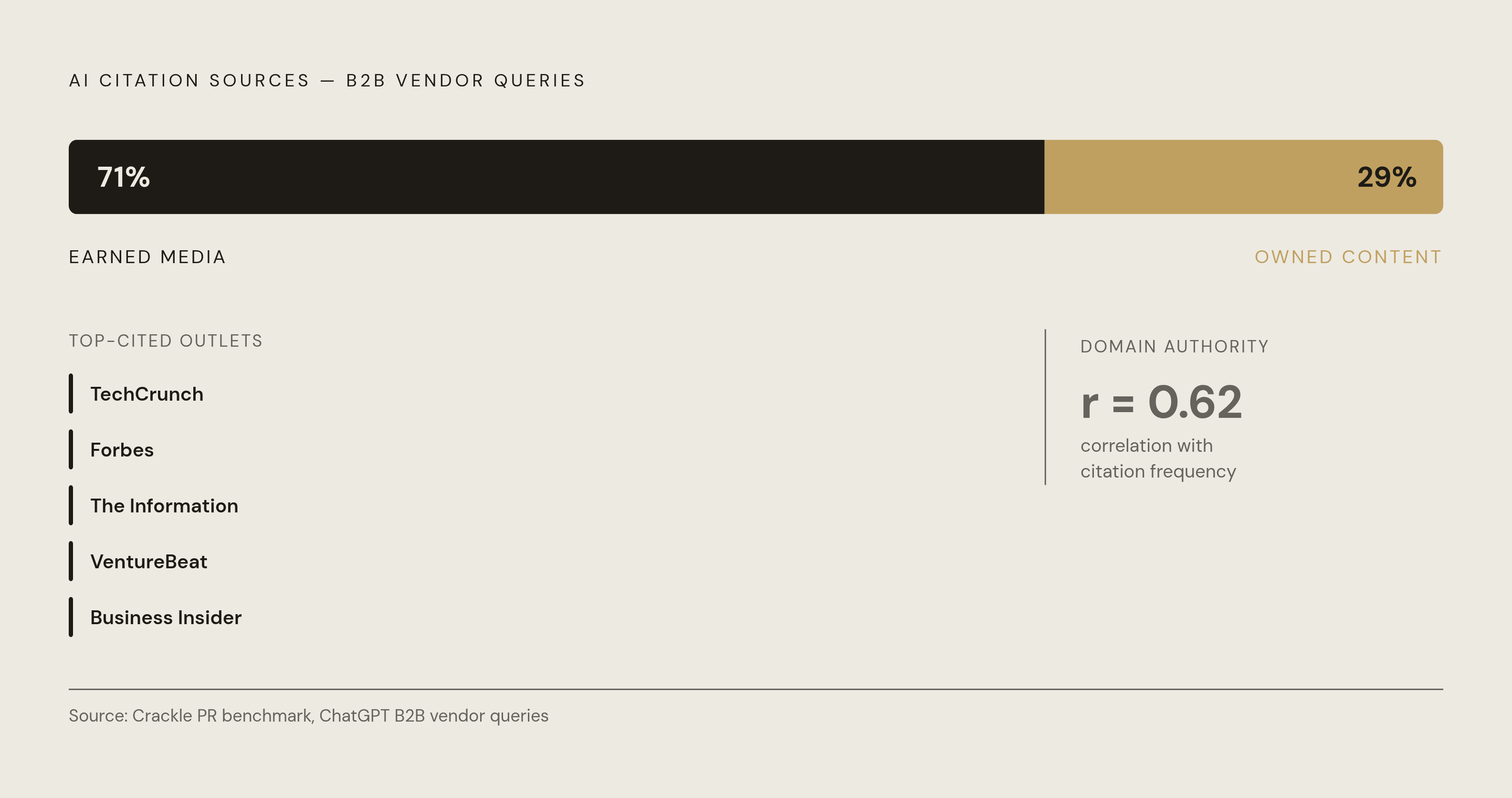
For B2B vendor questions specifically, the split tilts hard toward earned media. The Crackle PR benchmark found that 71% of ChatGPT citations for B2B vendor queries trace back to earned media placements, with only 29% coming from owned content. That's a meaningful reversal of where most marketing budgets still go.
It also matters which outlets get cited. The benchmark identified TechCrunch, Forbes, The Information, VentureBeat, and Business Insider as the publications ChatGPT reaches for most often when answering B2B tech vendor questions. This isn't about volume of coverage; it's about the authority tier of where that coverage lands. Domain authority correlates with citation frequency at r = 0.62 in the benchmark's data, a real, not trivial relationship. Twenty mentions in a low-authority trade blog won't do what two placements in Forbes will.
The most counter-intuitive finding in the whole benchmark cuts against the entire logic of traditional SEO: 34% of AI answers cite sources that rank below position 20 in Google search. A page buried on page two or three of Google can still get pulled directly into a ChatGPT answer, and a page that is at position one can be completely absent from that same answer. Ranking well on Google is not a reliable proxy for AI visibility. Treating them as one is how half the market ended up invisible without realizing it.
Five levers that increase citation frequency in AI answers
Practitioners working in this space have converged on five levers that move citation frequency, regardless of which platform's doing the citing: crawler access, content structure, entity clarity, freshness, and third-party authority.
Crawler access comes first, because none of the rest matters without it. If PerplexityBot or GPTBot can't reach a company's content, nothing downstream, no matter how well written, gets a chance to be cited. Companies skip checking robots.txt for accidental blocks against these crawlers, and this unglamorous technical audit failure is the single most common reason a company shows up nowhere. It's unglamorous foundational work, but it has to happen before any of the strategic work pays off.
Content structure is the second lever, and it's less about eloquence than about retrieval mechanics. Each section of content should answer its target question within the first 40 words, not build up to the answer through three paragraphs of preamble. Headers structured as H2s and H3s that mirror how someone would actually phrase a question, rather than how a copywriter might title a section, matter here because retrieval-augmented generation systems scan for relevant passages the way a person skims for a specific fact. Adding Organization, Product, and FAQPage schema markup gives these systems a cleaner signal for how to parse and attribute the content. Pages that answer the query directly and completely in their opening segment get favored by RAG retrieval; pages that meander don't get pulled in, even if the answer eventually shows up further down.
Entity clarity is the third lever, and it's the one most companies handle sloppily without realizing the cost. AI systems need to resolve a brand as a single, coherent entity, using the same name, the same category, and the same description of what the product does, consistent across every surface where it's indexed. A company that calls itself one thing on its own site, another thing in a directory listing, and describes its offering slightly differently in a press mention is making the model's job harder, and a model that can't confidently resolve who a company is and what it does is a model that won't cite it. Structured data and schema markup speed up that resolution process considerably.
Freshness and third-party authority round out the five, and both point back to the same conclusion: this is not a set-once, forget-forever exercise, and it is not a game a company can win by optimizing only its own domain.
AI citation's impact on pipeline, not just brand awareness
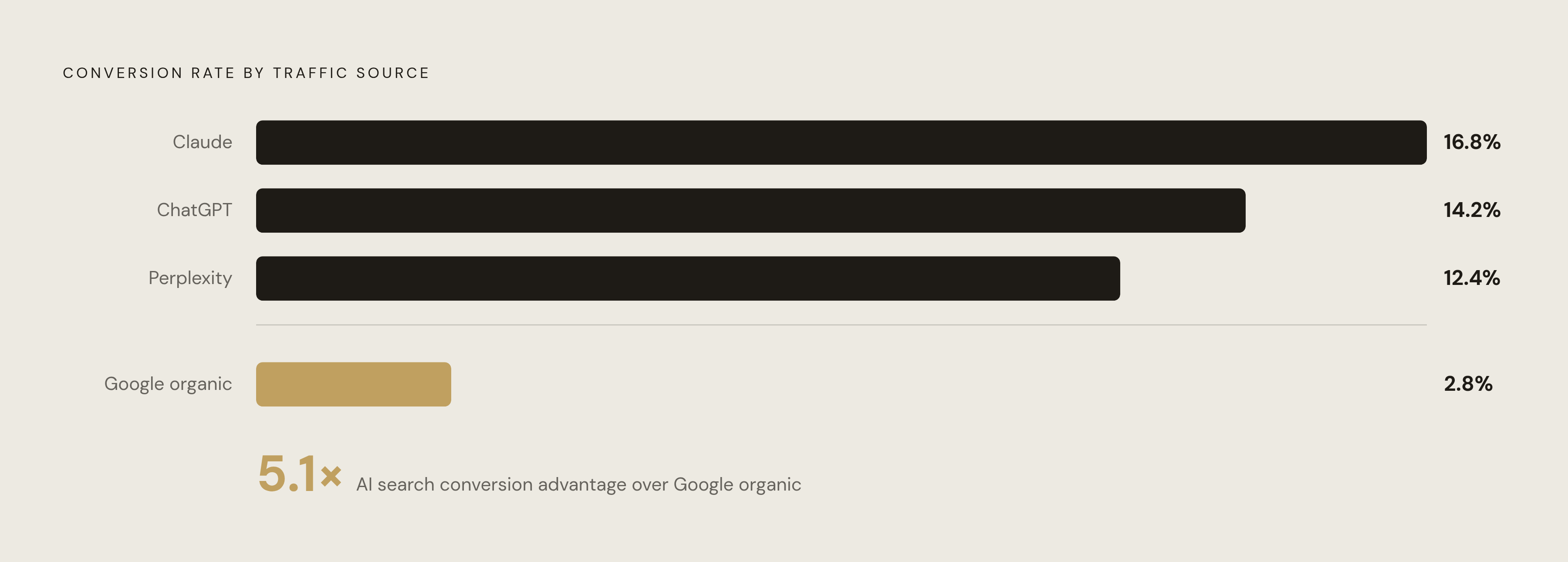
None of this matters commercially unless it moves revenue, and the data suggests it moves a lot of it. AI search traffic converts at 14.2%, compared to 2.8% for Google organic traffic. That's a 5.1x advantage, and it's not a rounding error or a small-sample fluke, it's a fundamentally different kind of visitor arriving through a fundamentally different kind of channel.
The conversion advantage isn't uniform across platforms, either. Claude-referred users convert at 16.8%, ChatGPT users at 14.2%, and Perplexity users at 12.4%, though conversion rates vary by platform. The pattern holds regardless of which specific number gets used: these visitors convert dramatically better than the ones arriving from a traditional search results page.
Thinking through who's actually asking these questions explains the reason. A buyer who asks ChatGPT to compare five vendors, then asks Perplexity to build a business case around the top two, has already done the work that used to happen across a dozen sales calls. By the time that buyer reaches a company's website or fills out a contact form, they usually have a shortlist and a budget already in hand. They're not top-of-funnel traffic kicking tires, they're buyers close to a decision, and The pattern is consistent with who these visitors are: someone doing final diligence before a purchase, not curiosity browsing.
Measuring AI visibility and share of model across platforms
Almost nobody is measuring any of this yet. Only 22% of marketers track AI visibility in any capacity, and the share doing it systematically is almost certainly even smaller. The overwhelming majority of B2B companies have no baseline at all, which means they can't tell whether their AI visibility is improving, degrading, or nonexistent, because they never established a starting point to measure against.
The metric gaining traction to fix that gap is "share of model," a term coined by Jack Smyth and Tom Roach. Share of model measures how often a brand actually appears in AI-generated answers relative to its competitors, across the platforms where buyers are asking, rather than relying on the vague sense that a brand "does well in AI search" because someone spotted a favorable mention once. It's the current era's analog to share of voice, except the audience being measured isn't reading, it's answering, and the answer a model gives is what a buyer sees before ever landing on a company's site.
Building that baseline means running the same vendor-comparison and vendor-research questions buyers are actually asking, across ChatGPT, Perplexity, and Gemini, and logging which brands get named, how often, and in what order. Without that tracking in place, half the market will keep discovering its AI invisibility the way it's discovering it now: through an unexplained drop in organic traffic and a sales pipeline that's quietly gone thinner than it should be.