How Google AI Overviews Select Brand Mentions
Brand mentions across the web matter far more than rankings for getting into Google's AI Overviews.
Google's AI Overviews now show up on roughly half of all queries, a sharp jump from a year ago. What follows breaks down how those Overviews decide which brands get named and which get skipped, using a selection process that runs almost entirely apart from where a page ranks in organic search. Marketers who treat proximity to the top 10 as good enough are optimizing for a system that no longer controls the outcome they're chasing, and that mistake will cost them the next two years of visibility.
The stakes aren't abstract. Queries that trigger an AI Overview carry a zero-click rate that accounts for a substantial share of searches, and when Google's AI Mode handles the same query, that number climbs higher still. Yet brands that land a citation inside the Overview see meaningfully more organic clicks and far more paid clicks than brands left out. Total click volume shrinks, but the reward for being cited grows. The citation fight is the new front door to brand awareness, and most teams are still knocking on the old one.
How the RAG pipeline selects sources, from 200-500 candidates down to 5-15 citations
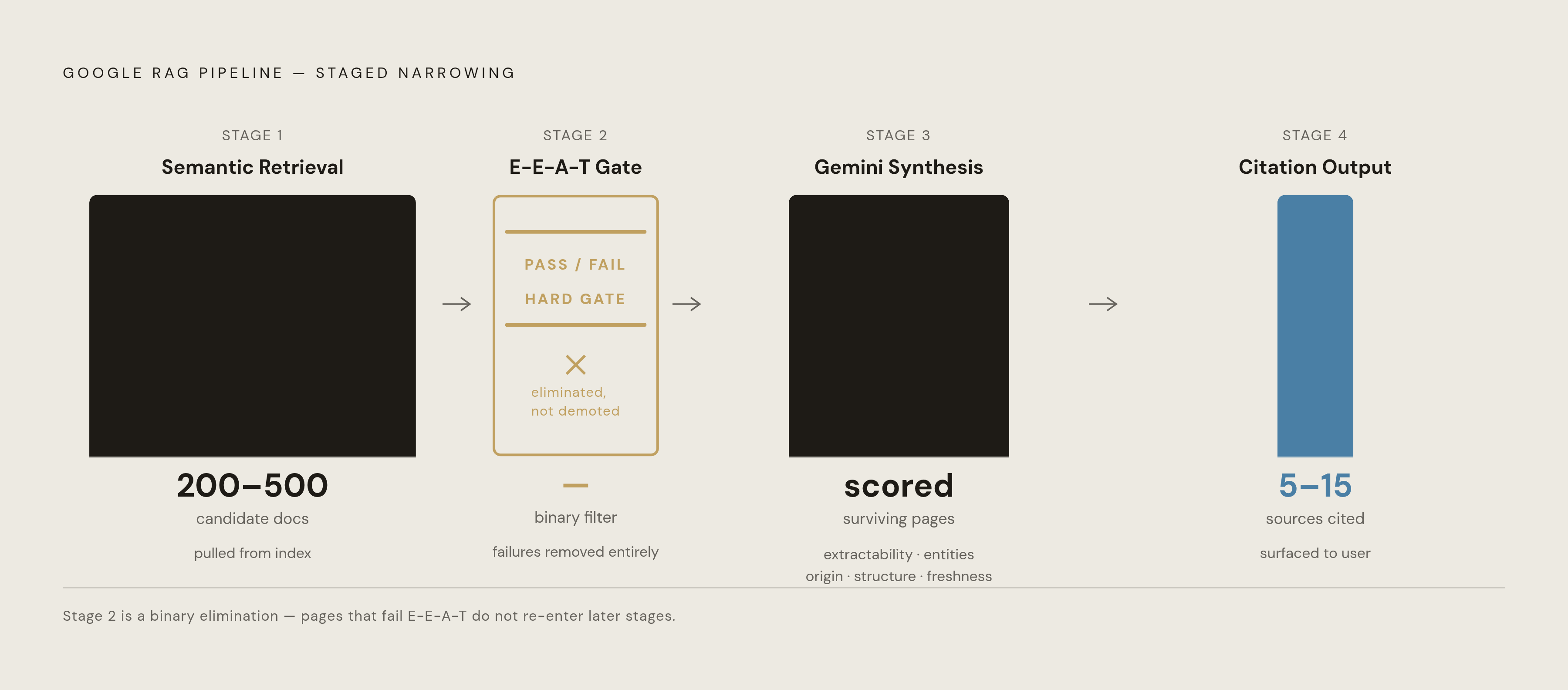
AI Overviews don't just reshuffle the top organic results and slap a summary on top. A retrieval-augmented generation (RAG) pipeline drives the whole thing: the system queries Google's index, pulls a wide set of candidate documents, and has a language model write an answer built from the passages it judges most trustworthy, relevant, and easy to extract cleanly.
The funnel runs in stages. Semantic retrieval starts wide, narrowing the field to somewhere between 200 and 500 candidate documents. Next comes an E-E-A-T authority check that behaves like a gate, not a scoring curve: pass or fail, nothing in between. Whatever survives that gate moves to Gemini-based synthesis, which grades the remaining documents on the ease of lifting their content, the clarity of named entity markup, the actual origin of the source, the presence of structured data backing it up, and the freshness of the content. What comes out the other end is the 5 to 15 sources a user actually sees cited.
The pipeline pulls from the same index organic search already uses, and no special schema or markup exists for AI Overviews specifically. The pipeline pulls from the same index organic search already uses, so eligibility runs on the same helpful-content principles Google has published for years. Nothing secret, no hidden tag to add. The rules were already public. Most sites just weren't built to satisfy the gate.
A page that fails E-E-A-T doesn't get pushed down the list the way a thin or spammy page might drop from position 3 to position 30 in organic rankings. It gets removed from consideration before the synthesis stage even starts. A ranking penalty costs a page position. Failing the gate costs it existence, at least as far as the Overview is concerned, and most SEO teams still haven't internalized that difference.
The decoupling from organic rank, what the data now shows about citation source distribution
Through early 2026, the share of Overview citations pulled from top-10 organic results fell from 76% to 38% in eight months. That's most of the correlation between ranking well and getting cited disappearing inside less than a year.
A longitudinal study out of Washington University in St. Louis backs this up from a different angle. Researchers ran 55,393 trending queries across 19 topical categories over 40 days and found that 29.8% of domains cited in AI Overviews do not appear in first-page organic results at all. Nearly a third of citations came from pages Google's own ranking algorithm wasn't surfacing in the traditional results sitting right next to the Overview.
Position still matters, just loosely. Pages sitting outside the top 10 get cited sometimes. Pages sitting at position one get skipped sometimes. The selection model runs alongside standard ranking, not downstream of it, and the two systems can and do disagree.
The two systems continue to diverge in what they surface, and the Ahrefs data above captures only part of that drift. Two decades of organic ranking signals no longer run the show. Treating them as the whole game is the fastest way to lose one.
The seven factors that determine citation eligibility, ranked by measured impact
An analysis of 15,847 AI Overview results spanning 63 industries identified seven factors that correlate with getting cited, and the strength of each correlation says a lot about what the synthesis layer actually rewards.
Semantic completeness leads by a wide margin, correlating at 0.87. Content that answers a query fully, without sending the reader elsewhere to fill in gaps, wins the extraction. The sweet spot runs 134 to 167 words: a self-contained passage the synthesis layer can lift whole, rather than one it has to stitch together from three different paragraphs.
Multi-modal integration produces the single biggest lift of any factor measured. Pages combining text, images, and video show a 156% higher selection rate than text-only pages. That's more than double the odds, and it's the clearest case in the data for treating a page as more than a wall of paragraphs.
Real-time factual verification matters too. Content carrying verifiable citations and recently sourced data shows an 89% higher probability of selection, a pattern consistent with how AI systems weigh source trustworthiness during retrieval. A stale statistic sitting uncorroborated on a page is a liability the system can spot and route around.
E-E-A-T as a binary gate rather than a ranking gradient
96% of cited sources clear a strong E-E-A-T threshold. That figure doesn't mean strong E-E-A-T pushes a page higher in some ranked list of candidates. It means weak E-E-A-T removes the page from the pool before the ranking step ever runs. Treating E-E-A-T as one ranking factor among many, the way teams treated title tags or word count for the last decade, is exactly the mistake that keeps otherwise strong content out of the Overview.
Author entity verification is where this stops being theoretical. Anonymous bylines, generic "staff writer" credits, and unverifiable credentials are active liabilities now, not neutral gaps. Google builds specific entities for authors: named individuals with a digital footprint that holds together, a professional history that can be traced, credentials that check out against other sources. A page with no real author behind it gives the retrieval system nothing to verify, and nothing to verify means nothing to trust.
Person schema backs this up structurally. Marking up credentials, bios, and professional affiliations gives the retrieval layer a structured signal that prose alone can't reliably deliver. An article can claim its author is a nutritionist in the body text; schema tells the machine that in a format it can check without guessing.
Google's March 2026 spam update, which targeted scaled content abuse, sharpened this exclusion mechanism further. It targets two specific patterns: third-party content parked on a host domain to borrow that domain's authority, and machine-generated content pushed out at scale without real oversight. Both patterns share the same tell: an author entity that's either missing or can't be verified. The update didn't invent new rules so much as make the existing gate harder to sneak past.
Brand mentions across third-party sources outweighing backlinks as citation signals
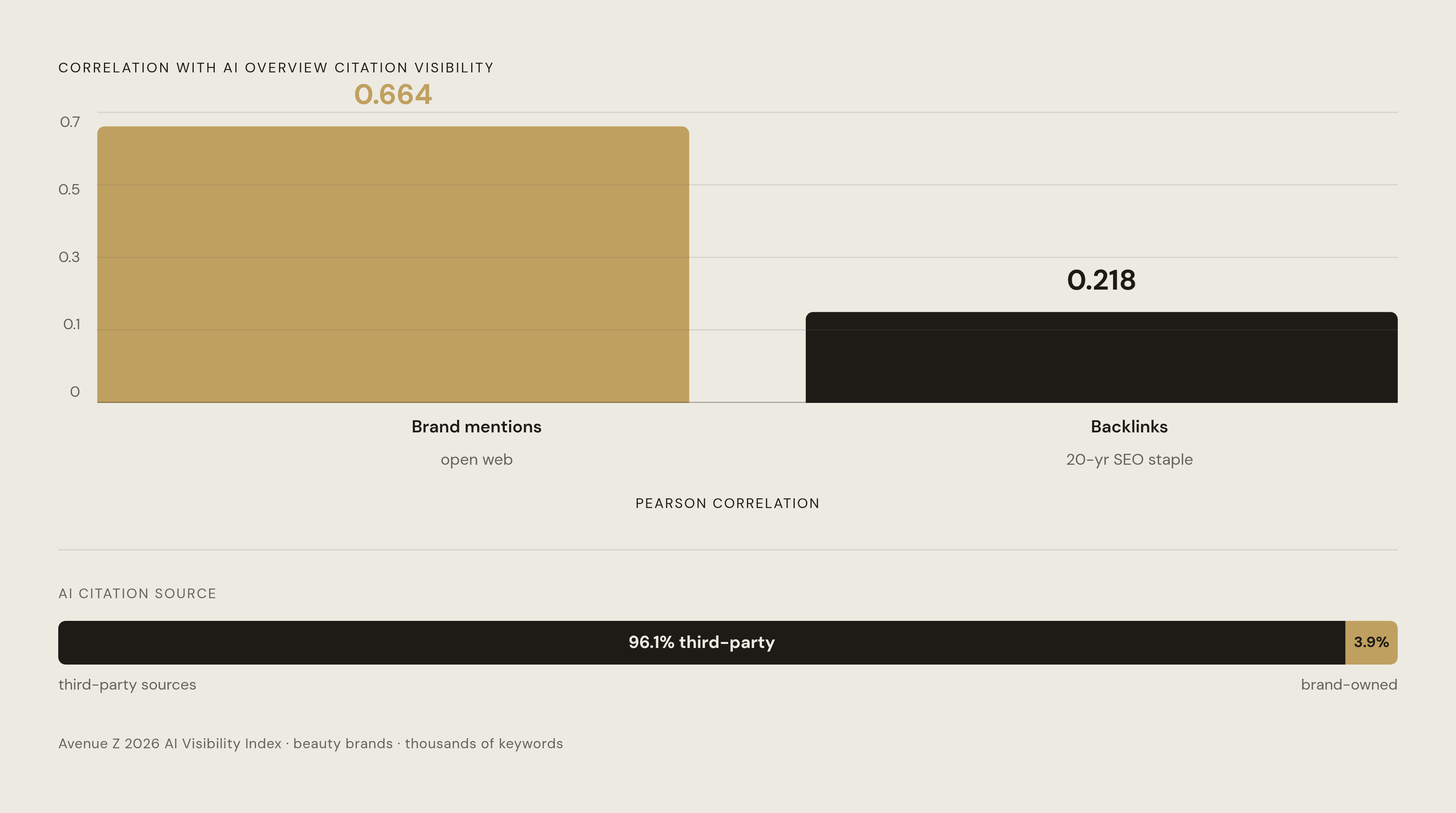
The old SEO currency and the new one point in different directions, and the gap between them isn't close. Across a sample tied to thousands of keywords, brand mentions across the open web correlate with AI Overview visibility at 0.664. Backlinks, the metric SEO has run on for two decades, correlate at just 0.218. One signal runs roughly three times stronger than the other, and agencies still budgeting primarily for link building are optimizing for the weaker lever, full stop.
The pattern also appears in vertical research, seen in Avenue Z's 2026 AI Visibility Index. Avenue Z's 2026 AI Visibility Index, focused on beauty brands, found that 63% of AI citations traced back to editorial media coverage. Brand-owned content accounted for only 3.9% of citations, with third-party sources combined making up 96.1% of the total.
AirOps' analysis reaches the same conclusion from a different angle: roughly 85% of brand mentions inside AI search results originate from third-party pages. A brand is several times more likely to get cited through someone else's site than through its own domain.
This tracks with what's visible on platforms that show their sourcing openly, including Perplexity, which leans toward authoritative industry publications, official documentation, and primary research over brand-published material. Google's own Overview citation patterns now reflect the same preference. A brand's owned blog still matters, but a mention in trade press, a well-regarded newsletter, or an industry report drives citation more than owned-channel polish ever will.
Content structure and freshness as selection factors in page-level decisions
Passage architecture decides what gets extracted. That 134-to-167-word self-contained answer unit is the literal shape the synthesis layer is built to lift. 44.2% of all LLM citations pull from just the first 30% of a page's text, so putting the direct answer, the number, the definition, at the top of a section is a structural requirement now.
Topic depth compounds this. A single well-written article rarely wins on its own. Google's systems favor sites that cover a subject from several angles, a cluster of related pieces reinforcing each other, over one isolated page chasing a keyword.
Answer-first formatting follows the same logic at the sentence level. Opening each H2 with a one- or two-sentence direct answer, then expanding after it with supporting detail, positions that opening line as candidate text for the Overview itself. This structure correlates with real gains in citation position and citation odds.
Freshness closes the list, and the gap here is stark. Content published or meaningfully updated within the last three months is three times more likely to get cited than older content, and pages left untouched past that mark become less likely to retain citation eligibility regardless of how well they've historically ranked. A lastUpdated field paired with a real, substantive edit can re-trigger eligibility for a page that had gone stale.
Measuring citation presence with Google Search Console
Google Search Console added a generative AI performance report on June 3, 2026, the first official first-party window into how a site shows up across AI surfaces. It surfaces AI Overview impression data alongside standard Search metrics within Search Console. It shows impressions. It doesn't show clicks, click-through rate, average position, or a query-level breakdown.
GSC can tell a brand where it already appears. It can't show which queries in a category are triggering Overviews where competitors get cited and the brand doesn't. Finding that gap takes tracking built outside Google's own tools, and any agency relying on GSC alone is working half-blind, whether it admits that or not.
Position reporting carries its own wrinkle. AI Overviews have historically assigned every cited URL the same position value, the position of the Overview block itself, typically position one, regardless of where inside the Overview a given source actually sits. AI Mode instead assigns position based on where a source lands within the generated response. That inconsistency makes aggregate position metrics unreliable for any query set heavy on AI features, since the same number means two different things depending on which surface produced it.
What actually needs tracking goes beyond a simple cited-or-not check: AI Overview eligibility for a given query, citation position within the Overview itself, which domain gets the citation, organic click-through impact cross-referenced against GSC data from before and after an Overview started appearing, and the format of the Overview, since a list, a paragraph, and a table each favor a different content shape at extraction time.
Implications for agencies managing AI visibility across a client portfolio
Every mechanism covered above, author entity verification, entity graph consistency, a freshness cadence, schema implementation, third-party mention development, multi-surface citation tracking, has to run across every account in a portfolio, not just the one client an agency happens to be focused on this quarter. Doing it well for one brand is already a coordinated effort across content, technical SEO, and PR. Doing it for a dozen brands at once, each with its own industry, its own competitive set, its own baseline E-E-A-T gaps, turns a tactic into something closer to an operating system.
A single workspace built to compare AI citation performance across an entire client roster stops being a nice-to-have at that scale. It becomes the only realistic way to see which accounts are gaining ground, which ones are stuck outside the gate on E-E-A-T, and which ones need a freshness push before the next content cycle. Agencies still running this account by account, spreadsheet by spreadsheet, will fall behind the ones that treat citation eligibility as infrastructure: built once, checked constantly, never left to age past the three-month mark.