Monitoring Brand Representation in AI Search Answers
Brands now need to track AI mentions, not search rankings, as discovery shifts.

Monitoring Brand Representation in AI Search Answers.
Why AI answer engines have become the new front door to brand discovery
Monitoring brand representation in AI search answers is now a distinct discipline from SEO tracking, and it requires knowing which platforms name and cite a brand, under what conditions, and what happens when they don't. That distinction matters because the ground underneath it has already shifted. Gartner's 2024 prediction that traditional search volume would fall by a quarter by 2026 has come to pass, and the rest of this piece operates inside that macro condition rather than treating it as a future risk.
The consumer research bears this out at the point where it counts most: discovery. Similarweb's Generative AI Brand Visibility Index found that 35% of US consumers now use AI tools at the product discovery stage, compared to 13.6% who use traditional search. The shortlist gets built before anyone opens a search bar.
Jack Smyth and Tom Roach have a name for this: the silent shortlist, the idea that a prospect's preferences form inside an AI conversation long before that person ever lands on a brand's website. Nothing about that process appears in a web analytics dashboard, because there's no visit to log.
That's the operational reality. It is a brand problem, and standard analytics will not reveal it, because the loss occurs in a conversation the brand never sees.
The crawl-vs.-refer gap and what it reveals about where brand value lives
Start with a number that ought to unsettle anyone still budgeting for AI traffic the way they budget for organic search. Cloudflare Radar found that every major AI chatbot combined, ChatGPT, Gemini, Claude, and Perplexity, accounted for just 0.29% of search referral traffic, a signal about where the value in this channel actually sits. That's not a rounding error. That's a signal about where the value in this channel actually sits. Platforms like Letterstory are built around that asymmetry, measuring whether ChatGPT, Claude, Gemini, and Perplexity actually name and cite a brand rather than how much traffic those engines send back.
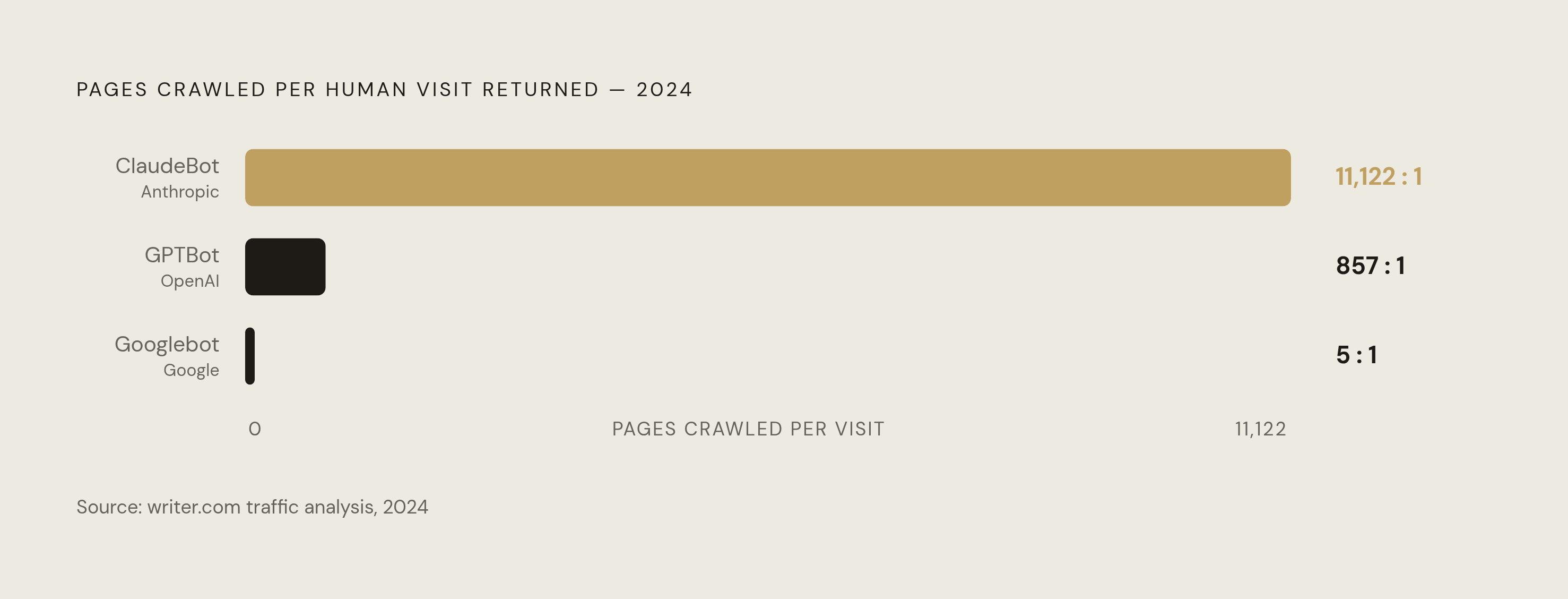
Now look at the crawl side of the ledger. Anthropic's ClaudeBot crawled 11,122 pages for every single human visit it sent back to the source site writer.com. OpenAI's ratio is 857 to 1 writer.com. Google, for comparison, is roughly 5 to 1 writer.com. These platforms are reading the web at a scale that dwarfs anything they send back in return.
Pew Research adds the click-through piece: searches that surfaced an AI summary sent a click through only about 8% of the time, roughly half the 15% rate for searches without one. Putting the three findings together, the pattern is unambiguous. AI engines consume brand content voraciously and return almost nothing proportional to what they took. Which means the brand's representation inside the generated answer, not the referral link beneath it, is the asset actually worth protecting.
This is exactly why monitoring what an AI says about a brand carries more weight than monitoring how much traffic that AI sends. Traffic was always a proxy. The answer itself is the product.
None of this means AI traffic is worthless when it does show up. The traffic that does arrive is unusually qualified. But that fact cuts in favor of the argument here, not against it: when AI traffic does arrive, it is high-intent, which makes the quality of the brand representation in the answer even more consequential Pew Research.
How AI visibility differs from SEO tracking and why that distinction shapes everything downstream
SEO, at its core, measures position: where a URL lands in a ranked list of links. AI visibility measures something categorically different, presence inside a synthesized narrative that has no position to rank. A brand doesn't rank third inside a ChatGPT answer Cloudflare Radar. It's either woven into the story the model tells, or it isn't.
Most companies haven't caught up to that distinction operationally. Only 16% of brands systematically track their AI search performance today, according to research cited by Writer. Organizations are flying blind in a channel they already know matters.
The overlap between top Google links and AI-cited sources has dropped from 70% to below 20%, per a research brief citing Brandlight via LLMrefs, so ranking well on Google no longer predicts appearing in AI answers writer.com. A page can dominate page one of Google and never once get pulled into a ChatGPT response Pew Research.
Part of the reason is where AI models actually go for their answers. Owned content matters, but it isn't where most of the citation action happens.
This is where the metric of share of model earns its place as the successor to share of voice. Share of model measures how often a brand shows up in AI-generated answers relative to named competitors, and unlike paid share of voice, nobody buys their way into it. It has to be earned through the sources these models actually trust.
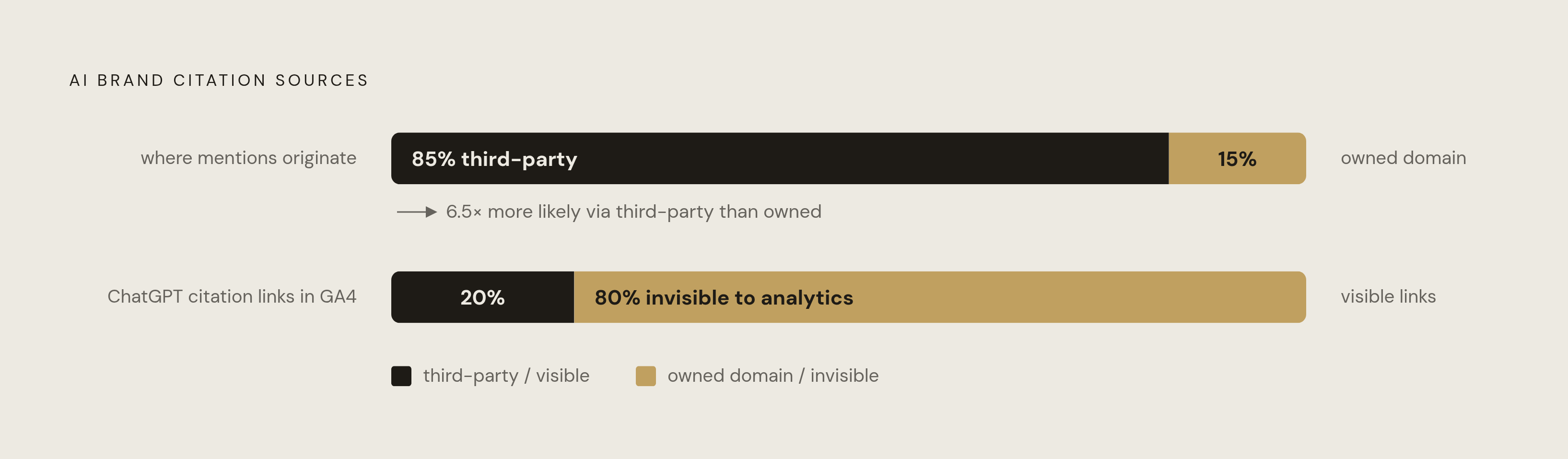
Traditional analytics tools are structurally unequipped to see most of this activity. Research citing BrandMentions.link found that only about 20% of ChatGPT mentions include a clickable citation link that would ever register in GA4 writer.com Brandlight. The remaining 80% shape a purchasing decision somewhere upstream, invisibly, with no line item in any dashboard to show for it writer.com Brandlight. Per Writer, citing AirOps analysis of over a billion citations, roughly 85% of brand mentions in AI search originate from third-party pages, not brand-owned sites, and brands are 6.5x more likely to be cited through third-party sources than through their owned domains. Brand presence is measurable across four surfaces (ChatGPT, Gemini, Claude, and Perplexity), each with different citation behaviors and referral profiles.
The four things to measure and what each one tells you
These should be treated as four distinct signals, not interchangeable dashboard items, since each answers a different question.
Brand mention rate is the awareness signal. It asks whether and how often a brand's name shows up in generated responses across a defined set of queries, and it doesn't require a citation link to matter: a name appearing in the text builds association at scale regardless of whether it links anywhere. This rate swings by platform, query type, and even phrasing, so a brand can appear consistently on Perplexity for a given category and barely register on Gemini for the exact same category.
Citation rate is the authority signal, and it's a separate event entirely from a mention. This measures whether the AI links to a specific URL as evidence for a claim, which is the piece that drives whatever referral traffic exists and the piece GA4 can partially see. Where in the answer that citation lands affects how it reads: a URL cited as the primary support for a claim reads very differently than one buried in a list of "further reading" at the bottom.
Share of model is the competitive signal. It tracks how often a brand shows up relative to named competitors across a relevant query set, and it's the metric coined by Smyth and Roach as the direct successor to share of voice. Measuring it properly means running the same prompts across multiple platforms, because a brand's share of model on ChatGPT and its share of model on Claude can differ substantially. And the platform weighting itself is contested: SE Ranking puts ChatGPT at 74.78% of all AI referral traffic, while a separate B2B brand-panel study from Goodie found ChatGPT at 62.6%, Claude at 18.5%, Gemini at 10.6%, and Perplexity at 7.3% Pew Research.
Sentiment and framing accuracy is the representation quality signal, and it's the one most likely to get skipped. This asks whether the AI describes a brand correctly, in a positive or neutral light, and without outdated or invented claims. Similarweb's 2026 research treats a positive-or-neutral framing as a distinct, measurable outcome of good GEO work, not something that happens by default. And framing isn't uniform across platforms: Claude might describe a brand one way, while Perplexity frames the same brand differently depending entirely on which sources it happened to retrieve. Per a research brief citing ZipTie.dev, brands are 3x more likely to be cited as a source than to be recommended by name in the same response, showing that mention and citation are not the same event. Misrepresentation is the most actionable finding, since an AI confidently describing a deprecated product feature or wrong pricing is a specific, correctable problem.
Which query conditions trigger brand representation, and which ones don't
AI answers don't behave like a search index. Visibility here is a matter of frequency across a large volume of prompts, not a fixed position to defend.
Certain query shapes reliably surface brand mentions. Category comparison queries ("best tool for X"), alternatives queries ("alternatives to competitor Y"), and validation queries ("is this brand trustworthy for Z") all tend to pull named brands into the response. Informational queries with no commercial intent tend to suppress brand mentions, as do queries in categories where the brand simply hasn't established a clear association in whatever sources the model retrieved.
The phrasing itself has changed too. A typical ChatGPT prompt runs around 60 words, against roughly 3.4 words for a typical Google search, according to Similarweb's GenAI Landscape report. Users are talking to these systems in full sentences and specific scenarios, not fragments, so a monitoring program built on keyword variants alone will miss most of the real query traffic.
Perplexity cites sources visibly in every response and shows a documented preference for freshness and community sources such as Reddit, which accounts for roughly 46.7% of its top citations, rather than authoritative industry publications and primary research writer.com Brandlight. Claude grew 320% between 2025 and 2026 and its citation habits are becoming increasingly relevant for B2B categories specifically writer.com Brandlight. Gemini grew 231% over the same stretch writer.com Brandlight. None of these can be monitored as a stand-in for the others.
The practical fix is to build a query library that spans category, alternatives, use-case, and validation prompt types, then run each one across all four major platforms and read the output as a frequency distribution rather than a rank to climb.
Where AI engines source their answers, and what that means for where monitoring points
Most modern AI search systems run on retrieval-augmented generation: a retrieval step surfaces candidate documents, and a generation step synthesizes them into the final answer, per Similarweb's research. Being indexed somewhere is necessary, but it isn't sufficient. Content also has to be structurally easy to parse and authoritative enough that a model chooses to cite it over the alternative it just retrieved.
Two separate layers deserve separate monitoring. On-model knowledge is what the model already "knows" from its training data, shaped by historical authority, whether the content made it into Common Crawl, and how often the brand turned up in training sources generally. Off-model retrieval is what the model pulls at the moment of the query, through live search, shaped by current crawlability, how recent the content is, and the authority of whatever pages get retrieved. A brand can be strong on one layer and nearly invisible on the other.
Citation authority is concentrated, not distributed. A small number of third-party domains capture a disproportionate share of AI citations across the major platforms, and most brand-owned sites simply aren't among them. Reddit, LinkedIn, Forbes, PR Newswire, and industry trade publications made up the major third-party citation ecosystem going into 2026. But that ecosystem isn't static: a September 2025 change to Google's search parameters (the removal of the num=100 setting) caused Reddit's citation share to drop sharply within six weeks, with Wikipedia absorbing most of the gap and Forbes and PR Newswire picking up additional share.
A technical layer needs checking before assuming a sourcing problem is strategic. Brands need to confirm their robots.txt file isn't blocking AI crawlers outright, and Cloudflare's default configuration now blocks AI bots, so any site sitting behind Cloudflare may have shut off AI crawler access without anyone noticing. Server logs should get checked for the ChatGPT-User agent specifically, since that's the clearest evidence of whether the crawler is even reaching the site.
And placement within the page matters more than most content teams assume. Roughly 44% of AI citations get extracted from the first 30% of a page, so a brand's key claims sitting deep in the copy, past the fold and beyond, may simply never get read by the model doing the retrieving writer.com. Monitoring shouldn't stop at whether a page got cited. It needs to check which part of that page actually got used.
Reading what you find: absence, misrepresentation, and correct-but-thin coverage as distinct problems
These three findings look similar on the surface, all cases where a brand isn't showing up the way it should, but they're diagnostically distinct, and treating them as one problem leads to the wrong fix.
Absence means the brand doesn't appear in answers to queries where it plausibly should. That can stem from on-model invisibility (the brand simply wasn't well represented in training data), off-model retrieval failure (crawlability or authority problems at the moment of query), or a category positioning failure, where the model has never learned to associate the brand with that particular query domain in the first place. Telling these apart requires running the same query repeatedly and across platforms: absence everywhere points to a sourcing problem, while absence on one platform and presence on the others points to something specific to that platform's retrieval behavior.
Misrepresentation is a different animal, and arguably the most urgent one. Here the brand does appear, but gets described inaccurately: wrong product details, stale pricing, incorrect positioning, or attributes that were simply fabricated. This is the most urgent finding, because it means the AI is actively misinforming prospects at scale. It usually traces back to outdated or wrong third-party descriptions sitting somewhere in the training data that the brand never got around to correcting. Newer models are increasingly able to detect when a page's timestamp has been refreshed but the underlying facts haven't actually changed, so a genuine factual correction is required, not a cosmetic date update.
Correct-but-thin coverage sits in a third category. The brand appears, gets described accurately, but only in passing, mentioned in a list without any real differentiation, or cited once where a competitor gets cited three times in the same response. This isn't a misrepresentation problem, it's a share-of-model problem, and it calls for a different fix entirely. Diagnosing it means comparing citation frequency and depth directly against two or three named competitors across the identical query set.
Sentiment framing is a fourth wrinkle underlying the other three, producing the effect that a brand can be present, accurately described, and cited frequently, and still get consistently hedged with qualifiers that quietly undercut trust. A brand can be present, accurately described, and cited frequently, and still get consistently hedged with qualifiers that quietly undercut trust, phrases like "some users report" or "though it lacks." Catching that requires monitoring the language surrounding the mention, not just whether the mention exists.
How to respond when monitoring reveals a problem
The response has to follow the diagnosis. A brand absent from every platform needs a different fix than a brand that's present but thin, and treating them the same wastes effort.
For absence across all platforms, the first move is a crawlability audit: robots.txt, Cloudflare's default settings, and server logs checked specifically for AI user agents. Next comes an honest look at third-party presence, asking which authoritative domains that AI engines actually favor mention the brand at all, since gaps there reduce visibility more than gaps on the brand's own site. On the content side, a Princeton study on generative engine optimization (published at ACM KDD 2024) found that adding source citations to a page raised its citation rate by roughly 28%, statistics raised it by around 41%, and expert quotes by around 29%, with the strongest tactics reaching visibility gains up to 40% overall Pew Research. Those are the interventions with the most consistent evidence behind them, and they all point toward the same practical habit: put the key claims and the supporting evidence early in the page, not three sections down.
For absence on a single platform, the fix narrows to that platform's specific retrieval preferences.
For misrepresentation, the work starts with tracing the claim back to its source, often a third-party review, a piece of outdated press coverage, or a Wikipedia entry that never got updated. Wherever possible, that source gets corrected directly. Alongside that, publishing clear, authoritative owned content that states the correct fact early in the page gives future retrieval a chance to find the right version instead of the old one.
None of this happens by accident, and almost none of it is visible in a standard analytics stack built for click-based attribution. Platforms built specifically to track brand mentions and citations across ChatGPT, Claude, Gemini, and Perplexity exist precisely because traditional analytics like GA4 are structurally blind to most of this, since only about 20% of ChatGPT mentions include clickable citation links that appear in GA4, leaving the other 80% invisible Cloudflare Radar Brandlight. The absence isn't a tooling gap that will close on its own. It's the reason a dedicated monitoring discipline for AI representation has become a separate, necessary function rather than an extension of existing SEO work. Perplexity and Claude have different source preferences than ChatGPT, so a response strategy targeting one platform's citation sources may not transfer. SOURCE PAGES are what the pages behind the outline's links say.