Employee Review Site Crises on Glassdoor and Blind
Review-site crises last for years and now feed AI hiring research.
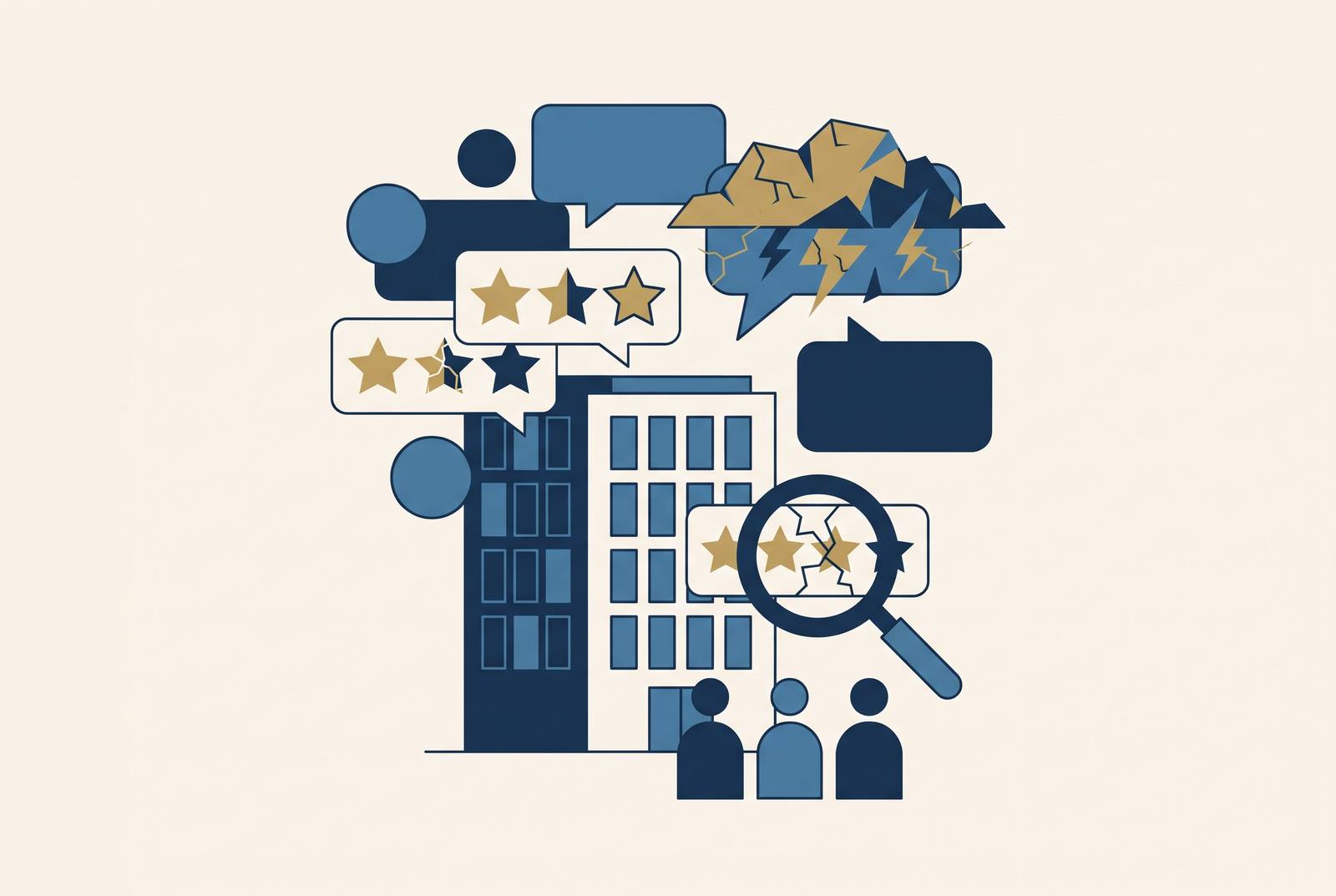
A crisis on Glassdoor and Blind is a compounding hiring problem, as real-time employee distress becomes a lasting rating decline and then enters AI-generated employer research. Recovery can extend beyond two years. The practical response starts with the conditions employees describe, then rebuilds credible public evidence and measures whether that evidence reaches candidates.
How Glassdoor and Blind serve different but overlapping functions in a candidate's research process
Glassdoor gives candidates a structured record of an employer. Its star rating sits above a searchable archive of reviews, with sub-ratings for leadership, culture, career growth, and compensation. That first impression accumulates over time. Candidates who look at the profile before applying see both the current score and accounts of what happened at work before, so a crisis stays in view after the worst of it has passed.
Blind serves a different moment in the research process. It is an anonymous professional network where employees discuss conditions as events unfold, rather than only recording a considered verdict afterward. Blind's CEO Sunguk Moon spoke about the change in May 2026. “The whole mood has changed. It went from personal career planning to mass anxiety.” Its user base at several major tech employers grew sharply after 2021, expanding the audience for those conversations.
The two platforms therefore offer overlapping but distinct evidence. What is happening inside the company now, and what does its longer record suggest? Blind supplies the live discussion, while Glassdoor preserves the accumulated assessment. When distress on Blind becomes material for Glassdoor reviews, candidates can encounter the same workplace problem at different stages of their research.
What triggers a simultaneous crisis on both platforms
The common trigger is a sudden, visible break in what employees believe their employer has promised them. Layoffs are the clearest example, but the review surge is not simply a collection of newly dissatisfied former employees. Glassdoor's layoff research found that former employees leave many more reviews after cuts without their opinions of the employer worsening. The event prompts them to go on record. Employees who stay also write more negative reviews that show their anxiety and survivor guilt.
Return-to-office mandates can also draw reactions as they happen and leave a lasting mark on reviews. Employees talk about the change on Blind, then warn people who might join them in Glassdoor reviews about having less flexibility. Career prospects add another source of strain. Glassdoor's 2026 trend data shows diminishing promotion prospects among remote and hybrid employees, giving dissatisfaction a specific expression in career-growth sub-ratings.
A crisis need not begin with one large announcement. The same trend data shows small layoffs rising from 38% of all layoffs in 2015 to a majority in 2025. These rolling “forever layoffs” may escape headlines while keeping employees anxious about another cut. Glassdoor's layoff research found anxiety keywords rising in the first year after layoffs and climbing further in the second. Its 2026 data also shows increased use of terms including misaligned, distrust, miscommunication, and hypocrisy, indicating how weakened leadership trust can amplify the response.
The anatomy of a rating collapse on Glassdoor once a crisis starts
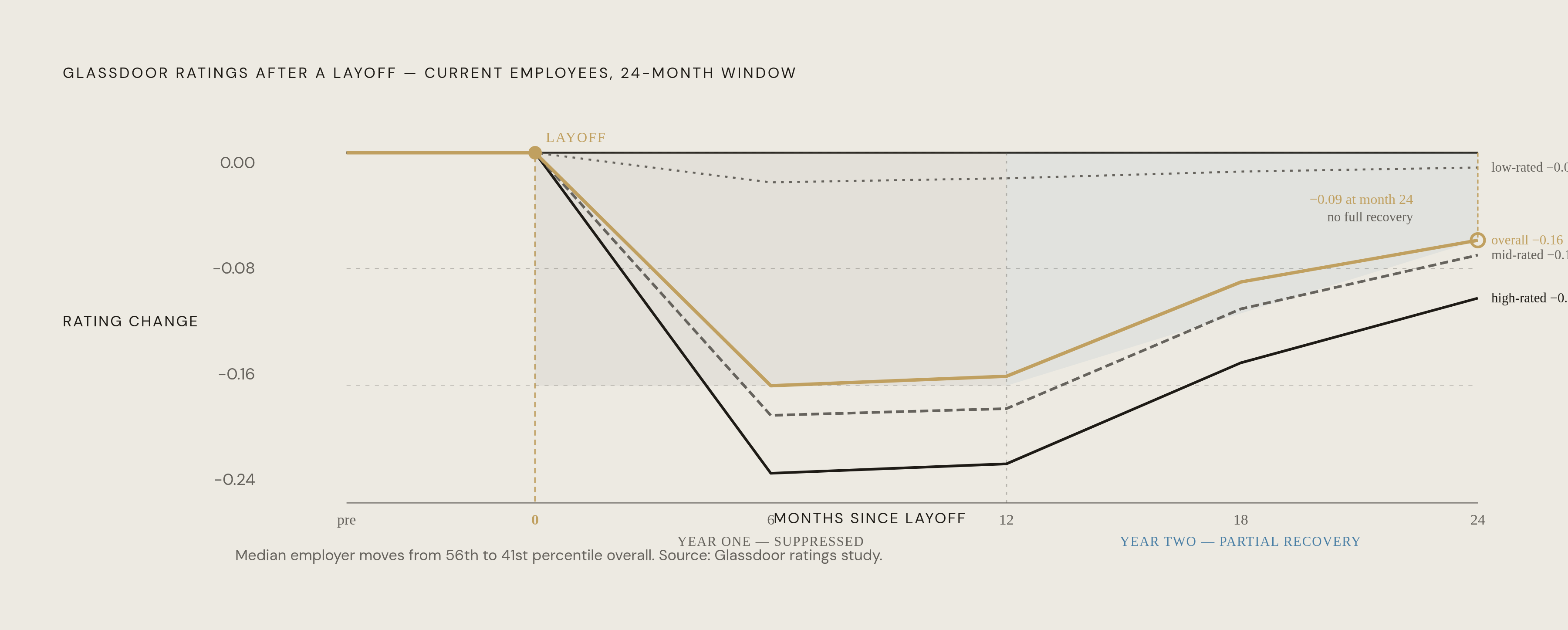
Glassdoor's layoff research shows that ratings fall right away and stay low for a long time. Overall ratings drop by 0.13 stars, enough to move the median company from the 56th to the 41st percentile of employer ratings. The numerical change can look deceptively small. Its effect on an employer's standing is not.
Current employees drive the deterioration, with their ratings falling by 0.16 stars. Former employees increase review volume while their opinions remain stable, a distinction that changes the diagnosis. The profile is not merely absorbing anger from people who have departed, but recording a damaged experience among people still inside the business.
Those current-employee ratings stay steadily lower during the first year and begin recovering in the second, without fully recovering by the end of the 24-month study window. The highest-rated employers show no signs of recovery across that period. Their ratings fall by 0.22 stars, compared with 0.18 for middling employers and 0.02 for poorly rated employers.
The damage also has a recognizable shape beneath the overall score. Ratings for leadership, career growth, and culture/values fall the most, and ratings from managers and key talent fall more than those from individual contributors. New hires provide no post-layoff “honeymoon” buffer. Repeated layoffs deepen the disruption further, with double the impact on current-employee reviews in the first four months after a second layoff.
How Blind's real-time dynamics turn a contained event into a persistent signal
Blind takes a company-specific event beyond the people searching for that employer. Its anonymous, employer-verified structure gives posts an identifiable workplace context without identifying the individual. That context lends the discussion implicit credibility. While reading a discussion about the wider industry, candidates may come across employees weighing in on another company's decisions.
Posts about meritocracy concerns at Amazon illustrate this spread. Employees at Microsoft, Google, and Capital One responded, turning one employer's workplace concerns into a reference point for discussing others. The conversation crosses company boundaries. Its reach is therefore broader than a review archive organized around a single employer profile.
The discussion can also loop back into the workplace. When managers respond to Blind rumors in internal Slack channels, talk outside the company has begun to shape what gets discussed inside it. Employees may then post about management's response, producing another round of discussion. The original event gains a second life through the response to it.
Blind's planned products show how seriously this information is being treated. Blind AI would let employers simulate employee reactions to changes such as stricter in-office mandates, while a layoff-alert feature is also close to release. These plans show that employee sentiment is being developed into a monitoring and forecasting resource, though they do not establish predictive accuracy.
How the crisis moves from review platforms into AI-generated candidate research
AI answer engines synthesize review content into employer research, placing employee accounts in front of people who ask ChatGPT or Perplexity about a workplace. The audience extends beyond direct platform visitors. An employer can lose consideration without seeing a candidate arrive at its careers page.
Third-party content has an advantage in this discovery layer. Most AI citations come from outside brand-owned websites, so the employer's polished message has to compete with what others say about it. Recency strengthens the advantage during a crisis. Roughly half of AI citations come from content less than 13 weeks old, making a fresh review surge well suited to those retrieval windows.
AI-referred sessions grew dramatically year-over-year in the first half of 2025, so this is already a hiring consideration. But visibility alone is not the goal. An answer can name an employer while describing it with outdated, inaccurate, or negatively framed information, discouraging candidates before a recruiter has any contact with them.
What the hiring pipeline actually loses when ratings collapse and AI amplifies the signal
The first loss is application volume, often before employers can observe a candidate's interest. Monster's 2026 Job Search Deal-Breakers survey found that a majority of workers would be deterred from applying by negative reviews or a poor reputation. Applications fall sharply below 3.5 stars, and most candidates screen employers by rating before reading individual reviews. The score acts as an early filter.
The damage continues after someone begins applying. CareerArc data shows that more than half of job seekers would abandon an application mid-process after reading negative reviews. Compensation offers only a partial remedy. A meaningful pay increase would persuade roughly a quarter of professionals to join a poorly regarded company, while close to half would rule it out regardless of the raise.
Passive candidates become harder to reach as well. Outbound recruiting may introduce an employer before someone has read its reviews, but response rates decline when the company's public rating is weak. Reaching out to more people may still fail to bring back that interest.
At the same time, employers face greater pressure to replace people already inside the business. Glassdoor's research found a large increase in active disengagement after layoffs and a 40% increase in current job holders searching for new roles on the platform, with those searchers disproportionately drawn from key talent. The company is losing access to candidates while its most costly departures become more likely.
Why the standard employer response — posting on Glassdoor, updating the careers page — fails to interrupt the cycle
An employer response on Glassdoor can address a candidate reading that exchange, but it does not change the rating or the volume of negative reviews. Nor does it replace the review content and ratings that AI systems synthesize. The distinction is easy to miss. A thoughtful public reply and a changed discovery signal are different outcomes.
A careers-page refresh encounters the same limit because brand-owned content remains a minority of AI citations. Recruitment marketing may make the employer look better without changing what candidates learn from other sources. How would the team know the difference? Without tracking employer descriptions in ChatGPT, Claude, Gemini, and Perplexity, the effect of that investment remains unmeasured.
The FTC's 2025 enforcement guidance made clear that deceptive or undisclosed AI reviews or testimonials can expose businesses to civil penalties of up to $53,088 per violation. Fabricated praise also leaves the underlying employee experience untouched. Authentic reviews can subsequently contradict the impression the employer tried to manufacture.
What a structured recovery actually looks like, from triage to long-term AI visibility
Work on a response starts inside the workplace, before the employer speaks to the public. Ongoing layoffs, unresolved return-to-office conflict, or eroding trust continue to generate the evidence a content campaign is trying to counter. Triage must address the cause as well as the review.
An emerging model assigns AI positive reviews, standard FAQs, and minor complaints with defined resolution scripts, while escalating legal language, media threats, discrimination claims, and other high-risk categories to people immediately. Speed supports that division of responsibility. A flag delivered within minutes preserves the chance to respond before a review gains engagement and citation weight.
The next step is to rebuild a body of real evidence in the sources that candidates and AI systems use. That includes structured careers pages with FAQ schema and JobPosting markup, third-party platforms such as Comparably and Reddit, relevant media coverage, and employee-sourced content. AI can support production from employee interviews, ambassador stories, and internal research data. It should not invent the underlying claims. Human review at each stage helps prevent inaccuracies from becoming material other AI systems later cite, while a regular publishing cadence keeps credible evidence recent.
The same set of prompts, phrased as candidates would ask them, should be used to track mention coverage, recommendation coverage, citation coverage, and factual errors across the four answer engines. Being listed is not the same as being recommended. Weekly or biweekly measurement helps catch citation losses early, particularly because recovery after losing a citation typically takes 6 to 12 weeks and visibility can vary substantially month to month.
Why recovery takes longer than employers plan for, and what determines the endpoint
The recovery horizon is constrained by employee experience. Glassdoor's research found that current-employee ratings had not fully recovered within two years, with no sign of recovery among the previously highest-rated employers during that window. Public evidence takes time to change. A content milestone cannot establish that the conditions behind the crisis have improved.
That limit also applies to generative engine optimization, or GEO. Making employer information easier for AI systems to retrieve does not neutralize a review ecosystem that remains negative. More visibility is not automatically better visibility. The employer needs authentic accounts that support a credible description of the workplace, rather than wider distribution of claims employees contradict.
AI measurement adds a useful test, though neither employers nor employees control the answers. Accurate, favorable descriptions in response to candidate questions indicate that the improved third-party signal is reaching the discovery layer. Unfavorable or inaccurate descriptions show that recovery has not yet reached candidates in that form. Blind's planned sentiment-simulation and layoff-alert products could also give employers earlier warning of renewed strain.
The endpoint is an employee experience whose authentic public record the employer can afford to have surfaced whenever a candidate asks about working there.