HARO and Qwoted for Brand-Building Press Mentions
HARO and Qwoted compete on quality and speed, not just pitch volume.

HARO's plumbing hasn't changed much since it started as a Facebook group in 2007 and turned into an email list in March 2008. A journalist submits a query. It drops into the next scheduled digest, morning, afternoon, or evening. Sources scan that digest and reply directly by email: no dashboard, no read receipt, no way to know how many other people replied to the same request. There's no vetting gate before a source can respond, either. Featured.com, which bought the platform out of shutdown and relaunched it on April 22, 2025, has since layered in AI-generated text detection, LinkedIn checks, image analysis, and community reporting. But the structure underneath is still an open inbox, and anyone can walk in, credentialed or not.
Qwoted, founded in New York, was built on a different premise entirely. A journalist posts a query on the platform itself, and sources browse and pitch through the Qwoted interface rather than email. The mechanical difference that actually matters: sources can see when a journalist has read their pitch, and how many pitches that journalist has received on the same request. HARO simply cannot tell a source that, and the omission carries real weight. It's the whole reason pitching on HARO still feels like shouting into a mailbox and hoping. Journalists on Qwoted can also search expert profiles and message people directly, so discovery runs both ways instead of only in response to a posted query. Both sides get vetted going in, which cuts down on the spam that floods a fully open system. The free tier delays queries by two hours, and on a platform where being first often decides who gets quoted, that gap exists for one reason: to push serious users toward the paid tiers.
What the volume and quality numbers actually say about each platform
HARO wins on sheer count. Dozens of queries a day is normal, and outlets ranging from Forbes and Business Insider to HuffPost and assorted trade press all post requests there. But a lot of what shows up comes from unnamed outlets, content farms, or blogs with no real domain authority behind them. That's the part HARO's raw volume obscures, and it's why treating the platform as a numbers game alone is the wrong read. A major pitch platform's own review of more than 2 million pitches found that human-written pitches get featured at roughly three times the rate of machine-generated ones, even though 21% of all pitches submitted are entirely machine-written. About 35% of journalists say they filter that content out on sight, before reading a word of it. Average success rate on HARO runs 10 to 20% depending on pitch quality, but that figure blends top-tier outlets and low-authority ones into one number, which makes it close to useless as a planning tool.
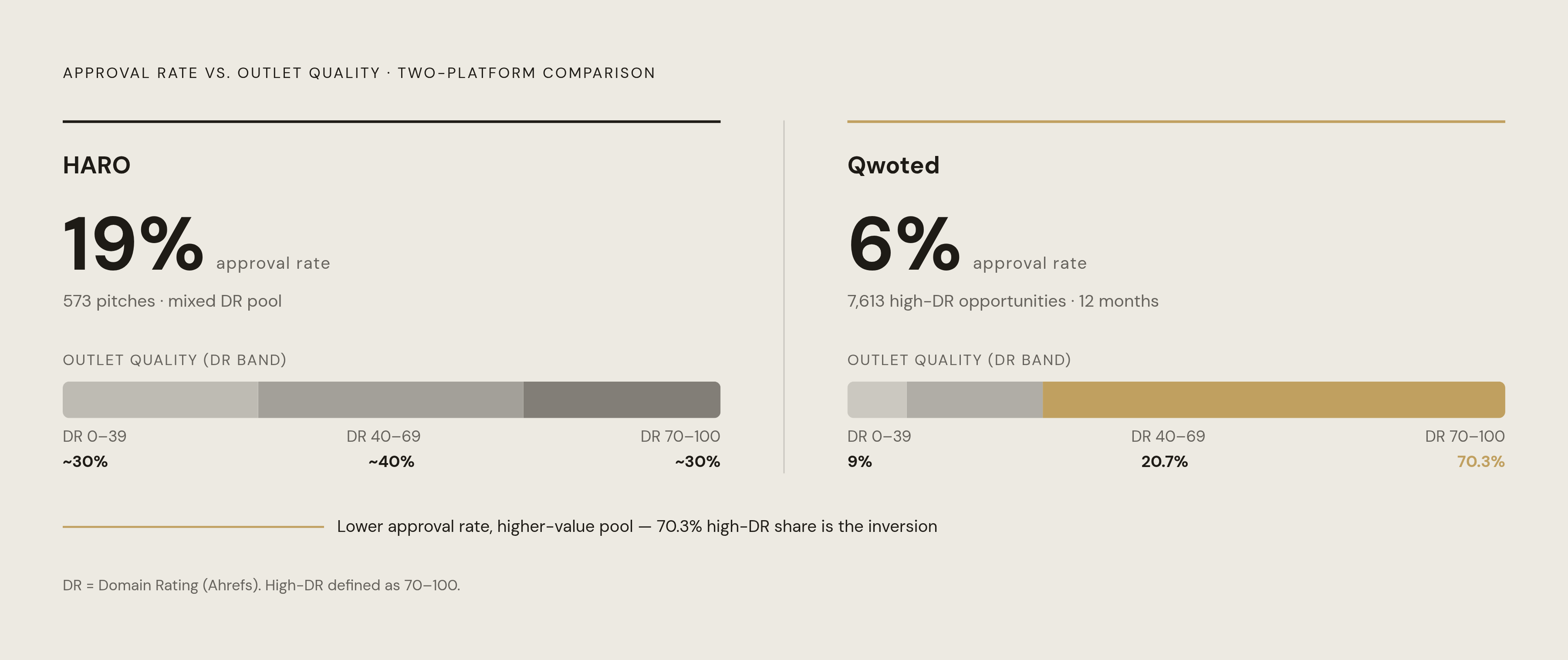
An independent 12-month test running pitches across seven platforms at once, more than 1,000 pitches total, put Featured's approval rate at 18 to 20% from 573 pitches, while Qwoted came in around 6%. Read alone, that looks like Qwoted underperforms. It doesn't. Of Qwoted's requests, 70.3% come from publications with a Domain Rating between 70 and 100, which worked out to 7,613 high-DR opportunities in that test window. A 6% hit rate against outlets in that tier beats an 18 to 20% hit rate spread across a mixed bag of high- and low-quality queries. Any brand chasing citation-grade coverage should weight the numbers that way and stop taking the headline approval rate at face value, because on its own that headline rate actively misleads.
There's an operational risk worth naming too. Featured's automated content screening has produced false positives, flagging and banning legitimate users, which matters more than it sounds like once an agency runs multiple client profiles at scale. And the market is shifting under both platforms anyway: 42% of journalists cite adapting to their audience's changing habits as their top challenge right now, and the trend line points toward curated, relevant pitches over generic mass email. That's a structural tailwind for Qwoted's model, not HARO's.
Why earned press mentions now feed AI visibility, not just SEO
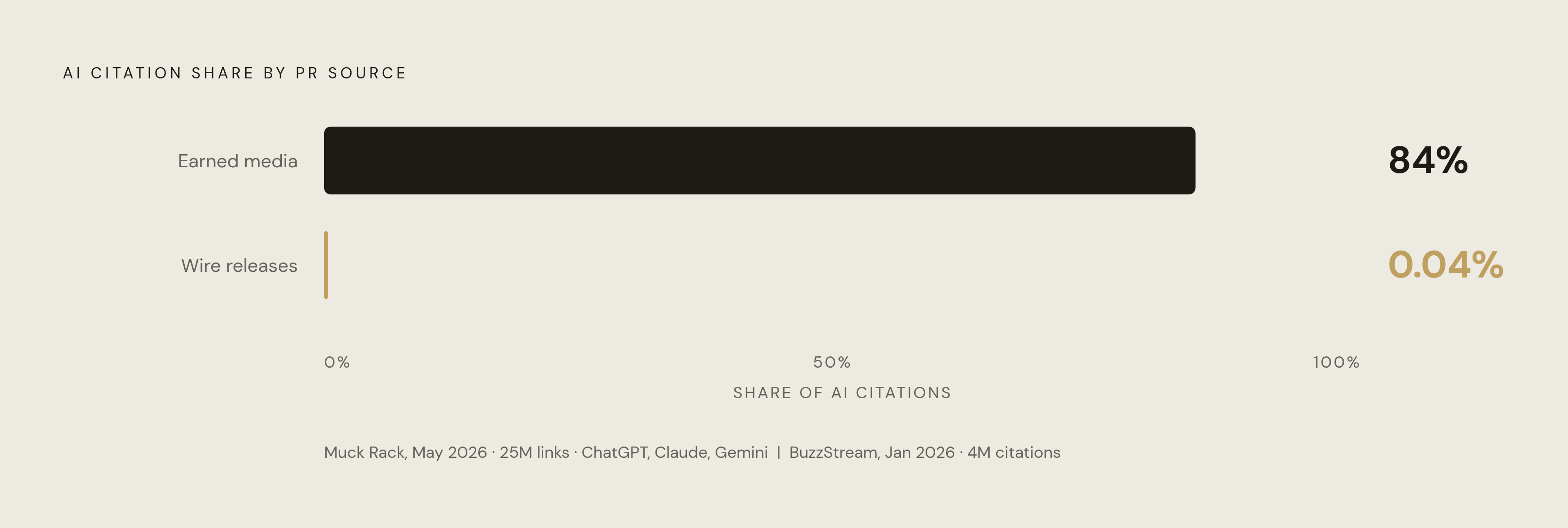
More than 80% of searches now end without a click. The AI engine synthesizes one answer, surfaces two or three brands inside it, and everyone left outside that answer set is invisible to that customer, no matter how good the underlying product is. Muck Rack's May 2026 analysis of more than 25 million links found that earned media drives 84% of all AI citations across ChatGPT, Claude, and Gemini. Compare that to wire press releases: a BuzzStream analysis from January 2026, covering 4 million citations, found press releases distributed through wire syndication account for just 0.04% of all AI citations. That gap is substantial. It's a different category of asset entirely, and treating a wire release as a substitute for earned coverage is the mistake most PR budgets still make.
Ahrefs studied 75,000 brands and found brand web mentions correlate with AI Overview visibility at 0.664, versus 0.218 for backlinks, roughly three times the strength. The top 25% of brands by mention volume average 169 AI Overview mentions; the next quartile down averages just 14. That gap is a cliff, not a gradient. And about 85% of brand mentions inside AI search come from third-party pages rather than the brand's own site, so a brand is far more likely to get cited through someone else's coverage than through its own blog post.
A quote in Forbes sourced through HARO, or a byline landed through Qwoted, now functions as an input into how AI engines describe a brand. Call it what it is: a generative engine optimization asset, whether the person pitching it thinks of it that way or not.
How a single expert quote becomes a citation signal in AI systems
Contributing expert quotes to journalist queries is now an explicit GEO tactic, and a single Forbes citation can raise the odds that AI systems cite the quoted person, and the brand attached to them, going forward. The mechanism is fairly direct: a quote in a high-authority publication strengthens the link between a person and a brand that large language models draw on when building their internal knowledge graphs. When the person shows up as relevant to a later query, the brand gets pulled along with them.
Distribution spread matters almost as much as any single placement. Getting content in front of readers through a wide range of third-party outlets produces a median lift of 239% in AI citation visibility, and across a broad enough spread of publications that lift can reach 325%. Research into AI citation patterns has found that high-DA publications aren't the only route in. High-DA publications aren't the only route in, and that fact should reframe how HARO's mixed-quality outlet pool gets judged: a low-DA blog picked up by an AI model's crawl still counts toward the same total.
Speed matters too. Profound tracked roughly 900 newly published marketing pages and found a median of 6.81 days before first citation by ChatGPT or Claude, with 90% of cited pages earning that first citation within 37 days. Recency compounds the effect: a large share of AI Overview citations trace back to recently published content. A single placement fades fast, while a steady cadence of them doesn't, which argues for treating earned media as an ongoing program rather than a one-off campaign. Across all of it, AI models check whether a brand describes itself the same way on its website, in third-party coverage, on social profiles, and in media mentions. Inconsistency between those channels weakens the signal no matter how many placements pile up behind it.
Which platform fits which pitch situation
HARO makes sense when speed and daily persistence are already built into someone's schedule, because the volume demands constant scanning and fast replies. It's also the better fit for an early-stage brand that needs breadth across many outlets fast, including lower-DA sites that contribute to overall mention volume. Free, unlimited pitching makes it the cheapest way to build volume, full stop.
Qwoted makes more sense when the target is specifically DR 70-100 placements, since 70.3% of its requests sit in that band. It's also the better tool when knowing whether a journalist has actually read a pitch, or how many competing pitches came in, changes how a source decides to follow up. And it suits brands or teams who want journalists finding them through profile search rather than only reacting to posted queries, though that only pays off once the Pro tier's $149 a month clears the free tier's two-hour delay and two-pitch cap out of the way.
Running both isn't unusual, and it shouldn't get treated as an either-or decision. The independent seven-platform test cited earlier ran pitches across all seven platforms, which says something about how practitioners actually work: HARO for volume and breadth, Qwoted for high-DR precision, run in parallel. Neither guarantees a placement. Both are reactive systems where the journalist makes the call, so a brand that needs coverage on a fixed timeline still needs something else running alongside either platform.
What makes a pitch competitive on each platform
On HARO, a journalist fielding a popular query gets flooded, and concise responses tend to perform better in a flooded inbox. Speed counts for a lot too, since the digest format means early replies land while a journalist is still reading, and late ones often don't get opened at all. Human-written pitches beat AI-generated ones by roughly three to one, per HARO's own 2-million-pitch dataset, which makes a generic AI draft a real liability with over a third of journalists filtering that content out on sight before they even get to the pitch itself. Successful HARO pitches consistently include explicit credentials and, where possible, original data or research. Selection leans hard on specificity, not polish, and the subject line alone decides whether most pitches get opened at all.
On Qwoted, profile completeness comes first, because a journalist searching proactively uses the profile as the initial filter. A thin profile means zero inbound discovery, full stop. Being able to see that a pitch was read, and how many others came in on the same query, turns follow-up into a calculated decision instead of a guess, and it also flags when a query's already over-competed, useful for deciding where to spend the next hour instead. Vetting on both sides means fewer pitches per query, but more qualified ones, so the noise that gets filtered out by sheer volume on HARO mostly never shows up here in the first place.
Across both platforms, the pitch, the expert's public profile, and the brand's own content need to describe the same expertise in the same terms. That consistency matters for the journalist's decision in the moment, and it matters again later for the AI citation signal that outlasts the placement itself.
How agencies running multiple brands manage HARO and Qwoted at scale
A workflow built for one brand falls apart fast once it's stretched across several. Scanning HARO's digests three times a day and tracking Qwoted queries for even a handful of client accounts creates inbox overload, and coverage opportunities get missed simply from the volume of it. Featured's screening false positives, and the account bans that have come with them, turn into a sharper risk the moment one agency login touches multiple client profiles at once. A single ban doesn't cost one brand. It costs all of them, at the same time.
Qwoted's Agency/PR team tier is built for exactly that multi-profile problem, with team seats and wider access under custom pricing, terms worth confirming directly on Qwoted.com since they vary. What a portfolio actually needs underneath that: inbound requests from HARO and other sources routed into one workspace and scored against each brand's own brief, pitches drafted in each brand's actual voice rather than one generic agency tone, separate expert profiles kept clean of cross-contamination between clients, and placement outcomes tracked per client, including AI citation performance, rather than folded into one aggregate number that tells no one anything useful.
That last point is the gap worth fixing first, because most agencies are behind on it. Only 14% of brands currently track AI visibility metrics at all, even as 66.2% of practitioners now count AI citations as a KPI, 61% track AI-generated mentions specifically, and 93% expect AI to reshape how success gets measured going forward. That gap between demand and reporting capability is where an agency actually differentiates itself right now, not in pitch volume.
Tracking whether placements are actually building AI presence
Most brand PR programs break down right at the point between earning a placement and knowing whether it did anything for AI visibility. That gap is closing, slowly, but it's still where a lot of reporting stops short, leaving placements unmeasured past the initial press release.
Profound's tracking of roughly 900 newly published marketing pages found a median of 6.81 days to first citation by ChatGPT or Claude, which means the feedback loop is short enough to measure in weeks, not quarters. A brand that lands a Forbes quote through HARO or a byline through Qwoted doesn't need to wait a year to find out if it mattered. It needs a system that checks, and most don't have one yet. The ones building it now, while only 14% of brands are even tracking AI visibility at all, will be the ones able to tell a client, with a number attached, exactly what an earned placement bought them.