How to Respond to Negative Press Coverage Before It Ranks
Early intervention in the ranking window costs far less than fighting negative results later.
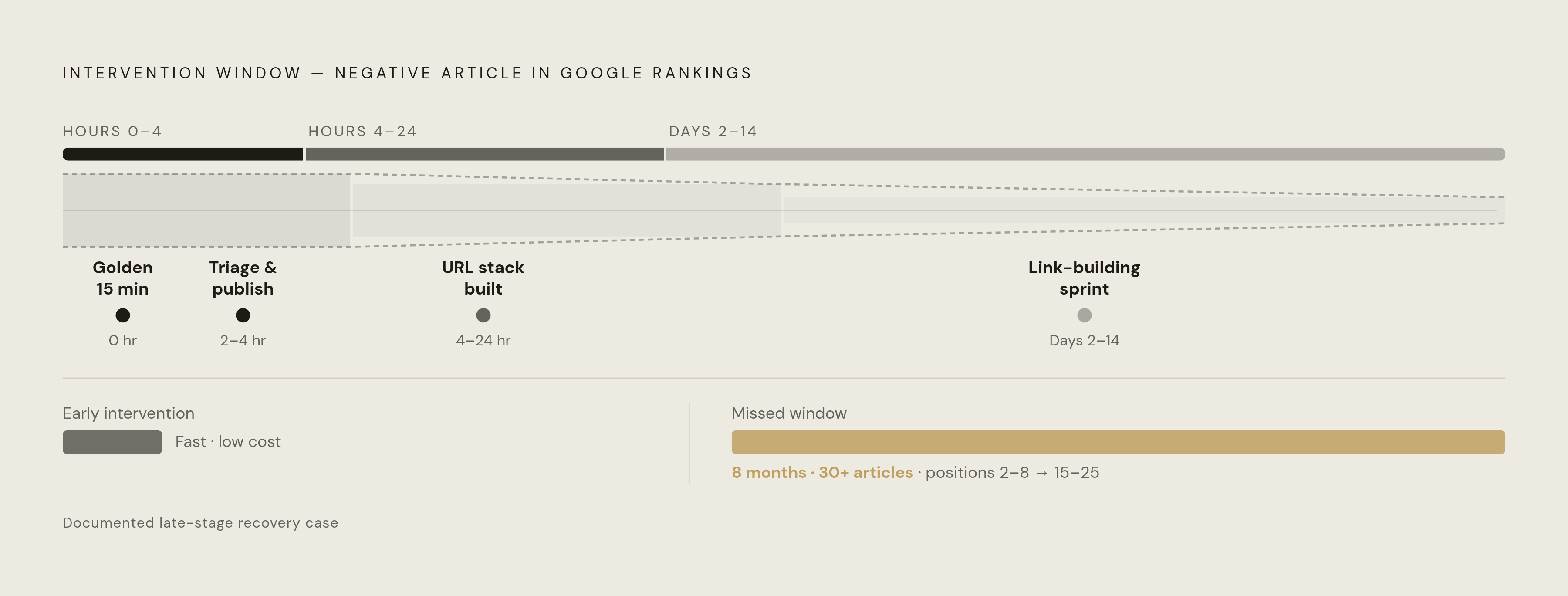
Google doesn't rank a negative article on page one the day it publishes. It starts nowhere, and it climbs there over hours and days, competing against every other URL tied to that brand's name. That climb has a beginning, a middle, and an end, and the stretch before it reaches the top is the only window a brand gets to change the outcome. Most brands lose that window not because they lack resources, but because they treat it as a scramble instead of a sequence, and the article wins by default while everyone waits to see how bad it gets.
Reputation practitioners call the earliest part of that window the "Golden 15 Minutes." The name overstates the precision but not the urgency. A freshly published URL has no backlinks, no click history, no engagement data, so it sits in a kind of ranking limbo while Google figures out what to make of it. That limbo closes fast, and every click the article earns, every share, every inbound link tells Google's algorithm that this URL matters right now. Brands often speed this up themselves without meaning to: an executive forwards the link to legal, legal forwards it to comms, comms drops it into a Slack channel with three exclamation points, and each of those clicks feeds the exact signal the brand is trying to bury.
Scott Keever's analysis of 100 major corporate reputation crises between 2015 and 2026 put a number on the ceiling this creates: negative results climbed to 61% of page-one results during active crisis periods. That's the majority of what a prospective customer sees when they search a brand's name, and it happens because most companies never build a response sequence before they need one. Waiting has a cost that compounds, too. A documented suppression case took eight months of sustained work against a portfolio of more than 30 negative articles to move the negative results from positions 2 through 8 down to 15 through 25. That's a real win, but eight months is what late-stage recovery costs. Early intervention inside the window is faster and considerably cheaper than fixing it after the article has already earned its authority. Most companies choose the expensive option by default, simply because nobody assigned the cheap one to anyone in advance.
A crisis can vanish from the news cycle within days. Its Google footprint doesn't vanish with it. It compounds, picking up links and engagement long after the story stops being news, and 48% of people say they've changed their minds about doing business with a company because of what turned up in a search result. The sequence that follows exists to keep that number from landing on any given brand's next crisis.
What a structured response sequence looks like versus a scramble
The scramble has a recognizable shape. Someone sees the article, reacts emotionally, and forwards the link to five colleagues who each click it out of concern. Someone else posts a defensive comment on social media, arguing with the premise of the story. No one screenshots anything. No one writes down what the search results looked like before the panic started. Nearly every one of these actions actively worsens the brand's position, and most of them happen inside the first hour, before anyone with SEO training even knows there's a crisis.
Clicking the negative result repeatedly is the most common mistake, and the most avoidable one. Every click contributes to the article's engagement footprint, reinforcing its visibility at exactly the wrong moment. Sharing the URL internally over email or Slack to vent about it spreads the link further, increasing the chances it earns external attention and signals. Posting a defensive or aggressive public response creates a second piece of negative content and signals culpability to every future searcher who stumbles across it, not just the one who provoked it. Arguing with a negative review in the replies does the same thing on a smaller scale, and it reads badly to every customer who finds that thread later, long after the original complaint stopped mattering to anyone.
None of this is complicated to fix, but the fix has to exist before the crisis, not get invented during it. A structured response sequence splits legal, communications, SEO, and content into distinct roles with a clear decision hierarchy, and every one of those roles needs briefing in advance, not a scramble to figure out who owns what while the article is already climbing. Some reputation teams keep what they call "dark sites," which are pre-built, non-indexed pages with placeholder structures for an apology, a press statement, and updated contact information. When a crisis breaks, that page goes live instantly, giving the brand a controlled URL before misinformation or a competitor's framing fills the gap.
The earliest hours aren't about writing content. They're about building a case file, and skipping this step is the second most common failure after the clicking problem. Before positions shift and before the story gets messy, someone needs to document exactly what the search results looked like by keeping a dated folder of screenshots and screen recordings, each showing the full URL and a timestamp, capturing the top 20 Google results for every key branded search as a baseline, and documenting review pages before and after any changes get made. This is paperwork with a real purpose. It's the evidence base for any future legal action or cleanup effort, and it's impossible to reconstruct once the crisis has moved past its early hours.
From hour one, two tracks need to run at once: displacing the article in traditional search results, and managing how AI tools describe the brand. These aren't the same pipeline, and they don't respond to the same tactics. Collapse them into one effort, and a brand can win the SERP fight and lose the AI-surface fight without noticing until months later.
Hours 0–4: monitoring, triage, and what to publish first
Monitoring starts with the queries a prospective customer would actually type: the brand name alone, the brand name paired with "review" or "complaint," executive names, competitor comparison searches that mention the brand, and common misspellings of all of the above. These are the exact terms that surface the negative article to someone doing due diligence before a purchase or a partnership decision.
Manual checking doesn't scale here, and trying to do it by hand is a waste of the hours that matter most. Visual change-detection tools such as Visualping can watch specific result pages continuously and alert a team the moment something on those pages shifts. That's the detection layer, and it needs to run before the response team even starts drafting anything.
Sentiment mapping comes next, inside the first hour: identify exactly which branded keywords the negative article is targeting, or is likely to rank for as it picks up momentum. Response content has to be built around those same terms, not around whatever language the marketing team prefers. If the article is ranking for "[Brand] scam," the response has to speak to that term directly, because that's the term the algorithm is already indexing the story against.
The first publish priority is activating the dark site, or, absent one, publishing a controlled official response page targeting the same keyword cluster the article is chasing. This gives Google a competing URL from a domain the brand already controls, one that usually carries more accumulated authority than a brand-new news story. Adding schema markup helps search engines parse that page and surface richer snippets, which lifts click-through rate even at a lower position on the page. Per onlinereputation.com, structured data does double duty here: it also feeds AI-generated answers, which lean on well-organized, clearly labeled content when building a response.
During triage, the negative article itself is off-limits. Don't link to it, don't embed it in an official statement, and don't reference its URL anywhere in public-facing material. Every one of those moves hands the article an inbound link from the brand's own domain, which is the last thing it needs.
Hours 4–24: building the positive URL stack that competes for page one
No single counter-piece displaces a negative article, and any plan built around one hero page is already broken. The realistic goal is a stack of high-authority URLs tied to the brand's name, deep enough that one negative story can't hold a top-five position on its own merits.
Several properties consistently hold page-one positions for branded searches and can be refreshed or expanded within hours. The main website, particularly a dedicated response or FAQ page, sits at the top of that list. The Google Business Profile can take a statement or a new post; Google has said reviews feed into "prominence," one of its three local ranking factors, though it has never confirmed how fast GBP content itself gets indexed. LinkedIn's company page and executive profiles carry real weight, as does a YouTube channel with a direct-response video. Active profiles on X, Facebook, and Instagram rank for brand names quickly because the platforms themselves carry high domain authority, and a Medium or Substack post can index fast enough to matter inside the first day.
Content aimed directly at the negative keywords matters more than generic brand content, and this is where most crisis response falls flat: brands publish a mission statement when they need a page that says the word "scam" or "complaint" out loud. Talking around the accusation instead of naming it is the single most common wasted opportunity in this window. If the article ranks for "[Brand] scam" or "[Brand] complaint," the brand needs a page built for those exact phrases, one that addresses the underlying concern honestly instead of dancing past it. A detailed FAQ, a transparent blog post, or a case study using that same language does more work than a glossy About page ever will.
Quality still governs all of this, and cutting corners here backfires specifically, not generally. JetDigitalPro's research on Google's March 2026 core update found that sites relying on generic AI-generated text without human editorial oversight saw traffic drops of 60% to 80%. Crisis content isn't exempt from that pattern. A response page written by a generator and published without a human editor underperforms, and it underperforms at the exact moment the brand can least afford it.
Review velocity runs on a parallel track. A fresh wave of genuine positive reviews on Google, Trustpilot, G2, or Capterra during this window reinforces the brand's authority signal while the content stack goes up. BrightLocal's research found that 96% of consumers read reviews before deciding whether to do business with a company. This is the moment to reach out to satisfied customers and ask them to speak up, not manufacture reviews out of nowhere, and the line between those two matters more than it sounds. Google prohibits incentivized reviews outright, and regulatory pressure against fake and paid reviews means that taking a shortcut here carries real legal and reputational exposure. Taking a shortcut here doesn't just risk getting caught. It compounds the exact crisis the brand is trying to manage.
Days 2–14: the link-building sprint that determines whether displacement holds
Content alone doesn't move a negative article off page one, and any team that stops at publishing has done half the job. Google ranks pages by authority and trust as much as by relevance, and a brand's own FAQ page, however well it's optimized for the right keywords, loses to a negative article that has meaningfully more inbound links pointing at it.
Earned media is the priority here, and this is the part most in-house teams underrate, usually because it's harder than writing another blog post. Coverage or guest posts on reputable third-party sites that link back to the brand's positive properties carry weight self-published content simply doesn't have, because they represent an outside source vouching for the brand rather than the brand vouching for itself. Time pressure is real here too: as the negative article earns organic links from other outlets citing it, journalists referencing it, and readers sharing it, its authority keeps climbing. The brand's link-building effort has to outpace that accumulation while the article's own link profile is still thin. That's the entire argument for moving early instead of late.
Co-created content with trusted partners or credible voices in the industry can earn links to brand-positive pages naturally, and it needs to stay editorial rather than paid. Paid placements carry their own disclosure risks and rarely carry the same trust signal as something a third party chose to write because it was genuinely useful.
Internal linking matters more than most teams realize during a crisis. Every recently published brand property should link to the others: a Google Business Profile post pointing to the FAQ page, the FAQ page pointing to the press release, each one indexed and reinforcing the others. That cluster of mutual signals does real work over the following weeks.
The suppression case that moved negative results from positions 2 through 8 to positions 15 through 25 took eight months, and that was already a late-stage recovery effort against a portfolio of more than 30 negative articles. A fresh article caught inside the response window should move faster than that. Still, tell stakeholders 3 to 12 months up front for sustained suppression, not sooner, because setting that expectation early is what keeps a board or a client from abandoning the strategy after six weeks just because the article hasn't disappeared yet.
The AI-surface track that runs alongside SERP displacement, and why it cannot be skipped
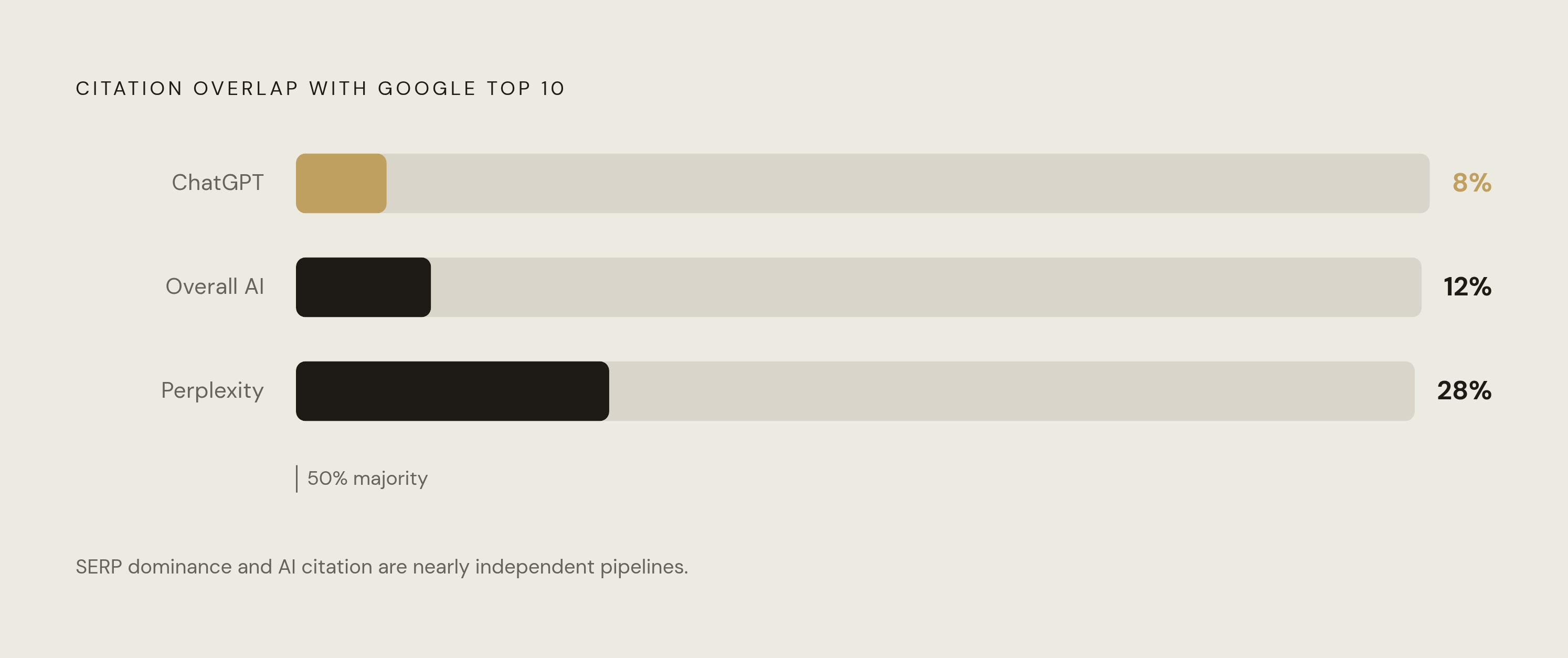
Suppressing a story in Google does nothing to suppress it in ChatGPT, Gemini, or Perplexity, because those systems aren't simply reading Google's results back to the user. A study by Louise Linehan and Xibeijia Guan using Ahrefs Brand Radar found only 12% overlap between AI citations and Google's top 10 results overall. ChatGPT's overlap with Google and Bing came in at just 8%. Perplexity ran the highest, at 28% overlap with Google, and that's still nowhere near a majority. A brand can win the SERP fight and lose the AI fight entirely, on the same day, over the same story, and most crisis playbooks don't even check for it, because the playbook was written before anyone had to.
This isn't a niche concern anymore. Recent data found AI assistant traffic rose 86% over the year, with time spent up 101%, and HubSpot's January 2026 data shows 42% of CRM software buyers now use AI search somewhere in their evaluation process. Whatever an AI model says about a brand during a crisis reaches a growing share of exactly the people the brand most needs to reach.
The September 2025 arXiv study on generative engine optimization found AI search tools show a systematic bias toward earned media, meaning third-party, independently authoritative sources, over content a brand publishes about itself. A brand with no meaningful presence on Reddit, Wikipedia, G2, Capterra, or in credible editorial coverage gives AI systems nothing to corroborate, whatever the brand's own site says.
The questions people ask AI tools look nothing like what they type into Google. Similarweb's 2025 GenAI Landscape report found that ChatGPT prompts average around 60 words, compared with 3.4 words for a typical Google search. That gap reflects a real difference in intent: AI users tend to ask evaluative questions like "Is [Brand] trustworthy?" rather than navigational ones, so a negative narrative sitting in the model's training data or retrieved sources surfaces directly inside the answer, not as one link among ten.
PEW Research Center found that when Google shows an AI summary at the top of a results page, users click through to a traditional result only 8% of the time. A brand absent from that summary, or framed negatively inside it, is effectively invisible at the exact moment someone was ready to act.
Remediation on this track looks different from SERP work, and treating it as an afterthought is the mistake most teams make. PR outreach should target the specific third-party sites AI models actually pull from, which tools like Evertune or Peec AI can help identify. Cross-posting brand content to LinkedIn Pulse and similar platforms raises the odds that multiple AI systems encounter the same consistent narrative and cite it. Adding a direct two- to three-sentence answer at the top of key owned pages, ahead of any introduction, sharply increases the odds an AI system pulls that exact language into its response. And hedging language like "might" or "could" needs to come out entirely, in favor of definitive, evidence-backed statements, because AI systems consistently favor confident, quotable claims over tentative ones.
Sentiment inside AI answers is now a metric worth tracking on its own, broken into positive, neutral, and negative by topic. A brand that shows up consistently neutral across commercial prompts still has work to do. Neutral is an unsafe outcome here. It's just a quieter version of the same problem, and it should be treated that way.
Monitoring cadence and the metrics that tell you whether the playbook is working
Three layers of monitoring cover the full window and beyond it. Daily tracking covers reviews across Google, Trustpilot, G2, and Capterra, since review velocity and sentiment move faster than almost anything else. Weekly tracking covers SERP rankings across every branded keyword cluster, including negative-modifier variants like "[Brand] scam" or "[Brand] complaint," since the negative article's position over time is the clearest single measure of whether displacement is working. Monthly tracking covers AI summary audits across ChatGPT, Gemini, and Perplexity for that same set of branded queries, watching tone, citation frequency, and how the brand gets framed relative to competitors.
SERP monitoring should track more than where the negative article sits. Which brand-owned URLs have broken into the top 10, what click-through rate looks like on positive listings (schema-enhanced snippets can lift CTR by up to 25%), and whether new third-party positive coverage is indexing and climbing all matter as much as the negative article's own position.
For AI visibility specifically, HubSpot's AI Search Grader scans ChatGPT, Perplexity, and Gemini to evaluate mention frequency, tone, and competitive positioning, and it's free, which makes it a reasonable starting point for a monthly audit even without a dedicated GEO budget. Semrush's AI Visibility Toolkit goes further, comparing Google AI visibility against ChatGPT visibility side by side, tracking mentions, citations, and share of voice for the same query set: a direct bridge between traditional rank tracking and AI-surface measurement for teams already inside the Semrush ecosystem.
Agencies managing this across a portfolio of clients face a scaling problem single-brand teams don't. The same sequence has to run in parallel across dozens of accounts at once, with progress reported on a defensible cadence. Per-client AI visibility tracking and weekly reporting infrastructure serves exactly that layer, giving account teams the data exports needed to show clients real movement, both on SERP displacement and AI-surface sentiment, across the full 3 to 12 month recovery horizon, rather than asking clients to take the work on faith.
That reporting cadence isn't internal hygiene for its own sake. Given a recovery timeline stretching out to a year, stakeholders need visible signs of progress well before full displacement happens, or the whole effort risks getting cut short by impatience rather than failure. Weekly rank movement reports and monthly AI sentiment summaries are what stand between a strategy that's working slowly and a strategy that gets abandoned because no one could see it working at all.
When the monitoring shows the article accelerating rather than settling, gaining links from other publications, climbing rather than holding position, that's not a signal to wait and watch longer. It's the trigger to escalate, prompting harder earned media outreach, a heavier push on the link-building sprint, and a hard look at whether the response content actually answers the question the negative article raised in the first place.