Press Release Distribution Services Compared for Brand Visibility
Wires verify compliance; pay-per-release boosts visibility.

A wire's job is syndication, full stop. It pushes text, unedited, to a fixed network of newsrooms, financial terminals, and indexed web properties, all at once. Nobody at the wire service reads a release and decides whether a reporter should see it; the release goes out to the whole network the same way every time, regardless of subject matter.
What no other category replicates is the timestamped, audited record. That record satisfies SEC disclosure rules and a fair-disclosure regulation, which is why public companies use wires for material announcements even when the news itself has no organic pull. A wire isn't a media relations tool at all, whatever the sales page implies. It's closer to a notarized filing that happens to be formatted like a press release.
Three services make up this category, and the pricing gap between them matters more than the marketing suggests. PR Newswire, owned by Cision, reaches more than 500,000 newsrooms, websites, direct feeds, and journalists across roughly 170 countries. A US national release starts at $805 for 400 words, with each additional 100 words adding an overage fee, and an active annual user can spend $7,000 to $10,000 once image and list add-ons stack up. Business Wire, part of Berkshire Hathaway, distributes to more than 100,000 media outlets across more than 160 countries, and prices a 1,000-word release with one image around $2,355; Vendr's February 2026 data puts the median annual contract at $19,000. GlobeNewswire, under Notified, undercuts both, with a base around $350 and typical releases running $700 to $1,200, and it throws in AI bot view tracking and AI citation visibility at no extra charge through a partnership with Profound, rather than treating those features as separately priced items.
Buying wire access for a product launch with no regulatory dimension is the single most common overspend in this business, and it's worth saying plainly: don't do it. Wires make sense for public companies, for anyone issuing a regulatory disclosure, and for anyone who needs the timestamped legal record more than a journalist's attention. They make no sense for an agency juggling client budgets, or for a startup whose real goal is coverage rather than compliance. That purchase buys infrastructure nobody asked for.
What pay-per-release services actually do: syndicated reach without the wire membership
This tier resells syndication, often riding the PR Newswire network or something comparable, without the annual membership or wire-of-record contract the big three require. The trade is plain: give up the audited disclosure standing and some of the breadth a direct membership buys, and pay per release instead, with no long-term commitment attached.
Like wires, these services don't pitch anyone. They push content into a network and let the network do what it does. PressPilot's September 2026 comparison table lists journalist database access as "not stated" or syndication-only for every vendor in this tier, and that gap is the tell that separates this category from the next one.
EIN Presswire charges $149 for a single release, $499 for five plus one free under a limited-time offer, and $999 for fifteen, valid 365 days with no contract. It syndicates to outlets including AP News, Google News, and Bloomberg Terminals by the vendor's own claims, and it's become a default for small and mid-sized companies chasing long-tail SEO on a tight budget. eReleases runs $399 to $699 per release and taps the PR Newswire network plus its own contact lists, claiming reach into 85,000 to 90,000 registered journalists; the pitch is PR Newswire distribution minus the membership overhead. Newswire.com prices from $399 up to $965, and It offers a polished dashboard with syndication built in, though the gap between the advertised entry price and a tier with real distribution runs wider than most competitors'. PRWeb runs $120 to $480 and syndicates to a broad network of websites, working as a low-cost visibility play with thinner editorial support than the tiers above it.
What gets bought at this level is syndication credibility, not a relationship with anyone in a newsroom, and that distinction should decide the purchase before price does. Pay-per-release fits companies that need a syndicated digital footprint but don't qualify for, or can't justify, wire membership, and it fits search-driven announcements made occasionally rather than on a schedule. It's the wrong purchase for anyone needing regulatory standing, and it's the wrong purchase for anyone whose real goal is a specific reporter writing about the story, because nothing in this tier does that.
What targeted outreach platforms actually do: journalist databases, pitching, and relationship infrastructure
Selectivity is the one thing that defines this category. Only these platforms let a user choose which journalists receive a pitch, filtered by beat, geography, outlet, or a reporter's past coverage. That's a different act than syndication entirely, and it's why pricing here doesn't resemble the tiers above it.
Cision's 2025 research found that 86% of journalists reject a pitch that doesn't match their beat or their audience. List quality and targeting precision beat raw distribution volume, and a pitch landing in front of the wrong reporter does worse than nothing: it burns a relationship a PR team may need again in six months.
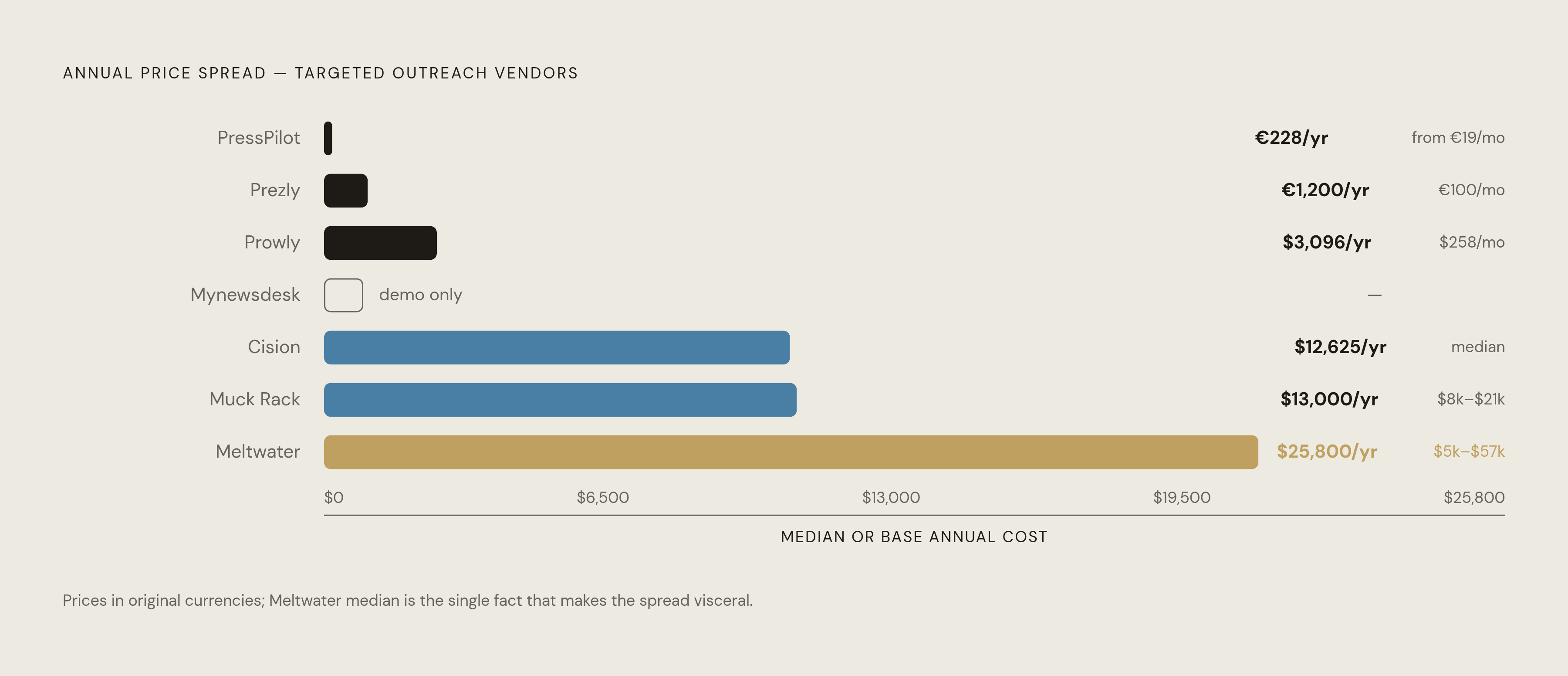
Database size swings wildly across this tier, from tens of thousands of contacts to more than a million, and size alone tells you little, since a bloated, stale list is worse than a smaller, accurate one. PressPilot's September 2026 comparison lists a live count of 46,701 journalists, priced at 30 EUR per 100 credits, or 19 EUR a month on subscription for 100 credits; credits don't expire and there's no contract, which suits startups and agencies doing direct pitching. Prowly, now folded into Semrush's AI PR Toolkit, runs $258 a month billed annually and claims more than a million media contacts as of its June 2024 figures, bundling media list building, email pitching, release creation, and monitoring into one product. Prezly, at 100 EUR a month, skips the native database entirely: users import their own contacts, and the product's strength is a polished owned newsroom rather than discovery, a fit for brands that already have relationships and want somewhere to house them. Mynewsdesk sells through demos rather than published pricing, claims more than a million journalists, and leans toward Nordic and European mid-market buyers on annual contracts.
Then the price jumps again, sharply. Muck Rack sits at a $13,000 median annual spend, ranging from $8,000 to $20,860 per Vendr's February 2026 figures, with more than 250,000 journalists in its database, sold annual-only with no free trial. Cision, the corporate parent behind PR Newswire and PRWeb, prices at a $12,625 median across 107 tracked deals, with a large media contact database, often bundled with monitoring and wire access in one enterprise contract. Meltwater runs highest, at a $25,800 median with a range from $5,375 to $56,993, over 800,000 contacts, and a 12-month minimum term, built for monitoring-heavy enterprise communications teams.
That spread, from a 30 EUR credit batch to a $25,800 median contract, isn't tier inflation dressed up as choice. Database depth, monitoring power, and how deeply the tool sits inside a daily pitching routine diverge sharply as price climbs. This category is the right buy for any team whose real goal is a journalist covering the story, not a release existing somewhere online, and it suits agencies running ongoing media relationships across several accounts, or brands that treat earned coverage as a long-term asset rather than a one-off event.
How AI visibility has changed what "distribution reach" means in practice
Search behavior has shifted, and press release strategy hasn't fully caught up. Buyers, journalists, and investors increasingly ask ChatGPT, Gemini, Perplexity, or Claude directly rather than searching and clicking through, and showing up inside those AI-generated answers is a form of visibility that distribution addresses only partway.
Wires clearly feed this system. A June 2026 Notified study covering more than 8,000 GlobeNewswire-distributed releases found that 99.3% were cited by ChatGPT or Claude somewhere downstream. AI systems ingest wire content as source material at a rate approaching universal, at least in that sample.
That number needs a counterweight, though, and this is the one that should actually guide budget: Authority Tech's 2026 analysis found that original editorial content drives the overwhelming majority of AI citations, while press releases account for less than 2% of the total. Ingestion isn't the same as being the source AI systems cite from. Press release citations did grow substantially across the second half of 2025 per Authority Tech's analysis, but that's growth off a small base, not a change in who leads. Anyone treating a wire release as an AI visibility strategy is misreading the 99.3% figure. Getting ingested is not the same as getting quoted.
What this means splits cleanly by category. Wire distribution to AP News and Yahoo Finance puts content where AI crawlers already look, which is why GlobeNewswire tracks AI citation directly and PR Newswire has moved toward AI-optimized formatting: snippet-ready lead paragraphs, FAQ sections built into the release itself. Pay-per-release syndication to Google News and Bloomberg Terminals offers some of the same surface area, though the domain authority behind the placement runs lower, and where a release lands matters more than how many go out. Targeted outreach sits closest to the actual lever: earned coverage drives AI citation, and a reporter covering a story creates exactly the third-party, authoritative mention AI systems cite preferentially.
The broader pattern is consistent: brand mentions inside AI answers draw heavily from third-party pages rather than a brand's own website. Off-site presence, press coverage, analyst mentions, industry listicles, is the primary lever for AI visibility, not a side effect of PR work. And that visibility doesn't hold still. Research into AI answer consistency suggests brand visibility in AI-generated responses can shift significantly from one query to the next, which means visibility needs ongoing monitoring, not a single distribution event followed by silence. Distribution, wire or pay-per-release, doesn't substitute for that monitoring layer. It gets content into circulation; it doesn't tell anyone whether the content shows up in the answers people actually read.
Matching service type to the actual goal: a decision framework
The first question isn't which service is best. It's what outcome is actually being bought: a regulatory disclosure record, a digital syndication footprint, or a journalist relationship that leads to earned coverage. Answer that first, and the category picks itself, most of the time without much debate.
For regulatory disclosure, investor relations, or a financial announcement, the wire is the only serious option, and there's no substitute worth considering. Business Wire or PR Newswire carry the strongest compliance standing, while GlobeNewswire's lower base price and built-in AI citation tracking are worth weighing if compliance strength alone isn't the deciding factor.
For a digital footprint, SEO value, and some AI surface area on a set budget, pay-per-release fits better. EIN Presswire, at $149 a release, suits anyone distributing at volume. eReleases makes sense specifically for broad network access without a long-term membership contract. Newswire.com earns its price when reporting analytics back to internal stakeholders matters as much as the distribution itself.
For journalist relationships, earned coverage, and the AI citation advantage that comes from third-party editorial mentions, a targeted outreach platform is the only category built for the job, and this is the one most companies underspend on relative to what actually drives AI visibility. Which vendor depends on the database size actually needed, the budget available, and whether monitoring needs to sit inside the same contract as the pitching tool.
Agencies face a structurally different decision than a single brand buying for itself. Managing several client accounts means the platform has to support portfolio-level reporting, per-client access controls, and ROI that shows across accounts, not distribution tied to one announcement. Wires and pay-per-release services price per event, which suits a single brand's occasional announcement far better than an agency running ten accounts at once. Targeted outreach platforms with multi-client workspace support, Prowly and Cision among them, fit that model more naturally. Even then, AI visibility monitoring across a full client portfolio needs a layer no distribution service, wire or otherwise, provides natively.
That gap points to a distinct category from anything above: ongoing measurement of whether clients actually show up in AI-generated answers, reported across a portfolio, so account teams can speak to AI visibility with more than a hunch. It is a complementary layer for agencies that already have distribution solved and need the monitoring sitting next to it.
A 2026 StreetInsider analysis described the broader market shift as one moving "from one-size-fits-all solutions toward modular platforms addressing specific communication requirements." Most serious PR programs now pair a distribution choice with a separate monitoring choice, rather than expecting one vendor to cover both. Anyone unsure which category they need should ask one question before signing anything: does the release need to land on websites, which points toward a wire or a pay-per-release service, or does it need to land in a specific journalist's inbox, which points toward outreach. Those are different products, solving different problems, at genuinely different prices, and no shared marketing language changes that.