Answer Engine Optimization vs Traditional SEO for Brand Content
Brands must optimize for both search rankings and AI citations, which no longer overlap.
Answer Engine Optimization vs Traditional SEO for Brand Content.
Why one content strategy no longer covers how search works in 2026
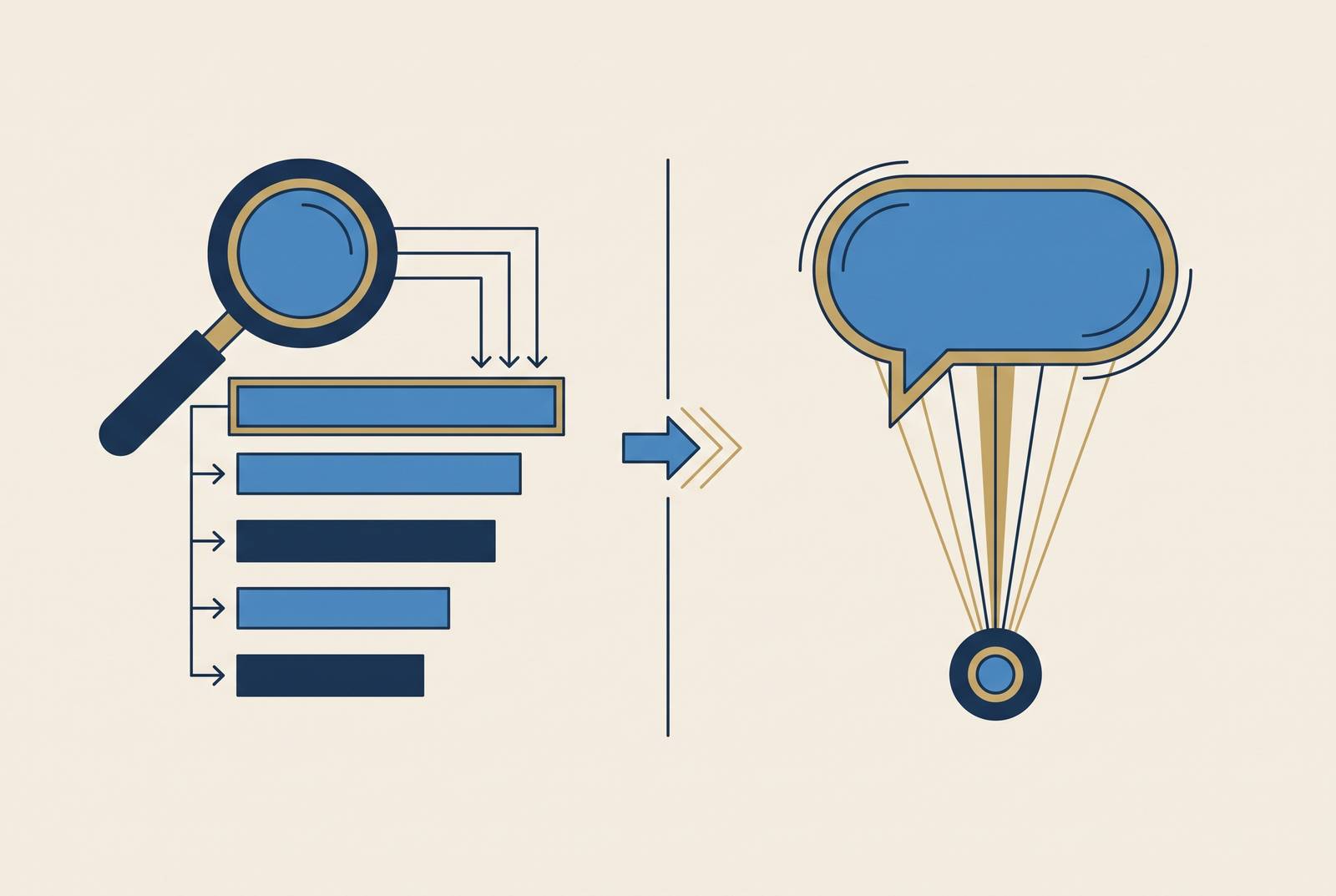
Search engine optimization and answer engine optimization are distinct disciplines with different success criteria: SEO earns a ranking slot, while AEO earns inclusion in an AI-generated answer. SEO earns a ranking slot; AEO earns a place inside the answer itself, and brand content now has to be built for both outcomes at once rather than treating one as a side effect of the other. That is the argument this piece makes, and the rest of it is spent proving why.
The old search loop, problem, search, compare, decide, has broken apart. Buyers increasingly hand the comparison step to an AI tool instead of clicking through a list of links to do it themselves. A single query today might surface on three separate surfaces: a traditional results page, an AI Overview sitting inside Google, or a conversational answer from ChatGPT, Perplexity, Claude, or Gemini. Each surface has its own logic for what it shows and why.
That is a real behavioral shift.
None of this means traditional search has been replaced. Traditional search still accounts for roughly 96% of total traffic volume, and it should not be framed as a winner-take-all story since both channels serve real volume.
What makes this genuinely uncomfortable for content teams is the independence of the two systems. A brand can lose Google clicks and gain AI citations on the very same page, in the very same quarter, because the two surfaces are no longer moving together. Buyers who arrive through AI answers tend to appear further along in their decision, already briefed by the summary and closer to buying. Volume may be flattening on one channel, but the value of the traffic that does arrive is changing shape. Teams still optimizing for a single surface are leaving visibility on the table, and that gap widens every quarter they wait, which is why platforms like Letterstory measure whether ChatGPT, Claude, Gemini, and Perplexity actually name a brand rather than relying on search rank as a proxy. When a Google AI summary is present, users click a traditional result only 8% of the time, versus 15% when no summary appears (SEOProfy).
Why conflating SEO, AEO, and GEO causes strategy failures
Three distinct disciplines are each doing a different job.
SEO optimizes pages to win ranking slots and clicks on a traditional results page; its currency is the blue link, and its purpose is to move a reader to a document. AEO, answer engine optimization, optimizes content to be extracted and quoted as a direct answer, appearing in an AI Overview, a featured snippet, a voice result, or a chat panel; the win condition there is not a click, it's a citation. GEO, generative engine optimization, sits a level above both: it shapes how an AI model associates a brand with a category at the level of what the model actually knows, not just what it can retrieve in the moment.
These layer on top of each other rather than compete. SEO is the infrastructure: without a crawlable, indexable site, there is nothing for AEO to extract in the first place. AEO adapts that infrastructure for an answer-first environment, and GEO forces the whole organization, PR, content, SEO, and product marketing, to converge around a single brand narrative. GEO is roughly 80% strategic work, positioning, ecosystem presence, brand authority, and only 20% technical, though most teams grab the technical 20% first because it feels more tractable 5WPR / Brandlight. That instinct is understandable and largely wrong.
What researchers call on-model versus off-model knowledge is the key distinction: what an AI model knows without a live search versus what it can retrieve and cite at runtime. On-model is what a language model already knows without running a live search, shaped by what was in its training data and how often the brand got mentioned there. Off-model is what the model retrieves and cites at runtime, when it triggers an actual search step, and that's shaped by crawlability and how the content is structured on the page. A brand can be strong on one and invisible on the other.
AEO is not SEO wearing a new label. Part of the reason traces back to the query itself: broad, generalist content aimed at a short keyword has a much harder time surfacing inside a long, conversational question than content built to answer that question directly.
The citation-ranking decoupling: why your best-ranked page may never appear in an AI answer
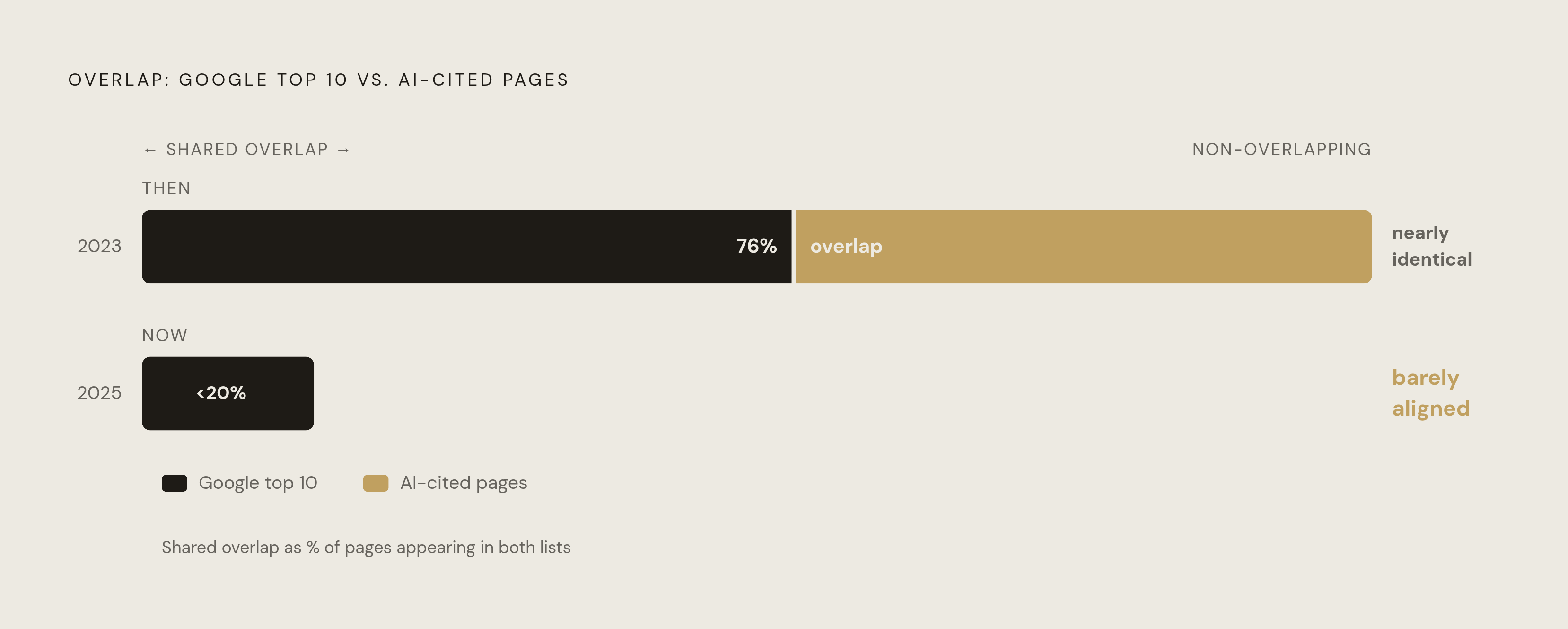
The overlap between pages that rank at the top of Google and pages actually cited inside AI-generated answers has fallen from 76% to under 20%, and it keeps falling 5WPR / Brandlight. That figure comes from an analysis synthesizing hundreds of millions of citations across ChatGPT, Claude, Perplexity, Gemini, and Google's own AI Overviews 5WPR / Brandlight. Two winner lists that used to look almost identical now barely resemble each other.
What that means in practice is blunt: ranking well is no longer a reliable proxy for getting cited, and being cited says almost nothing about where a page ranks. A more granular look at AI Overviews specifically bears this out Yotpo / Bain & Company 2025 Technology Report. An Ahrefs analysis of hundreds of thousands of keywords found only 38% of cited pages also sat in Google's organic top 10 for the same query, down from 76% in an earlier version of the same study, and a separate BrightEdge analysis using a different method landed near the low end of that same range. So a page that never cracked Google's first page can still be the page ChatGPT quotes back to a user on a regular basis, and that's the detail content teams need to actually internalize.
Freshness plays a bigger role here than it ever did in classic SEO. Content that's recently published or meaningfully updated appears in AI citation pools within days; Google's own ranking process can take months to catch up to the same page. That timeline difference alone should change how often a content team revisits its existing library rather than only chasing new topics.
Structure matters just as much as timing. A large share of AI citations get pulled from the first portion of a page. Front-loading the direct answer isn't a stylistic preference, it's a measurable citation-probability decision. The specificity of AI queries means broad, one-size-fits-all content is less likely to surface.
Put together, these numbers force one conclusion. A brand that assumes its SEO ranking is proof of AI visibility isn't measuring anything; it's just making an assumption, and a shrinking one at that.
Why owned content alone cannot sustain AI brand visibility
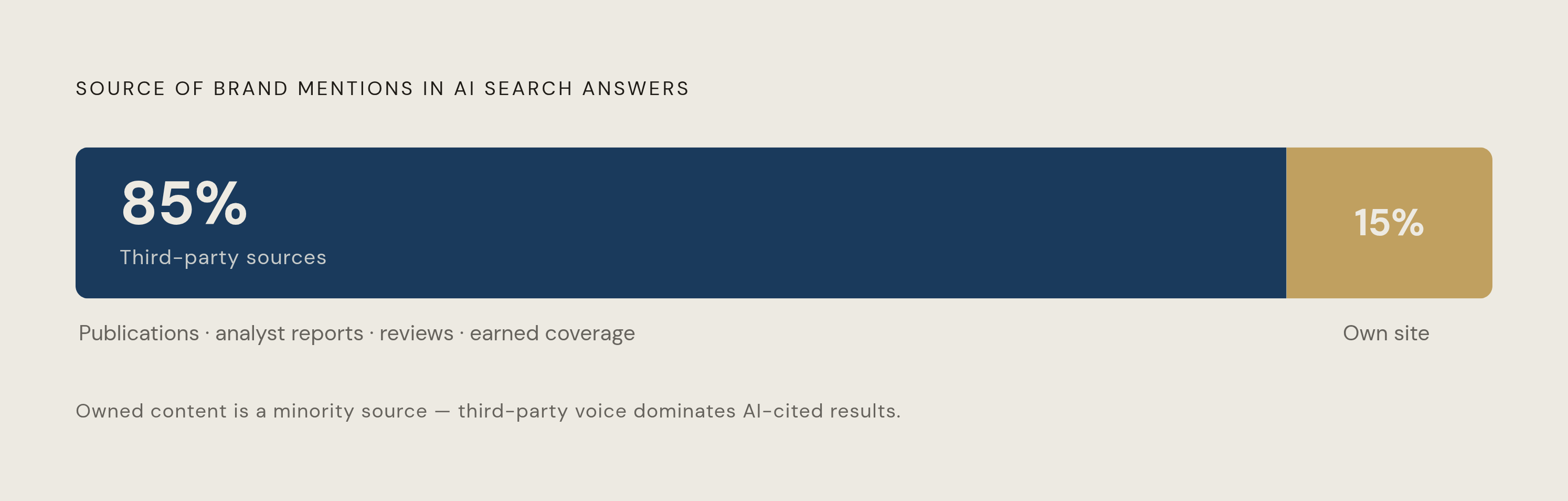
Roughly 85% of brand mentions inside AI search answers come from third-party pages rather than the brand's own site AirOps. That is not a small skew. It is close to the entire picture.
Think about what that means operationally. When someone asks an AI tool which vendor to trust in a category, the answer gets built from industry publications, analyst reports, customer reviews, and earned coverage. Multiple independent studies land on the same conclusion from different directions: PR and earned media drive the overwhelming majority of AI citations, and distributing a piece of content through a third-party outlet produces a real, measurable lift in how often it gets cited. The variable that matters most turns out to be distribution context, not content quality in isolation, because these systems weight the authority of whoever is doing the citing.
Editorial coverage specifically carries outsized weight, more than a listicle or a sponsored placement ever will. The logic behind that is almost mechanical: an independent journalist or publication has to decide a brand is worth covering before that coverage exists at all, and AI systems appear to treat that human editorial filter as a credibility signal that's genuinely hard to fake. A backlink can be bought or traded. A reporter's decision to cover a company cannot, at least not in the same way.
That distinction is visible in the data too. Ahrefs studied tens of thousands of brands and found that brand mentions across the web are now a substantially stronger predictor of AI Overview visibility than backlinks are. Backlinks still carry weight for traditional Google rankings, but their correlation with AI citations has weakened considerably. An old SEO habit, chase the link, matters less here than a newer one: get the brand mentioned, by name, in places an AI model already trusts.
The clearest illustration of how concrete this gets involves two of the largest retailers in the world. By early 2026, Amazon had blocked more than 50 AI user agents, including OpenAI's crawlers, and its share of ChatGPT citations dropped accordingly. Walmart made the opposite choice, left those bots unblocked, gained ground, and overtook Amazon in ChatGPT citations. Amazon held onto its strength inside Google's AI Overviews, where it still allowed Googlebot access, so the split wasn't a story of one company winning and one losing, it was a story of platform-by-platform decisions producing platform-by-platform outcomes.
There is a quieter version of this trap that catches brands who never made a deliberate choice at all. Cloudflare changed its default configuration to block AI bots. A brand running on Cloudflare's defaults may have lost AI crawler access without ever deciding to. Checking a robots.txt file is not an advanced technical step reserved for a later phase of AEO work. It is the prerequisite, and it should be the first thing anyone checks, not the last.
How to build owned pages that earn their place through content signals that predict AI citations
None of this means owned content is a waste of effort. Brand content still makes up the single largest source category inside AI Overview citations, according to an analysis of over a million citations. The right posture is not owned versus earned, it's both, working as complements rather than substitutes.
A handful of structural signals separate the pages that get cited from the ones that don't. Answer-first structure tops the list: leading with the direct, quotable answer and only then layering in context satisfies a ranking algorithm scanning for relevance and an AI engine scanning for something it can lift and quote, at the same time. Fact density matters almost as much. AI models favor content packed with verifiable, specific data points; conciseness has become a real ranking signal in its own right, and a page that just summarizes what other sources already said rarely earns a citation.
Schema deserves a correction here, because the conventional advice hasn't kept up with the evidence. FAQ and HowTo schema do not meaningfully increase the odds of an AI Overview citation. A controlled study of 1,885 pages found that adding JSON-LD schema produced no real citation lift across Google AI Overviews, AI Mode, or ChatGPT, and no later benchmark has confirmed the effect that schema vendors keep claiming. Time spent marking up FAQ schema is time that could go toward the answer itself.
Topical depth beats single-page authority, and the mechanism explains why. AI systems break a user's question into sub-queries, a process researchers call fan-out, and match each sub-query to whatever source answers it most clearly. A brand with several well-structured pages covering a topic from different angles gets more chances to win those sub-query matches than a brand with one long flagship page trying to cover everything. Keeping product names, use cases, and terminology stable across the site and across whatever third parties say about the brand makes it easier for a model to connect the dots and cite correctly. Inconsistent naming just fragments the signal.
The most actionable finding in this entire body of research comes from a study run by researchers at Princeton, Georgia Tech, and IIT Delhi Princeton / Georgia Tech / IIT Delhi, KDD 2024. It found that specific editorial techniques, adding statistics, citing sources, including expert quotations, lifted a page's visibility in AI answers by up to 40% Princeton / Georgia Tech / IIT Delhi, KDD 2024. There's also a real opening for smaller, focused publishers here. A narrow site that covers one topic exhaustively can outcompete a much larger general-authority publication for citations on that specific subject, because these models increasingly treat focus as its own kind of reliability signal. A 40% lift from technique changes means the gap between a citable page and an invisible one is usually an editing problem, not an engineering one Princeton / Georgia Tech / IIT Delhi, KDD 2024. It can be closed by rewriting the page, not rebuilding the site.
Running SEO and AEO simultaneously, how to structure content that does both jobs without compromising either
The structural principle that makes dual-purpose content possible is simple to state and harder to execute consistently: answer first, elaborate second. Open each section with a tight, directly quotable answer, then build out the comparisons, caveats, and depth underneath it for the reader who wants more. That structure gives a ranking algorithm the relevance signal it's scanning for and gives an AI extraction engine the clean answer it needs to lift, without forcing a choice between the two.
SEO still does work that nothing else replaces. It builds the domain authority and topical depth that long-term search visibility rests on, it drives the organic traffic that justifies the whole content budget, and it creates the crawlable, indexable foundation that AEO depends on entirely, since there's nothing for an AI system to extract from a site it can't reach.
AEO adds a different set of wins on top of that foundation. It earns zero-click visibility inside AI Overviews and featured snippets, awareness that happens before any click occurs at all. It earns citation inside conversational answers on ChatGPT, Perplexity, Claude, and Gemini, surfaces where traditional SEO signals barely reach.
Teams that only build for one of these usually see it clearly in their own numbers, strong in the discipline they optimized for, and strangely flat in the other, with no clear explanation why. Good SEO practice supports some AEO outcomes by accident, but it's not a substitute for deliberately structured answers, accurate schema decisions, and consistent terminology. And the quality shift among AI-referred visitors reinforces the case for investing here even before citation volume looks impressive: those visitors arrive already briefed by the AI summary, further along in the decision than a typical organic visitor, which changes what content needs to do at each stage of that journey.
A short, working checklist covers most of what a dual-track page needs. Does it answer a specific, conversational question in the first paragraph, rather than working up to it? Is FAQ or HowTo schema present, understanding now that it's a minor technical box to check rather than a major citation lever? Does the page include original data, expert quotes, or firsthand evidence, instead of just restating what other sources already say? Is the terminology consistent with how third parties describe the brand? And is the page actually crawlable by the AI bots that matter, a robots.txt check that takes minutes and should never be skipped? What AEO adds on top of SEO: a faster entry into citation pools (days versus months), allowing brands to respond to emerging topics while Google is still processing them.
Measuring AI visibility separately from SEO, the metrics that tell you whether AEO is working
Almost nobody is measuring any of this properly yet, which is itself the biggest strategic risk in the room. Only 16% of brands systematically track their AI search performance today, according to McKinsey research cited in mid-2026. The overwhelming majority are still running a measurement model built for a search landscape that no longer fully exists. Traditional metrics, rankings, organic traffic, click-through rate, simply don't register AI citation activity at all. A brand can be cited constantly by ChatGPT and Perplexity while its Google ranking dashboard shows nothing unusual, and the reverse holds just as easily.
A different set of metrics actually answers the question. Share of model tracks how often a brand shows up in AI-generated answers relative to competitors, across ChatGPT, Claude, Gemini, and Perplexity, and it functions as the AI-era successor to share of voice, except it's earned rather than bought. Citation rate by platform breaks that down further: which engines cite the brand, for which kinds of queries, and whether those citations point back to owned pages or third-party sources. Citation source distribution matters on its own, because a brand cited only through third parties has a more fragile position than one that also earns citations on its own domain, which is a more durable signal to build on. Whether ChatGPT-User, Perplexity-Bot, ClaudeBot, or Googlebot-Extended actually has access to the site is the most basic check of all, because nothing else on this list means anything if the answer is no.
The Amazon and Walmart example makes the case for platform-specific measurement better than any abstract argument could. A brand can lead on citations for one AI platform and trail badly on another in the very same quarter, purely as a function of which crawlers it allows in, and a single blended "AI visibility" score just papers over that entire story. Measuring this decoupling properly means watching what these models actually name and cite across real queries, not inferring citation behavior from search-rank data that was never built to capture it.