Product Battlecard Structure for SaaS Marketing Teams
One-page battlecards work only if reps can scan them in ten seconds.
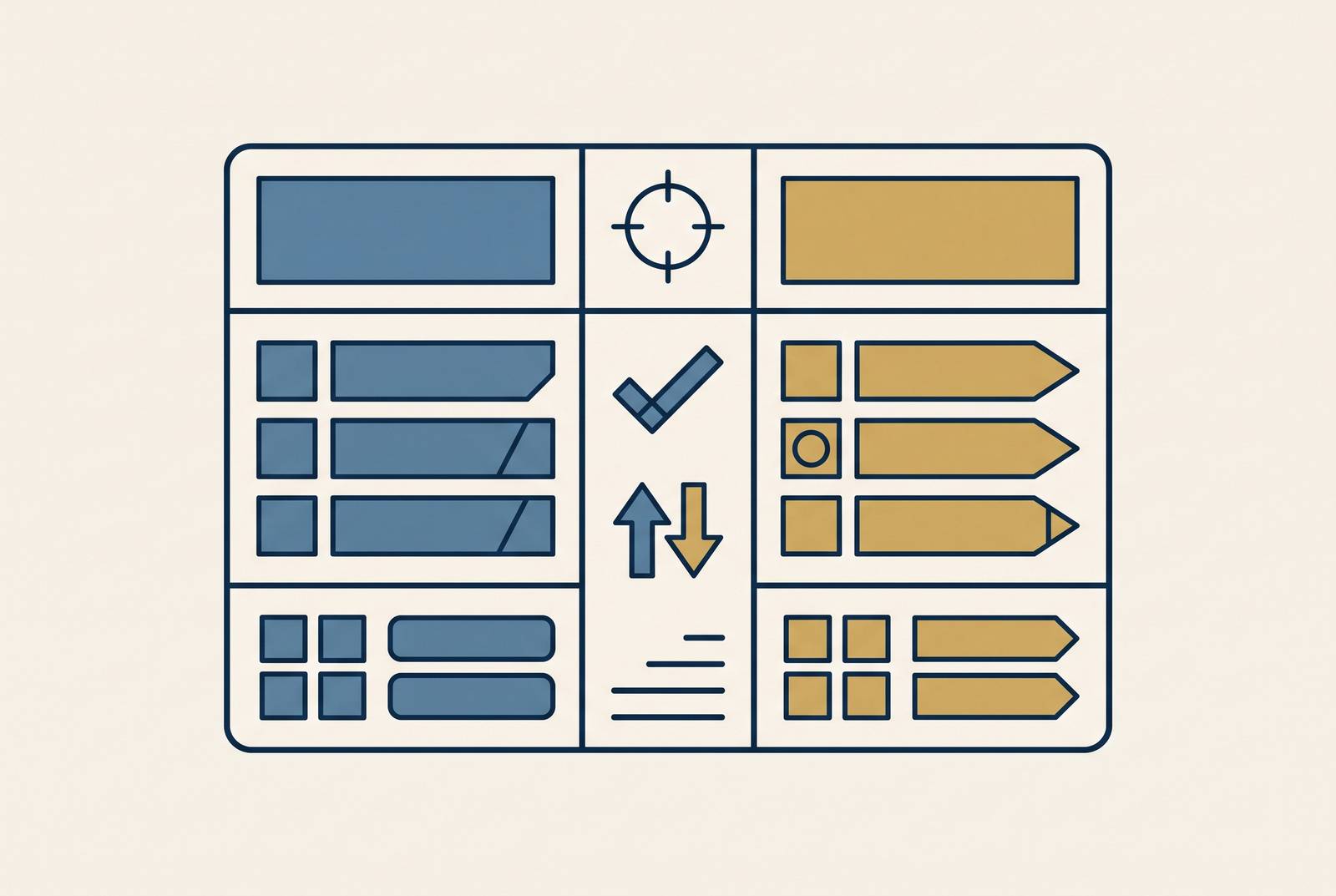
A rep is on a live call, the prospect mentions a competitor by name, and the clock that matters most starts running: about ten seconds to say something specific before the silence becomes its own answer. Most SaaS battlecards fail that moment because the format cannot survive contact with a live sales call. The intelligence on the card may be accurate and the positioning may be sound, but none of that matters if the card cannot be scanned in under ten seconds, because a card that cannot be scanned that fast will not be reached for. That single constraint, more than any gap in competitive research, is why most battlecard programs underperform their effort.
The one-page, one-screen constraint that governs everything else
Every decision about what goes on a battlecard has to answer to one hard limit: the whole thing fits on one screen, no scrolling, no second page. This is the condition under which a rep will actually reach for the card mid-call, and a card that violates it loses adoption no matter how good the content underneath it is. A battlecard, understood this way, is a separate artifact built for a separate job, and the full analysis it draws from belongs somewhere else.
The organizing logic that makes this workable comes in three layers: Know, which covers the competitive intelligence a rep needs; Say, the talk tracks and scripts a rep uses out loud; and Show, the proof that closes the gap between a claim and a prospect's belief in it. That sequence, Know, Say, Show, mirrors how a rep actually moves through a competitive conversation: orient to the situation, respond to what's said, then prove the response is true. Each layer contains specific sections, and the order those sections appear in on the card matters as much as which sections make the cut.
Competitor overview: context a rep needs before the call, not during it
The first section in the Know layer is the competitor overview, and its only job is to orient a rep before the call starts, not to carry weight during it. That means it has to be short: company name, a one-line positioning statement, the target market, and basic scale indicators like funding stage, employee range, or typical deal size where that information is known. Reps lose credibility fast when they describe a competitor in terms the prospect doesn't recognize, because the prospect has usually already looked at that competitor's own site. Funding history, product changelogs, and analyst rankings belong in the full competitive analysis, not on this card. Once a rep knows who they're dealing with, the card has to answer the question that actually drives the conversation forward: where does the team win?
Win and loss zones: the section reps trust most
The win/loss zone is the most valuable section on the card, and reps trust it more than any other section precisely because it tells them where to fight and where to walk away. That value depends entirely on one condition: the loss conditions on the card have to be as specific and as honest as the win conditions. A card that is honest about where the team loses earns the rep's trust when it says where the team wins, and that honesty drives whether reps use the card. Suppress the losses and reps stop believing the wins, because they can tell when a document is written to make PMM look good rather than to help them close.
Win conditions need to be tied to deal scenarios, not to product attributes. A line like "we win when the team is under 100 users and values ease of setup over feature depth" gives a rep something to act on. The most useful version of this section maps three zones, winning, battling, and losing, against actual win-loss data, turning the section into a decision framework that reps can act on. The battling zone carries particular weight here: it tells reps which deals are worth the extra effort and which ones to deprioritize, a distinction that a simple win/lose binary can't make.
Source data for this section should weight lost-deal interviews over won-deal notes, because memory of a won deal tends to be unreliable and flattering in ways that memory of a loss rarely is. Three lost-deal interviews per competitor will produce more useful loss conditions than thirty rep anecdotes about why the team usually wins. PMM teams often resist writing down honest loss conditions because they fear that information will be used against them internally, in an internal performance review or a pipeline review. That fear is understandable, but the alternative, a battlecard reps don't trust and therefore don't open, costs more than the discomfort of an honest loss section ever will. Honest loss conditions also do quiet work on pipeline hygiene: a rep who knows when to walk away from an unwinnable deal spends less time chasing it.
Competitor strengths and weaknesses: why honest framing of strengths is non-negotiable
The honesty standard set by the win/loss section has to extend to how the card describes what the competitor does well, and this is where the temptation to minimize runs highest. A battlecard that claims a competitor has no real strengths gets discarded the first time a rep runs into one of those strengths in an actual conversation. Prospects arrive at calls having already seen the competitor's demo, read the competitor's G2 reviews, or started a trial of the competitor's product, and when the card contradicts what the prospect just described firsthand, the damage lands on the rep's credibility, not the competitor's.
Weaknesses belong on the card too, sourced from G2 reviews, product changelogs, and Gong call transcripts where reps have surfaced specific competitor feature gaps in live conversations. The useful move for each strength is not to deny it but to pair it with a reframe: not "they don't actually do that well," but a redirect toward the deal conditions where the team's own approach is the better answer regardless. That pairing, strength plus reframe, turns this section into preparation. A rep who already knows what the competitor does well can raise it before the prospect does, which changes the entire dynamic of the conversation from defense to anticipation, and marks the hinge point on the card where intelligence turns into language the rep actually says out loud.
Objection handlers and talk tracks: the words a rep can use verbatim
The objection handler section turns the card from reference material into a script, because synthesizing a response mid-call is not something most reps can do well under pressure. The minimum viable content here is the three or four things a prospect most commonly says when evaluating this particular competitor, each paired with a verbatim response. Not talking points. Not bullet logic a rep has to assemble on the fly. Full scripts, written in natural, conversational language, not corporate messaging dressed up as a response.
The format that works: write the objection in the prospect's actual words, something like "Competitor X has been in the market longer and has more customers," and follow it with a two-sentence response that concedes what's true before pivoting to the relevant differentiator. The concession matters as much as the pivot. None of this should come from PMM imagination. It should come from actual sales call recordings and win-loss interviews, so that the objections on the card are the ones prospects are really raising, in the language they're really using.
Trap-setting questions: turning defense into offense during discovery
Objection handling is reactive by design, responding to something the prospect already said. Trap-setting questions do the opposite: they let the prospect discover a competitor's weakness independently, during discovery, before any objection has been raised. A prospect who reaches a conclusion on their own finds it more persuasive than the same conclusion stated by a rep. This section functions as offense.
These questions should be tied directly to the win plays already established elsewhere on the card, not treated as a standalone tactic. Each of the three win plays on the card should carry at least one question like this hidden inside it. These questions need to go in early, during discovery, not as a reply to a late-stage objection, because their power comes from shaping how the prospect evaluates the competitor in the first place, not from correcting an evaluation that's already been made. The framing has to stay genuinely curious rather than prosecutorial, since a question that telegraphs the rep's agenda stops working as discovery and starts reading as a trap in the bad sense. Keep this section to two or three questions total. Past that number, reps tend to default to using none of them.
Pricing intelligence
Pricing is the fastest-decaying fact on any battlecard, which makes date discipline here more important than almost anywhere else on the card. What doesn't belong is speculation about pricing the competitor hasn't disclosed. Mark that information as quote-only and move on, since inventing a range is worse for the rep's credibility than admitting the gap exists.
The framing matters as much as the figures themselves. In most B2B SaaS deals, reframing the conversation from sticker price to total cost of ownership, surfacing implementation fees, consulting requirements, and seat-based charges that don't show up in headline pricing, works better than a direct price-for-price comparison. A small but load-bearing piece of this section is the landmines list: specific pricing claims reps must not make, along with the reason why. A rep should never claim a competitor lacks a feature it has actually shipped; the real gap might be in rate limits or contract terms, not in whether the feature exists at all, and getting caught making a false claim about existence costs more credibility than the claim was ever worth.
Proof points: the Show layer that most battlecards skip
The Show layer is what separates a battlecard a rep merely presents from one a prospect actually experiences, and it's the section most commonly missing from real battlecards in the field. Proof points can take several forms: customer quotes with the company named, case study metrics tied to a specific outcome, links to interactive demos showing a workflow difference, or one-page comparison sheets, and which format fits depends on deal stage and how the rep plans to use the card in that moment. Interactive demos tend to convert better than passive formats at the bottom of the funnel, because the prospect experiences the workflow difference directly rather than being told about it secondhand, though a well-built static one-pager still beats having no proof on hand.
Every proof point on the card needs to attach to a specific claim elsewhere on the card. Proof that floats free of a win play or a differentiator is clutter, and the one-screen constraint exists to eliminate clutter. The strongest version of this section favors customers who switched from the specific competitor named on the card: a result from a company that moved from that competitor and saw a measurable outcome carries more weight than a proof point built around a generic customer success story. Every proof point needs a source and a date attached to it, the same discipline that governs the pricing section and the competitor overview, because an undated customer metric is exactly the kind of liability a sharp prospect will ask about mid-deal.
Keeping every section current after the card ships
A battlecard that's accurate on the day it ships and has no system behind it for staying that way becomes a liability within weeks. Competitor pricing changes, features ship, positioning shifts, and an outdated claim repeated in a live deal costs a rep more credibility than having no claim. The "last verified" column that runs through every section on the card is a trust signal that tells a rep how much weight to put behind each line, and a card with no dates on it is asking reps to trust it purely on faith. The date discipline introduced section by section throughout the card only holds up if there's an operational habit behind it, checking and refreshing claims on a set cadence rather than waiting for a rep to notice something's gone stale mid-call.
Sequencing the sections so a rep can orient, respond, and prove in under ten seconds
Choosing the right sections gets a battlecard halfway there. The order those sections appear in on the page shapes whether a rep can actually move from orientation to response to proof inside the ten seconds they have in a live call. Strengths and weaknesses sit in the Know layer, but they belong after the win/loss zones on the card, not before them, because they contextualize those zones rather than lead them: a rep reads where the team wins and loses first, then uses the strengths section to understand why. The Show layer, proof points and interactive demos, goes last on the card because it's used last in the conversation. Orient first. Respond second. Prove third. Any section that can't fit into that sequence without pushing the card past one screen belongs in a supplementary document, not squeezed into smaller type on the card itself, since a compressed section nobody can scan is worse than no section. The test that governs every choice on the card stays the same from the first section to the last: if a rep can't use it within ten seconds of finding it, it belongs somewhere else. A battlecard is the place for speed.