B2B Software Review Management on G2 and Capterra
G2's ownership of review platforms means vendors must master two different ranking engines.

G2's January 2026 purchase of Capterra, Software Advice, and GetApp from Gartner puts one company in charge of more than half of the global review infrastructure that software buyers use to make decisions. That's not a market share statistic to file away and forget. It changes how vendors have to think about review management, because the number of doors just dropped from four to two, and both of those doors now report to the same landlord.
How the B2B buying committee actually uses these platforms today
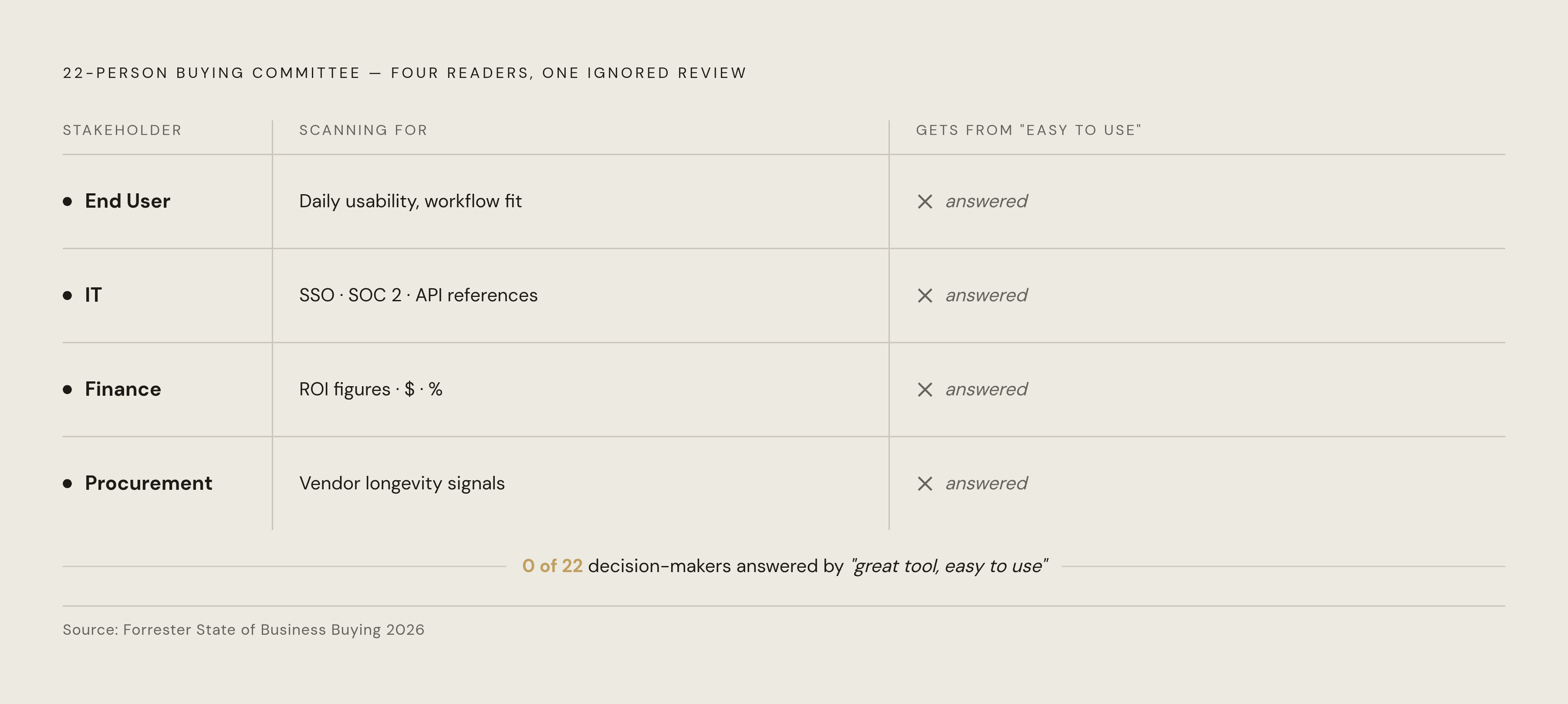
The modern software buying committee is not a person. It's a small congress, and it doesn't behave like one either. Forrester's State of Business Buying 2026 puts the average B2B software decision at 22 people, a mix of internal stakeholders and outside consultants, advisors, or influencers pulled in for their opinion. That many people rarely agree easily, and reaching consensus on a six-figure software contract requires evidence that speaks to each of them in their own language, which is where reviews stop being a marketing nice-to-have and start being a coordination tool.
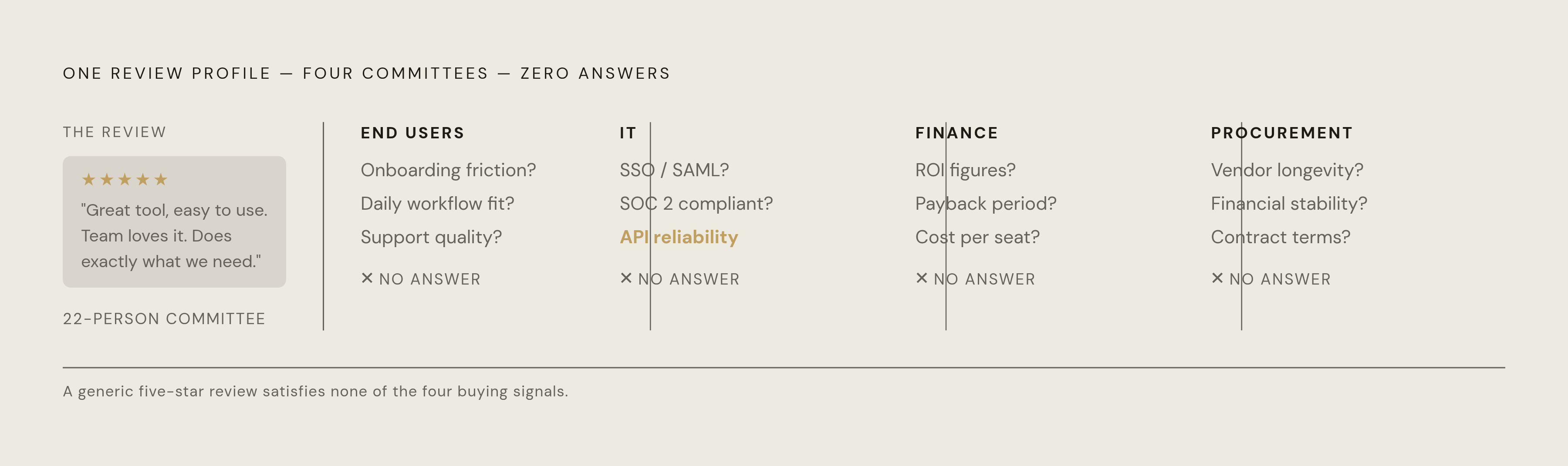
Here's the part that trips vendors up: those 22 people are not reading the same review for the same reason. The end user wants to know if the product is a pain to click through every day. IT wants to see someone mention SSO, SOC 2, or an API that didn't break during a migration. Finance wants a sentence with a dollar sign or a percentage in it. Procurement wants proof the vendor will still exist in three years. A review profile stacked with twenty near-identical five-star reviews that all say "great tool, easy to use" satisfies exactly none of these people, because none of them are asking that question.
Timelines have also compressed hard. AI-assisted research has compressed what used to be a multi-week evaluation crawl into a significantly shorter window, and 51% of B2B software buyers now start their research inside an AI chatbot rather than a search engine. A separate 2026 study from Quoleady on large language model outputs found that in a sample of software category queries, 99% of the tools ChatGPT named had G2 reviews attached, and 100% had Capterra reviews. If a product isn't sitting on those platforms with real review depth, it risks not existing yet by the time the shortlist gets built, no matter how good the product actually is.
What G2 and Capterra actually measure — and why the differences matter operationally
G2 and Capterra look similar from a distance. Up close, they run on different math, and treating them the same way is how vendors waste effort optimizing for the wrong lever.
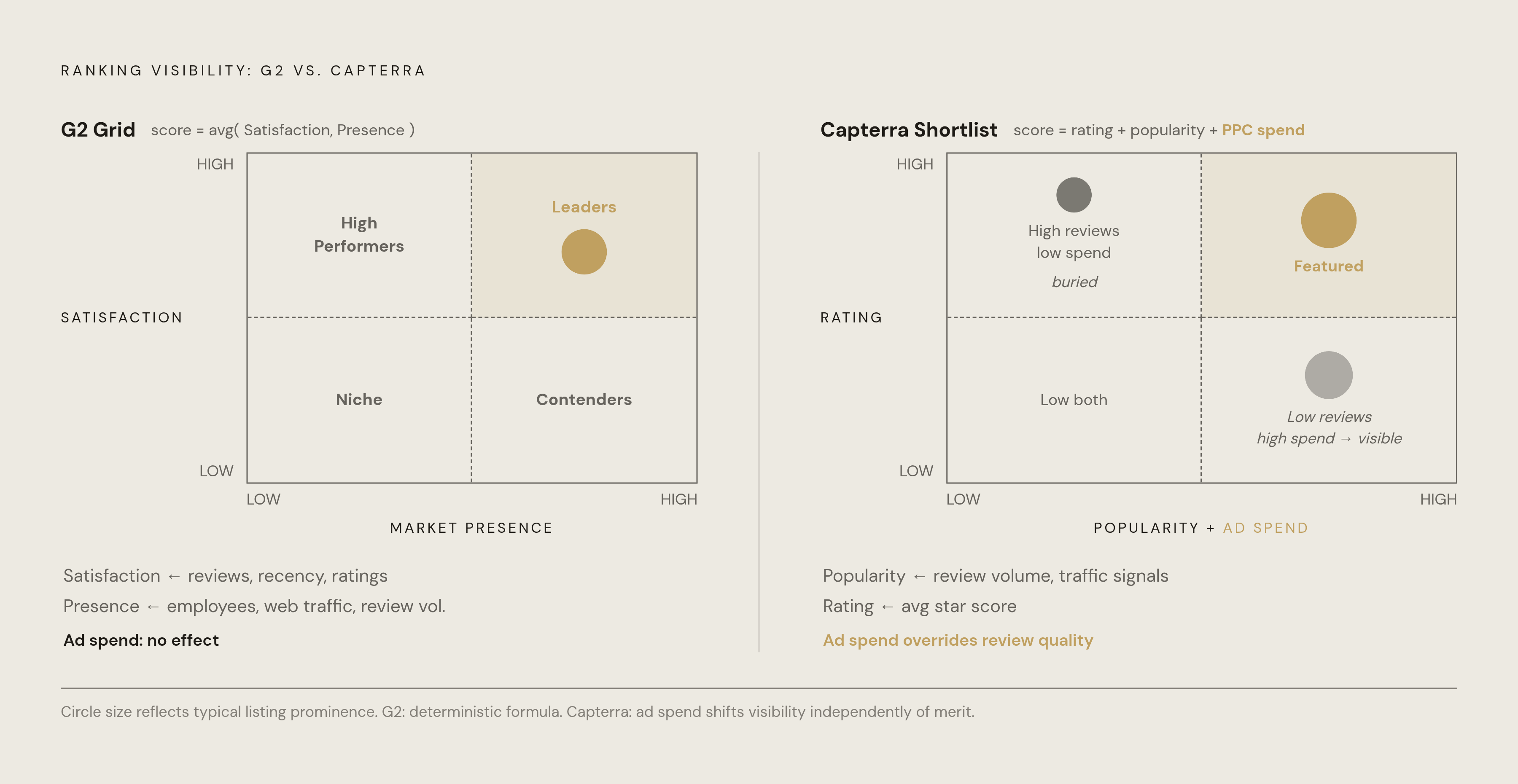
G2's Grid Score averages two axes: Market Satisfaction and Market Presence, divided by two. Satisfaction pulls from review scores, review quality, recency, and specific dimension ratings (ease of use, support quality, and so on). Market Presence pulls from company size signals: employee count, revenue indicators, web traffic, social following, and total review volume. The result sorts vendors into four quadrants, Leaders, High Performers, Contenders, and Niche, each of which does a different job in a sales conversation. A Leader badge closes deals faster, while a Niche badge tells a very specific buyer they found their people.
There's a gate before any of that happens, though. G2 won't publish a Grid for a category until it has at least six products with ten or more reviews each, plus a minimum threshold of total reviews across the category. That means review generation isn't purely a self-interested exercise; it's partly a public good. A vendor sitting at eight reviews in a category that's stuck below the Grid threshold is, in effect, waiting on competitors to catch up before the whole category gets ranked at all.
Badge access has gotten more expensive, too. The "Users Love Us" badge is still free, earned once a profile hits twenty reviews at a qualifying average. But as of Summer 2025, displaying any Grid badge, Leader, High Performer, Momentum, or Award, requires a paid G2 subscription. The G2 Best Software Awards now also require a minimum of ten reviews from the prior calendar year, which turns review cadence into an annual eligibility question, not just an ongoing nice-to-have.
Capterra runs on a different engine almost entirely. Its Shortlist uses a comparable two-axis format, rating on one side and popularity on the other, but visibility on Capterra is tied heavily to advertising spend rather than review scoring alone. That's a real structural difference: a vendor can out-review a competitor on Capterra and still lose visibility if that competitor is outspending them on PPC. Building a system that treats both platforms identically misses this, and misses it in a way that shows up directly in pipeline numbers.
Building the review generation engine: identifying who to ask and when
Volume matters, but the shape of that volume matters more. Two to five new reviews a month reads to both platforms' algorithms as a living, breathing customer base still using the product. A sudden burst of thirty reviews in a week reads as something else entirely, and both platforms have fraud detection tuned to notice exactly that kind of spike.
Picking who to ask isn't a guessing game if the data's already sitting in the CRM. Active users who log in on a regular cadence and touch the core features are the strongest candidates, obviously, but the highest-yield group is narrower than that: promoters who scored a 9 or 10 on an NPS survey and haven't reviewed yet. Add a filter for customer health, healthy or expanding accounts only, never anyone flagged at-risk, and a filter for tenure. Someone three to six months in has used the product long enough to be specific about what it does well, but hasn't been around so long that the novelty (and the enthusiasm) has worn off.
Timing beats persistence, every time. The best moments to ask sit right after a successful onboarding milestone, when the customer just felt the product actually work; right after a support ticket gets resolved well, when goodwill is at its highest; or during a quarterly business review, when there's already a structured reason to be talking about the relationship.
Incentives are legal on both platforms, within limits, but the framing matters more than the dollar amount. Capterra allows gift cards up to a set value for the act of submitting a review, not for a positive one specifically; this moves the needle for individual contributors but rarely gets a VP to sit down and write four paragraphs. G2 permits incentives up to $100 per review under its stated policy, and the framing of any such program should make clear it's rewarding participation, not a particular star rating. Calling it "recognition" instead of "reward" tends to land better with enterprise buyers whose legal teams get twitchy about anything that smells like pay-for-praise.
The floor matters more than most vendors assume. Research from Gartner Digital Markets found product listings with ten or more user reviews convert at twice the rate of listings with zero reviews. That's not about chasing a hundred reviews to beat a competitor's ninety-eight. It's about clearing the floor that keeps a listing from looking abandoned.
Running the outreach workflow: channels, sequences, and making it repeatable
Not all outreach channels convert the same, and treating them as interchangeable is a common way to burn through goodwill for nothing. A direct email from a named CSM, someone the customer has actually talked to, converts best by a wide margin. In-app prompts triggered by usage milestones convert lower per-send but scale without touching a human calendar. Automated CRM sequences, run out of a platform like Salesforce and tied to an NPS or health score trigger, are the volume play: lower conversion, but they run themselves. Slack or Teams messages work, but only for accounts where the relationship is already informal, where a review ask doesn't feel like a cold intrusion into a shared channel.
The message itself is where most outreach quietly fails. "How are we doing?" gets ignored because it asks the customer to do all the thinking. Naming the exact feature they use, the specific workflow they built, gives them a sentence to start from instead of a blank page. Drop a direct link to the review form; every extra click between the ask and the form is a chance for the customer to get distracted by something else, including their own inbox. And never ask for G2 and Capterra in the same message, since splitting the ask splits the completion rate on both.
One follow-up, five to seven days later, is the ceiling. This is an unpaid favor being asked of a customer with a full calendar; a second or third follow-up starts to read as nagging, and nagging is a bad look for a vendor asking someone to say nice things about them in public.
Making this repeatable means someone actually owns it. Review generation living on a marketing wish list, hoped for but never assigned, produces exactly the sporadic, bursty pattern that trips fraud detection. Living on the CS team's KPIs, with a monthly report tracking targets identified, outreach sent, and reviews posted by platform, turns it into infrastructure instead of a quarterly scramble. Rotating platform focus, G2 one quarter, Capterra the next, keeps both profiles growing without splitting attention every single month.
Turning review content into pipeline: how to activate what you've collected
A pile of reviews sitting on a G2 profile that nobody links to from the homepage is a wasted asset, plain and simple. The homepage and pricing page are where a buyer's evaluation intent peaks, which makes them the exact place to put earned badges and a specific review snippet, not a generic one.
Specificity does the heavy lifting in paid channels too. A line like "cut our onboarding time in half" pulled straight from a review will consistently outperform brand copy like "easy to use," because one of those sentences could have come from any vendor in the category and the other one couldn't have. G2 Comparison Reports and Capterra Shortlist placements can be dropped directly into LinkedIn campaigns aimed at accounts already researching a named competitor, which puts marketing in front of a buyer mid-thought.
Sales teams should be walking out of demos with G2 Crowd Reports or Capterra summaries as leave-behinds, not PDFs of the pitch deck. Map specific review snippets to specific objections: if pricing comes up constantly, pull reviews that talk about ROI in concrete terms, not reviews that just say the product is good. In deals with large buying committees, match the reviewer's role to the recipient, sending the IT director reviews written by other IT directors rather than a marketing manager's opinion on ease of use, which answers a question nobody in IT asked.
Reviews also double as raw material. A detailed review from a named user at a recognizable company is functionally a rough draft of a case study; someone just has to follow up and write it properly. Organizing reviews by use case or vertical on category landing pages helps both SEO and conversion at once, since it matches the structure buyers actually search in. None of this requires reinventing a content pipeline from scratch each quarter; it just requires treating review content as an input to be processed, not a badge to be displayed and forgotten.
Responding to reviews in a way that works for future buyers, not just current ones
Here's the thing nobody tells a new CS hire when they hand them the review response duties: the reviewer already made up their mind, and they posted the review before anyone had a chance to change it. The actual audience for the response is the next prospect scrolling through that thread six months from now, trying to figure out if this vendor is worth a demo call.
For a positive review, acknowledging the specific outcome the reviewer named does more work than a generic "thanks so much for the kind words," which says nothing to anyone. Adding one sentence that extends the point, something like noting that the onboarding workflow they mentioned was built specifically for mid-market ops teams, shows a prospect the vendor actually read what was written and knows its own product. Marketing language here reads as tone-deaf; matching the reviewer's own register works better.
Negative reviews are where the real test happens. Disputing a reviewer's experience in public, even a little, reads as defensive to everyone watching, and everyone is watching. Acknowledging the specific pain point directly, not the star rating, is the move. If the issue's already fixed, say so, with a date, because vague reassurance convinces nobody. Offering a named contact or a real support channel beats a vague promise to "reach out."
Speed matters here more than in almost any other part of this system. A critical one- or two-star review sitting unanswered for two weeks tells a prospect the vendor either didn't notice or didn't care; 48 hours is the reasonable bar for those, versus about a week for positive ones. And there's a strange but consistent pattern worth sitting with: a negative review handled with a calm, specific, human response often converts a skeptical prospect better than an unanswered five-star review does. Confidence reads as maturity, while silence reads as avoidance.
Using review feedback as a structured product and positioning signal
Most vendors read their reviews the way people read restaurant reviews before a first date: scanning for reassurance, not information. That's a missed opportunity, because the review corpus is actually a structured dataset sitting there, waiting to be tagged and counted.
A quarterly audit is the mechanism. Tag every review by theme, usability, integrations, support, onboarding, pricing, specific features, and track how those theme frequencies shift over time. A rising count of integration complaints over two consecutive quarters isn't a review problem to manage; it's a product signal to escalate. Running the same tagging exercise against the top two or three competitors in the category surfaces gaps in their profiles too, and gaps in a competitor's review themes are often exactly where a vendor's next piece of positioning copy should live.
The language itself is underused. Buyers write in their own words, using their own vocabulary, and that vocabulary usually beats anything an agency would draft from a brief, because it's the actual language of the person a vendor is trying to reach. Recurring phrases from reviews belong in homepage copy, in ICP definitions, on sales call talk tracks, word for word where it fits.
Product teams should get a monthly digest, categorized themes with frequency counts, not a raw dump of forty reviews nobody has time to read. Reviews that flag friction specifically in onboarding or early activation deserve their own flag entirely, since that friction correlates with churn more tightly than almost any other complaint category and usually has the shortest path to an actual fix.
One more thing the review corpus reveals, almost by accident: who's actually writing these reviews. If the target customer profile is a director or VP but the reviewer pool skews heavily toward individual contributors, that's not a review-strategy gap. That's a signal about where the product is actually landing inside organizations versus where the sales team thinks it's landing, and it's worth taking seriously before a renewal conversation surfaces the same gap the hard way.
Fraud, integrity risks, and the FTC environment vendors need to understand
Buyer trust in review authenticity is not what it used to be, and vendors ignoring that shift are optimizing for a world that no longer exists. TrustRadius's 2024 Buying Disconnect research found a large majority of tech buyers report seeing fake reviews on review platforms regularly or at least sometimes. That's not a fringe suspicion; that's most of the buying committee walking in already half-skeptical.
G2's fraud detection watches for the obvious patterns: clusters of reviews landing in a tight window with suspiciously similar phrasing, reviewers with no prior G2 history who suddenly post across multiple products from the same vendor, review text that reads templated instead of lived-in. None of that is exotic detection work; it's the same pattern-matching any spam filter runs, just pointed at prose instead of links.
There's a real asymmetry worth watching for on the moderation side. Community reports suggest legitimate critical reviews sometimes sit stuck in moderation loops longer than incentivized positive ones sail through, which is an uncomfortable irony given the platforms' stated integrity missions. The practical move is boring but effective: monitor the pending review queue directly and escalate through vendor support any time a review that should have posted clearly hasn't.
TrustRadius, for comparison, rejects roughly 48% of all submissions for quality reasons and keeps AI-generated content under 11% of what actually gets published, a materially tighter bar than G2's. That's relevant context for a vendor deciding where to concentrate review-generation effort, not a knock on either platform, just a different risk tolerance built into each one's model.
The regulatory backdrop changed meaningfully in August 2024, when the FTC's final rule took effect prohibiting the buying or selling of fake reviews and testimonials, with civil penalties attached. No B2B SaaS vendor has shown up in an enforcement action yet, which is a gap in enforcement history, not a gap in exposure; the rule is live, and being the first vendor named in that kind of case is a genuinely bad way to end up in the trade press. Every incentive program needs to be documented, disclosed, and capped inside each platform's actual stated policy, and compensation can never be conditioned on the reviewer saying something nice. That's not a compliance suggestion; that's the rule.
How the G2–Capterra merger and AI search change the maths
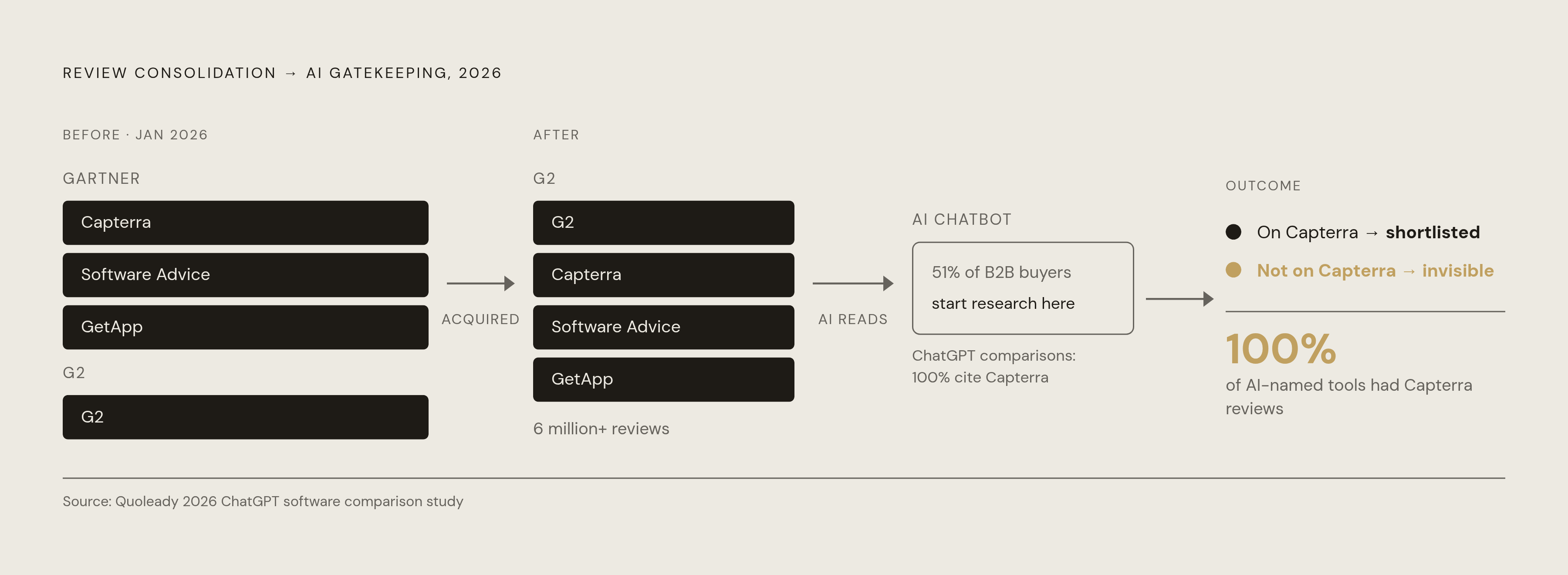
Step back and the picture gets simpler, in a slightly unsettling way. One company now sits behind G2, Capterra, Software Advice, and GetApp, holding a combined pool of over six million verified reviews and reaching hundreds of millions of buyers a year across the network. Submit a review on Capterra and it syndicates automatically to GetApp and Software Advice; one submission, three properties covered. That's operationally convenient, and it's also a concentration of gatekeeping power that would have looked alarming if any single company had proposed building it from scratch.
Calling these platforms gatekeepers isn't dramatic flourish. Presence on G2 and Capterra functions less like a ranking signal and more like a binary switch: a vendor is either in the comparison set an AI tool pulls from, or it isn't. The Quoleady research on large language model outputs found that in a study of ChatGPT-generated software comparisons, essentially every tool named carried reviews on both platforms. A product without meaningful review depth on either one risks not surfacing in the exact conversation buyers are increasingly having first, before a human salesperson ever gets a chance to make the case.
That's the operational argument this entire piece has been building toward, one section at a time. Review management stopped being a task somebody remembers to do before a board meeting and became infrastructure, the same category as billing or onboarding, something that runs continuously or breaks quietly in ways nobody notices until pipeline numbers start looking strange. The merger didn't create that fact; it just made the fact impossible to ignore any longer.