Yelp vs Google Reviews for Local Service Businesses
Google reaches more people, but Yelp converts higher-intent customers in specific categories.
Google and Yelp aren't competing for the same job. Google is the reach machine that decides whether a business shows up at all; Yelp is a narrower tool that does something Google can't, in a specific set of categories, for a specific kind of customer. Four platforms now host roughly 88% of all online reviews, so the old advice to just "be everywhere" doesn't hold up the way it used to. Picking wrong wastes hours that a plumber or an attorney or a hair salon owner doesn't have lying around.
The stakes went up recently too. The FTC's Consumer Review Rule carries civil penalties for fake or gated reviews, and Google has been actively enforcing its review-gating policies. Meanwhile Gen Z is quietly walking away from Google search for local discovery, favoring Instagram and TikTok instead, which means even the giant isn't as permanent as it looks. The question worth asking isn't which platform is better. It's which one does what, for whom, and under what conditions, because the two answers aren't close to the same.
How far Google's reach actually extends, and where it stops
Google holds somewhere around 57-58% of all online reviews and commands roughly 73% of the review platform market, according to Sixth City Marketing's analysis. BrightLocal found that 83% of consumers check Google for local business reviews, making it the only platform used by more than half of all surveyed consumers. That's a big number, and it's tempting to stop there.
But what does 83% actually tell you? Mostly that Google is where people already are when they start searching for anything, not that Google reviews get read more closely or trusted more than what's sitting on Yelp. Default behavior and deep engagement are two different things, and conflating them is where a lot of review strategy goes wrong.
The cracks show up at the edges of the age range. Among 18 to 24 year olds, SOCi's research found Instagram (67%) and TikTok (62%) actually beat Google Search (61%) as tools for local discovery. If a business sells to a younger crowd, Google's aggregate dominance starts to look a lot less dominant.
None of that changes what actually matters for most local businesses, which is the Google 3-pack, the little map block that shows up above the fold for local searches. Getting into that box is the real prize, not just having a Google listing that exists somewhere in the ether. And reviews feed directly into who gets a seat in that box.
How Google reviews feed directly into local search rankings
Google says, in its own documentation, that reviews are a ranking input alongside relevance, distance, and prominence. That's not an SEO consultant's guess, it's stated policy from the company that runs the algorithm.
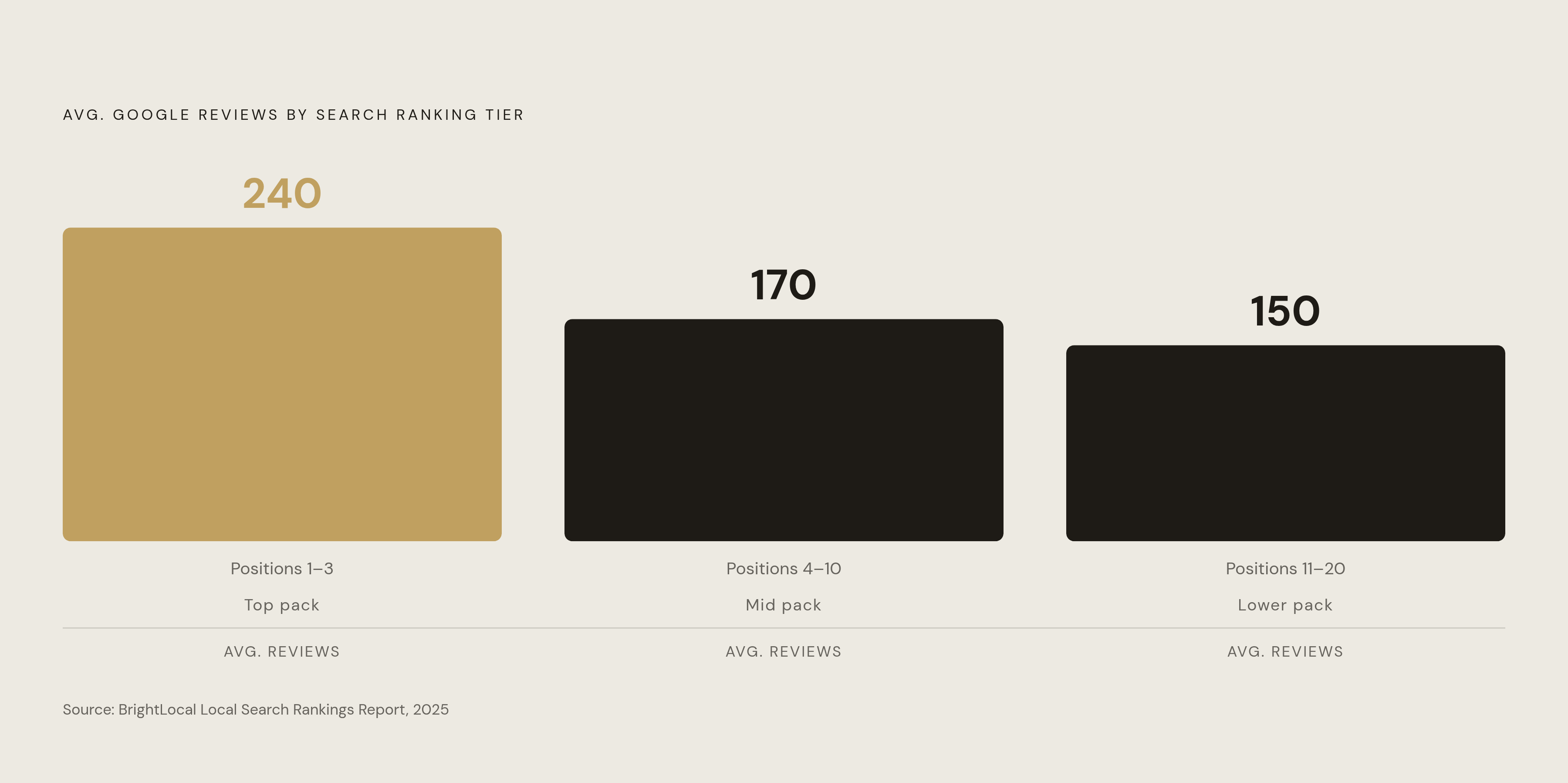
The numbers back it up in a way that's hard to argue with. BrightLocal's 2025 data shows businesses sitting in the top 3 local positions average 240 Google reviews, positions 4 through 10 average 170, and positions 11 through 20 drop to 150. It's a gradient, not a cliff, and the trend line points one direction. Separately, businesses with 50 or more Google reviews generate 266% more leads than businesses with fewer than 10, per BrightLocal, which is the kind of gap that should make an owner sitting on 6 reviews a little uncomfortable.
Three things are happening at once here, and it helps to pull them apart. Review volume and recency work as a ranking signal on their own. Review text works as a keyword signal too. When a customer writes "fixed our water heater in Somerville same day," Google's algorithm reads that as service and location data, the exact language it's trying to match against someone's search. And business responses add a third layer: when an owner replies citing a specific service or neighborhood, that response text becomes part of the listing's visible content.
There's a secondary payoff worth mentioning: A strong review base can support a business's overall visibility, reinforcing the value of organic rankings beyond search alone. And the bar for "good enough" keeps climbing. BrightLocal's 2026 consumer survey of US adults found only 31% of consumers will even consider a business rated below 4.5 stars, while the average rating across the top 20 local finder positions sits around 4.11, per SOCi. The floor is rising faster than a lot of business owners have clocked.
What Yelp's audience actually looks like, and why vertical fit matters more than platform size
Yelp still pulls over 75 million monthly visitors, with 2.5 million searches happening on the platform every day. That's not a rounding error, even with its market share slipping against Google over the years.
The demographic profile is where Yelp actually earns its keep. More than half of Yelp's users report household incomes in the six-figure range, the core age band runs 25 to 54, and usage clusters hard in dense urban markets like San Francisco, New York, and Chicago. Purchase intent runs unusually high too: the large majority of Yelp users arrive at a business page already leaning toward buying, and 57% contact or visit the business within a single day. Compare that to a social platform where someone's mostly scrolling for entertainment. Yelp traffic shows up with a decision half-made already.
That intent concentrates in specific categories. Home services (plumbers, electricians, contractors) and high-trust fields (legal, medical, financial) see outsized engagement on Yelp. Yelp's engagement clusters heavily in food and drink alongside home services and high-trust professional categories, which means a restaurant owner is playing a different game than a landscaper in the suburbs. Urban independent businesses feel Yelp's pull the strongest; chains barely register a blip, a pattern that shows up clearly in Harvard Business School research on restaurant revenue, discussed more below.
One wrinkle for Yelp's future: 75% of Gen Z users have never written a Yelp review. That's a real problem for the platform's long-term supply of fresh content. It's a smaller problem for a business whose actual customers are 30 to 55 and have money to spend, which describes a lot of Yelp's core categories anyway.
The fundamental difference in how each platform handles review solicitation
This isn't a minor policy footnote, it's a fork in the road that shapes the entire review-generation approach on each platform. Google explicitly allows, and even encourages, businesses to ask customers for reviews, with one condition: no gating, no paying, no cherry-picking who gets asked. Yelp goes the opposite direction entirely and prohibits asking for reviews in any form, whether that's in person, by email, by text, or through some third-party tool.
What that means day to day is pretty stark. On Google, a business can run a systematic follow-up (an email after the job's done, a text with a review link, a QR code taped to the checkout counter) and stay completely within the rules while building review volume fast. On Yelp, the only lever available is creating conditions where someone chooses to write a review on their own: doing good work, keeping the business profile complete, running a Yelp Check-In offer, and responding to reviews that already exist to show engagement. Responding to existing reviews signals engagement and encourages organic review activity. Responding, not asking, is the compliant growth lever on Yelp.
Review gating deserves its own callout here because Google has been actively enforcing its anti-gating policies, and the penalty isn't a slap on the wrist. A business caught gating can lose every review on its profile, not just the ones tied to the gating scheme. Layer the FTC's Consumer Review Rule on top of that (effective late 2024, carrying civil penalties for fake reviews, paid reviews, or suppression) and the rules apply across both platforms regardless of which one a business favors.
How Yelp's filtering algorithm suppresses reviews, and what businesses can do about it
Around 76% of Yelp reviews are marked "recommended," meaning a significant share of genuine customer reviews gets filtered out and doesn't count toward the visible star rating. That's a lot of real feedback sitting in a drawer nobody opens.
Yelp has described some of the factors behind the filter: reviewer account activity, how complete the reviewer's profile is, how much detail the review contains, a sudden spike in reviews hitting one business, multiple reviews coming from the same IP address, and how little the reviewer engages with other people on the platform. Put those together and a pattern emerges that explains why asking customers to review backfires specifically on Yelp. A business that pushes its customer list to go leave reviews ends up with a wave of new, thin Yelp profiles writing short reviews all at once, which is close to a textbook description of what the filter is built to catch.
An SMU academic study found Yelp's filter classified review recommendations with roughly 78% accuracy, and reviews were most likely to get recommended when they were positive, written in moderately complex sentences, and packed with detail across a real range of sentiment, not just "great service, 5 stars."
Within Yelp's rules, there's still real work a business can do. Responding to every recommended review signals engagement, and responding to existing reviews remains one of the clearest signals of engagement available within Yelp's rules. Filling out the business profile completely (categories, hours, photos, service descriptions) builds listing authority the filter seems to reward. Displaying the "Find us on Yelp" badge offers passive visibility without crossing into solicitation. And when a legitimate review gets caught in the filter, Yelp's reconsideration process exists for exactly that situation, though it's not a guaranteed fix.
What the revenue research actually says about Yelp ratings, and where it applies
Michael Luca's research at Harvard Business School found that a one-star increase in Yelp rating correlated with a 5 to 9% revenue increase for independent restaurants in Seattle, using data from 2003 to 2009. A separate UC Berkeley study found that a half-star improvement could make a restaurant 30 to 49% more likely to fill its evening seats. Those are real, cited numbers, and they get repeated constantly in marketing decks. Worth asking, though: repeated where, and does it actually apply everywhere it's cited?
Both studies are restaurant data. Nobody should assume the same revenue lift applies cleanly to a home services company or a law firm without equivalent research to back that up, and this brief doesn't have that research to point to. The effect was also concentrated in independent restaurants specifically; chains barely moved, which lines up neatly with the demographic pattern already discussed: Yelp's affluent, urban user base is often actively looking for the non-chain option in the first place. And the data itself runs through 2009, which is ancient history in internet years, long before AI-generated fake reviews and Yelp's current filter existed in their present form.
So the honest revenue takeaway for a business owner today: Yelp ratings matter most for a business that's independent, serves an affluent urban customer base, and operates in a high-consideration category like restaurants, contracting, or specialist professional services. Outside that lane, the Harvard and Berkeley numbers are suggestive, not proof.
Yelp's own 2025 financials suggest the platform isn't fading regardless: record net revenue of $1.46 billion, with services advertising revenue up 8% year-over-year to $948 million. Advertiser demand from service businesses is climbing, not shrinking, whatever the demographic headwinds look like on the consumer side.
How fake reviews and trust enforcement differ between the two platforms
Fake reviews are a problem on both platforms, though not equally. FTC economist Devesh Raval's research found Google carrying the higher rate of fake reviews among major platforms at roughly 10.7%, with Yelp lower at roughly 7.1%. Fake reviews on Google Maps grew substantially in 2025, a fairly direct consequence of generative AI making fake review production cheap and fast for anyone willing to try it.
Google's answer in 2025 leans on AI-powered detection systems built to catch fake content, coordinated posting campaigns, and policy-violating edits before they ever go live. Google's 2025 Trust and Safety Report cites hundreds of millions of policy-violating reviews blocked or removed that year, a number that's either reassuring or slightly terrifying depending on how you look at it. Yelp's own 2025 enforcement identified and filtered nearly half a million suspected AI-generated reviews, more than doubled user account closures tied to abuse, and warned consumers about roughly 550 businesses involved in review manipulation, according to Yelp's investor relations disclosures.
There's a quieter trust signal buried in the format difference between the two platforms. Yelp reviews run long, with only 2% coming in under 100 characters. Longer, more detailed reviews are harder to fake convincingly and easier for a filter to reward, which gives Yelp's format an edge on trust signal even where its raw fake-review rate looks better than Google's. And recency pressure hits both platforms the same way: 73% of consumers say they only trust reviews from the last 30 days, which raises the stakes on catching fake content fast, since a handful of recent fakes can do outsized damage to a rating regardless of platform.
How Yelp's new AI distribution channel changes the competitive picture
Yelp signed a data licensing deal with OpenAI, and Yelp ratings and review content now feed ChatGPT's local experience in relevant categories. A Request-a-Quote integration with ChatGPT is expected to launch soon, per Yelp's Q2 2026 reporting.
Think about what that actually means for a business owner. A strong Yelp rating and detailed review content can now show up inside a ChatGPT answer when someone asks for a local plumber or a good Italian place nearby, without that person ever opening Yelp.com. Yelp's data just became valuable in a place Yelp doesn't fully control the interface for, which is a strange and genuinely new kind of distribution.
Yelp described demand for its data licensing products as strong in Q2 2026 and pointed to the OpenAI partnership directly as a growth driver, with Q2 2026 net revenue at $376 million. On the Google side, Gemini is mostly sharpening enforcement rather than opening a new distribution channel, and Google's AI-generated local answers draw primarily from Google Business Profile data and Google's own reviews. The two companies are building AI strategies on parallel tracks right now, not really competing head-to-head yet.
Practically, that means a Yelp profile that used to matter only for Yelp.com traffic now has a second job: feeding a business's presence into AI-generated recommendations that never touch Yelp's own website. That's a real shift in what a Yelp listing is worth, even to a business that gets little direct traffic from Yelp itself.
Where each platform earns its place in a local service business's review strategy
For most local service businesses, Google ends up as the primary platform, and it's less a strategic choice than a function of how search actually works day to day. Reviews feed local rankings directly, solicitation is fully permitted and can be run as a system, the 3-pack captures most local click-through, and a solid review base makes Local Service Ads spend go further.
Yelp earns its place somewhere else entirely: independent restaurants, contractors, and high-trust professional services selling to an affluent, urban customer base, where Yelp's purchase-intent numbers and its now-expanding reach into AI platforms like ChatGPT make ongoing investment worth the effort. A suburban landscaper probably shouldn't lose sleep over a filtered Yelp review. A downtown restaurant absolutely should. Knowing which one describes the business in front of you is most of the strategy right there.