Google Business Profile Review Response Strategy for Retail Brands
Responding to every review boosts local rankings and foot traffic.

Ninety-five percent of consumers read reviews before buying anything, and most of that reading happens on Google. A shopper usually decides about a store before touching the door handle, and what decided it was a stranger's paragraph about a return policy, plus whatever the business said back. That's the part most retail teams skip, and it's the actual subject of this piece: whether anyone bothers answering them.
Trust in reviews as a stand-in for a personal recommendation has been sliding for years, mostly because shoppers got wise to fake and AI-written text cluttering the review section. So the review itself carries less weight than it used to, and what fills the gap is the response underneath it. A brand that shows up, sounds like a person, and handles a complaint like an adult does more credibility work right now than the five-star rating sitting above it. Most retail teams still treat responding as optional, and that's the wrong call. It shows up in Google's ranking math, not just in vague brand-trust talk, and the businesses skipping it are leaving foot traffic on the table for no better reason than nobody assigned the job.
How Google uses reviews to rank and surface retail locations
Google ranks local businesses on three factors, and reviews sit inside "prominence," one of the big three. That's a meaningful slice of why one coffee shop shows up in the map pack and the one across the street doesn't, and it's the piece of local SEO most retail marketers underweight, mostly because it looks like customer service on the surface and gets filed under "not marketing's job." That filing error is worth naming up front: treating review response as a support function instead of a ranking input is why so many locations sit in position four when they could sit in position two.
Volume matters more than most give it credit for. Businesses in the top Google local pack positions carry noticeably more reviews on average than businesses sitting in positions three through five, and one additional review can generate hundreds of search impressions and dozens of direction requests. Multiply that across ten locations and twelve months, and review volume starts looking like an unbudgeted marketing expense nobody put a line item on.
Recency beats volume in the eyes of the shopper. Most customers only weigh reviews from the past month, full stop. A business can sit at 900 reviews and a strong average and still lose ground if new reviews stop coming in for a few weeks, because both Google's ranking signal and the shopper's trust signal lean on "what happened recently," not "what happened ever." Text reviews also do more SEO work than a bare star rating, since Google's algorithm parses keywords, location mentions, and product names inside the text itself. A five-star rating with no words attached is a compliment. A four-star review that mentions "fast checkout at the Denver location" is a keyword doing double duty, and that's worth more to the algorithm than the extra star would have been.
Then there's the newer wrinkle. AI Overviews and Gemini-based recommendations now pull from review sentiment and language to decide who gets surfaced in an AI-generated answer, and Google began rolling out AI-generated review summaries in 2025. Businesses with detailed, recent reviews get nuanced, favorable summaries; the rest get generic ones or nothing at all. Review strategy now has to satisfy two audiences at once: the classic local pack algorithm, and whatever Gemini decides to say about a store when someone asks it where to buy running shoes nearby. Clearing a decent average rating is table stakes. It gets a brand into the conversation, but it doesn't win anything by itself, and treating it like a finish line is where most review strategies quietly stall out.
The revenue and conversion case for responding to every review
Businesses that respond to reviews earn meaningfully more revenue than businesses that don't, and the effect scales with effort rather than plateauing the way most marketing tactics do. A full response rate lifts conversions by double digits, and each additional quarter of reviews answered adds measurably more on top of that. The effect compounds with effort rather than plateauing the way most marketing tactics do, and that alone should embarrass every retail brand still treating review replies as a task nobody owns.
Research covering thousands of local businesses across dozens of industries found that businesses responding to most of their reviews ranked noticeably higher, on average, than businesses that let replies pile up unanswered. Direction requests are about as close to a real foot-traffic number as Google Business Profile data gets, and businesses clearing a high response rate see meaningfully more of them than businesses responding to less than half their reviews.
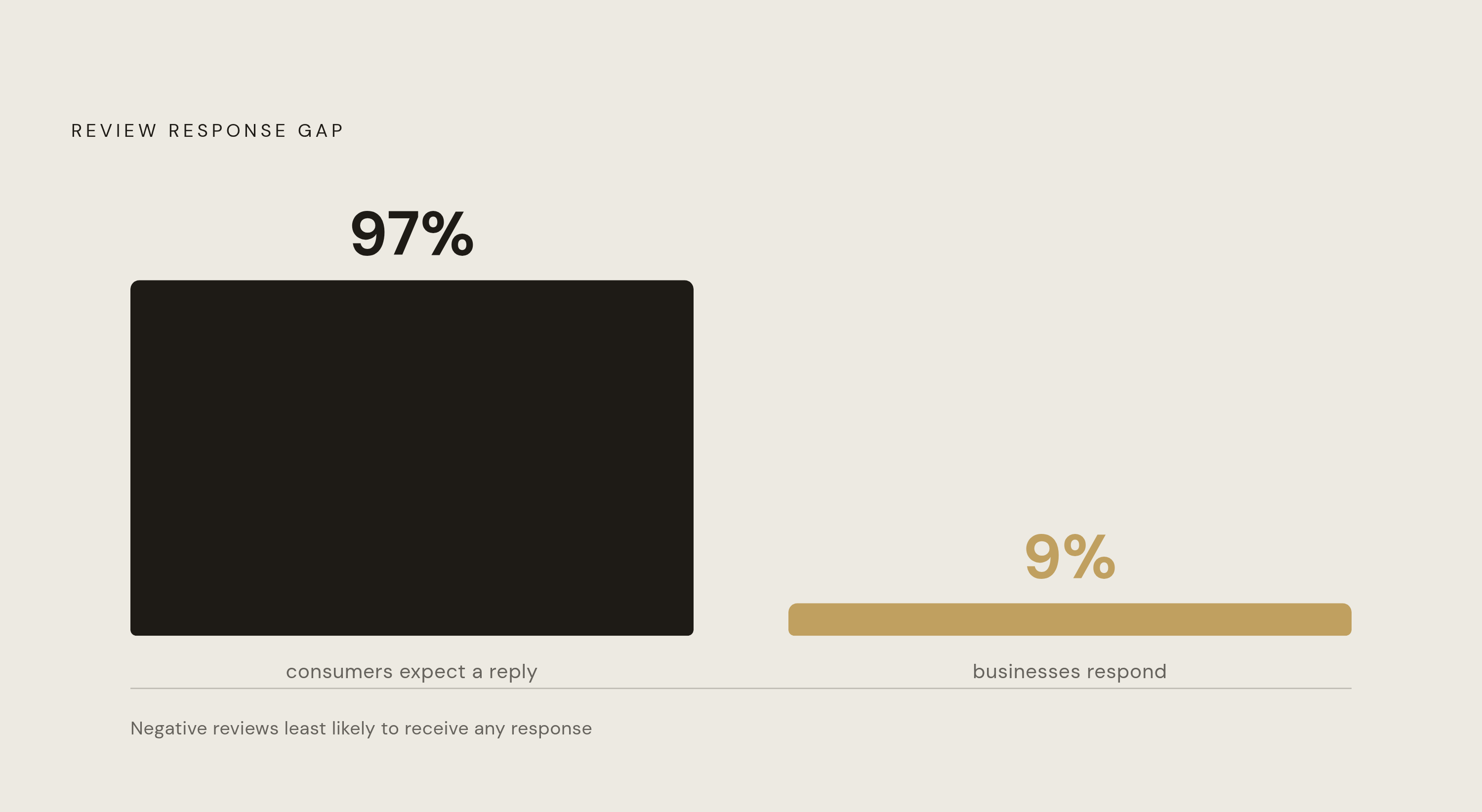
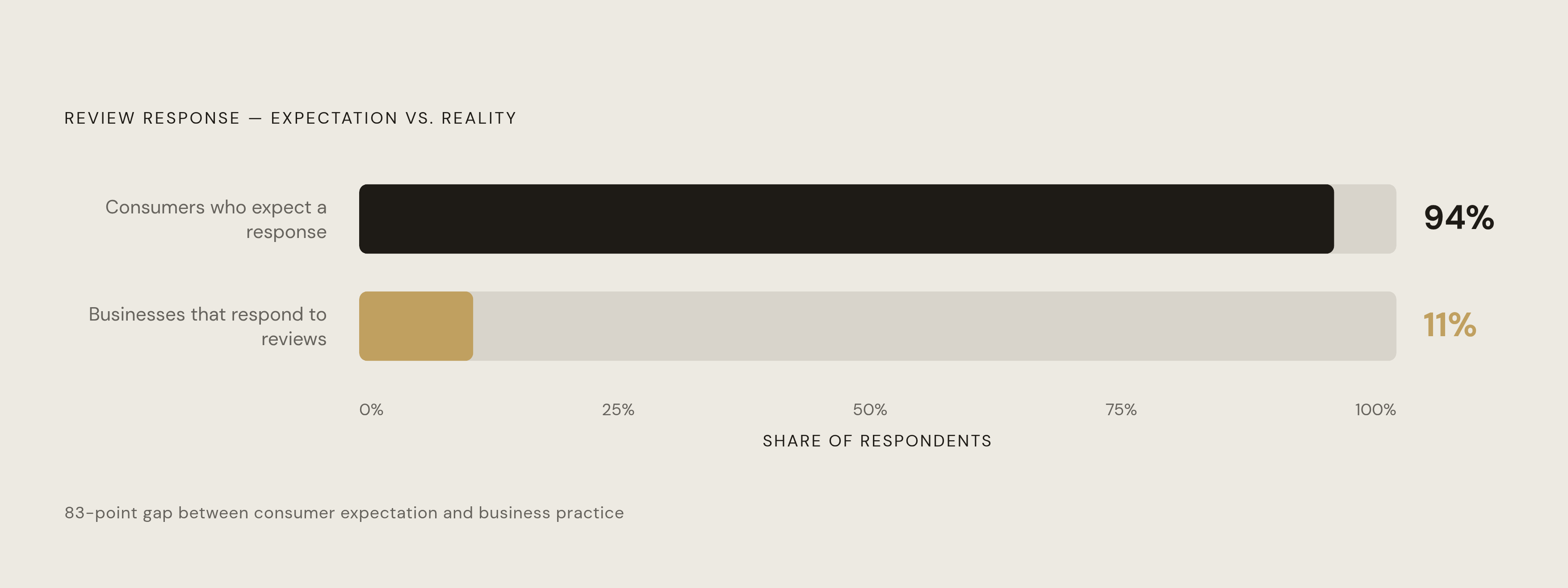
So why isn't every retail brand doing this? Because almost none of them are. Only a small fraction of businesses respond to their reviews at all, while the overwhelming majority of consumers expect a response when they leave one. Call it the widest expectation gap in local marketing: nearly everyone expects a reply, and almost nobody delivers one. Most reviews get no response whatsoever, and negative reviews are the ones most likely to sit there, untouched, doing quiet damage to every future shopper who scrolls past.
Call it what it is: an open lane. For a retail brand willing to build even a modest response habit, the gap is sitting out where competitors decided not to look.
Response time as a competitive variable, not an afterthought
Speed used to be a nice-to-have. It isn't anymore. Consumer patience for a reply has been shrinking fast, and the share of shoppers expecting a same-day response has been climbing just as fast, while the average business isn't close to keeping up. Most retail brands are behind the expectation curve before they've written a single reply.
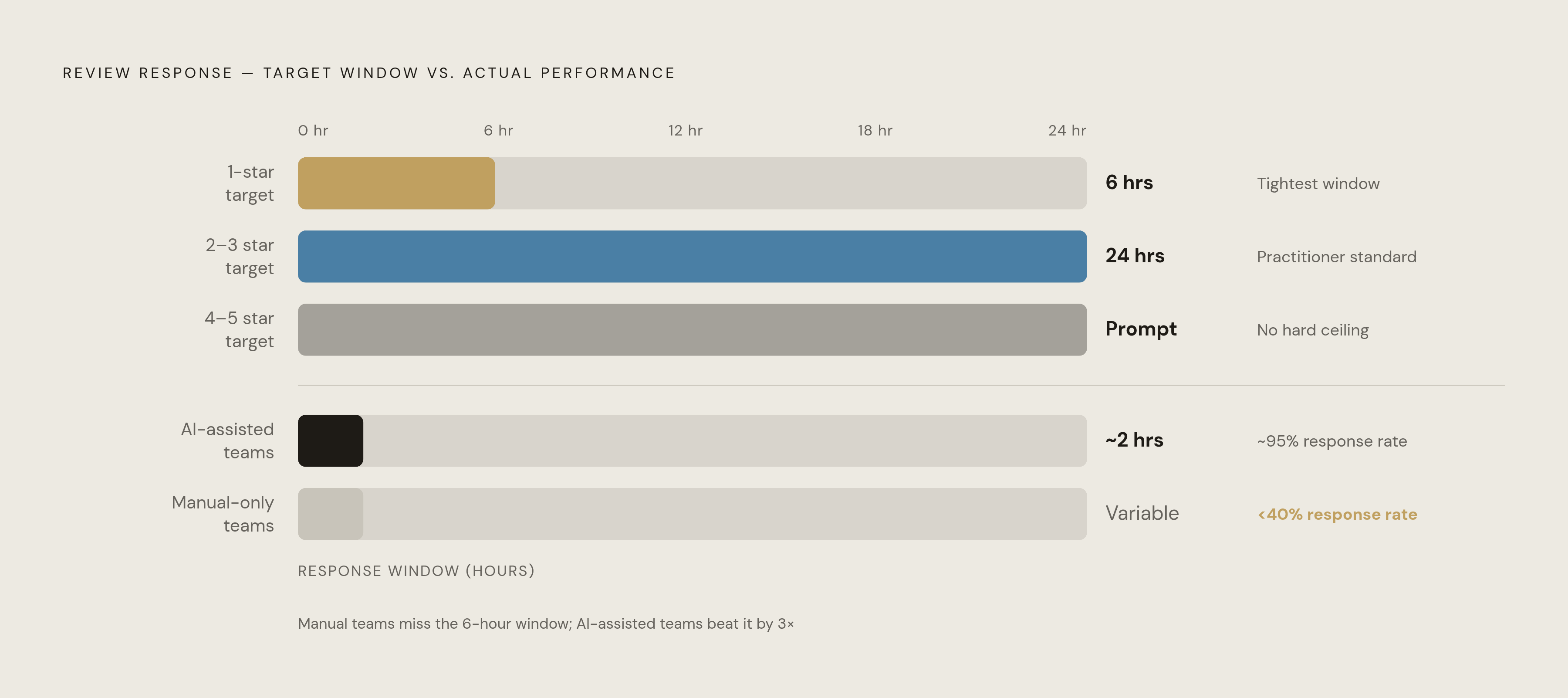
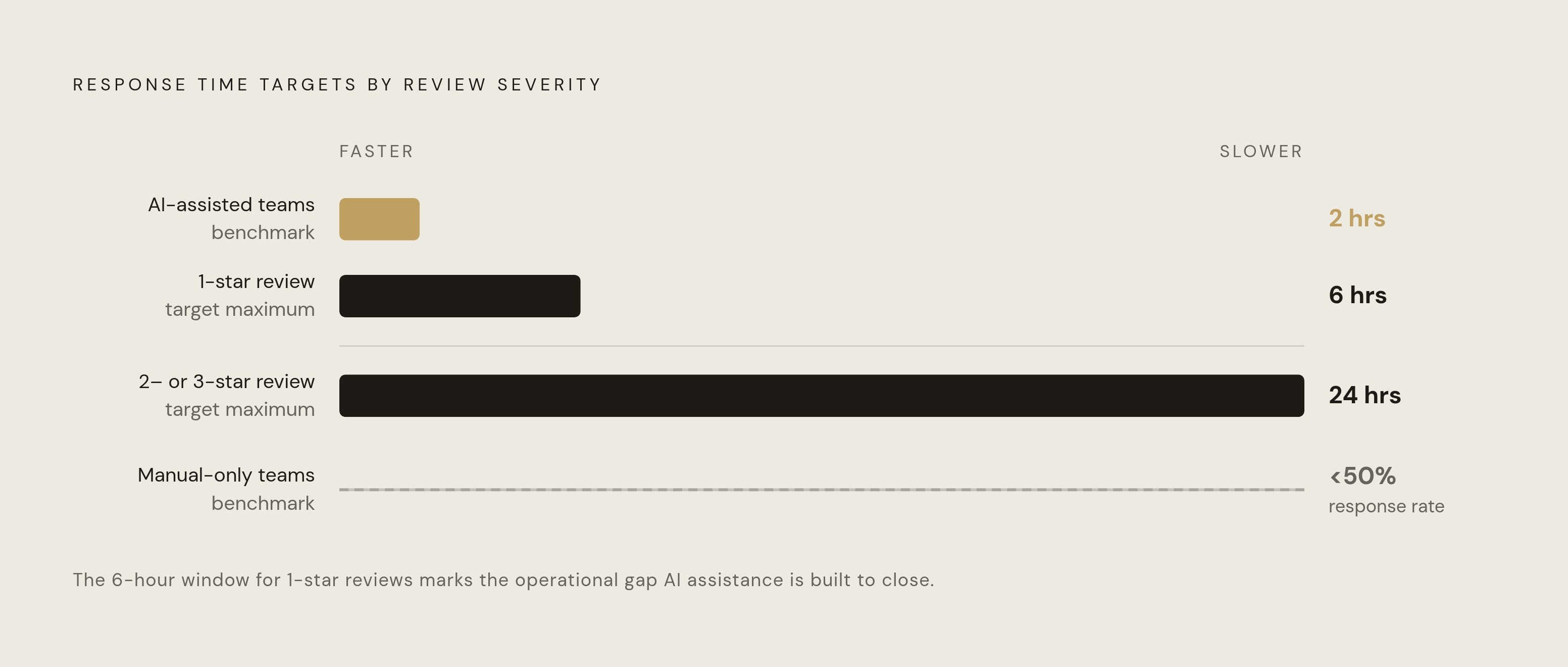
Negative reviews compress that window further. Practitioner consensus is fairly specific here: a one-star review deserves a response inside six hours, a two- or three-star review inside 24 hours, and positive reviews should still be answered promptly, since faster always signals a business that's paying attention. Six hours isn't a lot of time. It's roughly the length of one retail shift, which raises the obvious operational question.
How is a store manager, mid-shift, restocking shelves and running a register, supposed to hit a six-hour window on a one-star review about a bad fitting-room experience? Realistically, without some kind of workflow doing the watching, that manager can't, consistently, across every location, every week. That's a math problem more than a management failure, and pretending otherwise is where most "just respond faster" pep talks go to die. Manual response systems, run by a person checking a dashboard between customers, lose against a job with a six-hour clock on it almost every time. Businesses using AI-assisted drafting tools post response rates in the high nineties, compared to well under half for teams responding by hand alone, and top performers reply inside two hours. For a brand running fifty locations, a missed response window isn't one lost review. It's fifty separate, quietly compounding conversion losses, and the math on that adds up faster than most marketing leads expect.
How to respond to negative reviews in ways that recover trust and convert bystanders
Here's the mental shift that changes how a brand should write these responses: a reply to a negative review functions as the most-read copy on the entire Google Business Profile, closer to public testimony than private conversation with an angry customer. Shoppers are far more likely to zero in on negative ratings than positive ones, and most go looking for negative reviews on purpose, specifically to stress-test whether a business can be trusted. Writing one of these is closer to writing courtroom testimony than firing off a text message. Everyone's watching, and almost nobody involved is the actual reviewer.
That's also why the opportunity is bigger than it looks. Most unhappy customers will give a business a second chance if the response is handled well, and a solid share will go back and update their star rating after a good one. Businesses that respond to negative reviews consistently improve their overall rating over time, while businesses that let them sit there watch the average drag downward instead.
The formula that works is short, and it resists the urge to over-explain. Name the specific issue, not a vague "sorry you felt that way." Keep the apology brief, since length reads as defensiveness rather than sincerity. Offer a next step, not just a feeling. Then take the resolution offline with a direct contact: a name, an email, a number, so the public thread doesn't turn into a back-and-forth nobody asked to watch.
What kills a response faster than the original complaint did: matching the reviewer's tone, getting defensive, slipping in a promotional line about the weekend sale, or naming a staff member to blame them. All of it reads badly to the bystander scrolling through, and all of it is avoidable, including the templated opener. "Thank you for your feedback!" repeated across four hundred reviews reads as automation rather than consistent brand voice, and given how primed consumers already are to sniff out AI-generated text, a repeated template tells them nobody's actually reading these. Even so, the bar isn't perfection. A substantial share of customers say they'll still engage with a business after seeing a negative review, provided the response sounds professional. The response doesn't need to erase the criticism; it needs to show that a real person, with real judgment, is on the other end of it.
One tool worth knowing about, and using sparingly: Google does allow businesses to flag reviews that violate its policies. That's a last resort, not a first move, and it gets reached for far too often. Businesses that flag instead of respond are usually just avoiding the harder, more useful work. Sometimes flagging is warranted; usually it's overkill dressed up as a solution, and reviewers can tell the difference between a business defending itself and a business hiding from a fair complaint.
How to respond to positive and mixed reviews without wasting the opportunity
It's tempting to think positive reviews take care of themselves. They don't, at least not for the business's own reputation. Response rate across the whole profile, not just the negative slice, signals to prospective shoppers that a business is actually staffed by humans paying attention, and review engagement factors into local ranking signals. A profile sitting at 4.9 stars with zero responses looks abandoned. A profile at 4.3 with steady, thoughtful replies looks managed, and managed beats flawless almost every time. A rating shoppers can trust matters more than a perfect one, and chasing the second instead of the first is where a lot of review strategy goes wrong.
Research on trust patterns backs that up, and here's the part worth arguing with your own instincts about: a slightly imperfect rating, paired with consistent, specific responses, tends to build trust that holds up better under scrutiny than a pristine scoreboard with no engagement behind it. More stars isn't automatically more trust, and a brand chasing 5.0 as the goal is optimizing for the wrong number.
A good positive response does a few things at once, and none of them take long. It calls back the specific detail the customer praised, whether that's a product, an employee, or checkout speed, because specificity is what separates a real response from a form letter. It naturally works in the location name or product category, which happens to give a small SEO lift. And it invites a return visit or a referral without sounding like a coupon ad bolted onto a thank-you note. A positive review doesn't need an essay. It needs an acknowledgment that a person actually read it.
Mixed reviews, the three- and four-star range, are the ones retail brands fumble most, usually by ignoring them because they're not painful enough to demand attention. That's worth naming directly, because it's backwards: these reviews are often read by shoppers still deciding whether to visit, doing due diligence rather than damage control, which makes them more valuable real estate than the five-star reviews everyone's busy congratulating themselves over. The right move is to acknowledge what went well before touching the complaint, address the specific gap honestly without over-promising a fix, and skip the urge to treat a three-star review like a five-alarm crisis. It's a chance to show how a brand handles being merely fine instead of perfect, and that's often more persuasive than a wall of five-star praise.
Template fatigue is real, and it shows. The same opening line, repeated across hundreds of responses and dozens of locations, is a visible sign that nobody's customizing anything, and shoppers notice the pattern faster than brands expect them to.
Building a response system that retail teams can actually operate
None of the above works without a system behind it, because good intentions don't hit a six-hour response window on a Tuesday night when the store manager is closing registers. A working system needs four pieces functioning together, not four separate initiatives running in parallel and hoping to collide productively.
First, alerting and routing: somebody, or something, needs to know the instant a review lands, or the speed argument from earlier falls apart before it starts. Second, ownership. Does the store manager respond, does a central marketing team handle it, or does it run as a hybrid, with each setup trading speed against consistency and brand voice differently? Third, a short voice guide specific to review responses, covering tone, what belongs in a reply, what never belongs in one, and where the escalation triggers sit. Fourth, an actual escalation protocol for anything touching safety allegations, legal exposure, or a complaint that's gone viral, because those responses shouldn't be improvised by whoever happened to see the notification first.
AI-assisted response tools have a real, defensible role here, and it's narrower than most of the marketing around them claims. AI should not write the final reply that gets posted, full stop. Personalized responses consistently outperform generic ones, so the job of AI in this workflow is to draft fast enough that a human reviewer can check it, adjust it, and send it inside the response window instead of missing the window entirely. The wide gap in response rates between AI-assisted and manual-only teams points toward giving humans a faster starting draft so their limited attention goes toward the judgment calls that actually need it: whether a complaint needs escalation, or just a good, specific apology. Speeding up the human's first draft, then getting a human to actually read it before it posts, is the more useful ambition here, and any vendor pitching full automation on the final send is selling the wrong feature.
For brands running multiple locations, governance turns into a ranking issue as much as a brand issue. Locations carrying a strong volume of reviews with solid ratings are meaningfully more likely to get chosen by shoppers using Google, and Google accounts for the large majority of all online reviews across the retail sector, per Birdeye's 2025 State of Online Reviews report. That makes it the platform that matters most for a multi-location retailer, by a wide margin, with everything else trailing well behind. Centralized guidelines with local context built in hold up better than fifty locations improvising their own voice independently, once review volume gets too large for anyone to read every single one by hand.
What should actually get tracked, on a recurring basis: response rate by location, aiming well above the industry's typical response rate; average response time, benchmarked against the multi-day industry average as the line to beat; rating trend across rolling 90-day windows rather than all-time averages, since recency is what shoppers and Google both weight heaviest; the share of negative reviews that get an updated, improved rating after a response; and profile views plus direction requests as the downstream proof that any of this moved actual foot traffic.
None of it means much without new reviews coming in consistently, since most shoppers only weigh reviews from the last month. A response system built around a stagnant pile of two-year-old reviews won't do much good if nobody's feeding it. Review generation and review response function as one system, measured from opposite ends, and a retail brand that funds one without the other is paying for half a strategy and calling it whole.