Responding to Reviews on Google Places for Multi-Location Businesses
A system for responding to reviews across dozens of locations, and why it moves rankings.
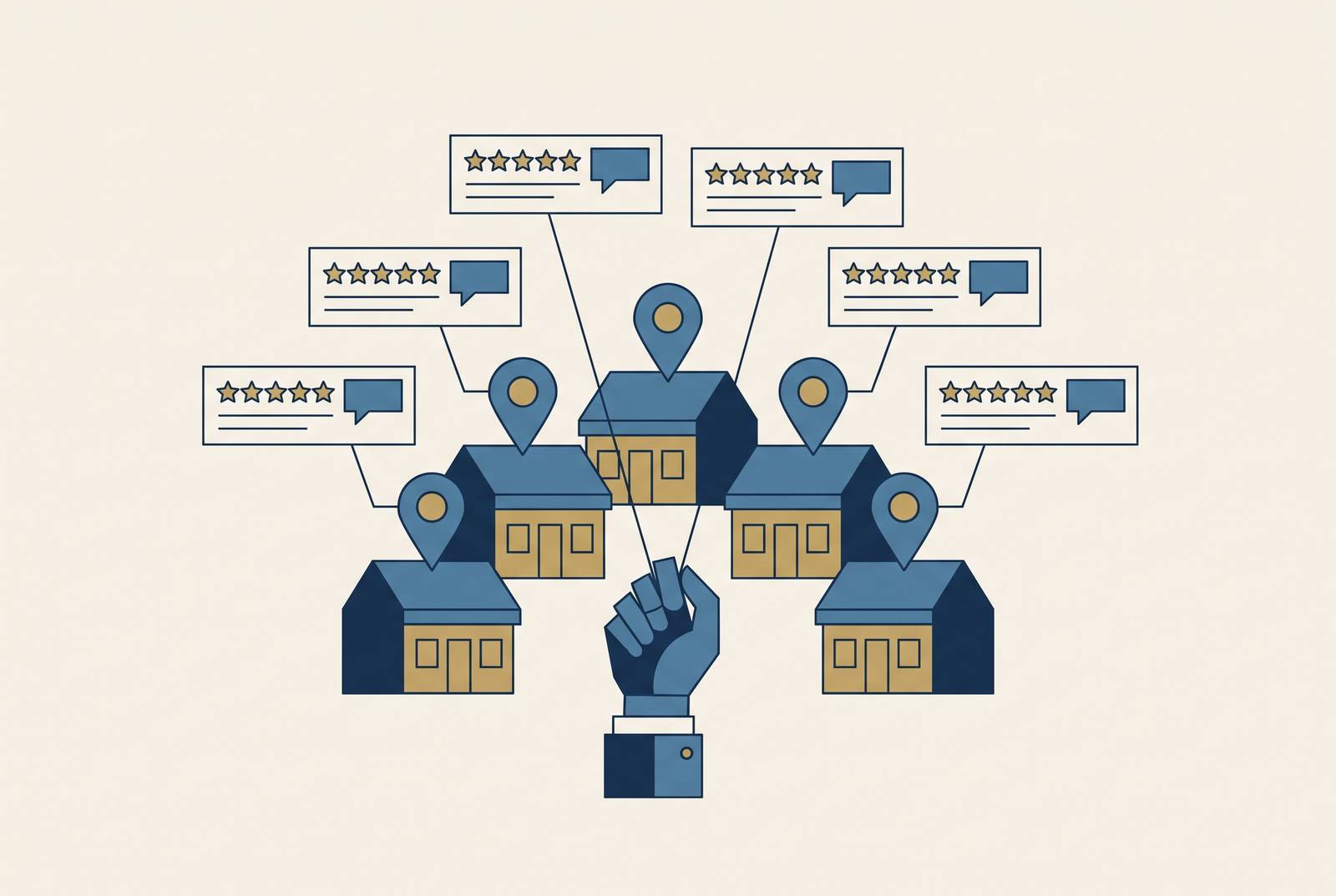
Google now hosts the majority of local business reviews, and it plays a meaningful role in determining how a business ranks in local search results. That single fact reframes review response from a customer service nicety into a ranking input, and for brands running more than one location, it turns a manageable task into a coordination problem with real math attached. This piece walks through that math: how responses move rankings, why the multi-location version of the problem breaks single-location habits, and what an actual system for handling it looks like end to end. Each section builds on the last, so by the time this gets to measurement, the framework should already be doing its job on paper.
How review responses affect local search rankings across every location
Google has said, plainly, that responding to reviews helps local rankings. This isn't a matter of interpretation or SEO folklore passed around in forums. Response activity is treated as a signal that can influence local rankings. Moz's analysis of local pack ranking factors puts review signals at roughly 15% of the total weighting, which means a brand ignoring responses is leaving one of the more controllable levers on the table.
Recency matters more than volume now. Review velocity reads as a signal of an active, trustworthy business, so a location generating recent reviews on a steady cadence can hold a meaningful ranking advantage over one sitting on older inventory. Consumers behave the same way: a large share only trust reviews younger than 30 days, treating anything older as background noise rather than current truth. So the profile that generates and responds to reviews at a steady clip is fighting a different fight than the one sitting on old inventory.
The prize for winning that fight is concrete. Businesses that land in the top three local pack results get dramatically more traffic and more conversion actions, calls, direction requests, site visits, than everything ranked below them. Every location in a multi-unit brand is competing for that same three-slot podium in its own zip code, which means a brand isn't managing one ranking problem. It's managing as many ranking problems as it has addresses.
There's a compounding effect worth sitting with here. One frequently cited finding is that simply starting to respond to reviews, with no other changes, lifts a business's average star rating by about 0.12 stars and increases review volume by roughly 12%. That's not a huge number in isolation. But stack it across 30 or 50 locations, multiply by the ranking weight review signals carry, and the aggregate lift starts to look less like a rounding error and more like a growth channel corporate hasn't been budgeting for.
And now there's a newer wrinkle: as AI-generated summaries increasingly appear in search results, the quality and consistency of a brand's review engagement may extend its relevance beyond the local pack alone. One multi-location automotive repair chain in Utah adopted a strict 24 to 48 hour response policy across its locations and saw local pack visibility rise 34%, with calls from Google Maps up 22%. That's one case, not a universal guarantee, but it's a useful illustration of what happens when the policy is actually enforced rather than aspirational.
The uncomfortable implication for multi-location brands: a strategy that polishes 10 locations while ignoring 30 doesn't produce an average outcome. It produces an uneven one, and the brand's aggregate search footprint gets dragged down by its weakest, most neglected profiles. Search engines don't average a brand's reputation. They rank each location on its own.
The specific operational problem multi-location brands face that single-location thinking cannot solve
Here's where the arithmetic gets ugly. A 2024 analysis from SOCi looked at nearly 3,000 enterprise companies, each with 50 or more locations, covering 2.8 million U.S. locations in total. The finding: the average multi-location brand ignores more than half of its reviews and leaves 90% of customer questions unanswered across search and social. Not a niche failure. The average.
That gap matters because reputational exposure at the local level rolls up to the brand level almost immediately. A large majority of consumers say that branch-level reviews affect how the whole brand is perceived, not just the individual location. A single bad thread of unanswered one-star reviews at a franchise in Tulsa doesn't stay in Tulsa. It becomes evidence, in a prospective customer's mind, about what the brand is like everywhere.
And the volume is concentrated on exactly the platform this piece has been building toward. Individual locations average around 111.5 Google reviews each, compared to 11.5 on Facebook and 9.6 on Yelp. Google isn't one review channel among several for a multi-location operator; it's where nearly all the volume actually lands, which is precisely why the earlier ranking math matters so much here specifically.
So what breaks, mechanically, once a brand tries to scale a single-location habit across dozens or hundreds of storefronts? A few patterns show up consistently. Different managers develop different tones, so one location sounds warm and personal while another sounds clipped and defensive, and a customer bouncing between two branches notices the inconsistency even if they can't name it. High-turnover locations, restaurant and retail especially, go quiet for weeks at a time whenever a manager leaves and nobody inherits the login. Negative reviews stack up before corporate even knows there's a problem, because nobody's watching that particular dashboard. And there's rarely a clear answer to who handles the review that mentions a lawsuit, or an injury, or gets picked up by a local news outlet.
The trend line is improving, to be fair. SOCi's data shows brands moving from responding to about 31% of Google reviews up to 37% over time. That's real progress. But 37% still means the majority of reviews across a brand's footprint get no reply at all, and improvement at that pace doesn't close a gap this wide on its own.
Piecemeal effort, one manager here doing a great job, one region there falling behind, doesn't solve a structural problem. It just produces uneven results that mirror the uneven ranking outcomes discussed above. What closes the gap is a system, which is the subject of the next four sections.
Choosing a governance model: who owns response at each location
Before any template gets written or any tool gets purchased, a brand has to answer a much more basic question: who's actually allowed to hit "post"? There are three real models here, and each one trades speed against control in a different way.
The centralized model puts a corporate team in charge of drafting and posting every response, across every location, no exceptions. It's the tightest version of brand voice control, and it's the easiest to audit for risk, since nothing goes live without someone accountable reviewing it first. The tradeoff is speed and local texture; a corporate responder in a shared office three states away doesn't know that the reviewer complaining about slow service was actually dealing with a broken point-of-sale system that day, and the response can read a little generic as a result. This model tends to fit regulated industries, healthcare groups, financial services, anywhere the cost of a wrong word is high enough that centralized control is worth the friction.
The decentralized model flips it: each location manager responds on their own, with their own judgment and their own login. It's fast, and it can feel more human, since the person replying actually knows the customer or remembers the visit. But it's also where brand drift comes from, the exact problem described in the last section, and it falls apart the moment a strong manager leaves and an untrained one takes over the account with no handoff.
Most multi-location brands land somewhere in between, and for good reason. In the hybrid model, corporate sets the policy, the tone guide, the template library, and the escalation rules, while individual locations personalize within those guardrails, adding the customer's name, the specific detail they mentioned, the particular fix that got made. Corporate handles voice consistency, quality checks, and anything that needs escalating. The location handles the human part. Every location needs a named owner for this, plus a backup, because ownership gaps are exactly what produce the silence described earlier.
None of this is a paperwork exercise. The governance model chosen here determines every downstream decision: what training gets built, what tooling makes sense, how escalation actually works. Skip this step and the rest of the system gets built on sand.
Building the response framework corporate sets and every location uses
The foundation is a brand voice document, and it needs to be specific enough to actually guide behavior, not just describe an aspiration. "Warm but professional" means nothing on its own; "warm but professional, never defensive, no exclamation points in negative responses" gives a manager something to check their own draft against. The same document should spell out prohibited language: never repeat a complaint's negative keyword back in the response, never admit liability, never make a promise the location can't keep.
On top of the voice guide sits a template library, organized by review type, because a five-star review with a paragraph of detail needs a different response than a five-star review with no text at all, and a mixed 3-star review needs something different again from a review with a genuine, specific complaint. A separate template covers the fake or mistaken review, the one left for the wrong location or clearly written by a competitor, where the right move is a calm correction and a flag for removal, not an argument in public.
There's a real SEO layer buried in this framework too, and it's worth being precise about it. Research into local SEO signals suggests that keyword relevance in the business's own response text may carry ranking weight in a way that review text alone does not. That means a naturally worded mention of a specific service or the city name in a response carries actual weight, but the operative word is naturally; stuffing keywords into every response is a fast way to look like spam, both to Google's systems and to the human reading it.
Last piece of the framework: escalation. Certain review types, anything mentioning legal action, a health or safety incident, or language likely to get picked up by media, need to route to a named contact at the regional or corporate level before anyone responds publicly. The rule here is simple and worth stating flatly: don't post a response to a sensitive review until the escalation path has actually cleared. A framework document that runs 40 pages and sits in a shared drive unread might as well not exist. If a location manager can't act on it in under five minutes, it needs to get shorter.
The technical infrastructure that makes responding at scale possible
Google's own tools have shifted meaningfully for multi-location operators. Business Profile Manager, at business.google.com, is the standard home base for managing profiles across locations. Inside it, Location Groups let a team make bulk edits, hours, categories, attributes, across every grouped profile at once instead of clicking through each one individually. Permissions work at the group level too, so an agency or regional manager gets access to an entire cluster of locations rather than being added one profile at a time, which matters a lot once a brand crosses into the dozens of locations. For networks above roughly 50 locations, the Business Profile API paired with a platform-level listings tool is the practical path forward, since manual management at that scale stops being realistic.
Third-party platforms exist specifically to fill that gap, and there are several established options in the space, Birdeye, SOCi, Yext, BrightLocal, Chatmeter, Reputation.com, Podium, and Uberall among them, each centralizing review monitoring, response workflows, and local SEO tracking under one dashboard. Evaluating any of them comes down to a short list of real capabilities: does it alert in real time when a new review lands, does it support a draft-and-approve workflow so corporate can check tone before something posts, does it manage templates centrally, and does it report performance at both the location level and the brand level.
AI-assisted drafting is now standard in most of these enterprise platforms, and Google is testing its own version of the same idea. AI-drafted response suggestions have been observed inside Google's own tools, with testing reported across multiple markets. What matters in any response, however it is drafted, is that the final text reads as genuine and accurately represents the business.
Real-time notification isn't optional at this scale, whatever the tool. Checking dozens or hundreds of profiles by hand, one login at a time, isn't a workflow, it's a hope. Automation is what turns monitoring into something that actually happens every day rather than whenever someone remembers to look. And for the writing itself, AI-assisted drafting paired tightly with the brand voice document from the last section can produce on-brand starting points that a location manager personalizes and posts, cutting the time-per-response without cutting corners on quality. The distinction that matters here is strategy first: a tool that encodes the brand's actual framework beats a generic generator spitting out interchangeable, forgettable text every time.
What a response actually needs to say — and what it should never do
Positive reviews are the easy case, and they still get botched constantly. The fix is small: use the reviewer's name if it's given, reference the one specific detail they actually mentioned, so the response reads like it was written by a person who read the review rather than a bot that scanned for a star rating. One relevant service or location term, worked in naturally, does the SEO work without tipping into keyword stuffing. An invitation back, or a nudge toward trying something else the location offers, does double duty as a retention play. None of this needs to run long. A three-sentence response that's specific beats a paragraph that's generic every time.
Negative reviews are where discipline actually gets tested. Lead with acknowledgment, not a defense of what happened. Never repeat the complaint's own negative language back in the response, because that phrase now lives twice in the indexed text instead of once, and it amplifies exactly what the location was trying to move past. Offer a specific, named path to resolve it offline, a direct line, an actual person's name, not just "please contact us." Don't promise a refund or an outcome that creates a liability the location can't actually deliver on. And respond even when the review feels unfair or exaggerated, because the person reading it later isn't the original reviewer; it's a prospective customer deciding whether silence means the brand doesn't care.
Even the reviews with no text at all deserve something back. A short, warm acknowledgment on a bare five-star rating is a small thing, but it's a human signal returned for a human signal given, and it costs almost nothing to send.
What never belongs in any response, at any location, under any governance model: arguing with the reviewer, correcting a factual error in public instead of handling it offline, sharing any personal information about the reviewer, slipping in promotional language that has nothing to do with their actual experience, or posting a copy-paste response that ignores what was actually written. A meaningful share of consumers, over half by some counts, report a more favorable view of a business specifically because the owner responded. That's worth sitting with for a second: the response isn't just a reply to one person. It's a signal broadcast to everyone who reads it afterward.
Keeping every location consistently active — training, accountability, and QA
A framework that only lives in one manager's head isn't a framework, it's a personality trait, and it leaves the moment that person does. Every location manager needs the same onboarding: the voice guide, the template library, the escalation protocol, and actual hands-on access to whatever tool the brand is using. Training that consists of handing someone a policy PDF doesn't work nearly as well as training built around worked examples, showing the same negative review answered two ways, one correctly and one poorly, so the manager can see the difference rather than infer it.
Accountability needs a name attached, not a department. Every location should have a primary responder and a designated backup, because the backup is what prevents the silence that shows up the moment someone quits or goes on leave. A response-time standard, 24 to 48 hours is a common benchmark, only means something if violations actually surface somewhere a regional manager will see them. And review response performance ought to factor into regional manager evaluations, not just the local manager's; regional oversight is what actually gives a policy teeth instead of leaving it as a suggestion nobody enforces.
QA has to happen on a schedule, not as an afterthought. Corporate or regional teams spot-checking a sample of responses each month catches tone drift and template overuse before it becomes a pattern. And it's worth looking for patterns specifically, not just individual mistakes; if three locations in the same region are all responding defensively to complaints, that's a training gap, not three unrelated bad employees. A shared dashboard tracking response rate and average response time by location does something simple but effective: it makes the numbers visible, and visibility changes behavior on its own, before anyone even has the conversation about it.
Staff turnover remains the single biggest cause of a location going quiet. A handoff checklist that explicitly includes review response access and responsibility, alongside the usual keys-and-badges items, closes that gap before it opens. And for locations that slip anyway, a centralized fallback matters: if 48 hours pass with no response, someone at corporate or regional picks up the queue rather than letting it sit.
Measuring whether the system is working across all locations
The metrics here aren't exotic, but they need to be tracked at the location level and the brand level simultaneously, because a strong brand average can hide a handful of locations quietly failing. Response rate is the obvious starting point: what percentage of reviews at each location actually got a reply, and how does that compare to the brand-wide average discussed back in the second section. Response time matters just as much, since a location that eventually responds to everything but takes three weeks to do it is still losing the recency advantage described in the first section.
Star rating trend over time is worth watching location by location rather than as a single blended number, since a brand average can mask one struggling location dragging the whole figure down. Local pack ranking position and AI Overview visibility, where trackable, tie the whole effort back to the search outcomes this piece opened with; if response rates climb but rankings don't move, something in the framework, the templates, the keyword integration, needs a second look.
None of these numbers mean much in isolation. What matters is whether they move together: rising response rates, shrinking response times, and improving star ratings across most or all locations, not just the flagship store corporate already pays the most attention to. That's the actual test of whether a system was built, versus whether a policy just got written down somewhere and mostly ignored, which, per the SOCi data cited earlier, is still the default state for most multi-location brands. Getting off that default isn't a one-time project. It's an ongoing operating habit, the same as inventory counts or payroll, just with a lot more public visibility attached to every mistake.