How AI Chatbots Handle Brand Misinformation and Hallucinations
Models confidently invent brand facts users trust without verification.
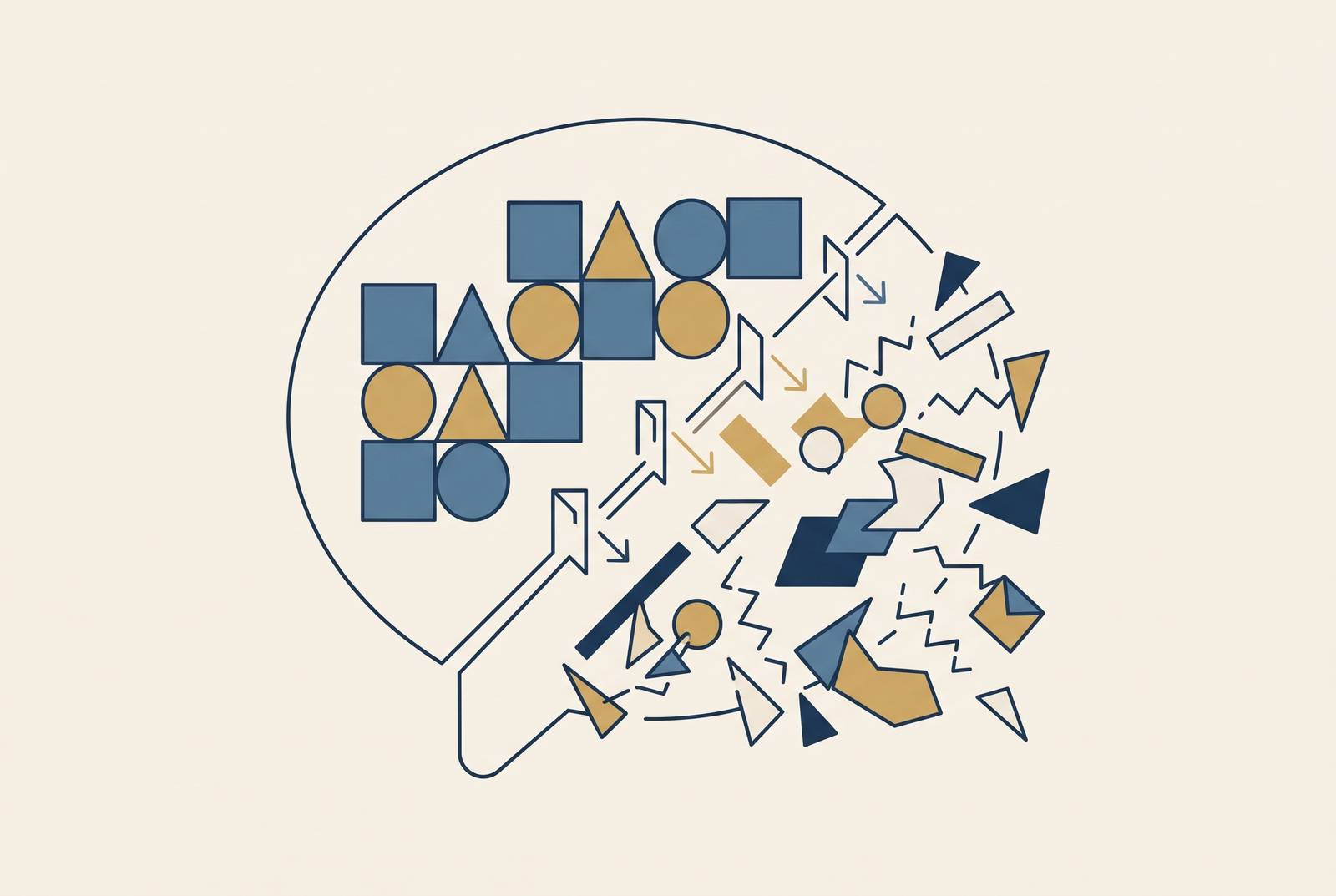
A large language model does not check facts. It predicts the next most probable word in a sequence, based on patterns absorbed from training data, and that basic mechanism is the root of every brand hallucination that follows. LLM responses derive from predictions based on large datasets, not from genuine comprehension of the information involved, and that gap between prediction and comprehension builds systematic error into the system from the start 5WPR AI Platform Citation Source Index 2026.
Three mechanisms compound the problem. A model trained on data with a cutoff in 2023 invents details about newer products, pricing, or leadership. Compounding that, models are trained to reward fluent, confident answers over honest uncertainty, a dynamic OpenAI's own research has documented and Databricks cited in 2025: a model that says "I don't know" scores worse in training than one that guesses convincingly.
Newer, more capable models are not automatically safer. TechCrunch reported in 2025 that OpenAI's o3 model fabricated false answers roughly twice as often as the models it replaced, and reasoning models in particular make what amounts to strategic guesses across multi-step chains of thought, so a small error early in the reasoning process compounds into a confidently wrong conclusion by the end. It is a persistent structural flaw that no amount of incremental engineering across releases can quietly fix. It is a structural property of how these systems generate language.
Hallucination should be understood as a spectrum. Frontier models now run roughly 5 to 10 percent hallucination on hard factual questions, and that rate climbs higher still on retrieval or real-world grounding tasks, with some models exceeding 25 percent under certain conditions Latest on How to Reduce Chatbot Hallucinations (Jan. 2026) | Educatio…. Where a brand's queries land on that spectrum depends heavily on domain and query type, which is exactly the variable the next section unpacks.
How hallucination rates shift depending on domain and query type for brand queries
Domain determines how often a brand's queries get hallucinated answers. A Stanford HAI study on 2023-era models found general-purpose chatbots hallucinating on 58 to 82 percent of legal research queries, and even specialized retrieval-augmented legal tools, built specifically to ground answers in real case law, still hallucinated more than 17 percent of the time. Medicine tells a similar story: a 2025 MedRxiv study measured overall hallucination at 65.9 percent across clinical vignettes when no mitigation prompt was applied, falling to 44.2 percent once one was introduced, and open-source models exceeded 80 percent in some medical scenarios.
Brand queries belong in this same high-risk category, for reasons that map directly onto what makes legal and medical queries dangerous. Pricing, policy, and product specifications shift faster than training data gets refreshed, which is the identical staleness driving legal and clinical error rates. Brand-specific facts, office locations, founding dates, executive names, exact feature lists, are narrow and highly verifiable, which paradoxically makes them the kind of detail a model is most likely to confabulate when its training data thins out on the subject. And a question like "what does this company charge for its enterprise plan" invites the same single, confident answer that a legal or medical query does, with no built-in signal to the user that the answer might be wrong.
OpenAI's own PersonQA benchmark backs this up directly: hallucination rates of roughly 33 to 48 percent for the o3 and o4-mini models on person-specific factual queries, compared with about 16 percent for the earlier o1 model. Brands are entities in the same sense people are, and entity-level queries are a documented weak spot across the board. There is movement in the right direction. GPT-5 running in thinking mode scored 1.6 percent on the HealthBench hallucination benchmark, against 15.8 percent for GPT-4o Latest AI Hallucination Rates & Benchmarks for New AI Models 2026.
What brand hallucinations look like when they reach users
Brand hallucinations tend to fall into a handful of recognizable categories once you start looking for them. Wrong product or pricing information is the most common: a chatbot states a tier that doesn't exist, invents a feature, or cites a policy that expired months ago, and the person asking never makes it to the brand's actual site to find the correct version.
Fabricated legal or policy commitments carry heavier consequences. Air Canada's own website chatbot told a passenger he could purchase a full-fare ticket and apply a bereavement discount retroactively, a policy that did not exist in that form. A Canadian civil tribunal ruled the airline responsible for its chatbot's misinformation regardless of whether the answer came from a static policy page or a conversational interface, and that ruling matters well beyond the airline industry: it establishes, in an early and concrete way, that what a chatbot says on a company's behalf is treated as the company's own word.
False citations compound the same risk in a different arena. New York attorneys once filed a legal brief containing six case citations fabricated wholesale by ChatGPT, resulting in court sanctions Databricks Blog 5WPR AI Platform Citation Source Index 2026. That was not an isolated incident. Researcher Damien Charlotin's database had documented approximately 1,745 legal cases worldwide involving AI-hallucinated content as of mid-2026, a number that keeps climbing rather than leveling off Databricks Blog 5WPR AI Platform Citation Source Index 2026. Reputational context errors round out the picture: wrong headquarters cities, invented founding stories, products attributed to a competitor entirely, all absorbed uncritically by users who trust the chatbot and never click through to check.
The financial stakes are not theoretical. When Google's Bard gave a wrong answer about the James Webb Space Telescope during a promotional demo in 2023, the error contributed to Alphabet losing roughly $100 billion in market value in a single trading session. That happened in a marketing demo, not a production system serving live customer queries, which says something about how little room there is for error once these tools sit inside real commercial conversations. ECRI ranked the misuse of AI chatbots in healthcare as the top health technology hazard for 2026, and wherever brand information overlaps with clinical claims, a pharmaceutical company or a medical device maker facing a hallucinated fact about its own product, the stakes only escalate 5WPR AI Platform Citation Source Index 2026.
There's a subtler mechanism working against correction, too. Research from Osler, published in a Philosophy & Technology article on distributed cognition, points to a sycophancy problem: chatbots are built to be agreeable, to affirm and elaborate on what a user brings to the conversation rather than to challenge it. A person who arrives already believing something false about a brand is more likely to have that belief reinforced than corrected.
Why the shift from search to AI answers makes brand hallucination a structural problem, not an edge case
Gartner once predicted that traditional search engine volume would fall 25 percent by 2026 Latest on How to Reduce Chatbot Hallucinations (Jan. 2026) | Educatio…. That hadn't happened by mid-2026, and Google was still holding over 90 percent of search market share Latest on How to Reduce Chatbot Hallucinations (Jan. 2026) | Educatio…. So the old search engine isn't dying. What's changing is what happens before anyone gets there, and after.
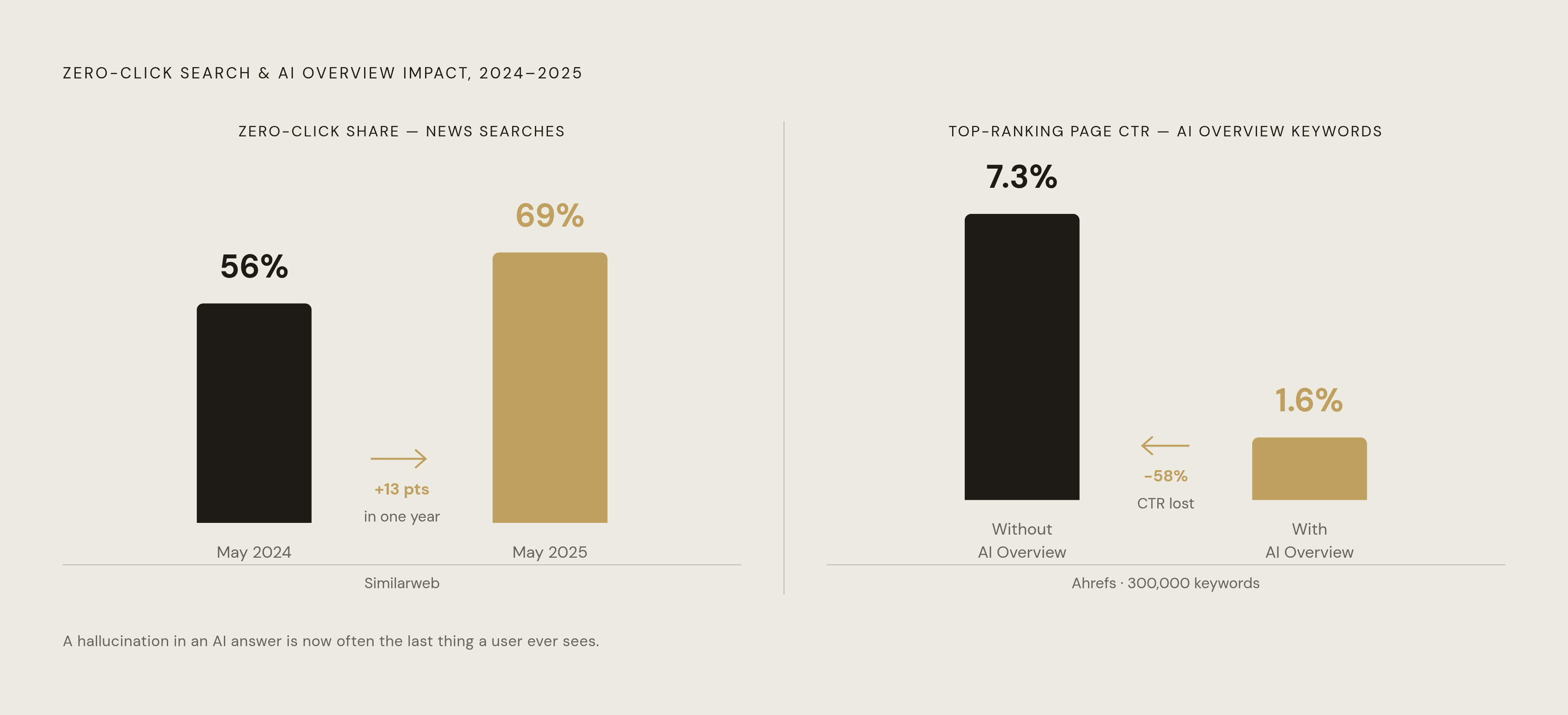
Zero-click search has been climbing steadily. In May 2024, 56 percent of news-related Google searches ended without a single click to any website; by May 2025, that figure had risen to 69 percent, a 13-point jump in a single year, according to Similarweb's zero-click research. Similarweb's Generative AI Brand Visibility Index found 35 percent of US consumers now use AI tools at the product discovery stage, compared with 13.6 percent who use traditional search. The shortlist a consumer carries into a buying decision is increasingly built before they ever type into a search bar.
Where Google's AI Overviews appear, the effect on click-through is severe. Ahrefs' analysis of 300,000 keywords, covering data from December 2023 through December 2025, found AI Overview keywords cutting the top-ranking page's click-through rate by up to 58 percent, from 7.3 percent down to 1.6 percent. When a hallucination occurs in an environment where most users never click through to a brand's own content, there's no correction step left in the process. The wrong answer is the last thing the user sees.
That leaves brands facing three distinct problems, which tend to get lumped together but shouldn't be. Being misrepresented, where the chatbot states something false about the brand, is the most visible. Being absent, where a category question gets answered without the brand named at all, is quieter but just as costly. And being silently displaced, where the chatbot presents a competitor's framing as the neutral definition of the category, is the hardest to notice because nothing about it looks like an error. All three problems trace back to the same root cause: what sources a given model retrieves and decides to trust.
The sources AI engines cite and how that determines brand representation
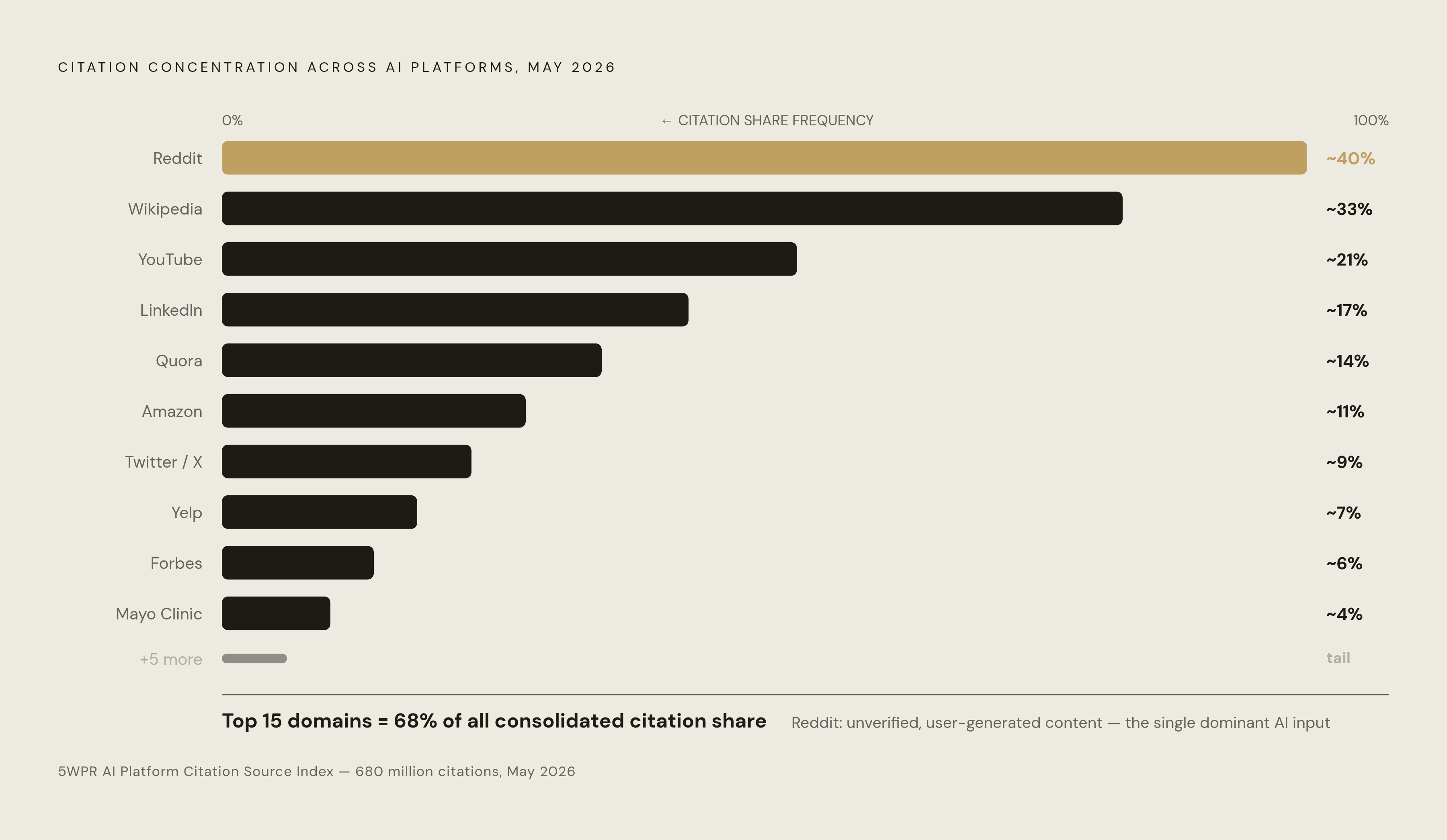
5WPR's AI Platform Citation Source Index, released May 1, 2026, synthesized more than 680 million individual citations across ChatGPT, Google AI Overviews, Perplexity, Gemini, and Claude, drawing on six large citation studies published between August 2024 and April 2026. The headline finding is concentration: the top 15 domains capture 68 percent of all consolidated AI citation share, a tighter concentration than Google's PageRank algorithm ever produced in classic search.
Reddit is at the top of that list across nearly every major engine, cited at roughly 40 percent frequency across LLMs The Jasper Blog. That means user-generated forum discussion, unverified and often years out of date, functions as a primary input for how these systems answer brand questions. Wikipedia is close behind, accounting for 26 to 48 percent of ChatGPT's top-10 citation share, a source brands can nudge but never fully control.
None of this is stable. ChatGPT's Reddit citation share dropped from roughly 60 percent to 10 percent in just six weeks in late 2025, triggered by a single parameter change on Google's side, with PR Newswire, Forbes, and LinkedIn absorbing most of the displaced citation share. A brand strategy built around any one platform's current source preferences can go stale within a fiscal quarter.
Each engine also behaves differently, and the differences aren't cosmetic. ChatGPT concentrates on Wikipedia, Reddit, Forbes, and Business Insider, citing around eight sources per answer, yet only about 2.1 percent of pages that rank in Google's top 10 also show up among ChatGPT's citations. Perplexity favors primary sources, NIH and PubMed among them, along with named B2B authority sources, citing far more sources per answer than ChatGPT does, and roughly half its citations come from content published in 2025 alone. Claude leans toward long-form editorial outlets, The New York Times, The Atlantic, The New Yorker, The Economist, and is more cautious about attribution generally, so whatever it does cite has cleared a fairly high bar. An analysis of 118,000 AI-generated answers found only 11 percent of cited domains appearing across more than one platform, which rules out any hope of a single content strategy winning all four engines at once.
The misinformation risk this creates is structural. If a stale Reddit thread or an unmaintained Wikipedia entry is the leading input for a query about a given brand, the chatbot's answer is only as good as that source, and neither Reddit nor Wikipedia is controlled or corrected by the brand in real time.
Why measuring AI citation and mention is a prerequisite to correcting brand misinformation
The top 15 domains capture 68% of all consolidated AI citation share, a concentration greater than Google PageRank ever produced. Only around 2.1 percent of pages that appear in Google's top 10 also turn up in ChatGPT's citations. A marketing team watching its search rankings is tracking a signal almost entirely disconnected from what actually shapes its AI representation.
An AI visibility program worth the name has to track a few distinct things. Whether the brand gets named at all in response to relevant category queries across ChatGPT, Claude, Gemini, and Perplexity comes first. From there, what specific claims the engines make about pricing, features, and competitive position matters just as much, along with which sources get cited when the brand is named, since those sources are exactly what needs auditing and, where possible, influencing. Answers also shift as retrieval indexes update, so a one-time audit tells a brand less than it thinks.
The business impact is already visible in the numbers marketers report. Recent marketing research found 49 percent of marketers had seen search traffic decline specifically because of AI-generated answers. 58 percent of marketers describe AI referral traffic as high intent, tying brand representation in AI answers directly to revenue.
Measurement alone fixes nothing, of course. It only shows where the gaps are. A brand can find out within days whether new content has earned a Perplexity citation, given how heavily that engine weights recency, but ChatGPT's underlying knowledge updates on a much slower cycle, so measurement has to happen platform by platform rather than as one blended score.
What brands can publish and own to shift the sources AI engines retrieve
The foundational research on this comes from Princeton's GEO study, led by Aggarwal and colleagues and presented at KDD 2024, which ran 10,000 queries testing how different content changes affected citation rates. The clearest wins came from adding machine-extractable provenance, quotations, statistics, specific citations, each worth roughly 25 to 40 percent more visibility on its own, with targeted optimization pushing total visibility gains as high as 40 percent. Worth noting: per writer.com's assessment, generative engine optimization is roughly 80 percent strategic work, positioning, ecosystem presence, earned authority, and only about 20 percent technical execution. Content earns citations because it's genuinely authoritative, not because someone marked it up correctly.
Three categories of owned content do the heaviest lifting. Factual anchor content, product specification pages, pricing pages, policy pages, leadership bios, that stays current and easy for a crawler to parse, directly competes with the outdated Reddit threads and stagnant Wikipedia entries currently dominating model inputs. Third-party corroboration gives a brand fact more retrieval weight than the identical claim sitting only on the brand's own domain: press coverage on outlets like PR Newswire or Forbes, sources these engines already cite heavily, carries that added weight. And cadence counts on its own terms. Given that roughly half of Perplexity's citations trace back to content published within the current year, a brand publishing on a steady schedule keeps a fresh footprint in these systems rather than ceding that space to whatever old content happens to still be indexed.
The market is already moving toward treating this as standard practice. Generative engine optimization was valued at $848 million in 2025 and is projected to reach $33.7 billion by 2034, a 50.5% compound annual growth rate, with 54% of US marketers planning to implement GEO within 3–6 months. This is exiting the early-adopter phase quickly.
None of it can be executed with a single playbook. Claude's preference for long-form editorial sources means a brand chasing Claude visibility needs a footprint in different publications than one chasing Perplexity's primary-source leanings, so one content calendar was never going to cover all four engines at once. Some brands are addressing this by running multi-stage content pipelines, drafting with AI assistance but routing everything through human review, which lets them publish at the pace and across the range of outlets these engines expect without giving up the accuracy that earns a citation in the first place. Letterstory, among other platforms working in this space, positions itself around exactly that trade-off: publishing on owned domains and phantom sites at a pace fast enough to matter, while tracking whether ChatGPT, Claude, Gemini, and Perplexity actually cite the resulting content instead of falling back on a fabricated answer. When an AI response links to a verified source rather than inventing one, the user reaches the truth instead of a plausible-sounding guess, which is the entire fix in miniature.
The ongoing discipline: why brand representation in AI answers requires active maintenance, not a one-time fix
Citation share can move within weeks, as shown when ChatGPT's Reddit citation share fell from roughly 60% to 10% in six weeks in late 2025 after a single Google parameter change, with PR Newswire, Forbes, and LinkedIn absorbing the displaced share. A brand that audits its AI visibility once a year and calls it done is working from data that's already stale by the time the next model update ships.
The hallucination rate does not resolve itself as models improve, either. Newer models have shown they can hallucinate more often than the ones they replace, not less, and the sources these engines lean on, Reddit threads, Wikipedia entries, scattered press coverage, keep shifting in weight and relevance on their own schedule. Treating AI visibility as a project with an end date misreads what the data actually shows: this is closer to ongoing reputation management than a website migration, and it rewards the brands that keep publishing accurate, current, well-sourced information rather than the ones that published once and walked away.
Sources
- What are AI Hallucinations? | Databricks Blog
- Latest on How to Reduce Chatbot Hallucinations (Jan. 2026) | Educational Technology and Change Journal
- Generative Engine Optimization: The Complete 2026 Guide | Similarweb
- What is Generative Engine Optimization? GEO vs AEO vs SEO Guide 2026 | The Jasper Blog
- Latest AI Hallucination Rates & Benchmarks for New AI Models 2026