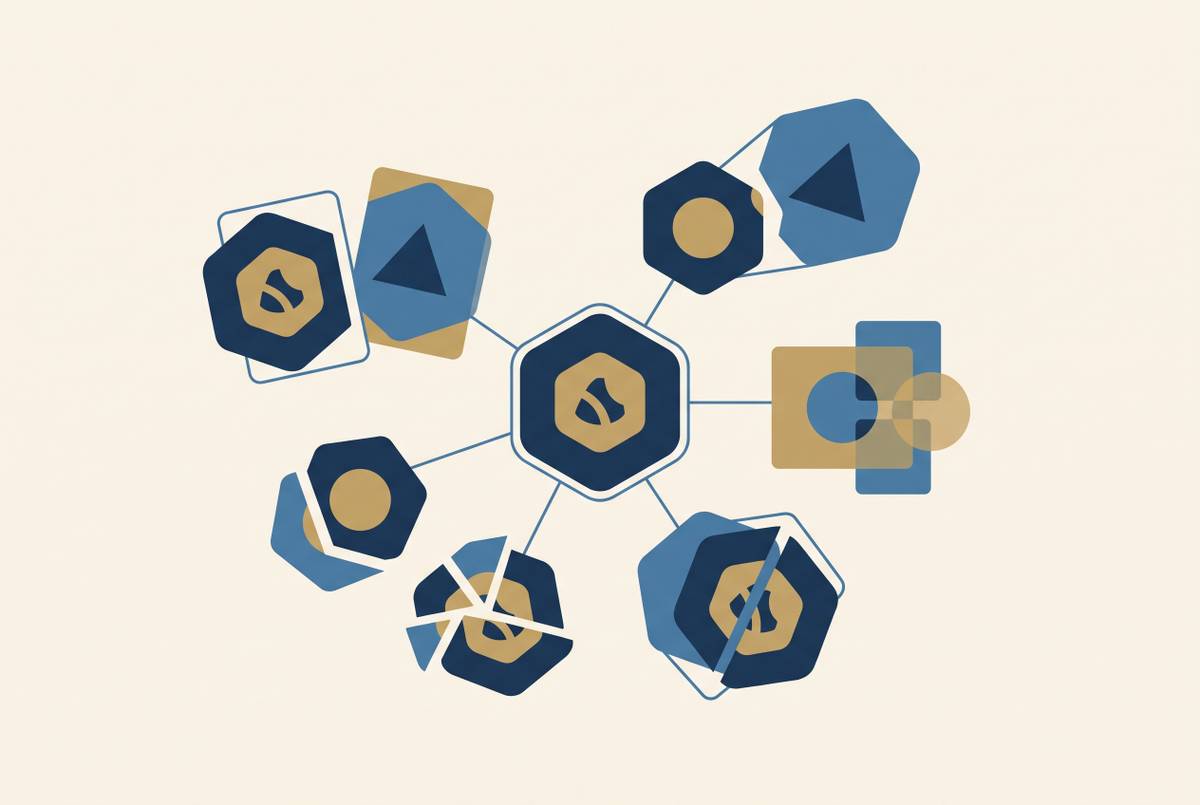
Diagnosing a Branded Search Volume Drop
Falling branded searches may signal migration to AI, not actual demand loss.
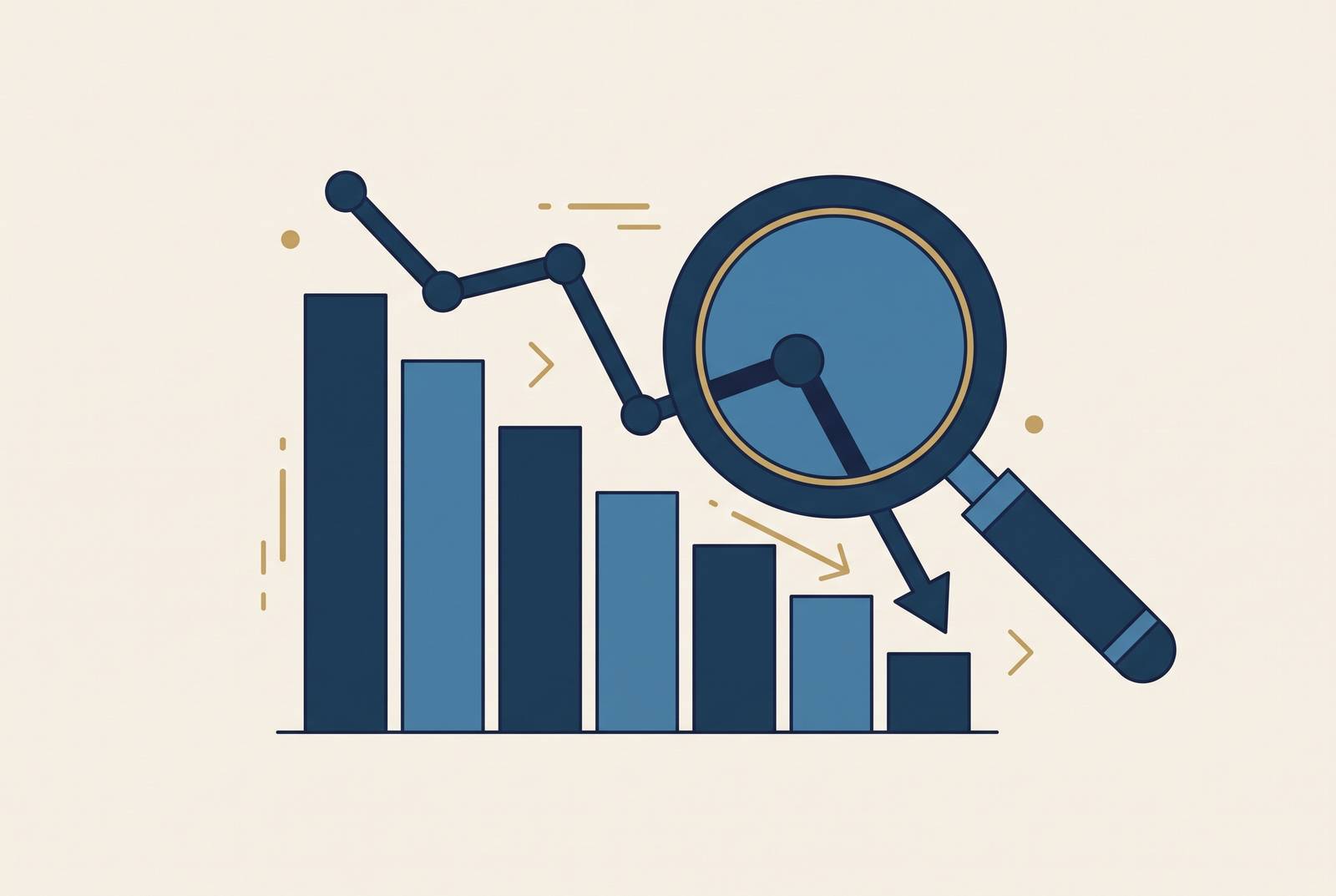
A branded search volume drop in 2026 does not automatically mean fewer people want a brand. The same demand is as likely to now appear somewhere the marketing team's dashboard cannot see. Gartner forecast that traditional search engine volume would fall by a quarter by 2026 as generative AI became a substitute answer engine for queries that used to run through Google, and that forecast now tracks close to what multiple 2026 sources are actually observing. Two things are happening on top of each other. On Google itself, AI Overviews now appear on roughly half of all queries, and when they do, organic click-through rate drops sharply, so both the number of searches and the yield per search fall at the same time. ChatGPT and Perplexity together handle billions of queries per month that never touch a traditional results page. A person who once typed a company's name into Google and clicked through to the homepage can now ask an assistant to "tell me about [brand]" and get a full answer without ever generating a Google impression or a click. The demand didn't disappear.
Why standard dashboards cannot distinguish migration from erosion
The tools most marketing teams use to monitor brand demand were designed for a search landscape that no longer covers the whole territory. A branded search volume drop in 2026 is as likely to reflect where intent went as whether brand demand shrank, because a growing share of queries that used to produce a search now end inside an AI answer engine that never sends a click. It has no way of knowing whether a brand is being named, cited, or recommended inside an AI-generated answer, so a team staring at a falling branded-volume chart cannot tell "people stopped wanting us" from "people are getting their answer about us somewhere the dashboard doesn't reach". Brand visibility in 2026 spans at least three separate surfaces, classic organic search, Google's AI Overviews layered on top of that same search, and standalone AI answer engines like ChatGPT, Perplexity, Claude, and Gemini, and each surface runs on its own retrieval logic and produces its own, largely disconnected signal. Only a small share of domains get cited by both ChatGPT and Perplexity at once, so strong visibility on one engine says almost nothing about standing on another, and a team checking a single engine can walk away with a false sense of security or a false alarm.
There's a further wrinkle that makes the picture harder to read. A brand can be well-cited once a user already knows it and nearly invisible at the top of the funnel during discovery prompts, two very different problems that look the same in a report. A team that watches branded volume fall with no AI visibility data at all will tend to reach for the brand-health explanation by default, because it's the only story the available data can tell, and that instinct can trigger repositioning work, new campaigns, or budget cuts aimed at a problem that was never the real one. A team whose branded volume looks stable may be losing ground in AI answers without knowing it, because AI discovery and branded Google search are not substitutes for each other.
What a correct diagnosis actually requires: separating the three causes
A rigorous diagnosis must separate three distinct causes that can each produce an identical signal: genuine brand erosion, search-to-AI platform migration, and Google-internal suppression via AI Overviews, because the right response to each is completely different.
Genuine erosion is the cause a team should hope not to find, but it is verifiable. Real erosion appears as several independent signals moving down together: branded search volume falls, direct traffic falls, brand mention share in earned media falls, and unaided recall in surveys falls. If branded Google volume is the only line moving while direct traffic, media mentions, and recall all hold steady, erosion is unlikely to be what's actually driving the number.
The second cause sits entirely inside Google's own results page. AI Overviews now appear across a large share of queries, and when they appear, organic click-through rate drops sharply, even in cases where the brand is named inside the overview itself. Impressions hold steady while clicks and CTR fall: the brand is still being surfaced to searchers, but the click is being intercepted before it reaches the site. Seer Interactive's research, cited in Arc Intermedia's 2026 case study, found that being cited inside an AI Overview actually produces a higher click-through rate than an equivalent plain organic listing. The brand either appeared as a named source inside a given query's AI Overview or it did not. It's whether the brand was named as a source inside it, because that single fact separates a brand losing clicks to Google's own interface from a brand losing visibility entirely.
Standard tools cannot see the third cause. Off-platform migration is invisible to standard dashboards entirely and requires direct interrogation of the AI engines themselves. One useful tell comes from direct traffic: research suggests that stronger AI visibility tends to correlate with rising direct traffic over time, so a branded search decline paired with direct traffic that's holding or climbing is a strong hint that migration, not erosion, explains the drop. Brand visibility runs across at least three distinct surfaces: classic organic search, Google AI Overviews, and standalone AI answer engines such as ChatGPT, Perplexity, Claude, and Gemini.
The signals that reveal AI visibility (and what they show about where brands actually stand)
That data isn't uniform across engines, because each one runs on a different citation mechanism. ChatGPT leans on training-data recall combined with live browsing, Perplexity relies on citing live sources directly, Gemini folds in signals from Google's own search index, and Claude draws mainly on training-data recall and category association. Tracking only one of these and generalizing to the others is a mistake, given how little citation overlap exists between engines.
The discovery-versus-branded gap needs its own measurement track, separate from branded-query performance. A brand can score well when someone already knows to ask about it by name, and score poorly on the category or comparison prompts that a prospective customer types before they've heard of any specific brand, and those are two distinct problems that call for two distinct fixes.
The stakes of getting this measurement right are not evenly distributed, and the numbers make that concrete. Seer Interactive's analysis, run across billions of impressions, dozens of brands, and millions of queries over fourteen months, found that brands cited inside an AI Overview earned dramatically more organic clicks per impression than uncited brands competing on the exact same query, and that being referenced as a source inside an AI-generated answer also produced a large lift in that brand's paid click-through rate. Traffic referred from AI engines still makes up a small share of total sessions, but it converts at a far higher rate than traditional organic visitors. Ahrefs found that AI search accounted for a tiny fraction of total sessions while producing a disproportionately large share of sign-ups. That asymmetry, a small number of visits converting far above their weight, is the reason citation status is worth measuring with the same rigor as organic rank, not treated as a secondary metric.
Exposure to this problem also varies sharply by industry, and that variance should set the pace of response. The majority of healthcare and B2B technology queries now trigger an AI Overview, while finance sees far fewer, so a healthcare or B2B brand has considerably more riding on its AI citation status than a finance brand does at the same moment.
Tools that actually measure AI brand visibility across engines
The minimum tracking set covers ChatGPT, Perplexity, Claude, Gemini, and Google AI Overviews, each treated as a separate channel with its own citation rate and source position signals. That set tracks mention frequency in recommendations for ChatGPT.
Purpose-built AI monitoring platforms now exist because traditional SEO tools were never designed to track how ChatGPT, Perplexity, Gemini, or Claude reference a brand, and each platform requires a different measurement approach. Profound tracks brand visibility across more than ten AI engines, including ChatGPT, Perplexity, both of Google's AI formats, Gemini, Copilot, Meta AI, Grok, DeepSeek, and Claude, and the company raised a large Series C at a unicorn valuation in February 2026, a signal of how much institutional money is now betting on this category. Semrush One, Evertune, and OpenForge are also built to monitor how AI engines reference a brand, each with its own approach to the same underlying question. PR Newswire expanded its AEO and GEO Brand Report into the APAC region on September 28, 2026, aiming the product at PR, marketing, and investor relations teams that need to move past traditional SEO metrics, with the underlying data powered by Trajaan, a search intelligence platform recently acquired by Cision. That expansion, alongside Profound's funding round, points to a category that institutional money and established media infrastructure are both moving into at the same time.
None of this is useful if it's only run against branded queries. Measurement should run at both the branded and the discovery-prompt level: a brand that performs well on branded queries but poorly on category prompts has a top-of-funnel visibility problem.
What determines whether a brand gets cited and where authority beats formatting
Citation is governed primarily by brand authority and ecosystem presence rather than technical formatting tricks, so the question of why a brand isn't being cited usually traces back to content quality, third-party coverage, and the signals search engines group under E-E-A-T. AI systems select sources through a retrieval-augmented generation pipeline: they crawl available content, identify passages that are semantically relevant to the query, weigh those passages against E-E-A-T signals, and only then pick a small number of sources to cite in the final answer. Content has to survive all three stages to get cited at all, and the opening of a page carries outsized weight in that process, since a large share of LLM citations pull from the first portion of a document rather than material buried further down. A page that links out to a verifiable study or an official dataset gives the AI system something to check its own retrieval against, and that verification step is what turns a claim on a page into something the model treats as citable fact rather than mere assertion.
The signal most teams underweight appears off their own site. Academic research from 2025 and 2026 found that AI search leans heavily on earned media, meaning coverage from independent, authoritative third parties, over content and social posts a brand publishes itself. Wikipedia and Reddit rank among the most influential source categories across the major large language models, and mentions across YouTube and the broader web correlate strongly with how visible a brand is inside ChatGPT specifically. That makes analyst coverage, presence on peer-review platforms, features in industry publications, and active community engagement direct inputs into the probability of getting cited, not simply goodwill exercises run by a PR team on the side.
None of this justifies chasing every tactic marketed under the GEO label. Practitioners who have run controlled tests report that several widely recommended tactics, llms.txt files, content chunked specifically for AI parsing, and copy rewritten for machines rather than for human readers, are not required to get cited. A more fundamental objection follows from that finding: brands that already rank well organically, get cited in AI Overviews, and earn strong click-through rates may simply share the same underlying E-E-A-T strengths, and if that's the real mechanism, the correct response is to build brand authority, not to chase technical GEO fixes that only look like they're doing something. The content patterns that correlate negatively with citation, keyword stuffing and overtly promotional copy, are the same patterns that erode trust with human readers, which suggests the signals that earn AI citation and the signals that earn human trust are, at bottom, the same signals.
How to respond once the diagnosis is made: matching the fix to the actual cause
The value of separating erosion, AI Overview suppression, and platform migration is that each diagnosis points to a different fix, and applying the wrong one wastes both budget and time.
If the data points to genuine erosion, falling branded search alongside falling direct traffic, falling earned-media mentions, and falling unaided recall, the answer runs through brand-building fundamentals: product performance, customer experience, and the kind of sustained media and community presence that shows up in the E-E-A-T signals AI systems already weigh heavily. This is not a technical problem, and no monitoring tool or markup change will substitute for rebuilding actual demand. Fixing this requires understanding how AI systems select sources in the first place.
AI Overviews appear on roughly half of all Google queries, and organic CTR drops sharply when they do, so the priority when the pattern points to Google-internal suppression is earning citation inside the AI Overview itself. That means treating AI Overview citation as its own optimization target, tracked separately from traditional ranking position.
If the evidence points to off-platform migration, branded Google volume falling while direct traffic holds or climbs and AI engines show real query volume around the brand's category, the response has to start with the engines themselves. That means building the third-party authority signals, earned media, analyst coverage, Wikipedia and Reddit presence, that these engines actually draw on, and it means tracking citation rate, source position, and category association across ChatGPT, Perplexity, Gemini, and Claude individually, since strength on one engine offers no guarantee of strength on another. In every case, the fix follows the diagnosis, and no diagnosis is complete until a team has actually looked at what the AI engines themselves are saying about the brand, because that is the one part of the funnel no traditional dashboard was ever built to show.
Sources
- Gartner Predicts Search Engine Volume Will Drop 25% by 2026, Due to AI Chatbots and Other Virtual Agents
- Case Study Article: Impact of AI Search on Users & CTR in 2026
- Gartner Predicts 25% Search Volume Drop by 2026: What It Means for Your Business
- AI Search vs Google Search in 2026: 40+ Stats That Show Why Your Brand Needs to Track Both
- PR Newswire Launches AEO & GEO Report for AI Brand Visibility