Share of Voice Measurement in Competitive Content Markets
AI search is now a major venue for brand discovery, yet most marketers aren't measuring it.

Share of voice measurement has a formula that hasn't changed in decades, even as the channels it applies to keep multiplying. The math stays fixed; what's under debate in 2026 is whether marketers are pointing that formula at the right places.
What share of voice measures, using a formula that stays the same across channels
SOV is a ratio, and it's always been a ratio: your brand's metrics divided by the total market's metrics, times 100. That's it. The formula counts ad impressions, social mentions, or keyword rankings alike; the logic holds no matter what you feed it. It started in paid advertising, where it measured ad spend and air time against competitors buying the same slots, and from there it spread outward: search, social, PR, earned media, all of it eventually got folded into the same basic accounting exercise.
What actually changes from channel to channel is just the numerator and the denominator. On social, the numerator is mentions. In paid search, it's impression share. In SEO, it's how much of the keyword landscape your organic listings cover. The units shift, but you're still asking the same question: how much of the total conversation belongs to you?
It exposes SOV's biggest limitation right up front: the formula (your brand metrics ÷ total market metrics) × 100 is channel-agnostic even though the inputs change. It only means anything in relation to a total. Anyone reporting SOV as a raw count, without the denominator attached, is reporting nothing.
None of this tells you about revenue directly. What it tells you is something upstream of revenue: recognition. The Sprout Social Index for 2025 found that consumers are considerably more likely to buy from brands they already recognize on social platforms, which makes SOV a leading signal for purchase intent rather than a stand-in for sales figures. Treat it as an early read on where demand is heading.
The one number inside SOV that actually predicts something is excess share of voice, or ESOV: the gap between your share of voice and your share of market. When it falls behind market share, that's an early warning that visibility, and eventually market position, is eroding. Everything downstream in this piece, especially once AI enters the picture as a new channel competing for a slice of that ratio, comes back to this gap. It's the single most actionable number in the whole discipline. SOV is a relative metric, not an absolute one, since 500 mentions means nothing without knowing the market total.
Why SOV discussions shifted so sharply toward AI in 2026
Hashtags like #geo, #aisearch, and #aeo, combined, now outpace #seo in volume, and 82% of online SOV discussions now have an AI angle. This isn't a theoretical shift some analyst is forecasting. It's already the dominant conversation among the people whose job is to track this stuff.
Some of the panic driving that shift got ahead of the data. Gartner's 2024 prediction, widely repeated at the time, was that traditional search engine volume would fall 25% by 2026. Mid-2026 reporting suggests that didn't fully play out. Google still holds north of 90% market share, and the actual picture looks a lot messier and more gradual than a clean 25% cliff. So the old search engine isn't dying on schedule.
And the growth in AI search traffic comes with a cost to the traditional channel sitting right next to it. Ahrefs ran a large-scale keyword analysis comparing December 2023 to December 2025 and found that wherever AI Overviews show up in the results, click-through rate for the top organic listing drops sharply. So even a page ranking first, technically flawless by every traditional SEO measure, can watch its traffic collapse the moment an AI Overview inserts itself above the fold.
Most measurement stacks in place right now were built for a world where organic and paid channels were the whole game. They were never built to answer whether a brand shows up when someone asks ChatGPT or Perplexity a category question instead of typing it into Google. That gap is what the rest of this piece is built to close, channel by channel. AI search visits grew an estimated 42.8% year over year between Q1 2025 and Q1 2026 (per digitalapplied.com, 2026). A brand can show strong SOV in traditional channels and simultaneously be absent from the surface where buying intent is forming, and the old measurement stack misses this entirely.
The measurement gap: only 14% of marketers track AI citations despite 43% naming AI search a core 2026 strategy
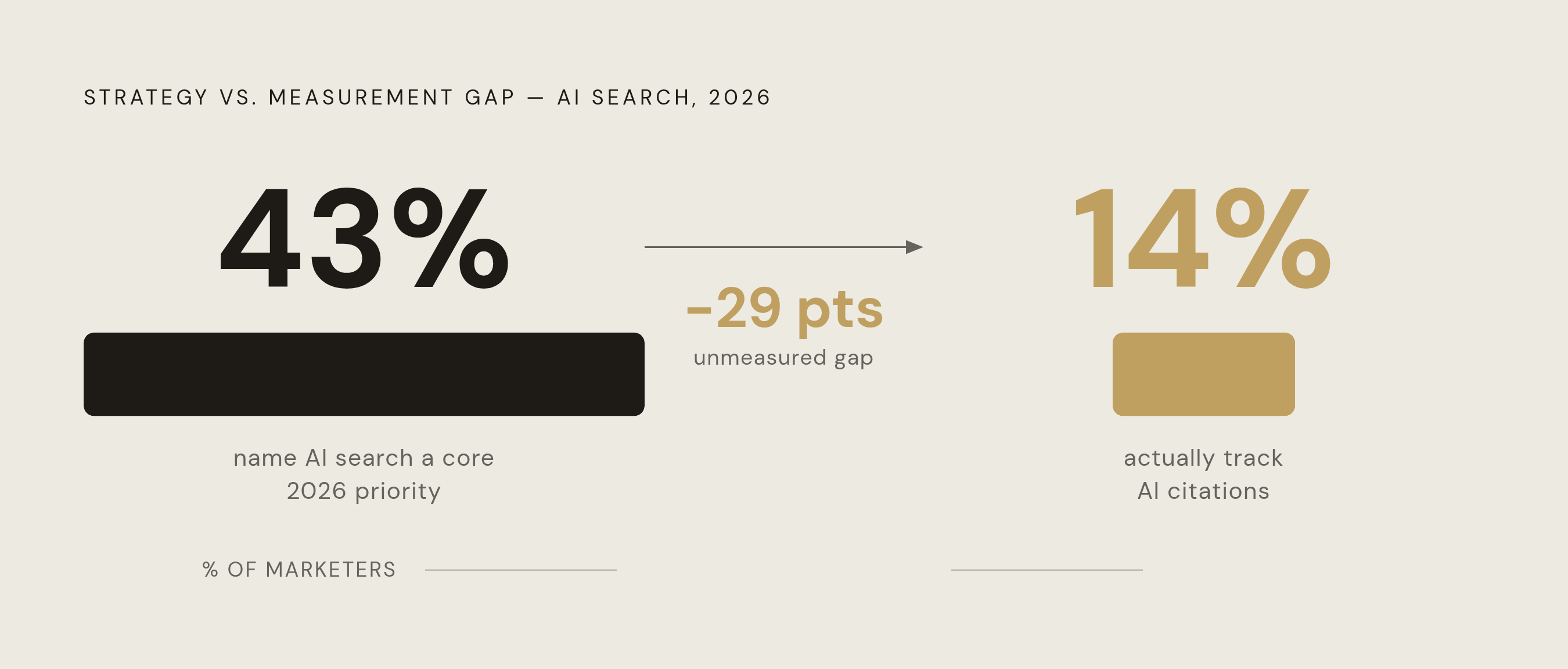
The number that makes the shift above concrete instead of abstract follows. Research from digitalapplied.com in 2026 found that only 14% of marketers currently track AI citations, even though 43% name AI search optimization a core part of their 2026 strategy. Nearly half the industry says this matters. That gap, between stated priority and actual instrumentation, is the central problem this piece exists to address.
It's not just a measurement inconvenience either. Binet and Field's research, cited via Talkwalker, found that brands running a lower excess share of voice than their competitors tend to lose market share over time, at a rate of roughly 0.5% market share lost for every 10% ESOV disadvantage. If AI answer engines are becoming a real venue where category conversations happen, and a brand isn't tracking its presence there, it has no way of knowing whether it's bleeding roughly 0.5% of market share right now, the amount research suggests correlates with each 10% ESOV disadvantage.
Part of why the tracking gap persists is that AI SOV is genuinely harder to control than the channels marketers are used to. McKinsey's State of the Consumer report for 2026 found that only about 1% of the citations large language models pull come from brand-owned websites. A brand can't just publish more content on its own domain and expect that to move the needle on AI citation the way it might move organic rankings. The inputs live somewhere else, mostly out of the brand's direct hands.
That traffic's intent looks unusually strong, produced by users who arrive already close to a decision. Data from Ahrefs, cited via omnibound.ai, found that AI search visitors generate a disproportionately large share of signups relative to how much total traffic they represent. So the channel almost nobody is measuring is quietly producing some of the highest-intent visitors a brand gets anywhere. That's not a small oversight. That's a blind spot sitting directly on top of the fastest-growing, highest-converting traffic source most teams have.
How to measure SOV in paid search and social: the established channels
Getting these channels right affects the accuracy of the measurement work, and the mistakes made here tend to repeat themselves in the AI measurement work that follows.
Paid search is the cleanest of all of them. In Google Ads, SOV literally is impression share: the percentage of eligible impressions your ads actually received out of the total you were eligible to receive, where eligibility itself depends on targeting, bid, quality score, and how competitive the auction is. Two columns in the platform tell you exactly why you're losing share when you are: Search Lost IS (budget) and Search Lost IS (rank). Those aren't just diagnostic labels. They're the two levers you actually pull: when SOV exceeds share of market, growth tends to follow, and when SOV trails share of market, visibility decline is a risk, and the gap between the two is the most actionable number. Impression share is the most precise SOV reading available in any channel, full stop, because the platform hands you both the numerator and the denominator directly. No estimation required.
Social SOV works differently. The metric is brand mentions, tagged and untagged both, divided by total mentions across the category. Manual tracking of that at any meaningful scale isn't realistic; social listening platforms like Brandwatch, Meltwater, and Brand24 exist specifically because this kind of counting has to be automated to be useful.
Organic search SOV runs on keyword rankings, organic impressions, and click share across a defined competitive set. Ahrefs' Visibility metric and SEMrush's Market Share and Position Tracking tools operationalize this directly, so nobody needs to build the tracking from scratch. PR and earned media SOV runs on media mentions divided by total category media mentions, and it functions as a proxy for third-party validation and brand authority more than for direct traffic. Earned media isn't a siloed, old-school channel anymore. It's directly upstream of AI citation risk.
Where most teams actually go wrong isn't the formula. It's everything around the formula. Sentiment gets ignored constantly: a PR crisis can spike mention volume without signaling anything good, so raw SOV numbers always need a sentiment layer sitting next to them, or a spike in visibility during a scandal reads as a win when it's the opposite. Competitor sets get built wrong too, often stuffed with aspirational names instead of the brands buyers are genuinely comparing you against in the moment of decision. Timeframes get mismatched, one brand's monthly figure stacked against a competitor's quarterly figure, producing a comparison that's really just noise dressed up as insight. And SOV gets treated as a revenue proxy far too often, when it was never built to be one. It's a leading indicator. Nothing more, nothing less. Earned media is directly relevant to AI SOV because LLMs pull heavily from editorial sources, so earned media is not siloed from AI citation risk.
What AI share of voice measures compared to traditional SOV
AI share of voice measures the percentage of AI-generated answers that mention, cite, or recommend a given brand across a defined set of category prompts, weighed against every brand mention that shows up across those same answers. It sounds like a straightforward extension of the traditional formula. It isn't, and the difference is structural, not cosmetic.
Compare that to paid search, where a brand controls its bid, its budget, its ad copy, directly. Or organic search, where a brand controls its own site content, even if ranking algorithms remain opaque.
There's a further wrinkle traditional SOV never had to deal with: not every citation is worth the same. Citation prominence needs its own score, tracked monthly, to catch whether a brand's position within answers is strengthening or slipping.
That last point explains why AI SOV can't just get bolted onto an existing technical SEO checklist as one more line item. Generative SOV is overwhelmingly a strategic problem, positioning, ecosystem presence, authority built across a scattered set of third-party sources, and only a small piece of it is technical at all. Fixing site speed or schema markup touches a fraction of what actually drives whether an LLM decides to mention a brand. McKinsey's State of the Consumer 2026 found that only a very small fraction of LLM citations come from brand-owned websites, so the brand controls the input only indirectly, through what third-party sources say about it, marking a key structural difference from traditional SOV. Traditional SOV vs. AI SOV comparison.
Why ChatGPT, Perplexity, and Google AI Overviews require separate measurement tracks
Same category, same brand, same underlying reality, wildly different sets of sources feeding the answer. Superlines ran a cross-platform analysis in March 2026 and documented extreme swings in citation volume for identical brands depending purely on which platform was asked. A single combined AI SOV figure, averaged across engines, would smooth right over that variance and tell a marketing team almost nothing useful about where the actual gaps sit.
When its training data comes up short on a query, it falls back on Retrieval Augmented Generation, searching live and then synthesizing an answer from what it finds. It also breaks a single query into several "fan-out" sub-queries, and content that keeps surfacing across those sub-queries, thanks to a ranking method called Reciprocal Rank Fusion, gets cited more often. Brand-owned content almost never appears directly in these fan-out sub-queries, so the number worth tracking is presence across authoritative outside sources, editorial coverage, LinkedIn, and review sites. Google AI Overviews / Gemini has 2 billion monthly users across 200+ countries.
Perplexity runs on the opposite model entirely. It crawls the web live, and every single response ships with clickable inline citations, averaging around 21.9 sources per answer. Discovered Labs and Whitehat SEO's 2026 research found that's roughly double ChatGPT's rate of 10.4 citations per response. Perplexity also tends to generate far more raw website links than brand-name mentions in the text itself, the inverse of how ChatGPT behaves. But a "ghost citation" pattern shows up often, where a brand gets cited and linked without ever being named in the visible answer text, so it drives real traffic while losing out on mindshare. Whitehat's research also found citation rates run considerably higher for content that's been updated recently versus content sitting untouched for a while, making recency a real ranking signal here. Perplexity's Pages feature, open to any user rather than only brands, sits temporarily retired as of this writing, and Pages showing up as cited sources inside Perplexity answers remains unconfirmed. That's a gap in the opportunity, not a settled fact either way. ChatGPT retrieves many pages but cites only a small fraction of them (AirOps analysis), a severe selection filter that favors high-authority, independently validated sources. It is the only major AI platform where brand visibility directly translates into trackable referral traffic in GA4.
Google's AI Overviews and Gemini behave almost the exact opposite of ChatGPT. Profound's large-scale citation analysis found Gemini leans heavily on brand-owned websites, with most of its citations pulling from domains the brand itself controls. That flips the entire measurement logic on its head for this one engine. A brand's own site structure, its schema markup, and the depth of its own published content all matter more for Gemini than they do for the other engines. Which means the technical SEO work a brand has already been doing for years isn't wasted effort in the AI era. It's just unevenly rewarded, mattering enormously to one engine and barely at all to another, which is precisely why a single blended SOV score across all three platforms hides more than it reveals. A 2026 per-engine audit (digitalapplied.com 2026) found the domains cited by ChatGPT overlap only minimally with the domains cited by Perplexity. ChatGPT has 883 million monthly users, accounting for roughly 79% of global generative AI web traffic (Similarweb 2026).
Building a prompt library and cadence for AI citation monitoring
None of the per-engine detail above is worth much without a system for actually running it on a schedule. The foundation is a prompt library: a fixed set of category-relevant prompts, run against each engine on a recurring cadence. Without that consistency, AI SOV figures from one month to the next aren't actually comparable to each other.
The prompts themselves should split into three types. Branded queries name the brand directly. Competitive queries name competitors or ask for a comparison between alternatives. Topical queries ask the kind of category-level question a buyer would type in without naming any brand at all, and this last category matters more than it looks, because it's where a brand can see whether the category still has no clear leader claiming that answer space.
Weekly, server logs get checked for AI crawler activity, which signals which content engines are indexing. Quarterly, AI referral traffic gets reviewed inside GA4, and the prompt library itself gets refreshed to account for new competitors entering the category and shifts in how the category gets discussed.
Citation prominence scoring folds into that same monthly cycle. A brand cited as the primary recommended source earns a higher weight in the score than a brand mentioned as one of several supporting references buried further down the answer. Tracked consistently, month over month, that score is what tells a brand whether its position inside AI answers is actually strengthening, or just holding steady while a competitor quietly climbs past it. Monthly, full citation probes should run across 20–50 target prompts, repeating each prompt multiple times to account for model non-determinism, tracking mention status (present, absent, partial) and tone/accuracy (neutral, positive, negative).
Sources
- What Is Share of Voice? Formula, Tools, AI SOV [2026] | Brand24
- Share of voice definition: How to measure it | Sprout Social
- Generative Engine Optimization: The Complete 2026 Guide | Similarweb
- AI Search Statistics (2025-2026): 55+ Data Points on GEO, Buyer Behavior, and Citation Rates
- Share of Voice: Definition + How to Measure and Grow It in 2025
- How to Monitor Your Brand in ChatGPT, Perplexity & AI Search (2026 Guide)
- AI Share of Voice: Tracking Brand Citations in AI Answers
- What Is AI Visibility? Complete Guide (2026) | Frase | Frase