Pull Request to Blog Post Automation for Developer Marketing Teams
Automation turns shipped code into publishable content while keeping human judgment in control.

Pull request to blog post automation gives developer marketing teams a way to keep pace with engineering without asking engineers to become writers. Automating the journey from shipped work to a reviewed draft preserves human judgment. A useful pipeline preserves the evidence in pull requests and releases, turns it into publishable content, and measures whether that content earns visibility in AI answers.
Why pull requests are the most credible raw material developer marketing already has
Engineers ship code all the time, while marketing often tells the story later. That delay is more than a scheduling problem. When content is written at a distance from the work, it can lose the explanation of what changed, why it changed, and which problem it solved. Marketing faces a velocity-credibility gap as it tries to publish faster while also trying to recover the substance that makes a developer believe the story.
For a technical audience, authenticity is the first filter. Developers want to know what was actually built. Pull requests and releases already contain the raw material for that explanation, anchored in work a reader can examine. They are upstream inputs for generation.
What the pipeline needs to do before a word of copy is written
If the repository holds the evidence, the ingestion layer must read it directly. A summary typed into a brief is another handoff. It asks someone to select and reconstruct context before the system can begin, which preserves much of the work automation is meant to remove. The pipeline therefore needs access to commits, pull requests, and releases, rather than just a text box where someone describes them. Connecting to GitHub is an architecture decision about the source of truth.
That choice sets the criteria for evaluating the ingestion layer. Can it handle code snippets, API changes, and technical concepts without inventing details? Does it connect to the tools developers already use, and does the draft sound like someone who knows the product wrote it? Accuracy alone is not the whole test. The workflow must also reduce formatting and repurposing work while leaving technical positioning and strategic judgment to people.
Those requirements distinguish a developer marketing pipeline from a general-purpose writing workflow that needs all its context supplied by hand. The distinction begins before prose is generated. A single upstream event should feed a changelog entry, a blog post draft, and distribution copy without making the team do three separate jobs by hand. Each format has a different job, but all should use the same product evidence. That shared input is what makes the architecture useful beyond writing a first draft.
How to wire a GitHub repository to a content generation stage
The core pattern treats content like code. Content is generated in a structured format, committed to version control, and passed through a deployment pipeline for publication. This gives the content workflow the same basic model engineers already use for software, including review before a change goes live. It also makes the boundary between producing a draft and approving it easier to understand. Generation is a step that requires separate approval for publication.
GitHub Actions provides a natural integration point. A workflow file in .github/workflows/ can trigger on a PR merge or release tag, then call a generation service with the diff and PR description as context. The workflow stages a draft for review before publication. Because the file is version-controlled with the product code, changes to the content pipeline can pass through the same review process as other infrastructure changes.
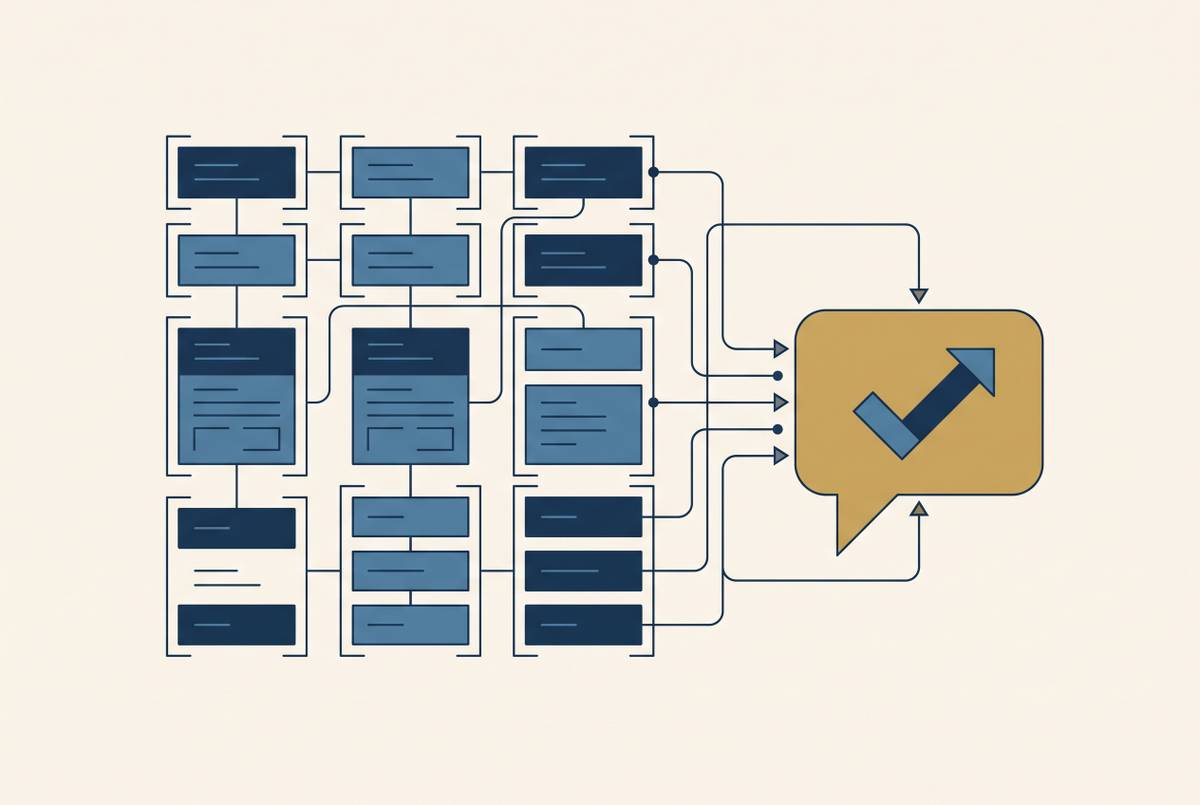
A simplified diagram would move from trigger to context extraction, then generation, draft staging, a review gate, and publication. The arrows describe handoffs. Context extraction gathers the evidence for generation, and draft staging gives reviewers a place to check the result before readers see it. At the review gate, the team decides whether the brand is willing to publish a piece after the workflow has run successfully. The team can add more detailed approval checkpoints along that path.
Connections to external endpoints, including WordPress, a headless CMS, or Slack notifications, use application-specific tokens that can be revoked independently. Media needs its own preprocessing step because images referenced in Markdown must be uploaded to the CMS media library and their paths replaced before publication. Otherwise, the pipeline merely moves a formatting chore downstream. Handling the packaging before publication keeps the editor focused on the article.
Tools that connect the GitHub layer to a publishable draft
The right tool depends on where content originates and how much of the pipeline the team wants to own. A publishing platform and a repository integration help with different parts of the work. Before comparing them, the useful question is whether the team needs help extracting engineering context, generating content, delivering it to a CMS, or connecting those stages. A tool that handles the last stage well does not, by itself, establish that the first stage is covered.
Sight AI has both content generation and native CMS auto-publishing for WordPress, Webflow, and other platforms. Its IndexNow integration notifies search engines immediately on publication, while Autopilot Mode removes manual scheduling steps. Sight AI also includes visibility tracking for how models such as ChatGPT and Claude reference a brand. A free trial is available, and paid plans are scalable. These tools help generate, deliver, and measure content, but the pipeline described here also needs a way to connect the repository to generation.
General-purpose platforms such as Jasper produce polished marketing content at scale, but they do not integrate with developer tools. Context must be provided manually, reintroducing the blank-page work the pipeline is intended to remove. Where native connections are missing, Zapier and Make can bridge a generation service to WordPress, Webflow, Ghost, or Shopify through scheduled triggers and multi-step logic. That flexibility has an operational cost. Each connector adds surface area the team must manage, so the choice partly determines how much orchestration the team owns and how much it delegates.
Why human review must be a structural gate, not an afterthought
The lesson for teams designing this workflow is to concentrate human attention at explicit checkpoints. Automation should handle briefs, outlines, first drafts, metadata, format variants, and repurposing. People must own factual accuracy, technical positioning, expert judgment, final approval, and brand-sensitive decisions. That division gives review a defined purpose. An editor is not being asked to redo every automated step, but to judge the parts for which the brand remains responsible.
To keep that review fast, approval should be built into the pipeline’s states. Brief approval comes before generation, an outline check follows research and precedes drafting, and pre-publish review blocks unapproved content from going live. A post-publish trigger returns underperforming pieces for rework. The ability to say no belongs inside the workflow as a formal requirement.
Sanity’s Content Agent, generally available in January 2026 and built on Mastra and Temporal, follows the draft-first pattern by making every AI-generated change a draft for a person to review. The pattern is useful because producing a change does not authorize its release. But does all that reviewing use up the time saved? Starting from a PR diff and description gives the draft a stronger factual structure than a blank prompt does, shifting the editor’s task from reconstruction toward refinement. It does not remove the need to check the claims.
Review also needs to consider what happens after publication. In 2026, SEO has expanded to include Answer Engine Optimization, or AEO, where the goal is to become a source cited inside a synthesized answer alongside ranking among links. Publication and citation are different outcomes. AI answer engines draw from a site’s corpus and select passages that are easy to extract, so draft structure becomes part of distribution. The article needs to explain the work so an answer engine can use it and keep its meaning intact.
To help with that use, each idea needs enough room between headings to be explained fully. Tables can make comparisons, conversion data, and changelog summaries easier to extract. Specific figures and names make the content stronger, and recent updates give it an edge by keeping it fresh. The repository supplies substance for those choices. Real version numbers, performance deltas, and API changes are more useful than unsupported specificity added merely to make a post sound authoritative.
Allow the major AI crawlers in robots.txt, including GPTBot, OAI-SearchBot, ChatGPT-User, PerplexityBot, ClaudeBot, Claude-SearchBot, and Google-Extended. Implement JSON-LD schema using Organization, Article, and FAQPage where appropriate. Schema is not a citation shortcut, however. Controlled evidence does not show meaningfully more AI Overview appearances for sites with complete schema, so that implementation should not be mistaken for proof of improved visibility.
Why owned content alone is not enough and what a source stack adds
Even a fresh, well-structured blog has a distribution limit. Brand websites are only a small share of the sources AI systems cite, while most citations come from third-party platforms such as community sites, technical publications, and aggregators. That changes the question after a post is approved. Where else can its evidence become useful? Publishing only on the brand’s domain leaves it absent from the third-party sources a model may use to construct an answer.
A source stack is a plan to get the brand into those sources. One route is to write tutorials and architecture guides for technical publications and community platforms that accept them. Partner engineering blogs and ecosystem-adjacent sites are another, often closer to conversion because their readers already use tools in the same stack. Expert contribution networks provide a supporting layer through quotes and attributions in broader articles.
The connection to the pipeline is direct. A draft grounded in a real release contains the original, specific, verifiable material that can support a contributed tutorial, architecture guide, or product announcement. The pipeline produces the draft, and distribution places the work where other audiences and AI systems can encounter it. Owned publication and third-party contribution are therefore two outputs of the same system.
Measuring whether the pipeline is actually generating AI visibility
A publishing pipeline can run well even when few people see what it publishes. Output counts cannot tell the difference. Measurement needs to distinguish a citation, which links to a page, from a mention, which names the brand without a link. Both have a role in an AI answer, but combining them obscures whether the content itself became a source. Tracking them separately makes the result more useful than a single total of brand appearances.
Referral traffic answers the next question about whether those appearances bring readers to the site. Google Analytics 4 can group sessions by whether their source contains perplexity.ai, chatgpt.com, claude.ai, or you.com. This counts visits without assuming that every citation gets a click. Tracking also needs to cover different platforms because major AI engines use few of the same sources. A brand can be frequently cited on one and absent from another, so a single-platform view can give a misleading picture.
Gauge provides daily monitoring across ChatGPT, Perplexity, Gemini, Claude, and AI Overviews, with citation intelligence. Ahrefs Brand Radar is a paid option covering AI Overviews, AI Mode, ChatGPT, Perplexity, Gemini, and Copilot, and reports mentions and citations separately. The distinction is useful when interpreting performance. Some practitioners argue that low click-through rates make GEO more a brand-management tool than a performance channel, but developers may use AI answers to research technical decisions before visiting a vendor’s site. Presence in that answer can be the first-touch impression even when it produces no immediate session.
Each published post adds an opportunity to earn a citation, and tracking shows which subjects and pages actually did. That signal can inform what the next PR-triggered article emphasizes and which existing pieces need rework. The repository keeps showing how the product has changed. Review, distribution, and measurement turn that evidence into a content engine whose success is judged by useful visibility.