Review Syndication Risks Across Third-Party Aggregator Sites
Syndication spreads reviews but surrenders control over how they appear to AI.
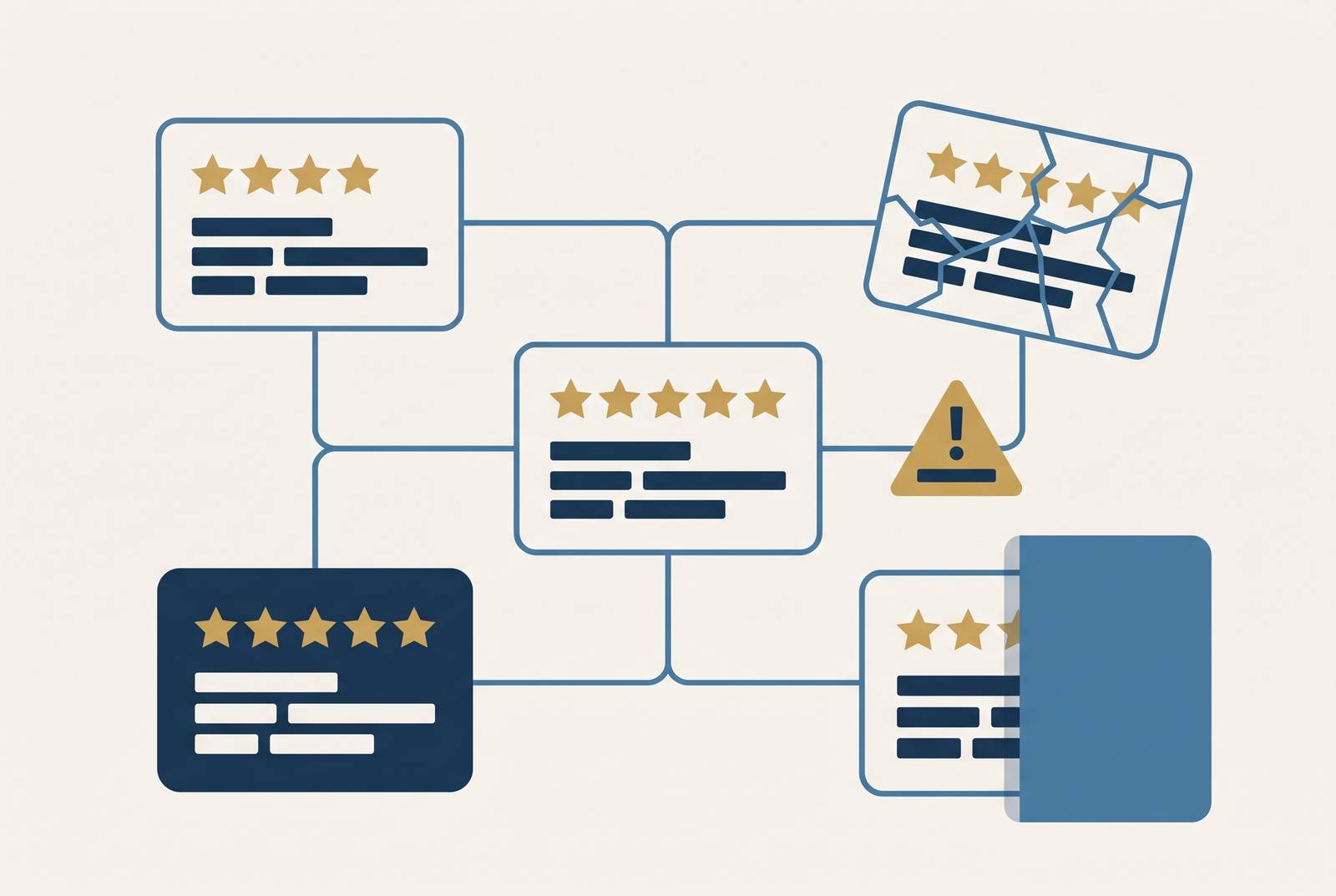
Review syndication risks across third-party aggregator sites begin with a simple trade-off. A brand spreads customer feedback further but gives up control over how that feedback appears and gains authority. Duplicate content, missing context, compliance gaps and AI-generated sentiment are all linked to this trade-off. To use syndication well, a brand needs to understand those links, build owned sources people can trust and track which versions of its story people and AI engines see.
What review syndication actually does and how it moves reviews across the web
Review syndication distributes customer reviews collected on one platform, typically a brand’s own site, to retail partners, aggregators and other selling channels. The same review can then appear wherever the product is sold. Distribution follows a defined technical path. A collection platform pulls the reviews, moderation checks them against retailer content guidelines, and a matching system connects reviewed SKUs to retailer catalog entries through GTINs or UPCs. An API then pushes the review to each destination.
The reviews go to retailer sites such as Amazon, Walmart and Best Buy, and to third-party review platforms such as Trustpilot, Yelp and Google. Reviews also travel to social channels and search engines. The destination changes, but the customer’s words may not. That distinction becomes important because copying the text does not necessarily preserve everything that made it useful at its source.
Yotpo’s 2026 syndication guide describes review volume and sentiment data as assets in B2B negotiations because category managers read them as evidence of demand and lower inventory risk. The machinery therefore serves more than a display function. It distributes evidence that other businesses, customers and search systems use to make judgments. But each site has its own rules for how reviews look and what they can say, which the brand cannot directly control. The same pipeline that distributes trust signals also distributes risk.
How duplicate content penalties emerge from syndicated reviews and why canonical tags alone do not solve them
Identical review text on a brand site, retailer page, aggregator and search engine product listing creates an attribution problem. Which version should a search engine treat as the source? Duplicate content does not automatically trigger a penalty. A search engine may select another version to rank, leaving the brand’s original page with less visibility. Syndication can therefore transfer authority away from the site that collected the feedback.
Canonical tags are designed to signal the preferred version, but cross-domain syndication makes that fix dependent on another site’s cooperation. The receiving retailer or aggregator has to apply the markup correctly. The brand cannot enforce that after distribution. A visible attribution tag naming the brand’s site gives display credit, but it does not replace canonical markup for crawlers.
A second problem emerges when the brand changes the review pool before sending it. Filtering by star rating, called review gating, skews the feedback toward a less representative selection and creates FTC compliance risk. That is not a remedy for duplicate content.
Authenticity signals that degrade when reviews circulate without their original context
A genuine review can become less trustworthy without a single word being fabricated. Its disclosure tags, response thread, verified-purchase context and date all help readers interpret what the customer said. Those signals can be obscured in transit. Once they disappear, the text may look like a complete account even though important qualifications are missing. Authenticity depends on more than preserving the quotation.
Disclosure loss also creates a compliance gap. The FTC’s official FAQ says that someone who received a free or discounted product to provide a review should disclose that connection everywhere they endorse the product. A disclosure at the collection point is not enough. If the review travels without it, readers at the destination lose information needed to judge the endorsement. The original review’s legitimacy does not remove that obligation.
Response threads show whether anyone addressed a complaint. On an aggregator where the brand cannot respond, a negative review may stand without the corrective context available at the source. Age can create a similar distortion. An automated sync that pushes a three-year-old review to a new retail partner can undermine trust if the product has changed, even when the text retains SEO value. Yotpo also identifies the March 2026 Google Merchant Center updates as a timing constraint, with missed platform requirements putting product rating visibility at risk across search and shopping surfaces.
Why aggregator pages, not brand sites, are the surfaces AI answer engines most often cite
Third-party review pages now influence discovery through AI answers as well as through search listings. When an engine cites an aggregator, customer feedback on that page helps shape a brand narrative the brand does not directly control. The destination becomes a source of interpretation. This makes the earlier risks more consequential because missing context or uneven review selection can affect not just a page’s appearance, but an answer about the business.
The leading review and commerce citation surfaces vary by category, including Trustpilot for services, TripAdvisor for travel, Amazon for products, Yelp for local queries and G2 for B2B software. Human-generated consensus on these platforms supplies sentiment signals for brand summaries. Ratings and recurring review themes can influence descriptive language. A review pool that readers encounter as individual comments can therefore reach an AI user as a short characterization of the brand.
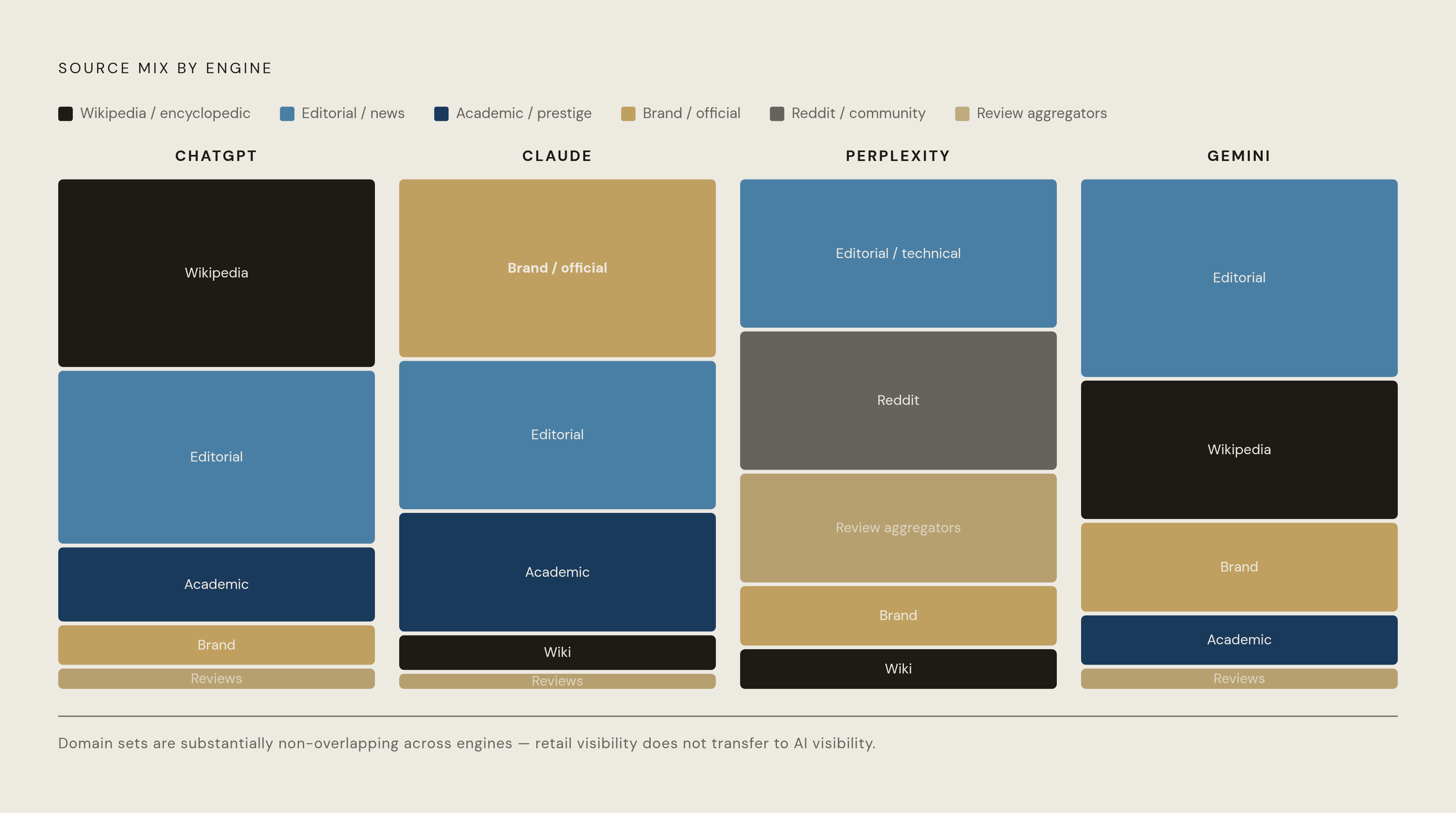
How often an engine turns to aggregators depends on the engine and the query. ChatGPT leans toward Wikipedia and editorial sources overall, while directories play a significant role in local and home-services queries. Claude tends toward prestige editorial and academic sources, yet brand and official sites account for its largest citation share by volume. The engines draw on substantially non-overlapping domain sets, so retail distribution success does not translate neatly into AI visibility. The sentiment in those answers can also change more than an organic ranking might suggest.
How AI-generated brand sentiment can flip without the brand noticing or owning the page it flipped on
AI-generated sentiment depends on which sources an engine retrieves and how it weighs their content for a particular query. An answer can still name a brand while changing how it describes it. That is a different exposure from moving down a search results page. The business is still present, but the answer may now frame it negatively rather than positively, based on material published elsewhere.
AI answers can re-read sources and re-weight sentiment at query time. Citation volumes can fluctuate substantially from month to month, while sentiment changes more frequently than mentions. A stable mention count can therefore conceal a worsening account of the brand.
For a brand concentrated on a few aggregators, a spike in negative Yelp reviews or a moderation error removing positive TripAdvisor reviews can change the evidence available to an engine. A competitor’s review campaign on G2 can also alter the comparative picture. These are structural dependencies that syndication programs can face while still succeeding. The brand may not be able to edit, respond to or remove the source material, but it can measure the resulting answer and build stronger owned sources.
Building brand-owned pages engineered to be extractable by AI retrieval systems
The structural response is to build brand-owned grounding pages that AI systems can extract and cite directly. These give engines an alternative to relying entirely on aggregator pages. The aim is to make the brand’s own well-supported information available in a form retrieval systems can use, reducing dependence on sources the brand cannot maintain.
A grounding page should use an answer-first structure, giving a direct response in the opening words of each section. Supporting material can then explain the answer. Schema markup helps describe the page’s content and identity, including FAQPage, Article with Author, and Organization with sameAs attributes. Primary-source citations in the page back up its claims. A regular refresh cadence keeps that support and the page’s account of the brand current.
Owned pages cannot do all the work alone. Brand mentions correlate more strongly with AI visibility than backlinks do, which makes presence across relevant platforms part of the same strategy.
There is also a limit to extraction-first design. Pages built only for AI retrieval may get impressions without clicks, which raises the concern that weak click-through signals could harm traditional search authority. That concern should shape the balance. A grounding page should remain useful to human readers rather than become a separate artifact built only for machines.
The source stack AI engines treat as ground truth and where syndicated reviews fit inside it
The source stack AI engines use as authoritative evidence includes more than review aggregators. In 2026, it includes Reddit, Wikipedia, YouTube, LinkedIn and vertical-specific directories such as G2 for B2B software. These sources play different roles. A review directory shows what customers think, while other platforms offer community discussion, reference material or professional context.
Community and review platforms stand out in part because people write their content. AI models prioritize human-first material to avoid model collapse, the degradation associated with training on AI-generated text. Even when a person wrote a review, a copy may be out of date, unfairly selected or missing a required disclosure.
The stack also differs by engine, so there is no single distribution footprint that guarantees broad representation. A brand visible in ChatGPT answers may be absent from Claude or Perplexity answers. Reach is not the same as citation relevance. Perplexity’s source preferences skew toward community sources, especially Reddit, editorial and technical content, and commercial review and comparison aggregators such as G2, NerdWallet and PCMag.
For a B2B SaaS brand whose buyers research through Perplexity, that mix changes how its current footprint should be evaluated. A site with lots of visitors does little to help people find a brand through AI if the engine they use rarely draws from it. Conversely, a destination that appears in the engine’s source stack can contribute authority beyond its direct audience.
Measuring whether AI engines are actually citing the brand and detecting when the signal changes
AI visibility can be measured across ChatGPT, Claude, Gemini and Perplexity, but each engine needs separate tracking. Their citation behavior is not interchangeable. ChatGPT names brands much more often than it links to them, so citation counts alone miss part of its influence. A consolidated score can also hide a gain in one engine and a loss in another. Measurement has to distinguish those outcomes before a brand can interpret them.
A brand should track whether answers to queries about its category name it, whether citations point to owned pages or third-party aggregators, and whether the answer’s sentiment matches how the brand wants to be seen. These are related but distinct signals. A mention shows presence, a citation identifies the supporting surface, and sentiment shows how the engine frames the business. None can substitute for the others.
Sentiment deserves particular attention because frequent negative mentions can be worse than fewer accurate, positive ones. The aim is not visibility at any cost. Tracking the source pages behind an answer helps distinguish an owned-page gap from a problem rooted in an aggregator’s review pool. McKinsey reports that only a small share of brands track AI search performance in a systematic way, so many have no way to spot those differences.
The operational loop begins by measuring current answers and identifying the owned and aggregator pages behind their citations. A team can then strengthen grounding pages for high-value queries and align review distribution with the sources each relevant engine uses. Re-measurement tests whether those changes moved the signal. That closes the gap between distributing reviews and understanding what they become once another platform turns them into evidence.