Multi-Location Brand Review Audit Process
Consistent review quality matters most when customers compare your brand across locations.

Multi-location review management means checking review data, listing accuracy, and response quality across every location on a set schedule, instead of reacting one complaint at a time. Most brands still treat it as marketing's side project, and that's the wrong call. BrightLocal's 2024 Local Consumer Review Survey found 91% of consumers say a local branch's reviews shape how they see the entire brand, so a single underperforming location three miles from a five-star sibling doesn't stay contained. Customers don't see two franchisees with different levels of discipline; they see one brand name, and the weakest link sets the ceiling for all of them.
Call it the franchise paradox, though it applies just as well to corporate-owned chains, healthcare networks, and multi-branch service businesses. One location earns five stars because a manager actually reads the reviews. Another, a short drive away, sits at 2.8 stars because nobody's checked on it in six months. The brand equity built by the first location ends up covering for the second. Damage that starts at one location travels up the chain, and so does the fix, if the fix is built to travel too. That's what the rest of this piece works through: five audit pillars, a benchmarking method, and a governance model built to catch problems while they're still a local-manager headache instead of a brand-level headline.
What makes multi-location review management structurally different from single-location management
Single-location review management means watching one listing with one team behind it. Multi-location management means watching hundreds of listings, each with different staff, different habits, and wildly different levels of attention, and the difference isn't scale alone. It's coordination.
Take F45 Training: nearly 650 U.S. locations as of 2023, each running its own Google Business Profile, plus Facebook, Yelp, and TripAdvisor pages that all collect reviews independently, on their own clocks. That's thousands of reviews landing in parallel, and no manual process catches that at scale, no matter how sharp the regional manager is, without something built to centralize it.
Three problems build from there, and they compound rather than sit side by side. Volume is the sheer number of reviews landing across locations on any given day. Consistency is keeping response quality and brand voice from swinging depending on which location manager happens to be paying attention that week. Visibility is catching a location's slide before it becomes a public story instead of a private, fixable one.
There's a tension underneath all of this, and it doesn't fully resolve; it just gets managed. Local teams know their regulars and their regional quirks. Corporate owns brand standards and, increasingly, legal exposure. An audit process has to serve both without pretending the tension isn't there, and the five pillars below are built around that fact. Each one targets a specific way review management breaks once a brand goes from one location to many.
Deciding where to audit: the review platforms that actually move the needle
Google is not optional. Its share of total online reviews climbed from 79% to 81% in 2024, and 67% of consumers say it's the source they trust most. Building an audit around Google alone is close to a guess with a spreadsheet stapled to it.
Stopping at Google misses real ground, though, and this is where most brands get it wrong. Google, Facebook, Yelp, and TripAdvisor together host roughly 88% of all reviews, leaving 12% spread thin but not nothing. BrightLocal data shows 36% of consumers check two review sites before choosing a local business, and 41% check three or more. An audit built around one platform is auditing against a shopping habit that stopped existing a while ago.
Platform priority should track the industry, not raw traffic, and here's where a lot of audit plans go generic when they should go specific. A restaurant chain needs TripAdvisor weighted heavily. A home services brand needs Angi, HomeAdvisor, and Houzz in rotation, since those platforms carry category authority Google can't touch. Healthcare brands need Healthgrades and Zocdoc watched directly, because patients hunting for a provider often start there, not on Google.
Then there's the newer wrinkle: AI answer engines like ChatGPT, Gemini, and Perplexity now pull structured listing data and review content directly to answer reputation questions. An audit built only for traditional search risks falling behind how people are starting to ask about businesses in the first place. The practical output is a platform priority matrix: primary platforms audited monthly, secondary platforms audited quarterly, and an AI-visibility check on whatever cadence the brand can actually sustain without it turning into theater.
Pillar one: auditing listing accuracy and NAP consistency across every location
NAP, meaning name, address, phone number, sounds like a housekeeping detail. It's actually one of the most common reasons a location with genuinely strong review sentiment still underperforms in local search. Inconsistent NAP data confuses search engines about which listing is the authoritative one, dilutes local rankings, and undermines the structured-data cross-referencing that AI-powered search leans on more every quarter.
Duplicate listings make it worse quietly. A location running two Google Business Profiles, one tied to an old address, one current, splits its social proof between them. The review count on either listing looks lower than the location's real reputation, because half the proof is trapped on a page nobody checks anymore.
The per-location checklist isn't glamorous, but it's exact. Confirm the business name field matches exactly, with no keyword stuffing tacked onto the end. Confirm primary and secondary categories are set right, since a mismatched category quietly drops a location out of searches it should be winning. Check that hours are current, holiday hours included, because nothing erodes trust faster than a customer showing up to a locked door on a listed business day. Swap generic stock photography for location-specific images, fill out every attribute and service field, flag unanswered Q&A threads, and check that Google Posts aren't stale relics from two quarters back.
The audit has to extend past Google Business Profile into Apple Maps, Bing Places, Yelp, Facebook, and whatever industry-specific directories feed local search for that category. A wrong phone number is a direct conversion loss: a customer ready to buy dials a dead line and doesn't call back. Run a full listing audit twice a year, and trigger an immediate one for any location move, rebrand, or phone number change. Those are exactly the moments NAP data quietly falls out of sync.
Pillar two: auditing review volume and recency at each location
Recency carries real weight in rankings, and rankings can drop sharply if a location goes as little as three weeks without a new review. The volume audit has to check timing as closely as it checks totals.
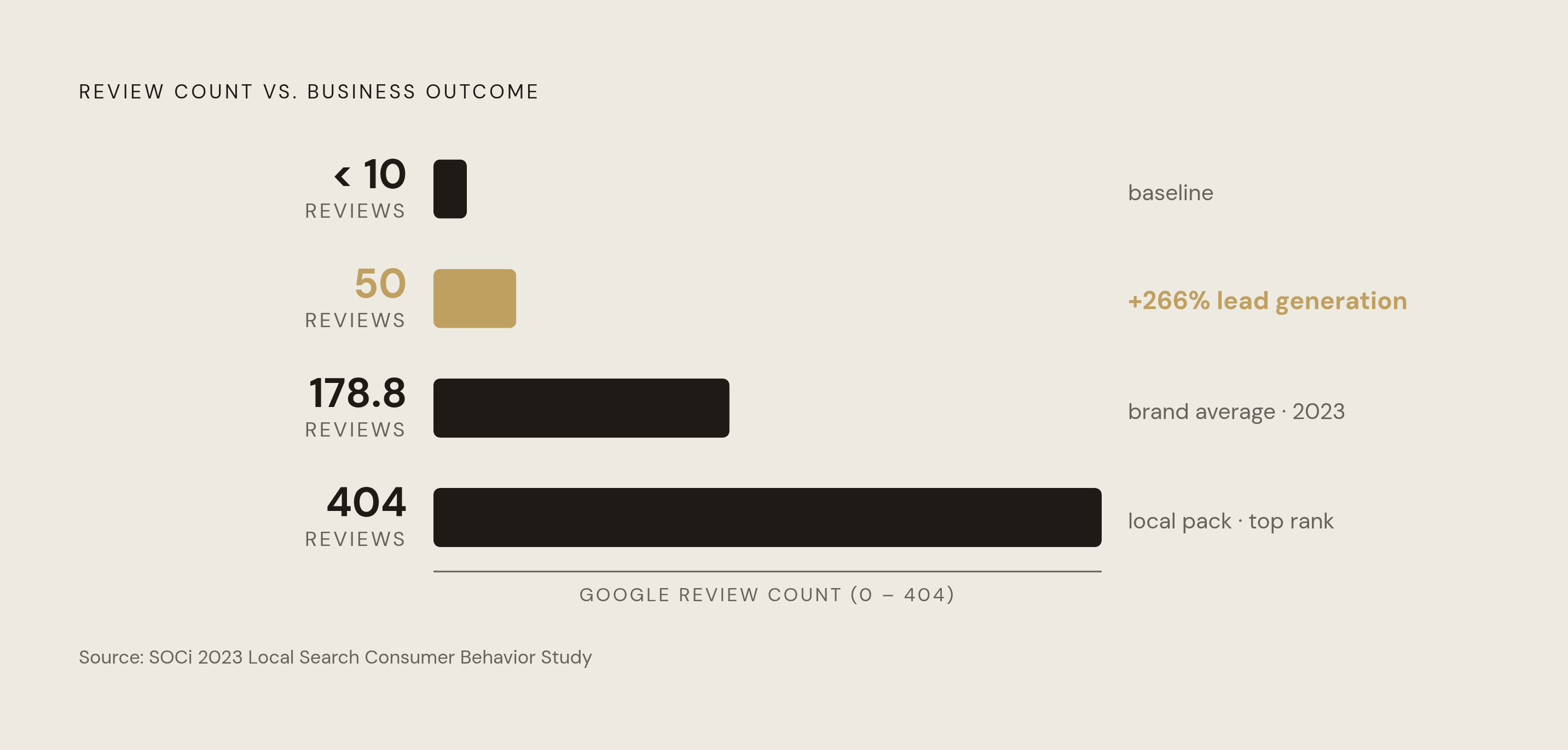
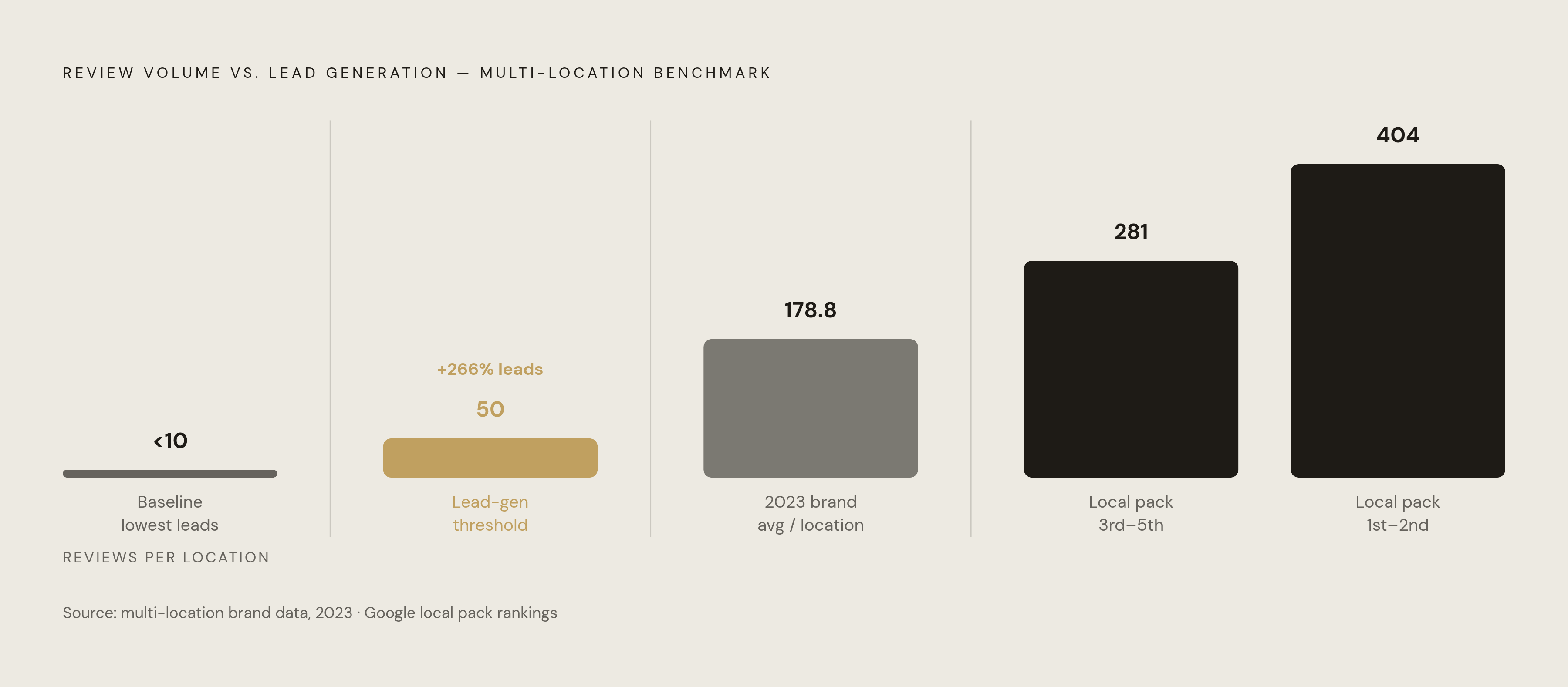
Context matters here, and the trend isn't encouraging. SOCi found the average multi-location brand had 178.8 Google reviews per location in 2023, down from a higher baseline in 2022. That's a shrinking baseline, so the audit isn't measuring against last year's number; it's measuring against a target moving in the wrong direction. Compare that to what actually wins: locations in the top Google local pack positions average 404 reviews, while locations ranked third through fifth average 281. That gap gives the audit a real tier structure instead of an abstract goal.
There's a threshold worth building generation targets around: locations with 50 or more Google reviews earn 266% more leads than locations with fewer than 10. Fifty isn't a round number picked for tidiness. It's the point where lead generation visibly shifts.
The volume audit flags three things location by location: locations below the brand average, locations with no new reviews in the past three weeks, and locations collecting star ratings with no written text attached, since text-and-keyword reviews carry more SEO weight than a bare star does. Generation mechanisms deserve a look too, whether that's email requests, SMS, QR codes at the point of service, or loyalty program integrations. Every location should have at least one active channel running, because a location relying on organic reviews alone is relying on customers remembering to bother, and most don't remember. The output is a per-location volume scorecard, ranked against the brand average, the top-pack benchmark, and the 50-review threshold.
Pillar three: auditing star ratings and sentiment trajectory across locations
Here's a fact that surprises people who assume five stars is the finish line: Northwestern University's Spiegel Research Center found that a 4.2 to 4.5 star range builds more consumer trust and longer-term loyalty than a perfect 5.0 does. A flawless rating tends to read as suspicious rather than as excellence. 46% of shoppers distrust a perfect 5-star rating outright, and among Gen Z that distrust climbs to 53%. A location chasing a spotless record might be working against itself without knowing it, which is a strange thing to have to explain to a franchise owner who thought five stars was simply the goal.
There is a hard floor, though, worth stating plainly: 71% of consumers won't consider a business rated below 3 stars. A location down there isn't merely struggling; it's functionally disqualified before a customer reads a single review. The asymmetry between good and bad reviews is real too. 85% of consumers say positive reviews make them more likely to use a business, but 77% say negative reviews make them less likely to. That imbalance argues for protecting the rating floor at every location, not for pushing an already-strong location toward a perfection it doesn't need and customers don't trust anyway.
A single rating snapshot misses the more useful signal, which is trajectory. A location sliding from 4.2 down to 3.6 over 90 days is an operational warning building quietly, one a static average hides until it's too late to fix quietly. Sentiment trajectory needs time-series data, tracked location by location, not one number pulled once a quarter.
Cross-location benchmarking earns its keep here. Comparing a location against the rest of the portfolio, rather than against a fixed corporate standard alone, surfaces an outlier faster. A location sitting one standard deviation below the brand average shows up through peer comparison well before it would trip an absolute threshold. Beyond the star average, sentiment theme analysis matters just as much: flagging recurring complaint categories, wait times, staff behavior, cleanliness, that repeat across multiple reviews at the same location. Those recurring themes are what turn a review audit into an operational fix instead of a spreadsheet nobody acts on.
Pillar four: auditing review response rates, speed, and quality
Response rate is the pillar with the clearest before-and-after math attached. Birdeye's State of Online Reviews 2026 report puts the industry response rate at a record 75.5% in 2025, with 40% of those responses AI-generated. That's the high-water mark, and it's the number every brand audit should measure against.
The average multi-location brand responded to just 46.3% of Google reviews in 2023, up from 36.2% in 2022, per SOCi. Real progress, but still well behind the frontier, and that gap is exactly where the audit should spend its attention.
The financial case for closing it is straightforward: SOCi found that for every 25% of reviews a business responds to, conversion improves by 4.1%. Consumers have made their expectations explicit, too: 88% choose businesses that respond to every review, while only 47% would consider one that never responds at all. 89% expect a response to both positive and negative reviews, not just the negative ones needing damage control. On timing, one-third of consumers expect a response to a negative review within 3 days.
That sets a workable SLA: a 24-hour response window for all reviews, tightened to 4 hours for anything under 3 stars. Automation can carry the volume, but a human should gate anything negative before it goes out, since an automated apology to an angry customer tends to read as insincere and, frankly, a little insulting. Manual, personalized responses climbed to 61% of all responses in 2024, a sign that consumers reward specificity. Consumers reward specificity, evidently, and a template opening with "We're sorry to hear about your experience" is losing ground for a reason. The response audit flags locations below the brand average, locations copying template language word for word, and locations where a negative review has sat unanswered past the SLA window.
Pillar five: auditing for fake, incentivized, and non-compliant reviews
This is the pillar with actual legal teeth, and it's the one most likely to get skipped by a brand fixated only on ratings and volume. The major platforms have each ramped up enforcement against policy-violating reviews, removing content that crosses from encouraging feedback into manufacturing it.
The regulatory backdrop has shifted as the FTC has taken direct aim at fake reviews and testimonials, targeting not just fabricated content but also undisclosed insider reviews, suppression of negative feedback, and incentive programs that reward customers for a particular sentiment rather than simply for leaving a review. Enforcement isn't hypothetical: the FTC sent warning letters in December 2025, its first public action under the new rule, which is a fairly clear signal that active monitoring has started, and that "we'll deal with it later" is no longer a defensible compliance strategy. The exposure is real money, too: the FTC can pursue penalties of tens of thousands of dollars per violation, on top of consumer redress.
The compliance audit at each location checks how reviews get solicited in the first place, flagging any language steering customers toward leaving only positive feedback. It checks whether any incentive, discounts, gift cards, loyalty points, is conditioned on the review's sentiment rather than the act of leaving one. It checks whether insider or employee reviews are disclosed as such, and it checks for any quiet removal or suppression of negative reviews, including whether the brand's own website selectively displays its best reviews while burying the rest. The output is a compliance checklist covering solicitation, collection, moderation, and display, run past legal before it ever lands in a location manager's inbox.
How to structure the cross-location benchmarking analysis that turns raw data into action
Five pillars produce five streams of data, and none of it means much until it's pulled into one place a regional director can read in under ten minutes. That's the job of the location-by-location scorecard: NAP accuracy status, review volume against both the brand average and the top-pack benchmark, current star rating alongside the 90-day sentiment trajectory, response rate against the brand average and the 75.5% industry benchmark, and compliance status, all in a single ranked view.
From there, a three-tier framework does the sorting. Tier 1 covers locations that need action now: declining sentiment trajectory, a notably low response rate, or an unresolved compliance issue. Tier 2 covers locations below the brand's volume average with no active generation program running, fixable but not urgent the way Tier 1 is. Tier 3 covers locations performing at or above benchmark across the board, where the audit cadence can loosen without real risk.
One pattern deserves specific attention here, and it's the one most audits miss entirely. When the same complaint theme, slow service, unclean facilities, unresponsive staff, shows up across three or more locations, that's not a location problem anymore. That's a signal pointing at training, product, or process, and handing it to a single location manager misdiagnoses what's actually broken; it treats a systemic fever like a scraped knee. The scorecard's real output is a prioritized action queue, with an owner assigned at both the corporate level and the location level, because findings with no owner tend to sit unaddressed.
The governance model that makes corrective action stick across a distributed organization
A scorecard without an owner is just a document. Governance is what turns the audit's findings into something that changes behavior at 650 locations, not just the three the regional director happened to visit last month.
That starts with clear ownership splits. Corporate holds brand standards, response SLAs, and compliance policy; location managers hold day-to-day solicitation, response tone, and the operational fixes flagged by recurring complaint themes. Neither side does the other's job well, and pretending otherwise is how audits turn into binders nobody opens.
Cadence matters as much as ownership. Tier 1 locations need check-ins measured in weeks, not quarters, until the metric that landed them there moves. Tier 3 locations can go months between touches, since the whole point of tiering is spending attention where it earns something back. And the pattern-diagnosis finding from the benchmarking stage, the complaint theme repeating across three-plus locations, needs a path straight to operations or training leadership, bypassing the location-by-location escalation chain that would otherwise bury it as three unrelated complaints instead of one systemic one.
None of this resolves in a single pass, either. A brand running 650 locations manages this the way a hospital system manages infection control: through a schedule that never really ends, a scorecard that gets checked again next quarter, and the quarter after that.