Famous Brand Repositioning Cases and What Triggered Them
Four pressures force brands to reposition, and the cases show which ones worked.
Famous brand repositioning cases are best understood through what forced the brands to move. Competitive displacement, audience drift, reputational crisis, and business model change each call for a different response. A new identity works only when it answers the pressure behind it while keeping the brand’s meaning clear to customers and, increasingly, AI answer engines.
Why repositioning happens at all: the difference between cosmetic redesign and strategic necessity
Cosmetic redesign changes how a brand looks. Strategic repositioning changes what it means, who it serves, or what customers compare it with. A new wordmark can express that change, but it cannot supply the reason for it.
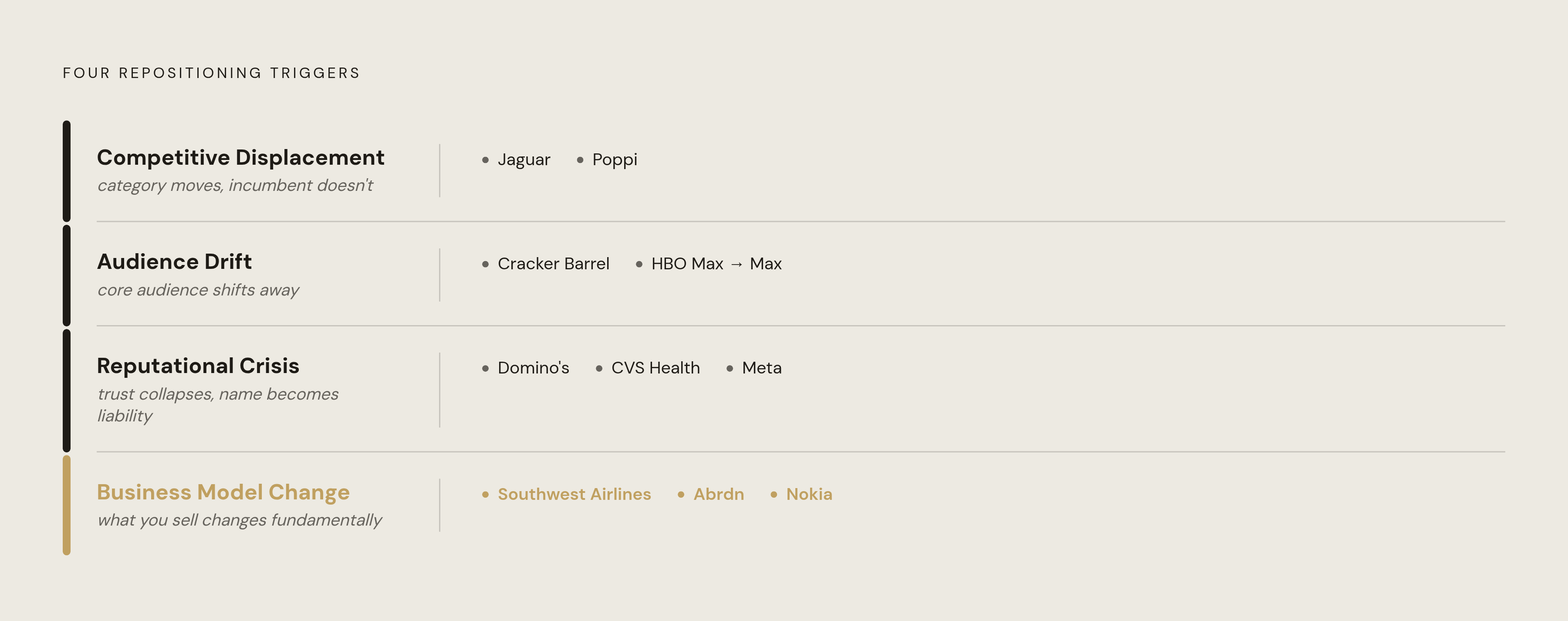
That distinction changes how success and failure should be judged. An unpopular design may expose a deeper problem, namely that customers can no longer tell what the brand stands for or against. Conversely, a familiar identity may need to change because it no longer describes the business. Across these cases, four triggers provide the framework, which are competitive displacement, audience drift, reputational crisis, and business model change.
Competitive displacement as a trigger: when a category moves and the incumbent brand does not
Competitive displacement begins when the terms of comparison change. A new entrant, a regulatory shift, or a technology wave can redraw a category before an incumbent has changed its own story. The brand may still be recognizable. But the qualities it stands for may no longer give someone a reason to choose it.
Jaguar’s November 2024 repositioning faced that structural problem. Global zero-emission policies were rewriting what a luxury car brand would compete against, while Jaguar sought ultra-luxury EV positioning for younger, wealthier buyers at higher prices. This was more than an aging-audience problem. Jaguar needed to establish a new competitive position without discarding the heritage that helped justify premium pricing.
Instead, Jaguar deleted its social media history and swapped images of its heritage for abstract, high-fashion images. Its slogans included “Copy Nothing” and “Delete Ordinary,” but no cars appeared in the launch video. The break was unmistakable. The product connection was not. For a luxury brand, removing familiar distinctions risks anonymity precisely when buyers need a reason to pay more. Kia’s EV repositioning shows that brands can face the same category shift with different results.
Poppi shows another route through category displacement. It began as “Mother Beverage,” built around an apple cider vinegar trend that faded, leaving a niche health product without a clear path to mainstream demand. The product did not need to change. Reframing it as a “better-for-you soda” gave buyers a more useful category and opened a path to PepsiCo acquisition. Unlike a visual break without a product anchor, the new frame made the existing offer easier to understand.
Audience drift as a trigger: when the people who built the brand are no longer the people the brand needs
Sometimes the category stays the same while the audience changes. Audience drift can look like loyalty for years because customers who keep coming back hide how hard it is to draw new ones. Audience drift becomes urgent when the people who built the business can no longer sustain its growth. Does reaching another generation require abandoning what the first one valued?
Cracker Barrel’s August 2025 rebrand answered that question too aggressively. Its loyal base was aging, and attracting younger diners was a genuine business need. But replacing the “Old Timer” logo with a plain text-only wordmark while modernizing interiors created a broad break. Nostalgia was treated as an obstacle to expansion. Yet nostalgia and tradition were also reasons to visit, with appeal that need not belong to one generation.
The response made the miscalculation difficult to ignore. The stock fell sharply, erasing close to $100 million in value, and leadership reversed within days. The intraday low represented a loss nearly double the closing decline. The strategic goal was not the central error. The execution removed distinctive assets without establishing why their replacements would attract either existing or prospective diners.
HBO Max’s move to Max and back to HBO Max between 2023 and 2025 followed a related pattern. After the Warner Bros.–Discovery merger, the shorter name was intended to broaden appeal beyond HBO’s adult-skewing content and surface Discovery+ lifestyle and documentary programming. Broader programming did not make the HBO signal expendable. Chobani offers a different audience-related diagnosis, having repositioned from a leading market position because its personality underrepresented its actual footprint.
Reputational crisis as a trigger: when the product itself is the problem the brand must address first
Reputational pressure changes the order of the work. When customers see a gap between a brand’s promise and its behavior, a new story cannot resolve the contradiction. The underlying problem must be addressed first. Otherwise, the repositioning gives critics a new claim to test against the same evidence that let them down before.
Domino’s illustrates the value of confronting that evidence. Its reputational warning was overt and prolonged. The brand chose to accelerate its response to the criticism. The credibility of the fix depended on correcting what was wrong with the product.
CVS Health made the same principle tangible through sacrifice. Selling tobacco conflicted with a health mission, so CVS gave up substantial tobacco revenue to make that mission credible. The operational decision preceded the brand story. Unlike a statement of future intent, the withdrawal supplied evidence that the company would accept a cost to align its business with its claim.
Meta’s 2021 rebrand provides the cautionary contrast. Reinvention did not resolve the trust deficit behind the change, so the new name absorbed the old skepticism. A different identity could not settle an unresolved problem. Across these cases, the decisive distinction is whether the repositioning describes an operational change or asks customers to believe ahead of one.
Business model change as a trigger: when what the company sells outgrows what the brand says it is
A brand can also become inaccurate without losing its audience or facing a reputational crisis. The business itself may have moved. Nokia’s B2B shift illustrates the basic tension, as a changing commercial focus creates a need for an identity that explains what the company now sells. The trigger comes from within, even if customers encounter the mismatch first.
Southwest Airlines shows how difficult that adjustment becomes when the business model was the identity. During 2025–2026, it moved away from defining positions including no fees, open seating, and an anti-corporate cultural identity. These features explained its opposition to the competitive model it was now adopting, so removing them without a coherent replacement eroded the basis of loyalty.
Standard Life Aberdeen had a different problem with its identity after a merger. Its 2021 rebrand to “Abrdn” sought to express sleek modernity following a merger and strategic pivot, but the vowelless name drew widespread mockery as confusing and unpronounceable. By 2025, the company had restored “Aberdeen.” The original trigger was legitimate. The chosen name did little to anchor the new business meaning for clients or analysts.
What does the replacement identity help people understand? When a brand expresses aspiration rather than operational reality, business-model repositioning produces the same credibility gap seen in crisis responses. The words point one way while the evidence points another.
What all four triggers have in common: the loss of categorical clarity and why that now has a second consequence
The shared failure is a loss of categorical clarity. Customers need to understand what a brand offers, who it serves, and why it belongs in their consideration set. Cracker Barrel removed familiar reasons to visit, while Max softened a signal that helped viewers understand its programming.
That ambiguity now has a second consequence. AI answer engines also need enough consistent evidence to place a brand within a category before presenting it as a relevant answer. A repositioning that confuses customers can therefore weaken the signals those systems use to describe and recommend the business. Recognition alone is not enough if the recognized name has an uncertain meaning.
Jaguar’s deletion of its social history makes the risk concrete. Beyond the customer-facing rupture, it removed material that could help anchor the brand’s identity. This shows why repositioning decisions affect the available evidence of what a brand is and who it serves.
How AI answer engines categorize brands and what repositioning decisions do to that signal
Getting named in an answer depends on how a system represents the brand, drawing on signals distributed across its own site, third-party directories, review platforms, and editorial coverage. When those descriptions reinforce one another, the category is easier to establish. When they conflict, a clear sentence on the homepage cannot settle the whole question.
A brand may claim a new category while directories still describe its old business and reviews point to a different promise to customers. The evidence then points in several directions. The same operational-before-brand principle applies here, because a new claim becomes more credible when other retrievable material supports it.
A large share of LLM citations comes from opening sections, and statistics and authoritative sources can make content more likely to be cited. But those techniques cannot substitute for a coherent identity across sources. Content that performs well in search is not automatically content that earns an AI recommendation, and search rankings alone cannot show whether the new position has registered.
Recognizing the trigger before the urgency arrives: the signals that precede each trigger type
For teams applying these cases, diagnosis starts before the redesign brief. Competitive displacement appears when entrants or policy changes begin redefining luxury, sustainability, or convenience before an incumbent’s sales reflect the shift. Jaguar’s pressure was visible in EV regulatory trajectories before its November 2024 launch. Teams need to assess early whether the category’s buying criteria are changing faster than the brand’s explanation of its value.
Audience drift leaves a different trail. Loyal customers may be aging while first-time consideration weakens, or transaction value may hold while visit frequency falls. Repeat business can conceal the problem. These patterns call for distinguishing between assets that appeal across generations and habits tied to the existing audience, rather than assuming that everything familiar is a liability.
Reputational pressure becomes visible when reviews, editorial coverage, and comments on social media keep showing the same gap between what a brand promises and what its product delivers. Business-model drift is often visible inside the company first. Revenue may concentrate in a segment the brand does not claim, sales teams may describe the offer differently from marketing, or new customers may arrive for reasons the positioning never explains.
AI visibility adds a consistency check. Declining mentions on category-defining queries can flag weakening recognition before the problem is apparent in revenue, though the pattern needs direct measurement. Tracking answers across ChatGPT, Claude, Gemini, and Perplexity helps reveal whether the new positioning is being understood. The useful evidence is repeated behavior.
What measuring AI visibility during repositioning actually requires
Measurement must test both presence and meaning. A brand needs to track how often AI systems cite it on category-defining queries and whether they describe it correctly after the change. Checking ChatGPT, Claude, Gemini, and Perplexity over time shows how answers change over weeks, without the wait for a quarterly assessment.
Different errors require different diagnoses. A brand may show up in the wrong category, keep its pre-repositioning identity, or disappear altogether from answers where it belongs. These are distinct failures of recognition. Tracking them separately helps identify whether the problem lies in the category claim, the persistence of old descriptions, or insufficient supporting evidence.
The practical response is to align that evidence. Third-party directories, review platforms, earned coverage, and distributed content should back up the same accurate claim about the brand’s category that appears on its site. Publishing at scale can strengthen the signal only when the material is consistent and supported by retrievable third-party corroboration. The final test is not how thoroughly the old identity has been replaced, but whether the new one gives people and AI systems a defensible reason to choose the brand.