Security and Compliance Signals Buyers Check Before Choosing SaaS Vendors
A look at the pass-or-fail security gates that decide enterprise SaaS deals.
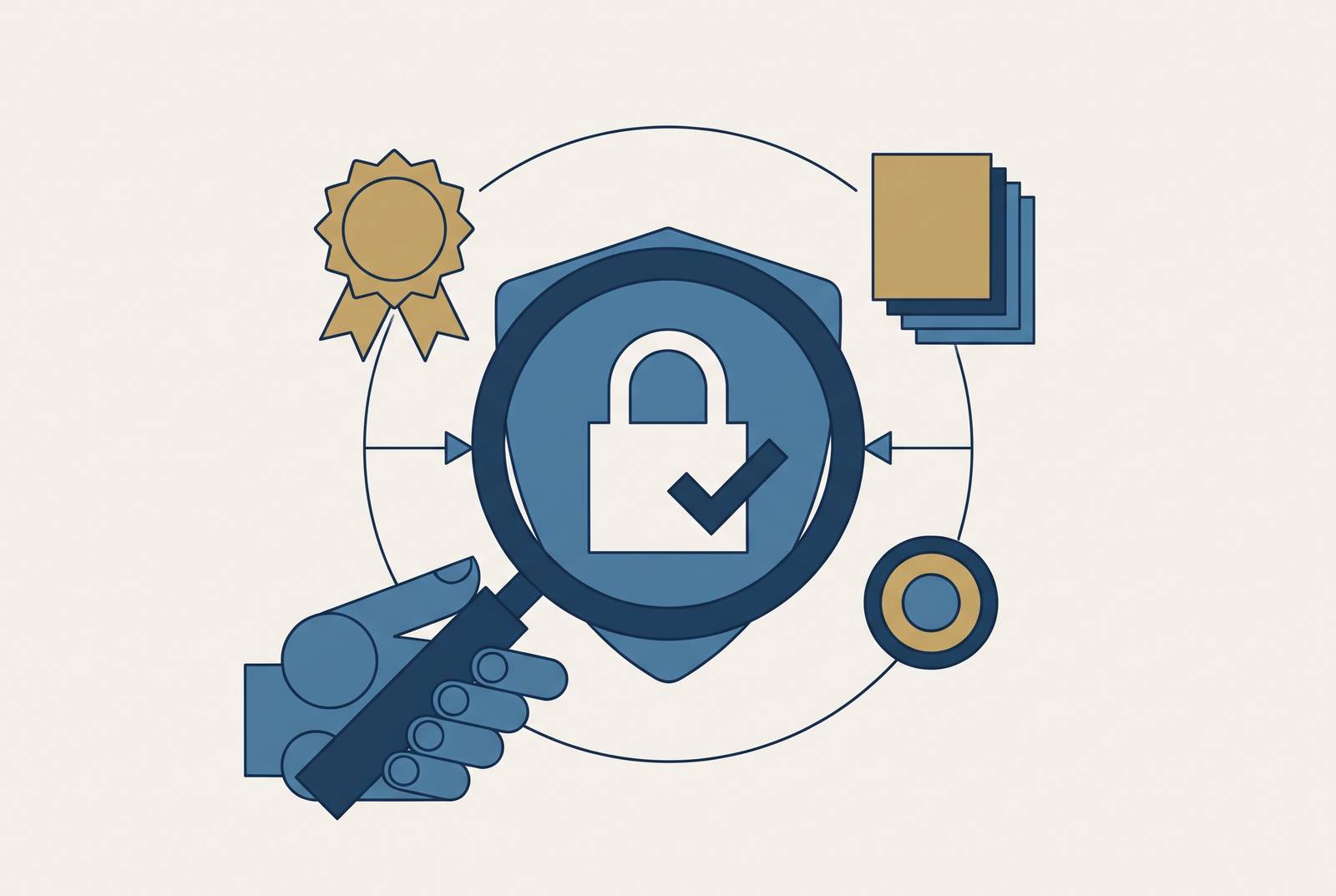
Enterprise SaaS buyers check security and compliance signals to decide whether a vendor can advance. This article maps those gates, from external scans and audit reports to access controls, contracts, and AI disclosures. Buyers need up-to-date evidence they can use before they can put a vendor’s product, price, or promises to work.
Why enterprise SaaS procurement now works as a gate system, not a scorecard
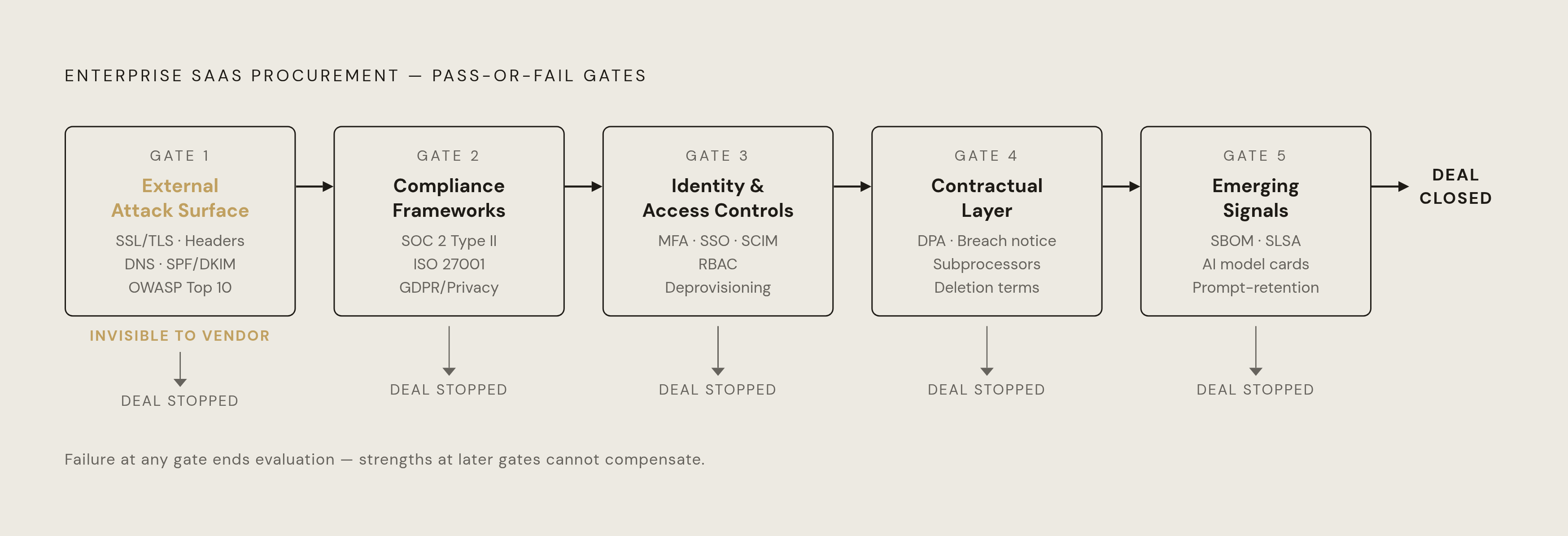
Before 2024, enterprise SaaS procurement could treat security as a box to check while weighing other parts of a deal. Now it increasingly works as a sequence of pass-or-fail decisions. A vendor that fails a required security or compliance check can be stopped before buyers look at its features, pricing, or references. A gate requires every prerequisite to be met, while a scorecard allows strength in one category to compensate for weakness in another.
The shift reflects changes in who must answer for vendor risk. The SEC adopted disclosure rules covering boards’ oversight of cybersecurity threats, while NIS2 management liability in the EU pushed cybersecurity onto board agendas. When a CISO presents vendor risk quarterly, the quality of the supporting evidence affects that person’s credibility. Procurement needs more than a persuasive assurance. It needs records that hold up when people outside the team choosing the software check them.
Breach costs reinforce that pressure. Cloud and SaaS-environment breaches cost materially more per incident than the global average, with sprawling third-party integrations, fragmented identity controls, and difficulty tracing data across connected applications contributing to the expense. Supply-chain risk also leads buyers to check more than the application itself. Buyers check several layers of evidence because each answers a question that the layer before it leaves open.
What buyers scan before they even send a questionnaire: external security posture
The first assessment can happen without the vendor’s knowledge. Enterprise security teams scan a vendor’s public-facing attack surface on their own before they send a due diligence questionnaire, or DDQ. They examine SSL/TLS configuration and certificate hygiene, HTTP security headers, DNS security records, and email authentication through SPF, DKIM, and DMARC. They also look for OWASP Top 10 exposure. These signals are directly observable and can be assessed independently of a sales team’s explanation.
Why begin outside the formal review process? Buyers can inspect this layer without vendor cooperation, which makes it useful for triage before they commit to a questionnaire. A poor result can end consideration in an internal meeting. The vendor may never hear about the decision. This gate is easy to overlook precisely because it produces no request for evidence, yet it establishes whether the buyer considers a deeper review worthwhile.
The compliance framework layer: SOC 2 Type II, ISO 27001, and what each one actually signals to a buyer
Once the formal review starts, buyers need evidence they can keep on file. The American Institute of Certified Public Accountants governs SOC 2 under System and Organization Controls reporting. Within that framework, Type I validates whether controls are designed properly at a point in time, while Type II validates whether they operated effectively across the audit period. Vendors may start with Type I for their first sales, but enterprise buyers usually require Type II.
Buyers therefore look beyond the presence of a badge. They ask for the formal report, check the currency of its audit period, and examine explicit mapping to access control, change management, monitoring, and incident response. The trust service criteria are Security, Availability, Confidentiality, Privacy, and Processing Integrity. The report’s scope deserves attention as well. A framework name alone does not tell the procurement team which criteria the evidence addresses.
ISO 27001 answers a related but different question. It shows that governance has a structure through an Information Security Management System, or ISMS, backed by written records of risk assessment practices. Buyers value its global compliance alignment, risk management maturity, and standardized control coverage, particularly outside North America. The frameworks are not interchangeable. Enterprise buyers more often expect both to meet the requirements of global and US enterprises.
For EU-market deals, privacy obligations form a parallel gate. Buyers require an explanation of the legal basis for processing personal data, retention rules, data subject request handling, breach notification preparedness, and regional hosting or residency options where needed. Many enterprise contracts outside the EU also use GDPR-equivalent terms. A strong but undocumented program leaves a gap. Certification gives procurement and legal teams a third-party-verified artifact, while privacy commitments address obligations that the certification name cannot settle on its own.
Identity and access controls buyers verify on every deal
Certification does not remove the need to inspect operational controls. Because identity failures drive the majority of breaches, buyers ask specific, testable questions about who can gain access and how that access is managed. MFA enforcement is a baseline, at least for everyone with elevated privileges. For those with the highest privilege levels, buyers more often expect phishing-resistant methods such as hardware tokens and passkeys.
SSO addresses the buyer’s need to manage access centrally. A majority of enterprise buyers require it, and SSO support correlates with higher average contract value, making it a commercial requirement as well as a security feature. SCIM provisioning increasingly accompanies that expectation, especially in large organizations managing hundreds of seats. Access has a lifecycle. Automated provisioning and deprovisioning help buyers assess how that lifecycle will work in practice.
Buyers check that the vendor’s role-based access control enforces least privilege, so employees can reach only the customer data they need for their roles. They then ask how quickly access is revoked when employees or contractors leave. Accounts of former employees are still active in a large share of organizations’ SaaS tools, so this risk keeps coming up in day-to-day operations. A correct setup at the start does not answer whether access will be removed at the end.
The contractual layer: what a signed DPA must actually contain
Technical controls describe protection, but the contract defines commitments. A Data Processing Agreement, or DPA, must contain specific, enforceable terms on processing scope, minimum cybersecurity standards, breach notification timelines, subprocessor rules, and deletion obligations. Generic promises do not resolve these questions. For buyers in regulated sectors, vague terms can leave a compliance gap because they are legally required to keep documented vendor posture on file.
Location and delegation require their own clarity. Buyers check where data is stored and processed, which international transfer safeguards apply, who the vendor’s subprocessors are, and what notice and recourse exist when a new one is added. The European Commission identifies Standard Contractual Clauses as a means of providing safeguards for transfers from the EU to third countries. A hosting location is only part of the answer. Buyers also need to understand the terms governing the parties and transfers involved.
Buyers ask what happens to customer data at termination, when deletion occurs, and how the vendor certifies it. Without those terms, buyers are unsure what the contract requires the vendor to do after service ends. That uncertainty can stop procurement early. Buyers often request the DPA before the questionnaire as a fast triage filter, so these gates represent distinct requirements rather than an identical administrative order in every deal.
Evidence response speed as a proxy for security maturity
A complete evidence response within 72 hours signals that the vendor already has its records on file. Taking two weeks can suggest that the package is being assembled for the occasion. Speed alone is not the test, however. Buyers read speed together with completeness and organization as evidence of whether the security program is maintained between sales opportunities.
Organized evidence maps explicitly to the controls in the questionnaire. It includes current scan reports and audit periods that have not lapsed, rather than a folder of unstructured PDFs that leaves the buyer to find the connections. Enterprise DDQs commonly contain well over a hundred questions, but the decisive questions map to a smaller set of risk dimensions. Living documentation makes those connections easier to show. Starting from scratch with each questionnaire takes longer and leads to answers that are less consistent.
The evidence also needs to show activity over time. Buyers increasingly consider an annual penetration test insufficient and ask when the last scan ran and how often scanning occurs. Weekly or monthly scan history with trend data provides more context than a single annual report. Findings themselves are not automatically a bad sign. Experienced teams can find zero findings suspicious and instead look for defined remediation SLAs, with critical issues patched quickly, high-severity findings addressed within days, and medium findings within weeks, supported by records across scan periods.
Emerging signals now appearing on enterprise checklists: SBOM, AI model cards, and prompt-retention terms
The minimum checklist is expanding beyond established certifications and access controls. Supply-chain and AI-governance evidence now blocks deals in regulated sectors and AI-forward organizations, even though these signals did not appear on standard DDQs two years ago. Buyers are extending the boundary of their review. They want to understand both the components beneath a product and the models operating within it, rather than accepting the application as a self-contained system.
A Software Bill of Materials, or SBOM, identifies the open-source components and third-party libraries the application contains. SLSA, short for Supply chain Levels for Software Artifacts, attestation provides a verifiable record of how software was built and what went into it. These artifacts answer different supply-chain questions. Buyers in regulated sectors more often ask for the attestation with the standard DDQ because assurances about the finished application leave some of its origins unexplained.
For AI-powered SaaS, buyers also ask whether data is used to train shared models. An AI model card documents training data, intended use cases, limitations, and risk considerations, giving the buyer a basis for assessing whether model behavior is documented and governable. It is not a general statement of good intentions. The expected signal is a document that makes the model’s intended role and known limits available for review.
Prompt-retention terms address a separate contractual concern. Buyers ask how long prompts and completions are retained, whether they are logged, who can access them, and whether they support model improvement. Those terms increasingly sit beside DPA requirements as a contractual minimum for AI-enabled tools. The pattern resembles the spread of SOC 2. Requests from security-forward buyers become wider expectations as risks become visible, creating deal friction in 2026 and beyond for vendors that have not anticipated them.
How security signal gaps show up in AI-driven discovery before a buyer ever contacts a vendor
Even the earliest security scan assumes a vendor has entered consideration. AI answer engines play a growing role in that earlier shortlist, as a large and growing share of enterprise buyers use AI-powered platforms to find products. This creates another form of exclusion. A vendor may have the required controls and reports but fail to appear because its posture is poorly documented in publicly retrievable content.
When buyers ask which vendors hold SOC 2 Type II or ISO 27001, the engine constructs its answer from content it can retrieve. Clear, machine-readable documentation on vendor sites and third-party sources makes it easier for the engine to find and show those claims. Public documentation serves a different purpose from confidential evidence. Public documentation helps show that a vendor belongs on the shortlist, while formal procurement still needs the reports, controls, and promises in the contract that back up those claims.
Trust and security pages should be answer-first. The certification, audit period, and frameworks covered should appear early, before marketing copy. Freshness also influences retrieval, as AI platforms favor recent material and can deprioritize compliance pages left untouched for several months. Current documentation helps prevent a strong security posture from being represented by stale public evidence.
Visibility also needs measurement. Available tooling can track whether a vendor appears in compliance-related answers across ChatGPT, Claude, Gemini, and Perplexity, yet most brands do not track that presence. A missing answer can reveal a gap between the evidence a vendor possesses and the evidence a buyer can find, leaving a qualified vendor outside the procurement process before any formal gate is reached.