Paid Amplification Impact on Influencer EMV Calculations
Separating bought impressions from earned ones keeps EMV honest.

Paid amplification changes influencer EMV calculations when bought impressions enter a metric meant to value organic attention. The solution is not to stop amplifying creator content, but to separate earned exposure from purchased distribution before calculating its value. That distinction makes campaign comparisons useful and provides a sound basis for measuring newer earned outcomes, including brand citations in AI answers.
What EMV is supposed to measure and why the boundary between earned and paid matters
Earned media value estimates what a brand would pay for advertising to get the same exposure as its organic, third-party attention. It translates unpaid impressions, engagements, and mentions into an advertising-equivalent dollar figure. The standard impression-based structure is (Total Impressions / 1,000) × CPM × Engagement Multiplier. More developed models also account for sentiment, share of voice, and content type. The calculation estimates an advertising-equivalent cost.
The definition depends on where the exposure came from. Earned media is attention a brand did not buy and does not fully control, including independent creator mentions, press coverage, community shares, and customer reviews. Paid media includes purchased distribution through boosted posts, dark posts, and whitelisted creator ads. A commissioned creator placement is also distinct from a genuinely earned mention. An organic delivery channel does not, by itself, make every placement unpaid.
That boundary determines what the calculation can explain. EMV can support comparisons of creator efficiency, show which formats earned organic attention, and provide a benchmark against paid media costs. It cannot attribute revenue or project sales. Nor does it independently justify a budget. Its legitimate question is narrower, asking what comparable advertising would have cost for the attention actually earned.
How paid amplification enters the EMV calculation and inflates it
The distortion begins before the formula is applied. Platform analytics can surface aggregate impression counts, which teams then pull into a campaign report. If those totals include both organic delivery and purchased distribution, both go into the impressions variable. The CPM and engagement multiplier then convert the mixed total into a dollar figure. The arithmetic works, but the input has changed categories.
With whitelisting, a brand runs paid ads through a creator’s account, so purchased impressions can resemble organic creator activity in aggregate reporting. Dark posts are sponsored placements shown to targeted audiences but kept off the creator’s public feed. Their distribution is paid from the start. Boosting adds bought impressions to an already-published post that may also have earned organic attention.
In each case, the additional distribution has a known paid cost. Yet an unfiltered EMV calculation treats those impressions as exposure for which the advertising cost still needs to be estimated. That is the category error. The output describes the combined advertising-equivalent value of organic and paid exposure, while its label suggests something else. A reader expecting to learn what the campaign earned beyond purchased distribution receives a blended total instead.
Why blended EMV is tempting to report and hard to catch
Paid amplification can be a reasonable distribution choice. Platform algorithms reward early engagement momentum, and amplifying a strong creator post within the first day or two can capture that window. Paid amplification increases total impressions. A report showing that growth is not inventing performance. The problem begins only when the purchased portion appears in the earned column.
The reporting environment makes that mistake easy to miss. There is no universal EMV benchmark or industry-standard formula, and tools use different CPM sources, some fixed and some dynamic. Ayzenberg’s Earned Media Value Index is licensed or adopted by several major platforms, but that does not establish a single method across every tool. Different calculations can therefore produce different results. A high number has no simple external reference that automatically exposes a paid input.
Organizational incentives add to the ambiguity without requiring deliberate misrepresentation. Teams often use EMV to explain creator budgets to leadership, so a larger figure supports the case they are expected to make. Aggregate platform reporting supplies the number, and varying methods make it difficult to challenge. Even teams that take care with their reports can miss this mistake. Teams should check whether anyone defined which impressions were eligible before the report was built.
What blended EMV actually breaks in practice
A heavily amplified campaign can appear stronger than an organic campaign, even when the latter earned more unpaid attention per dollar spent. The apparent advantage may reflect the distribution budget, leaving content performance uncertain. Without separate inputs, the report cannot distinguish those explanations.
Creator evaluation inherits the same problem. A creator whose post had a lot of paid support can look more valuable than one whose content spread without a boost. EMV already rewards reach without necessarily establishing relevance or conversion. Paid impressions add another source of ambiguity. A high score may say little about the creator’s ability to prompt independent attention, which is the signal the team needs for future organic work.
The confusion becomes more costly when EMV is compared with ROI. EMV asks what exposure would have cost to buy, while ROI asks about the revenue return from the campaign. Neither number substitutes for the other. Blending bought impressions into EMV makes a high exposure estimate and weak revenue performance harder to interpret, eroding confidence in the report. If that same inflated figure then justifies the influencer budget, paid spend is being used to prove organic value in a circular argument.
A clean methodology for separating organic EMV from paid amplification results
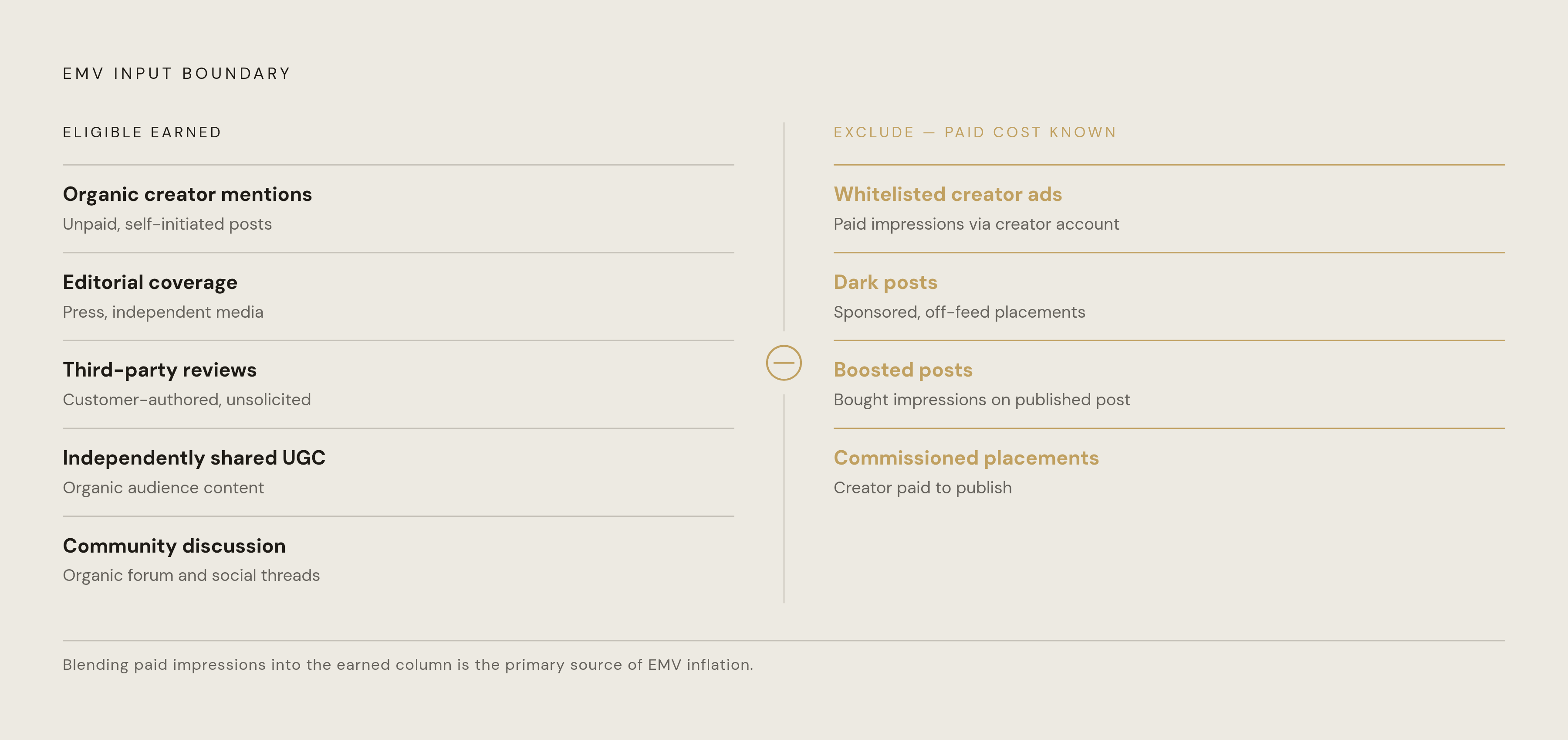
The practical fix starts before data collection. Teams should define earned exposure in writing and retain that scope across campaigns. Eligible activity includes organic creator mentions, editorial coverage, third-party customer reviews, independently shared user-generated content, and organic community discussion. Paid amplification belongs outside that scope. Paid creator placements should also remain distinguishable from genuinely earned mentions rather than disappearing into a broad influencer total.
Next, teams should collect impressions by distribution layer. Native post insights should be requested from creators at a fixed point before amplification begins, or within a window that isolates organic delivery. The collection date belongs with the data. Any figure that mixes paid and organic impressions should be labeled mixed.
Paid amplification then needs its own column in the report. CPM, CPC, and ROAS are appropriate measures for purchased distribution because they address its cost and return. Keeping them separate lets the report describe both whether content earned attention and whether spending to extend it produced useful results, with each outcome assessed on its own.
The valuation assumptions need the same care as the inputs. Teams should document the CPM source and retain the rate table and its version so that the calculation can be audited. If the CPM is assumed without support from the brand’s documented paid media history on the same platform, the report should show a sensitivity range.
Finally, EMV should function as an internal benchmark series. The same method, CPM source, and scope rules should be applied consistently over time. Otherwise, a change in accounting could change the reported figure even with performance unchanged. Stable methods make comparisons possible. They also let teams see how paid results did on their own while keeping track of what was earned organically.
What creator selection and brief design signal about organic EMV potential before a campaign runs
Some creators generate strong organic attention without a boost, while others look strong only after paid support. That distinction is more useful for judging future organic potential than follower count or demographic fit alone. It identifies what the creator actually earned. A blended total hides that evidence behind the reach a budget could buy.
For teams choosing a roster, the lesson is to use that distinction in creator and budget decisions. Assess which creators have generated attention without purchased distribution separately from which campaign posts accumulated the most impressions. Selection should distinguish amplified content’s value for paid distribution from evidence of organic appeal.
Brief design benefits from the same separation, although EMV is not a complete test of a brief. Clean measurement can show which formats earned attention, giving teams a clearer signal about what the content prompted before paid support entered. That evidence leaves the prospect of repetition uncertain. A high blended figure cannot show whether the brief led people to respond organically or amplification brought in most of the exposure. Separating the two makes selection and briefing quality easier to assess together.
An emerging gap in every current EMV framework: AI answer-engine visibility goes unmeasured
Current EMV formulas do not assign value to brand citations and mentions in AI answer engines. A brand named in a ChatGPT, Claude, Gemini, or Perplexity answer receives exposure it did not necessarily buy or fully control. That exposure can generate impressions and referral traffic. Yet the impression and engagement inputs used to value earned attention leave that exposure out.
AI visibility presents an unresolved measurement and valuation gap. An AI answer mentioning a brand in response to a product or category question can serve as an organic endorsement on a high-trust surface. There is still no established dollar value for that outcome within current EMV models. Treating it as earned exposure does not supply the missing conversion formula. Recognition and valuation remain separate tasks.
The omission is especially relevant to campaigns that generate third-party mentions, press coverage, and community discussion. Those signals can support both organic EMV and the probability of appearing in AI answers, but only the former currently enters the EMV report. Brands with strong independent mention footprints appear more consistently than those relying on owned content and paid distribution alone. The accounting can therefore be distorted in opposite directions. Bought impressions inflate one total, while genuinely earned AI visibility is absent from another.
How to build toward AI citation as a measurable earned media outcome
The next step is to measure AI visibility separately. Semrush’s AI Visibility Toolkit and Ahrefs Brand Radar, launched in beta March 2025, offer ways to track brand mentions across major AI answer surfaces. These include ChatGPT, Gemini, Google AI Overviews, and Perplexity. Tooling makes the exposure observable. It does not make an AI citation interchangeable with a social impression.
For marketing teams, that means tracking specific answer engines on a consistent cadence and treating brand mention rates as outcomes that content and PR decisions can influence. The content work has two connected parts. Structured, schema-marked owned-site content refreshed regularly provides a primary citation target. Independent reviews, editorial listicles, and community discussions create off-site citation surfaces. As with EMV, owned activity and third-party attention should remain distinguishable in the report.
Influencer reporting can then include an AI citation check after a campaign. Did the campaign generate third-party mentions and press coverage that appear in AI answers? Available tools let teams investigate that question. The check adds an earned outcome without treating citation counts as proof of revenue or a dollar-equivalent value.
Reports need to identify what was bought, what was earned, and what the instrument actually measures. Organic EMV, AI citation rate, and organic share of voice become more actionable when their boundaries stay visible. Separate measures let teams see which activities purchase distribution and which build brand presence that can persist after paid spending stops.