Software Vendor Evaluation Scorecard for Marketing Teams
A scorecard category that tests whether vendors can earn AI citations.

Marketing teams need a category of its own for AI visibility in their software vendor evaluation scorecard. Features, pricing, and support remain essential, but they do not show whether a vendor can help your brand get cited and recommended by ChatGPT, Claude, Gemini, and Perplexity. That capability deserves its own criteria, weight, and evidence, rather than being assumed from a promise of better search rankings.
Why AI answer engines have become the front door to vendor discovery
Similarweb’s 2026 Generative AI Brand Visibility Index found that more than a third of US consumers use AI at the product discovery stage, compared with roughly one in seven who use search. That finding covers consumers as a whole, including software buyers, but it shows why marketing teams need to treat AI answers as more than a side channel. Discovery can begin before a website visit. When an answer names vendors and explains their differences, it can shape the shortlist before the buyer opens a search results page.
The change is not simply another place to advertise. AI answer engines retrieve candidate documents and synthesize them into a composed answer, rather than leaving the reader to inspect every source. A page can be indexed without earning a citation. For marketing teams, that leaves a hole in a scorecard built only around conventional search performance.
Why ranking on Google and being cited by an AI answer engine are different jobs that require different vendor capabilities
SEO, AEO, and GEO are linked, but each has a different job. SEO aims to get a link ranked, while answer engine optimization makes it easy to pull a direct answer from the content. Generative engine optimization aims for the brand to be cited and recommended within the synthesized answer. A vendor may make a page easy to find without demonstrating that an AI engine uses it to recommend your brand.
The answer engine also changes the test. Ranqo’s large-scale study found that ChatGPT, Gemini, Claude, Perplexity, and Grok differ in how often they cite sources and which source types they use. Performance on one engine cannot stand in for performance on another. A vendor that reports one result across all engines may hide a weakness on the engine your buyers use.
Even a citation is not the whole outcome. The same study found that sentiment changes more often than brand mentions, so a brand can remain visible while its portrayal worsens. Does the answer cite the brand as a source, describe it favorably, or recommend it for purchase? Those are separate questions. A scorecard that folds them into “SEO-optimized content” gives the vendor credit without asking for the evidence that distinguishes them.
How brand stature and content architecture determine which vendors get cited — and which stay invisible
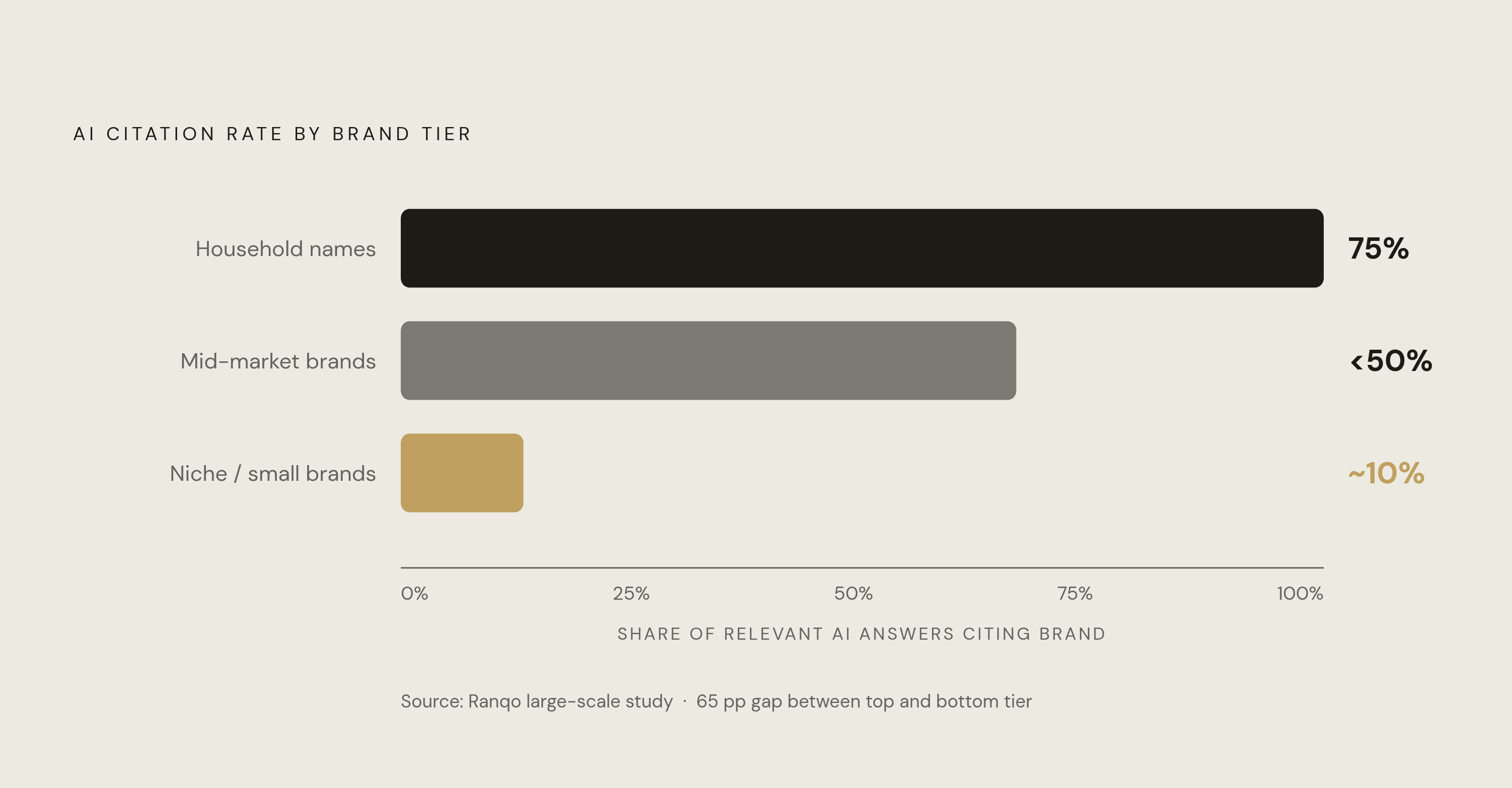
Ranqo’s study found a clear brand-stature ladder. Global household names appeared in roughly three-quarters of relevant AI answers on the first run, established mid-market brands in under half, and niche or small brands in roughly one in ten. Vendors therefore start from different positions. A result achieved for a household name does not, by itself, demonstrate that the same approach will work for a smaller brand.
For less familiar brands, content architecture gives the evaluation something more concrete than reputation to examine. Answer-first sections, structured FAQs, and comparison tables make it clear what the information is for, while structured data labels parts such as the article and its author. Topic depth gives an engine more than a passing reference to work with. Publication volume is a weaker signal on its own. A large library does not demonstrate that its pages are readable, authoritative, or supported by other sources.
That support extends beyond the brand’s website. Review platforms, community discussions, editorial outlets, and video provide third-party sources from which engines can draw, including G2, Reddit, and YouTube. If the vendor works only on owned content, its work leaves out those sources. Yet broader presence still needs an outcome test, because “ghost ranking” occurs when an answer mentions your brand but recommends a competitor for the purchase. Visibility can coexist with losing the recommendation.
What a vendor evaluation scorecard needs to cover before you add an AI visibility category
The existing scorecard remains the foundation for a sound purchase. It should cover features and capabilities fit, pricing and total cost of ownership, integration with the existing stack, support and onboarding, security and compliance, and the credibility of the vendor’s roadmap. AI visibility does not replace any of these. A vendor’s citation performance cannot answer whether the software fits the team’s work or whether the team can afford to run it.
Compliance also connects the old framework to the new category. The EU AI Act’s Article 50 disclosure requirements apply from August 2026 to AI-generated text that is published to inform the public on matters of public interest. The AI Act service desk says that, for the exception to apply, there must be both human review or editorial control and a natural or legal person who holds editorial responsibility. Review alone is not the entire condition. A content vendor’s approval process therefore belongs in the assessment of governance as well as production quality.
The AI visibility scorecard category: what to evaluate, what questions to ask, and how to weight it
Citation measurement capability is the first sub-criterion. It asks whether the vendor can demonstrate brand visibility separately for ChatGPT, Claude, Gemini, and Perplexity. The evidence should include brand mention rate, share of citation, cited-source diversity, and competitor displacement for each engine. Can the vendor show a dashboard or report for a comparable client? Measurement comes first because every other capability needs a way to test its result.
Content architecture for AI retrieval is the second sub-criterion. The evaluation should examine whether answer-first formatting, structured FAQs, comparison tables, and schema markup are standard deliverables. Relevant markup includes FAQPage, HowTo, and Article + Author, while an llms.txt file is another output to ask about. Delivery format deserves a direct question too. Does the vendor publish static HTML by default, or depend on client-side script rendering that can create a barrier to retrieval?
Third-party source building is the third sub-criterion. It asks whether the vendor’s scope reaches the sources engines use beyond the client’s own domain, including review platforms, editorial media, communities, and video. Does the vendor build a presence on G2, Reddit, and similar platforms, and does it publish through third-party editorial outlets? Scope is the key distinction here. A vendor that includes off-site work as a core deliverable offers a different capability from one that distributes content when time allows, and the evidence should show source diversity.
Sentiment and recommendation tracking is the fourth sub-criterion. Ranqo’s study found that positive or negative framing flips about 6.7 times more often than whether a brand is mentioned at all. A mention count can miss that instability. Can the vendor detect an answer that cites your brand but sends the buyer toward a competitor? Can its reporting distinguish a source citation from a purchase recommendation?
AI visibility belongs beside features, pricing, and support as a category in its own right. Within it, citation measurement and content architecture should receive the majority of the weight because they underpin the other capabilities. The notes do not support a universal percentage split. The useful principle is to give the greatest weight to work that makes citation possible and makes its outcome observable, while retaining separate scores for source building and recommendation quality.
What a human-review gate in the content pipeline tells you about a vendor's reliability
Human review shows whether the vendor can control what its automation publishes. Without a required gate, AI content produced at scale puts quality at risk and may fall short of disclosure obligations. A two-pass process separates editorial judgment from generation by having a human approve the outline before the draft is produced. That separation gives review a defined place. When the stages collapse together, the editor can become the bottleneck through which unreviewed work leaks into production.
For buyers, the lesson is to ask for a demonstration of the approval path. Is there a named human approver at each AI-led stage, with a queue, an SLA, and a metric for the gate? Can the buyer check and reverse every AI-generated output before it is published? Automation should preserve the ability to say no. A review option is not equivalent to a mandatory approval stage, so the evaluation needs to distinguish what the system permits from what the chosen workflow requires.
Letterstory is one example, with multi-stage pipelines that pair AI drafting with human review or let the buyer choose full autonomy, while a named human can stop and reverse output before it enters the publish queue. It also publishes through a client’s own blog and independently hosted phantom sites, then checks whether ChatGPT, Claude, Gemini, and Perplexity name the brand, connecting production choices to a measurable visibility outcome.
How to score and compare vendors on AI visibility when most of them do not yet use that language
Most vendors will not present their work in GEO terms, so terminology is a poor scoring shortcut. The buyer has to surface the capability through delivered work and reporting. Conversely, a fluent explanation of AI visibility does not establish that the vendor measures it.
A content sample makes the first test concrete. Does each section open with a direct answer in its first few dozen words, and does the work include structured FAQs and schema markup? What does the vendor allow or block through robots.txt, and has it considered AI crawlability?
Success reporting provides the next dividing line. Organic traffic, keyword rankings, and click-through rate remain useful, but a vendor reporting only those measures has not demonstrated AI visibility measurement. Off-site publishing needs the same scrutiny. Even a large owned-content plan limited to the client’s domain does not show that the vendor can build third-party sources.
The red flags should lower the scores for the work they affect. They include no per-engine citation tracking, client-side script-rendered content as the default, no off-site publishing program, no human-review gate, and no way to show whether engines name the client. The strongest green flag is actual citation data for a comparable client. That evidence should come from a named measurement layer covering at least ChatGPT, Claude, Gemini, and Perplexity separately. Such a layer also gives the buyer a way to assess performance after selection, when the demonstration is over and the contract is running.
Turning the scorecard into a living instrument as AI engine behavior evolves
As AI citation behavior changes, the scorecard needs checks beyond the first assessment. Engines change which sources they cite, how they frame brands, and which content formats they favor as models and products evolve. The measurement layer supplies the feedback for those changes. The buyer needs fresh evidence to tell whether a vendor’s apparent strength when chosen holds up as it does the work.
A practical cadence begins with a monthly review of per-engine brand mention rate, share of citation, and sentiment direction for signs of drift. Quarterly, the team should re-run the AI visibility category against the vendor’s deliverables using the same questions about direct answers, structured markup, and third-party presence. Annually or at contract renewal, the team should reconsider the category’s weight relative to the full scorecard if adoption or citation mechanics have materially shifted.
A decline in visibility becomes a reason to examine sources, content structure, and recommendation patterns, rather than assume that more publishing will solve it. The scorecard’s purpose is to distinguish a capability that can be proved and maintained from a claim made during procurement. With that evidence, a marketing team can judge whether its vendor is helping the brand become a recommended choice.