Organization Schema Implementation for Brand Identity Signals
A clear brand record helps AI engines cite you accurately.
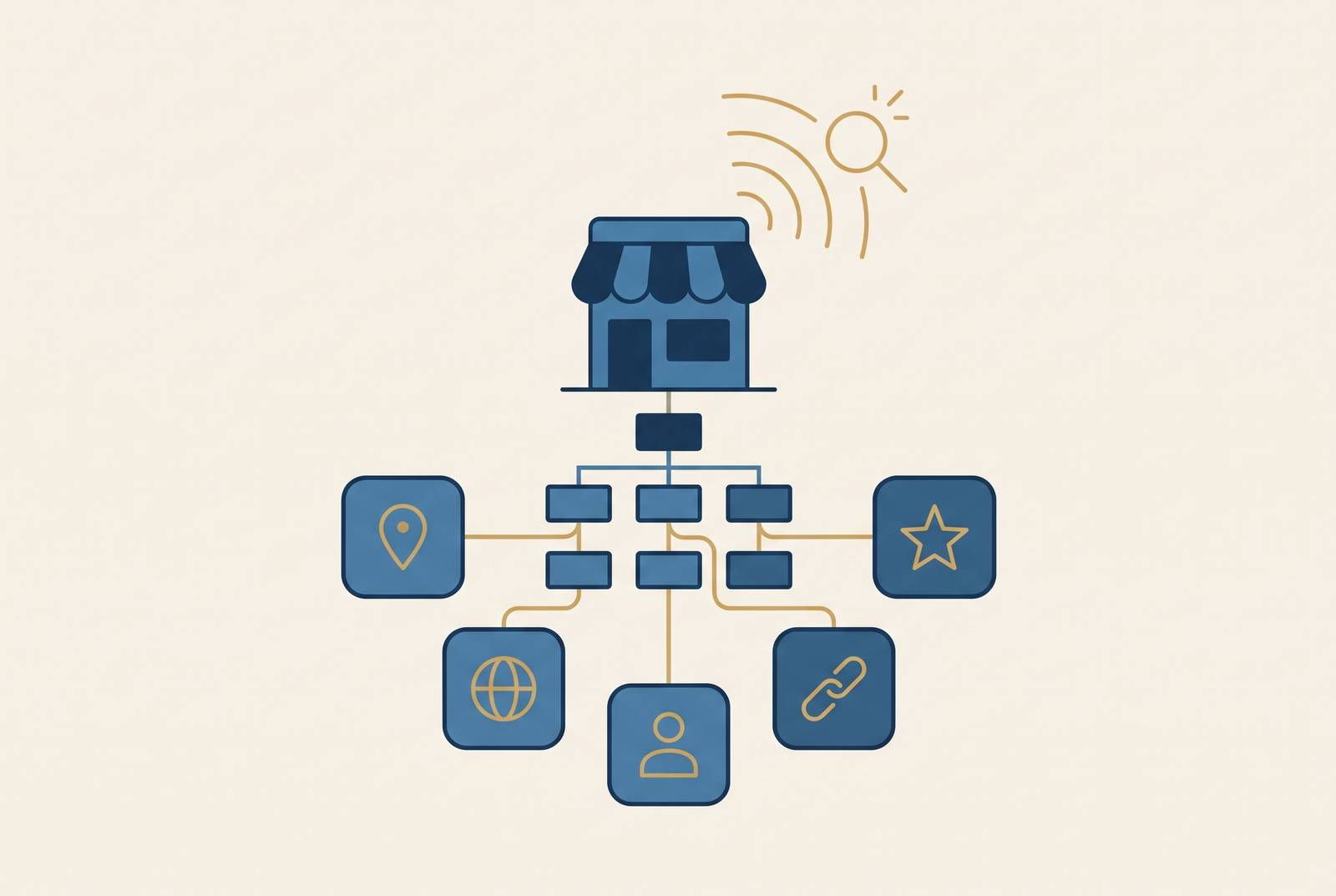
Organization schema implementation gives AI answer engines an explicit record of a brand’s identity. That record connects a company’s website, profiles, people, and content to one entity. A clear identity makes a brand easier to recognize and cite, but only when the declaration matches useful content and consistent evidence elsewhere.
Why AI answer engines need an explicit brand record, not inferred identity
A page can name a company without making clear which company it means. “Apple” illustrates the problem. The word alone does not declare an entity’s type, attributes, or relationships, so a system must work out the intended meaning from context. ChatGPT, Google Gemini, and Perplexity face that broader problem across millions of pages. Before assembling an answer, they need to resolve what a source is talking about and who stands behind it.
This is an entity-resolution problem. When two brands look similar, a clearer entity graph leaves an answer engine with less to work out. The ambiguous brand may lose a citation to the clearer one, or the engine may rely on a structured third-party directory such as Yelp or Crunchbase instead. Who gets to define the brand, then? Without a clear record, the answer may depend on which outside source makes the brand easiest to identify.
What Organization schema actually declares and why those fields are identity signals
Organization schema declares a company’s identity in machine-readable form. Its properties can describe the company’s name, official URL, logo, contact details, industry, founders, description, and social profiles. These are not merely labels attached for technical housekeeping. They establish which organization a page represents and give systems facts against which to compare other sources.
The name, url, and logo properties establish the canonical brand record. The name identifies the organization, the URL identifies its official website, and the logo supplies its visual identity. The sameAs property then connects that record to external profiles representing the same organization. That connection serves a different purpose from a description. It helps a system tell whether a company named elsewhere is the company behind this website.
Schema.org supplies the shared vocabulary for these declarations. Founded by Google, Microsoft, Yahoo, and Yandex, it defines entities, properties, and relationships that search engines and AI platforms can use to build Knowledge Graphs. JSON-LD is the implementation format recommended by Google Search Central. It keeps structured markup separate from page content, which cuts errors and makes it easier to use across large sites. The vocabulary says what the record means, while the format makes it practical to publish.
For implementation, the recommended starting point is a minimal record containing name, url, logo, and a sameAs array of verified profile URLs. Those values must describe the actual brand. The Organization declaration belongs site-wide in the header, rather than only on the homepage, so that content schemas throughout the site can connect to the same root entity. A fuller record can then declare the other identity details that the site accurately supports.
How the sameAs property collapses scattered signals into a single verified entity
A website, LinkedIn company page, social profile, and Crunchbase listing can all describe one business without making clear that they refer to the same one. The sameAs property supplies that missing connection. It declares that these URLs represent the same entity, giving systems building Knowledge Graphs a direct way to join distributed signals. A profile belongs here because it represents the brand.
For that purpose, useful targets include the LinkedIn company page, Twitter/X profile, Crunchbase profile, and Wikidata entry. A Google Business Profile URL is also relevant, especially for a business with a physical presence. Wikidata provides a particularly strong external corroboration signal in this identity framework. But the link alone is not enough. The link is useful when the page it points to backs up what the website says about who the company is.
What happens when the linked profiles disagree? A different company-name spelling on LinkedIn or an outdated description on Wikidata introduces the uncertainty the markup was meant to remove. To make sameAs useful, a team should confirm that each URL resolves and that the profile accurately represents the same organization. The linked records should agree on who the company is and the details they give about it.
The relationship between Organization schema and the schemas built on top of it
Organization schema provides the root entity for a connected content graph. Article schema links a piece of content to that organization through its publisher property, while Service schema identifies the organization as the provider. These connections establish who published the content and who delivers the service. The distinction is useful for B2B companies. A service declaration helps a system understand what kind of vendor the brand is as well as recognize its name.
Person schema adds founders and authors to that graph. Linking people to the organization makes authorship and credentials machine-readable, which helps a system judge whether it can trust the source. FAQPage schema has another role, identifying genuine question-and-answer pairs for extraction. When those answers link to the organization’s record, a system can tell where they come from. BreadcrumbList shows where a page sits within the site’s hierarchy.
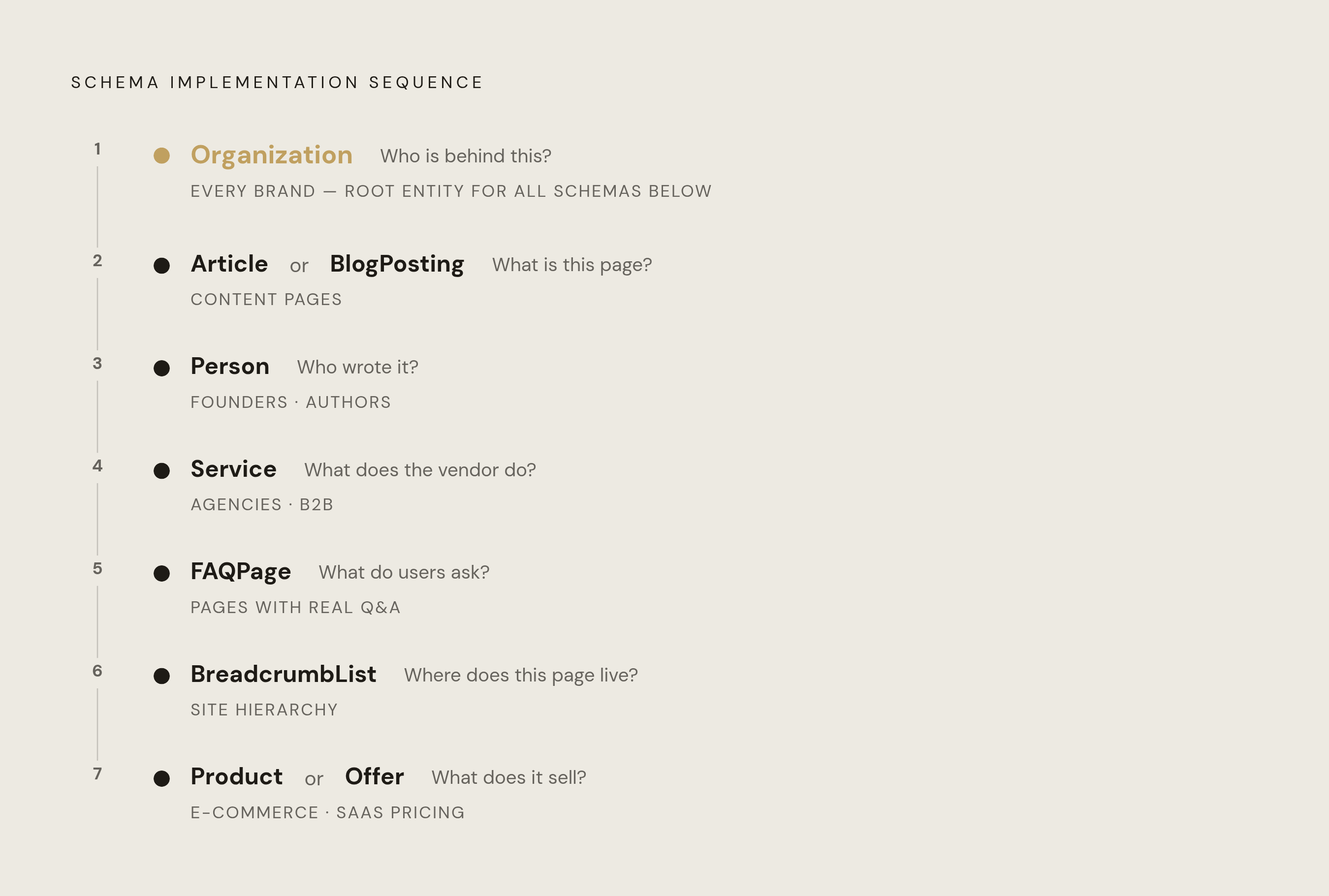
The recommended implementation order follows these dependencies. Organization comes first for every brand, followed by Article or BlogPosting for content pages, Person for founders and authors, and Service for agencies and B2B companies. FAQPage belongs on pages that have real questions and answers, while BreadcrumbList describes how the site is laid out and Product or Offer describes what it sells. Each type answers a different question. Together, they describe the content, its author, its publisher, and its purpose without asking a retrieval system to reconstruct every relationship from prose.
What most implementations get wrong and why technically valid schema still fails
A page can pass Google’s Rich Results Test without doing much to help its AI visibility. Validation and usefulness are different tests. The first addresses technical correctness, while the second depends on whether the declarations accurately connect the brand to its content and external evidence. A valid record can still be incomplete, inconsistent, or detached from the pages it is meant to explain.
One common problem is an orphaned Organization record on the homepage. If content pages do not connect to that root entity, parts of the site’s Knowledge Graph are missing. Another is a sameAs array that points to unfinished or conflicting profiles. Manufactured FAQ content creates a different failure. Labeling thin material as questions and answers does not make it useful to a system looking for a clear response to a real question.
Audits should cover relationships, accuracy, and syntax. Every sameAs URL should resolve, and the Organization name should be exactly the same in the markup, Google Business Profile, and LinkedIn. Every Article’s publisher property should point to the same Organization @id, the identifier that refers to that entity. These checks turn a vague question about whether schema is “working” into concrete questions about its connections.
How Organization schema feeds the RAG layer that AI answer engines actually query at runtime
The value of these connections extends beyond indexing. AI Overviews, Perplexity, and ChatGPT’s browsing features use retrieval-augmented generation, or RAG, to assemble answers from retrieved material. At inference time, the retrieval layer searches indexed pages for relevant, trustworthy content before the model generates its response. Retrieval therefore needs more than a matching phrase. It needs context about what a source describes and why that source is suitable for the answer.
Organization schema can give a system some of that context by making clear which entity it is looking at. A brand declared consistently across its site is easier to identify than one whose name appears only in body copy. When a retrieval system can connect the declared entity to the query, it has less ambiguity to resolve. This reduced ambiguity explains why a coherent identity record is relevant to retrieval as well as search indexing.
The surrounding schemas help classify what gets retrieved. Article identifies content type, Product signals commercial content, and FAQPage identifies question-and-answer pairs that can support direct extraction. Person linked to Article supplies a machine-readable authorship connection for evaluating source reliability. Each declaration reduces a different kind of uncertainty. Their combined value comes from describing both the material and the people or organization responsible for it.
That structured entity layer also provides a semantic foundation for emerging standards such as WebMCP. The roles remain distinct, however. Organization schema describes the entity, while WebMCP adds a separate action layer of callable tools for agent-based systems interacting with a site programmatically. Publishing an identity record establishes the meaning on which that separate interaction layer can build.
Why schema is a necessary condition for AI citation but not a sufficient one
Does a clean identity record make a weak page citable? No, because recognition and usefulness are separate questions. Schema is foundational infrastructure for an explicit brand identity. It describes content structure. A well-marked-up page can still offer too little useful information for an answer engine to select.
Citation readiness also depends on clear headings, concise opening statements, and explicit factual claims that a retrieval system can extract. Independent sources must corroborate the brand, while linked profiles should maintain consistent name, address, and phone details. Schema establishes the on-site declaration, but outside evidence helps validate it. What, then, does a full implementation look like when the goal is not simply to publish markup, but to measure whether the brand becomes more visible?
Implementing Organization schema as part of a measurable AI visibility program
The work should start with an Organization JSON-LD record in the header across the site. Its sameAs array should include the brand’s verified external profiles, with resolving URLs and information that matches the declaration. Every Article’s publisher and every Service’s provider should point to the same Organization @id.
The next step is to connect founders and primary authors through Person schema, using affiliation or worksFor to link each person to the organization. Google’s Rich Results Test provides a validation step, but passing it is only a baseline. The markup also needs a schema-to-content check. Every declared property should be accurate and supported by visible page content, so that the machine-readable record does not contradict what a reader can see.
Measurement then moves beyond the markup itself. Validation cannot show whether ChatGPT, Claude, Gemini, or Perplexity actually names and cites the brand in response to relevant queries. That requires watching answers across those platforms as well as checking Google Search Console. Mentions and citations are distinct from technical correctness. Watching them connects the implementation to the retrieval layer where the intended benefit should appear.
To interpret that movement, a team should track schema changes together with content changes. Otherwise, a rise or fall in citations may be credited to the wrong cause. Profile accuracy, content consistency, and citation monitoring therefore remain ongoing work. The investment is a brand record that can stay coherent as its content and external presence develop. Its long-term value lies in making the organization recognizable to answer engines today and understandable to systems that may interact with it tomorrow.