Reputation Damage Quantification for Marketing Budget Justification
Brands lose revenue to reputation damage already—now you can prove it to finance.
Reputation damage carries a real dollar cost, but marketing teams rarely know how to put a number on it, and that gap is what gets the line item cut. Marketing budgets have shrunk for four straight years and are now 7.8% of company revenue, Gartner's 2026 CMO Spend Survey found, even as growth targets have moved in the opposite direction: most CMOs describe their targets as high or very high, while fewer of them hit their marks across acquisition, retention, and ROI. CFOs facing that squeeze respond by asking for revenue attribution, forecasting accuracy, and a clear line between spend and outcome. Reach and engagement numbers alone no longer answer that question. Performance marketing can point to a cost-per-acquisition figure and close the conversation; reputation investment has usually had to make its case with anecdote and sentiment scores, which lose every time finance tightens the room. Reputation damage has a dollar figure, and a marketing team that builds the calculation, from customer defection through AI invisibility, can bring it into the same financial language a CFO already trusts.
What reputation damage costs, before any formula is applied
Reputation damage rarely lands as one event. It builds up across several channels at once, and each of those channels carries a cost that is visible in the revenue numbers, even when nobody labels it correctly. Sales conversion suffers first: a prospect searches the brand name before buying, finds an old complaint or an unresolved dispute, and quietly moves to a competitor without ever explaining why. The business loses that revenue but books it as a soft conversion rate, not a reputation cost. Marketing spend takes a second hit. Paid ads and SEO campaigns still drive the click, but if the next thing a prospect does is run a branded search that surfaces red flags, that traffic stalls out before it converts, so the brand pays to send people toward a result working against it. Recruiting costs rise the same way: negative employer content filters out strong candidates before they ever submit an application, and that cost never appears on a reputation line item, only in a higher effective cost per hire. Investors and partners run reputation checks before any serious commitment, and unresolved negative content on the first page of a branded search slows deal flow in ways that are hard to trace back to their source. Referral volume falls off too, as satisfied customers grow less willing to recommend a brand when they aren't sure what a friend or colleague will find when they look it up. None of this is a projection. It is already sitting in the revenue data, just filed under the wrong cause.
The core formula: translating customer defection into a quarterly dollar figure
The most defensible way to put a number on this starts with a formula tying together three things: how many customers were exposed to negative content, what share of them is likely to defect because of it, and how much each one is worth over their lifetime as a customer. Multiplying those three together produces a dollar figure for a given period, built from inputs finance already recognizes. Customer lifetime value itself needs no introduction in a budget meeting: it's calculated as average purchase value times purchase frequency times customer lifespan, the standard definition used across marketing ROI measurement and already sitting in most B2B SaaS unit-economics dashboards. The three inputs come from existing data, not new research. The number of customers exposed can come from branded search volume in Google Search Console, from review-platform impression data, or from an estimated reach figure tied to a specific incident. The defection rate should use the conservative end of historical churn, segmented by NPS cohort, or be modeled as a range, low, base, and high, so finance gets a bounded estimate instead of a single number that invites argument. Say branded search shows a substantial volume of monthly searches during a reputation incident, and historical churn data suggests a conservative share of exposed prospects defect as a result, with a certain average CLV per customer: multiplying the resulting number of lost customers by that CLV produces a sizable dollar figure for a single quarter. Starting conservative keeps the first number from being picked apart as inflated, even though it may understate the eventual total. The brand protection ROI approach says to begin at the low end of every range and refine the model as real program data comes in, so the first number you present is never the one that gets picked apart as inflated. This formula covers the demand-side risk, the customers who leave or never arrive because of what they found. It leaves out the slower, compounding losses that build in brand equity over years rather than a single quarter, and a complete model has to account for those too.
Adding brand equity and long-horizon losses the defection formula misses
A defection-based model captures the immediate revenue at risk, but it understates the real damage because most of the compounding effect lands in brand equity over years, not in one quarter's churn number. Research on brand purpose, cited in the Kantar Purpose data referenced by Sponsorship Lab, found that brands rated highest on perceived positive social impact grew brand value at more than double the rate of brands rated lowest, over a twelve-year span. That gap is not visible in a single campaign's ROI report. It only becomes visible when you run the analysis across years, which is exactly the timeframe most quarterly reputation reporting fails to cover. The practical consequence: a brand that absorbs a reputation hit and does nothing about it keeps losing more than this quarter's defectors, as the rate at which its brand equity compounds shrinks for years afterward, the same way a lower interest rate compounds into a much smaller balance over a long enough horizon. Finance teams already think in these terms, so the model should speak their language directly. Build two scenarios: one where the brand's current equity trajectory continues unimpaired, and one that reflects a sustained reputation impairment, then express the gap between them as foregone brand value over a three-to-five-year horizon, the same window used in standard discounted cash flow analysis. Framed this way, reputation investment stops looking like a defensive cost center and starts looking like what protects the compounding rate that makes every future acquisition dollar work harder. That argument raises a related, newer problem: a damage channel that doesn't appear in search rankings, review scores, or churn data at all, because it occurs in systems that don't report to any of those dashboards.
AI invisibility as a new and unmeasured category of reputation damage
Reputation damage today includes not just what gets said about a brand, but what never gets said at all: a brand that generative AI systems simply don't mention when a prospective buyer asks for a recommendation. That absence matters more now because early-stage buyer consideration increasingly happens inside an AI answer, not a search results page. A brand can hold page-one rankings on Google and be entirely missing from AI-generated recommendations at the same time, because these are two separate distribution systems with different rules for who gets surfaced. The discipline built around this problem, Generative Engine Optimization, is documented by Similarweb as the practice of structuring content and building brand authority so AI platforms select, cite, and surface a brand in response to user queries, and it differs from traditional SEO because the signals that earn authority are not the same ones. This kind of damage concentrates in a few specific places. It shapes early-stage consideration directly: AI Overviews and AI chat answers build a buyer's shortlist before a single click happens, so exclusion at this stage means the brand never makes the list. It also slows trust formation: a brand cited consistently across AI-generated answers earns credibility before a prospect ever visits its site, while an absent brand has to build that same trust later and from scratch. This channel resists measurement with the tools most teams already use, since a prospect who never put a brand on their shortlist leaves no trace in any CRM. For the quantification model, AI invisibility damage should be expressed as a share-of-consideration estimate: the fraction of relevant AI-answer sets where the brand doesn't appear, multiplied by estimated query volume and the downstream conversion value those queries represent. Brand visibility inside these systems is a rate that depends on content and signals being maintained continuously, because an AI system that cited a brand last month has no obligation to cite it again.
Authority signals and AI citation
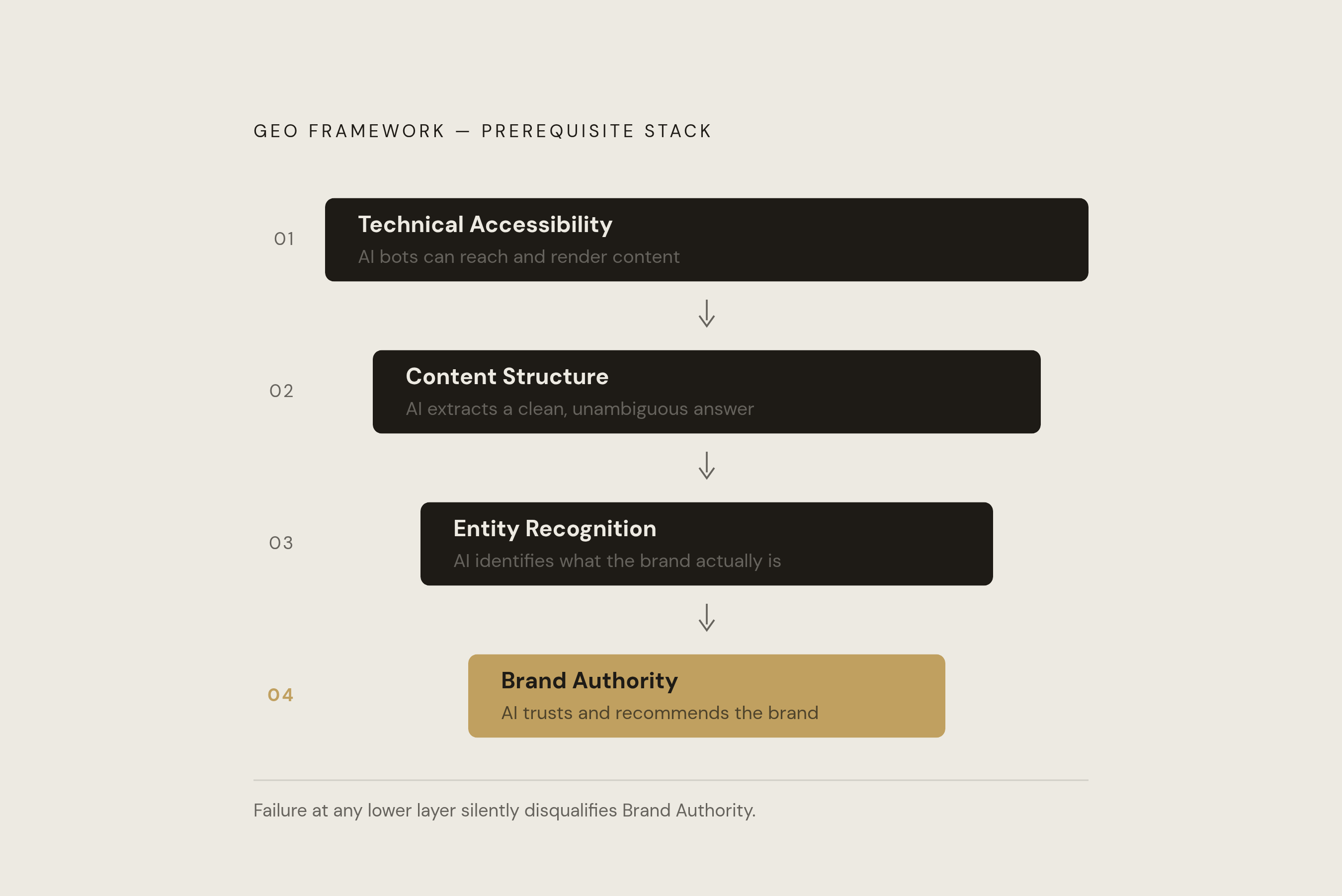
The work that protects brand reputation, earned media, third-party mentions, editorial-quality owned content, is the same work that builds AI citation authority. That means the budget case here isn't for a new line item, it's for recognizing that an existing one is already doing double duty. Traditional SEO rewards backlinks above almost everything else. AI citation runs on a different combination of signals: entity recognition, content structured so it can be extracted cleanly, third-party corroboration, plus technical accessibility and freshness, but the content investment that produces all of this overlaps heavily with what reputation management already requires. Owned content is necessary but not sufficient on its own, since AI systems favor content they can pull a clean answer from, check against other sources, and attribute to a credible author, which takes both strong owned content and outside corroboration working together. The GEO framework documented by Lumar lays this out as four layers that each have to succeed in sequence: technical accessibility, meaning whether AI bots can access and render the content at all; content structure, meaning whether it's formatted so AI can extract it; entity recognition, meaning whether AI knows what the brand actually is; and brand authority, meaning whether AI trusts the brand enough to recommend it. Each of those layers doubles as reputation protection. A brand with a clearly defined entity, accurate and extractable content, and a third-party footprint that backs up its own claims is protected against misrepresentation in AI answers and positioned to be cited by them at the same time. That's the budget argument in its simplest form: reputation investment and AI visibility investment are one investment, and a marketing team that has kept them in separate budget lines has been paying for the work twice while only counting the return once.
Building a content operation that defends reputation and AI visibility
Content that protects reputation and earns AI citation reads as editorial work, not marketing copy, and producing it at the pace AI systems require takes a structured pipeline rather than occasional publishing. The pipeline that content organizations serious about this build runs in stages. Drafting starts with AI producing structured drafts and flagging obvious errors or inconsistencies before a human ever opens the file. Then a contextual analysis layer checks brand alignment, claim accuracy, and audience relevance before anything reaches a human reviewer. Human review comes next, and it's the stage that actually controls for brand safety: a person brings the context the system doesn't have, which brand signals matter in a given market, which claims need sourced evidence behind them, where a cultural detail changes the whole brief, and when something that looks fine on paper still shouldn't run. Performance monitoring closes the loop: it feeds citation tracking and mention data back into the pipeline so future output improves based on what's actually getting cited. The bottleneck in this kind of system sits consistently at the quality-assurance and human-review stage, not at how fast content can be generated, so once you build the review infrastructure, scaling output further costs you comparatively little. Human judgment isn't there to compete with the model on volume; it supplies what the system can't: brand-specific sensitivity, claim verification, and the final call on whether a piece should run. Run this way, an AI-assisted pipeline lowers the cost of producing each piece while keeping a human as the deciding factor on brand safety, so a team gets real scale without giving up editorial accountability.
Measuring AI citation and brand mentions for live inputs
None of the AI invisibility math holds up as more than a one-time guess without ongoing measurement, and that's where most existing tools fall short. Traditional rank trackers were built to watch search engine results pages, and they simply don't see what happens inside an LLM's answer. Tracking AI citation and brand mentions takes a different kind of measurement, and tools built for that now exist. The central metric is Share of Model: a brand's mentions divided by total brand mentions across all competitors in a tracked set of prompts, functioning as the AI-visibility version of share of voice. This is the number that turns the AI invisibility dollar figure from a static estimate into something tracked over time, the same way a defection rate or a churn cohort gets revisited every quarter. Share of Model combines two distinct measurements, and a complete model needs both. Mention tracking checks whether the brand's name shows up in an AI-generated answer at all, and that speaks to consideration and trust. Citation tracking checks whether that answer links back to owned content, so it speaks to traffic and attribution. Mention tracking without citation tracking shows a brand it's being talked about but not where the resulting interest can be captured. If a brand gets left out of an AI answer, citation tracking alone misses that broader consideration damage, even when the one time it does appear, it links back correctly. Both measurements, tracked consistently, give the quantification model live inputs that keep it credible in front of finance, rather than a single snapshot taken the day the budget request went in.