Structured Data Strategy for Multi-Author B2B Content Sites
Schema can verify who wrote a page, but only clear prose gets quoted.

Structured data strategy for multi-author B2B content sites is now about more than rich snippets. Its central job is to make the relationship between an author, a publisher, and an article clear to machines. That trust layer can help AI answer engines understand who is speaking, but it must work with clear, quotable content. Neither markup nor good prose can do the whole job alone.
Why structured data's job has changed on multi-author B2B content sites
Before a B2B buyer contacts a vendor, an AI assistant may have already researched the category, compared options, and built a shortlist. A brand left out of that answer loses a chance to be considered. The buyer may never see its best article. This changes what content infrastructure needs to support, because publishing a useful page does not necessarily make its source recognizable to the system assembling an answer.
The older case for structured data centered on search appearance. A team added markup to earn an FAQ box, a breadcrumb, or a star rating. As rich-result options have narrowed, however, the less visible role of structured data has become more important for B2B editorial pages. It provides an explicit account of what a page represents and how its source relates to other entities.
A publisher may be clearly identified while the people writing under its name remain little more than bylines. Readers can interpret a name and biography, but the machine-readable record may not connect that person to their expertise or employer. The gap grows with every unresolved author.
How AI answer engines use entity signals to decide what to cite
Entity verification starts with a basic question. Does this page belong to a source the system can recognize, or does it just have a name that looks familiar? Stable identifiers and external identity references help distinguish those cases. Organization and Person schema describe the publisher and author, while Article schema connects those entities to a particular piece of content.
The distinction is between a label and an identity. An author name says who appears to have written the page, while a stable @id gives that author a reference that other pages can reuse. External links through sameAs provide further identity anchors. For enterprise B2B sites, Wikidata and Crunchbase can reinforce recognition beyond the site itself. Wikidata is an influential input to the Google Knowledge Graph, making this a downstream extension of entity work.
Does this mean schema is a ticket to citation? No, and the distinction is important. Google’s May 2026 AI Search guidance says there is no special schema.org structured data required to appear in AI Mode. Ahrefs’ 2026 controlled study found no statistically significant AI citation lift from adding JSON-LD. Entity markup is therefore best understood as infrastructure for clearer attribution.
The Person schema requirements that make an author a verifiable entity
A useful Person record connects an author to a stable profile, an organization, external identity anchors, and documented areas of expertise. Start with a canonical author profile page. That page gives the person a durable home. Its URL should serve as the Person node’s @id, so articles refer to a defined entity rather than creating a fresh, disconnected author description each time.
The record’s sameAs references should include LinkedIn and professional directory profiles where they exist. These links should identify the same individual described on the author page. If the author’s credentials differ across those destinations, the record presents conflicting evidence.
The worksFor field supplies the institutional connection by referencing the publisher’s Organization @id. Without that connection, the author record lacks an explicit link to the organization behind the content. The knowsAbout field serves a different purpose. It names the topical territory associated with the author, giving systems a structured account of relevant expertise. Those fields should reflect documented knowledge rather than an aspirational collection of search terms.
The common shortcut is to emit only an inline author name. That can look adequate in a schema check while leaving the identity unresolved. A name is not a reusable author record. The requirement to specify and audit is therefore not simply that an author field exists, but that it resolves to the correct Person node through a stable @id.
How Organization schema anchors the whole author trust graph
The author’s institutional link is only as useful as its destination. If worksFor points to a thin or inconsistent Organization record, every connected author inherits that weak foundation. The publisher needs its own coherent identity. Organization schema should have one authoritative node on the homepage, with a stable site-wide @id shared by Person and Article records.
The sameAs field should link the node to profiles for the same organization on LinkedIn, Google Business Profile, and relevant industry directories. The company name, description, and founding year should match across the sources that show which organization it is. Contradictions that change the underlying facts become “hallucination fuel,” giving systems competing accounts of the same organization.
The descriptions can use different words for the same facts. The resulting structure lets an article identify both its author and its publisher without introducing rival versions of either. For a team auditing this layer, the practical test is straightforward. An Organization node with no sameAs references leaves every Person node pointing to it on an externally uncorroborated foundation.
Article schema that connects each post to its verified author and publisher
Article schema brings the entity structure onto each editorial page. It should include the headline, author, datePublished, dateModified, publisher, and image. The author should resolve to the Person @id, and the publisher should resolve to the Organization @id. Those references close the chain of attribution.
For editorial pages, Article or NewsArticle is the core content type. BreadcrumbList adds the page’s place in the site hierarchy and belongs on hierarchical pages. FAQPage needs a more selective decision. Google removed FAQ rich results for all sites in May 2026, including the government and health sites that had retained them. Where genuine question-and-answer content exists, FAQPage can still describe that structure for systems that ingest schema.org types, but it should not be retained merely in pursuit of a vanished display benefit.
HowTo rich results were removed in September 2023, while seven other types were retired in June 2025. Production templates should lose obsolete markup retained solely for those retired features. More schema is not automatically better schema. Additional types need a reason grounded in what the page actually contains.
A theme and contributor plugin may each emit Article nodes, or the author field may use inconsistent identifiers across posts. These errors break the graph as well as the formatting. A page can pass a standard validator without proving that its attribution is coherent. A rich results testing tool is therefore not a complete audit of the relationships that support entity recognition.
Why visible body text, not schema alone, is what actually gets quoted
Retrieval-Augmented Generation, or RAG, grounds answers in retrieved passages and chunks of visible content. Schema supplies structured information about those passages and their source. It is not the passage being quoted. A clearly identified author still needs to say something precise enough for an answer engine to use.
For content teams, the practical standard is a direct answer to the primary question within the first 60–120 words, supported by self-contained statements. Named expert quotations and verifiable claims with named sources provide usable evidence. Short answer blocks help a passage stand on its own. By contrast, vague praise and adjective-heavy descriptions give a system little to extract, even when the page is indexed and its entity markup is complete.
Consistency connects this content requirement back to the trust graph. Company names, product names, and author credentials should agree across the article, profile pages, LinkedIn, and directory listings. Conflicting facts make attribution less clear. Schema should reflect the visible account. The goal is a recognizable source making a claim that can be quoted without importing contradictions.
Generating and maintaining schema at scale across a multi-author editorial operation
Manual upkeep becomes fragile when several authors publish regularly. Each static JSON-LD block copied into a post is another record to update when an author’s title, LinkedIn URL, or expertise changes. The copies can drift apart. Schema should be generated at render time from structured author records and article metadata, with posts referencing the shared Person identifier.
This makes author onboarding a schema event. Before the first article publishes, the process should create the canonical profile and Person node, including its stable @id, LinkedIn sameAs, worksFor reference, and accurate knowsAbout fields. The author then enters an existing attribution structure. Retrofitting those links after several posts have appeared creates avoidable repair work across the archive.
The operating rule should be one emitter per type, because the theme, CMS plugin, and author plugin may otherwise produce competing records. Automation can spread the same conflict to every page unless the publishing system sets which component supplies each node.
A weekly rendered-HTML crawl provides the ongoing control. It checks the markup actually delivered rather than assuming the template produces the intended result. That distinction exposes duplicate nodes, missing identifiers, and missing script wrappers in published output. The crawl should also check that external identity references still work.
The audit sequence for a multi-author site that has accumulated schema debt
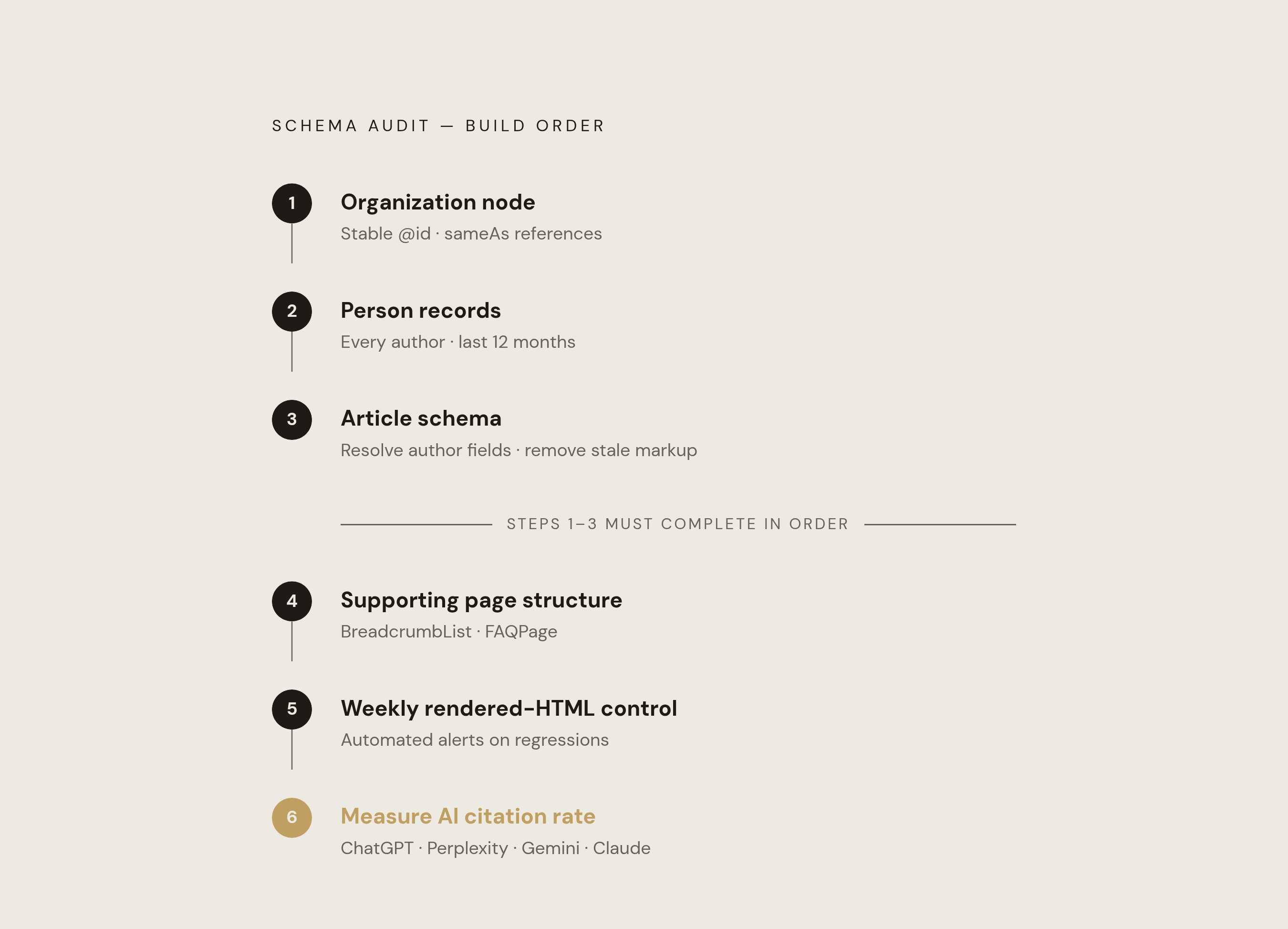
The audit should work from the foundation upward. Its first step is to establish one Organization node with a stable homepage @id and resolving sameAs references. Those references should include LinkedIn, Google Business Profile, and relevant industry directories. The team should then compare the organization’s name, description, and founding year against LinkedIn, Wikidata, and Crunchbase. This establishes the institutional identity that later steps will reuse.
The second step is to identify every author who published in the last 12 months and audit or build their Person records. Each author needs a canonical profile page, a stable identifier, fields that describe their expertise accurately, and links to external sources that show who they are. The organizational dependency now becomes concrete. Every worksFor field should reference the Organization @id established in the first step.
The third step is to inspect Article schema in rendered editorial pages. Author fields should resolve to the Person identifiers established in the second step. The crawl should find duplicate Article nodes, while the review checks that dateModified values are right and removes markup that is no longer needed. These first three steps address the main layers of invisible schema debt. Fixing them in order avoids attaching repaired articles to unresolved authors or inconsistent publishers.
The fourth step is to review the supporting page structure. BreadcrumbList belongs on hierarchical editorial pages, while FAQPage should remain only where actual question-and-answer content justifies it. The fifth step turns that repair into a weekly rendered-HTML control. Alerts should cover new duplicate nodes, missing @id values, and broken sameAs references, so later publishing changes do not quietly undo the work.
The sixth step is to measure AI citation rate directly. Google Search Console reports rich results and impressions, but it does not show whether ChatGPT, Perplexity, Gemini, or Claude cite the brand or its authors. That outcome needs its own instrumentation. Measuring citations makes it possible to assess the combined effect of clear attribution and useful content over time, rather than treating a passing schema test as evidence that the brand has entered the buyer’s shortlist.