CI/CD Pipeline Integration for Content QA in Dev-Tool Marketing
Automated checks and human approval gates keep dev-tool marketing accurate for AI engines.
Content QA for dev-tool marketing belongs in the same CI/CD discipline as the product it explains. Automated checks, explicit approval gates, and post-publish monitoring can keep accuracy attached to publishing speed. The goal is to ship content that is accurate, structurally sound, and easy for AI answer engines to extract and cite, with a person accountable for what goes live.
How dev teams already think about quality gates — and why content teams don't
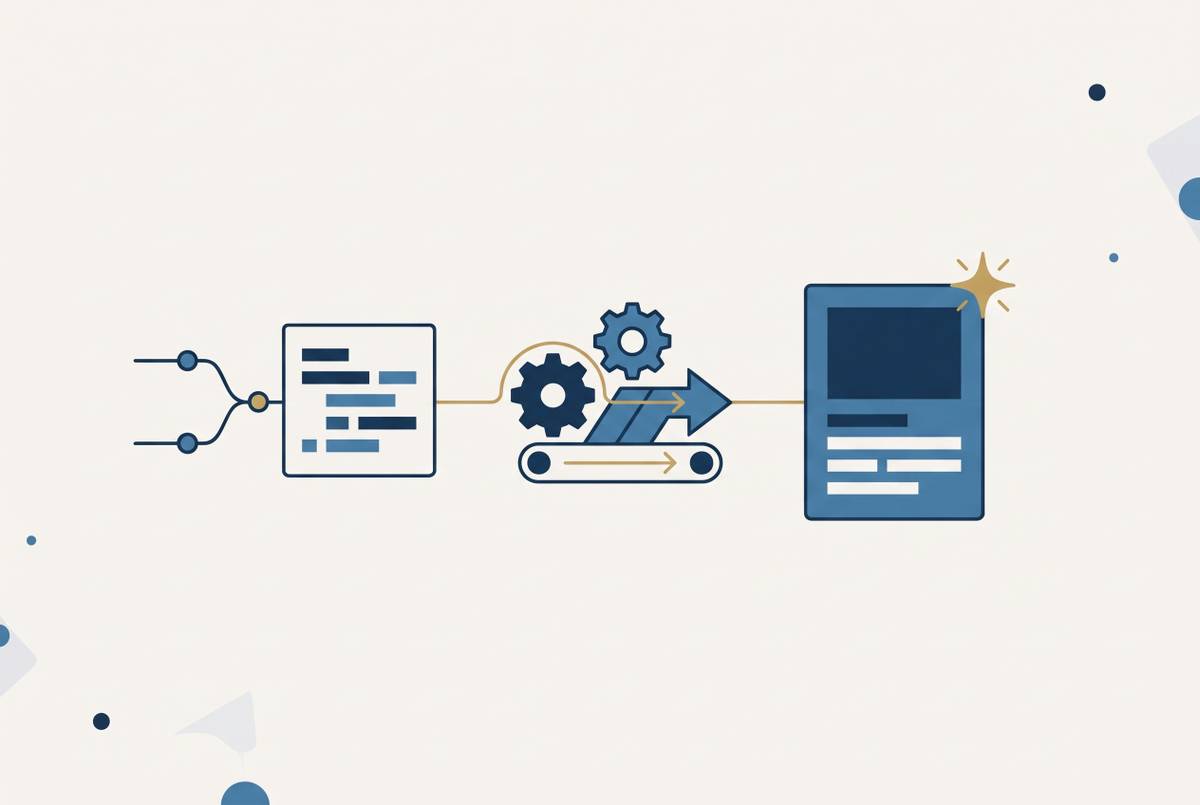
Development teams treat quality as a property of the pipeline. Every code change triggers a sequence through source, build, test, and deploy, with each stage required to pass before the next begins. A failure stops the sequence and reports back before broken code reaches users. Speed depends on those checks. Automation keeps the feedback loop short so teams can release often.
Content at the same company can follow a much looser path. A draft gets written, perhaps edited, and published without defined stages, explicit gates, automated checks, or a documented rollback process. Missing checks are easy to miss because a page can look finished even when it has a vague claim or an outdated product description. Publication is not evidence that those checks happened.
The distinction between continuous delivery and continuous deployment offers a useful starting point. Delivery automates the path up to production but leaves the final go-live decision to a person, while deployment automatically ships changes that pass every gate. Content needs that distinction too. A page that passes mechanical checks can still require editorial judgment, especially when its claims may become the facts AI answer engines use to describe the brand.
Why content accuracy now determines AI answer-engine visibility, not just reader trust
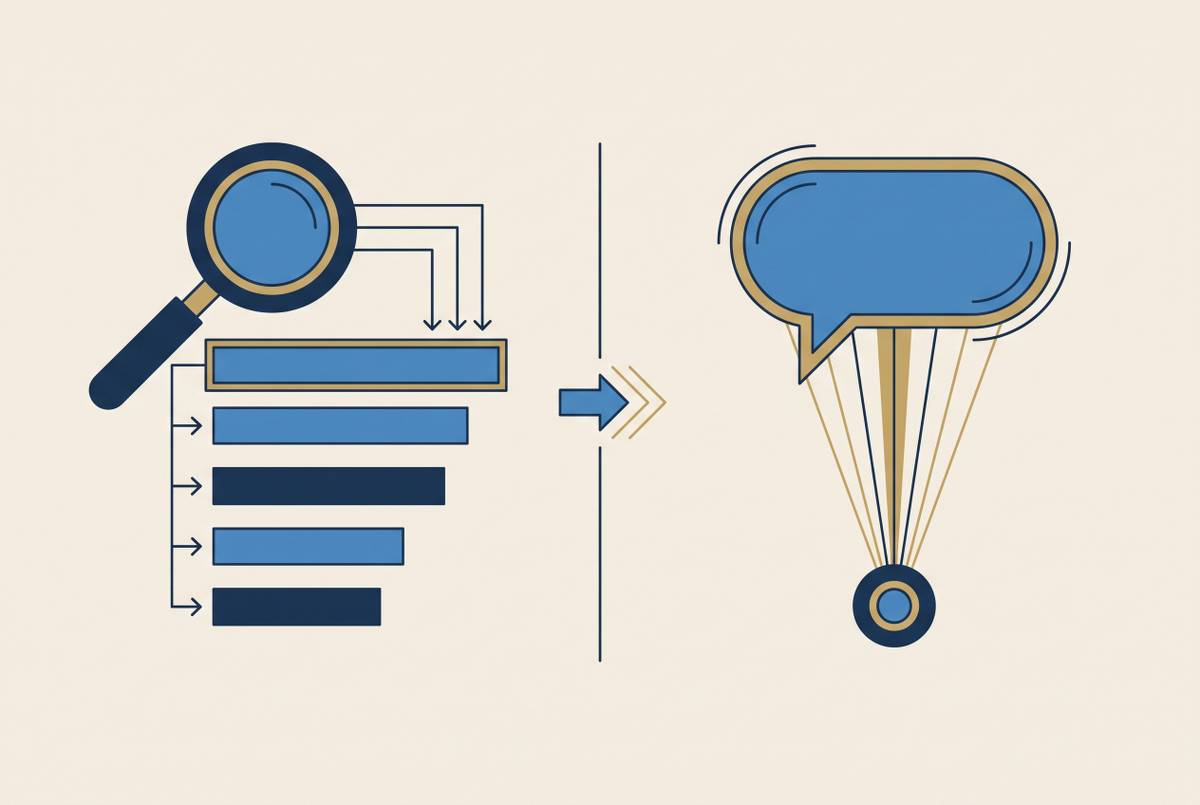
What makes a published page usable as an AI source? Being indexed is not enough. An answer engine needs statements it can extract without ambiguity or contradiction. When a page has little clear evidence the system can use, it may leave that part of the question unanswered.
That makes accuracy more than a reader-trust concern. A clear claim gives an answer engine something it can use, while consistent descriptions help it connect that claim to the right business. Entity grounding adds another check through a brand’s Wikidata entry, references from authoritative domains, and descriptions that agree across sources. A brand that fails those checks can be skipped. Better writing alone cannot make conflicting evidence about what the company does agree.
Freshness adds a time dimension to this problem. Recently updated content receives meaningfully more citations than stale content, making a refresh cadence part of the publishing system. Buyers increasingly get answers directly from ChatGPT, Claude, Perplexity, and Gemini. For a source seeking a citation in those answers, the outcome is stark. Quality gates cannot guarantee inclusion, but they can remove obstacles that make a page difficult to use.
What a content QA pipeline stage actually checks — and why each check maps to a CI/CD analog
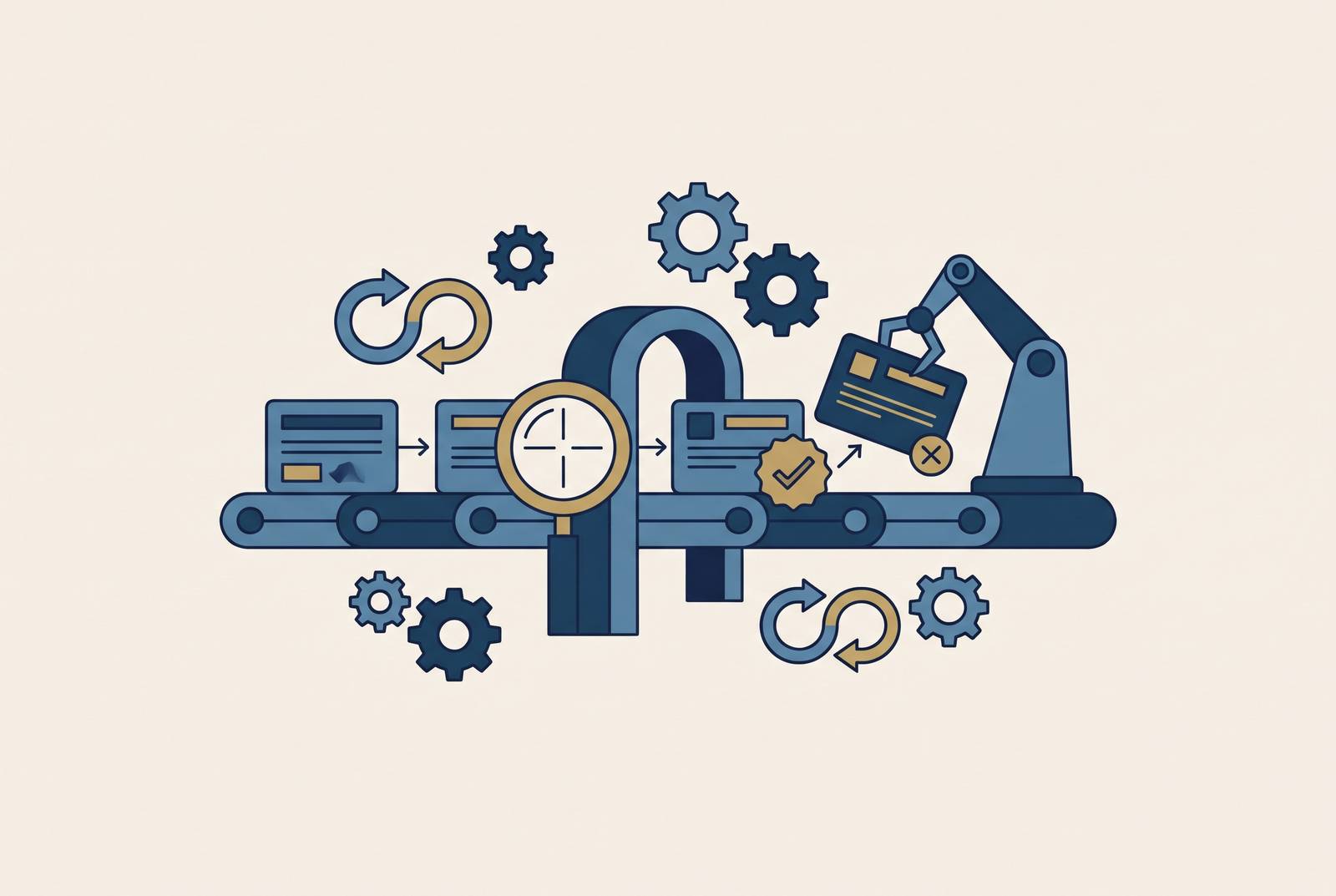
A content quality gate replaces a general request to “give this a read.” with a discrete check with a pass or fail result. Each stage answers a different question and blocks progress when its requirements are unmet. Together, the stages separate missing inputs, suspect claims, editorial decisions, and changes that arise after publication.
The first stage is intake, equivalent to the source or commit trigger. Content arrives with structured metadata, including its topic, target audience, claimed facts, links, and publish date. Completeness is the gate. Without those inputs, later checks do not have the information they need, just as a malformed input can waste work in the pipeline stages that follow.
The second stage is automated first-pass scoring, which is like build and unit tests. An AI model evaluates factual claim density, structural clarity, tone consistency, schema markup presence, and internal link integrity. It flags vague, unattributed, or contradictory claims. A failed check stops the work from moving to the next stage. This is also where the pipeline checks for extractable statements and compares brand descriptions with other pages and third-party sources.
The third stage is risk-tiered human review, analogous to code review on a pull request. Evergreen explainers and stable product descriptions receive a light, documented scan of the automated report. For product comparisons, competitor claims, and pricing-adjacent copy, a reviewer needs to check the claims and whether the copy fits the strategy. Regulated claims, customer data, legal exposure, and statements that could shape procurement decisions need line-by-line review and sign-off from a subject-matter expert. Risk determines the depth of review, keeping routine work from waiting behind the most sensitive pieces.
The fourth stage is explicit approval, which is like merge approval. A logged decision records that a piece passed its checks on a specific date, with a named approver. That record supports accountability when a claim later proves wrong.
The fifth stage is post-publish monitoring, which is like production observability. Freshness, citation rate, and factual drift are tracked on a schedule because publication does not freeze the underlying product facts. A stale page or one contradicted by newer product information returns to automated scoring. The pipeline supports a targeted correction.
Wiring the content pipeline into the tools dev teams already use
These stages become useful when they run where the team already works. The stages integrate through a version-controlled repository connected to the CI/CD platform that already runs code pipelines. Drafts, metadata files, schema markup, and llms.txt can live with the site’s code or in a dedicated content repository with the same branching discipline. A commit or pull request against a content file triggers the checks. Nobody has to remember to start them.
Intake validation becomes a linting job that checks required metadata fields and fails fast when a file is malformed. Automated QA becomes a job that calls an AI model API, passes the content, and receives a structured report of flagged items. The failure threshold must be explicit. If flags go above it, the job exits non-zero and blocks the merge, so the report acts as a gate the work must pass.
A protected branch rule requires a named reviewer’s approval before the content branch can merge to main. The llms.txt file also stays under version control and is updated in the same pipeline as other content changes. Treating it as a pipeline artifact keeps the instructions provided to AI crawlers current with the published material.
The team’s choice of platform depends on the infrastructure it already has. GitLab CI/CD has stronger built-in features for complex pipelines and fits teams that want source control, CI/CD, and content QA in one interface. Jenkins offers maximum flexibility at the highest maintenance cost. That trade-off is warranted when requirements are very specific or the team is already deeply invested.
The human review gate — why removing it undermines both quality and AI citability
If automated checks can block bad content, why keep a human approval step? Because detecting a suspect claim is not the same as taking responsibility for publishing it. AI can check heading hierarchy, link integrity, metadata completeness, consistency, and freshness, and score several dimensions faster than a human reviewer. Those capabilities reduce repetitive work. They do not establish whether a claim accurately reflects proprietary data or lived customer experience.
Original insight has a different source from automated scoring. Expert examples and proprietary context must come from people who have the relevant knowledge, while humans also define and update the brand’s voice standards. AI can follow those standards while people stay in charge of them. The final reviewer decides whether a statement is accurate enough to put the brand’s credibility behind it.
Continuous delivery is therefore the better parallel for content. The pipeline automates the route to a release decision, while a person makes the go-live call. A bad publication can be harder to undo than a bad code deployment. Moreover, increasing output without improving its usefulness can dilute the clear, extractable signal across the site, so throughput alone is the wrong measure of success.
The EU AI Act adds a specific transparency consideration. Article 50(4) requires disclosure for AI-generated or manipulated text published on matters of public interest, with an exemption where the content has undergone human review or editorial control and a natural or legal person holds editorial responsibility. The European Commission’s FAQ gives 2 August 2026 as the applicability date. This is not a blanket requirement that every marketing page receive human review. For covered text, however, the human gate has both an editorial purpose and a compliance role when relying on that exemption.
Measuring whether the pipeline is working — tracking AI citations as a pipeline output metric
Approval shows that content passed its checks and leaves open whether answer engines are using it. The pipeline needs an observability layer to distinguish those outcomes. Otherwise, a team can keep raising its own scores without knowing whether answer engines cite its sources in the answers buyers read.
Two signals need separate tracking because they answer different questions. An AI mention means the brand is named in a response, which measures visibility. An AI citation means the brand’s content is linked as a source, which measures extractability and referral potential. Neither substitutes for the other. A named brand has achieved presence, but that alone does not show that its own content supplied the answer.
The measurement job uses a fixed prompt set based on buying-intent questions the target audience actually asks. It runs on a schedule against ChatGPT, Claude, Gemini, and Perplexity, providing cross-platform coverage from the start. Checking across platforms keeps the team from taking one answer engine’s results as the whole picture.
Those results then feed back into QA. Pages that are not being cited return for freshness review and improvements to how clearly their facts can be extracted. A missing citation is a reason to investigate its possible causes. This feedback loop gives post-publish monitoring a practical consequence, much as production observability surfaces regressions that trigger a targeted fix.
Brand visibility in AI answers reflects site-wide content legibility, not a single optimized page
A page can pass its local checks while conflicting with the rest of the site. That is the limit of treating content QA as a series of isolated reviews. AI answer engines compare pages and third-party mentions to form a coherent model of the brand. The pipeline therefore needs cross-page consistency checks as a standard part of QA.
Structured data helps describe what the business does, but the evidence around it must match that description. That description must also match what appears in comparison listings, developer forums, and editorial roundups beyond the company’s own pages. The brand does not control every source. Its content workflow can still give those sources accurate material that keeps the product story the same.
Ranqo’s analysis of a large sample of prompt responses found that ranked “best-of” listicles were the most-cited content format. That points dev-tool marketers toward comparison roundups, G2/Capterra listings, and independent developer forums as places where product information that sources can use may help the brand get cited. Placement must be earned. The pipeline’s role is to make supporting material clear and consistent.
The same analysis found a clear tier structure in AI answer inclusion. Global household names appeared in a large majority of relevant answers, established mid-market and regional brands in a smaller but meaningful share, and niche or small brands in just 11%. A dev-tool startup still starts at that disadvantage even with a good product. Consistent, extractable, well-structured content published on a cadence gives the brand a way to build a stronger signal over time.
Run content QA continuously. Every new piece, refresh, and schema update enters the pipeline on a commit, with monitoring bringing changed or stale material back for review. Batching that work delays feedback and makes failures harder to unwind. Cadence is infrastructure, so the quality system must remain active between launches as well as during them.