Developer Content Distribution Channels AI Assistants Cite
Official documentation and versioned references earn the most reliable citations from AI assistants.
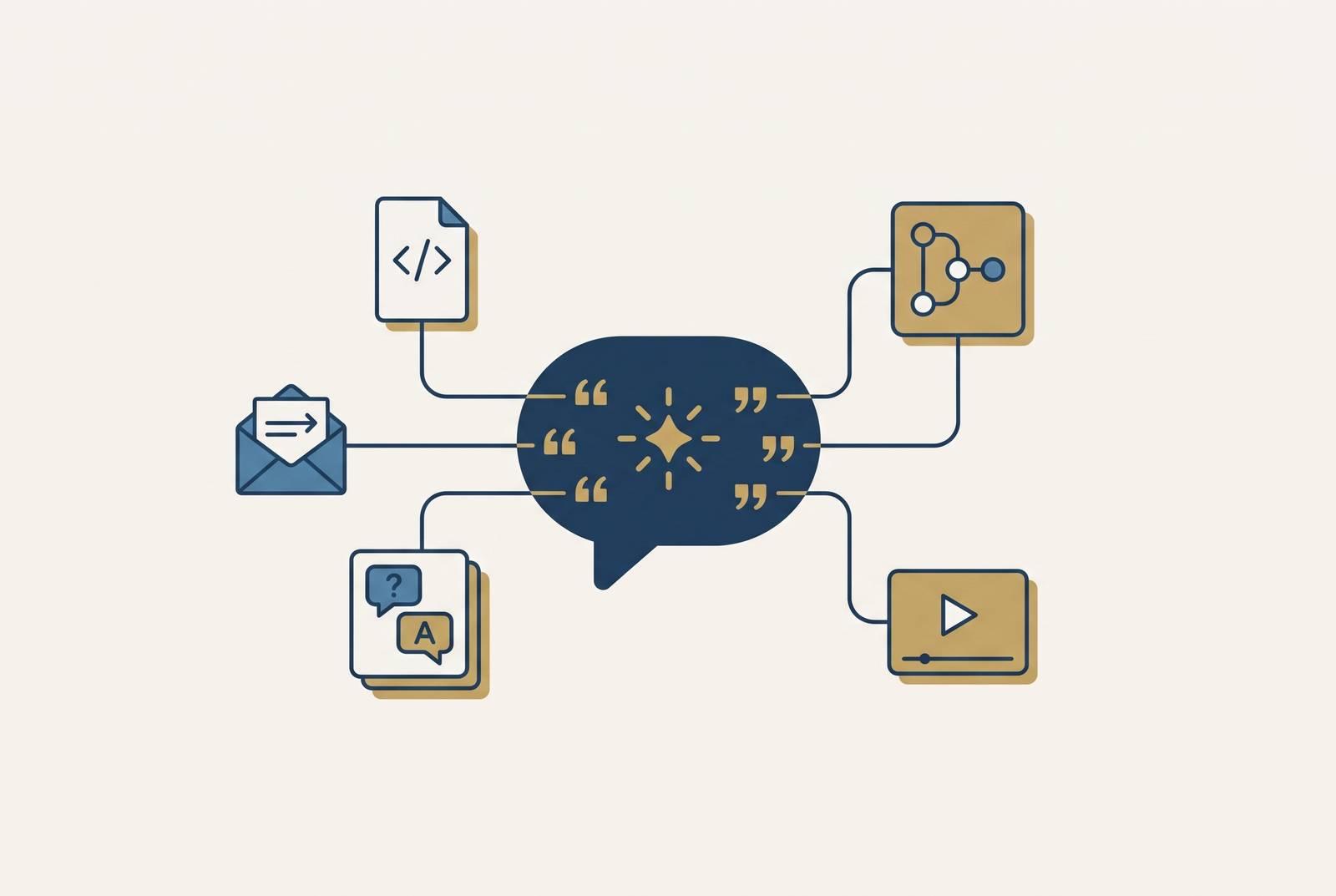
AI assistants cite developer content selectively, so distribution is more than a way to attract visitors. A brand needs distribution to become a source for an answer at all. Documentation, technical blogs, community discussions, package profiles, and structured reference sites each serve different questions. The best strategy matches those channels to the questions developers ask, then tracks citations because traffic alone does not tell the whole story.
Why AI assistants don't cite the web evenly — and why developer content is the clearest proof
A brand can be prominent on one AI platform and nearly invisible on another. This gap is especially clear in developer queries because they need exact references for the subject at hand. Most AI search engines use Retrieval-Augmented Generation, or RAG, to retrieve candidate documents and synthesize an answer, sometimes splitting the question into sub-queries first. Retrieval does not guarantee a citation. Only some candidate pages become sources in the final response, and platforms differ sharply in how many sources they cite.
The selection filter favors pages with clear headings, answers given at the start, and passages that answer a sub-query on their own. Authority signals, including backlinks, domain age, and expert authorship, strengthen those candidates, while freshness helps distinguish answers that change with releases. Engines must have crawl access before any of those strengths can help. Generative Engine Optimization, or GEO, addresses this combination of content structure and channel presence so that engines can select and cite a source.
Official documentation hubs and versioned reference sites as the most reliably cited channel
Official documentation is the closest thing developer AI answers have to a primary source. Language references, API docs, framework guides, and versioned SDK references give precise answers on subjects they have the authority to cover. A heading about authentication maps to a specific question, while a function reference or parameter table can answer it without requiring the engine to reconstruct an argument from surrounding prose. Code examples with inline explanations give the answer both an implementation and its context.
Versioning also helps because a technically correct answer can still be wrong for the release someone uses. Versioned URLs and structured changelogs help distinguish those cases while tying updates to the release cycle. Newness alone is not enough for this task. Identifying which version an answer applies to provides a useful signal. That is why maintained references are better suited to these questions than broad product descriptions.
For developer brands, documentation should serve as both a distribution asset and a support artifact. A documentation subdomain with proper crawl access, schema markup, and consistent headings can earn citation authority independently of the marketing site. Depth still counts within that structure. A comprehensive reference can fully answer a sub-query, while a shallow overview may only name the topic.
Technical blogs on owned and high-authority domains as citation training ground
Where documentation establishes how a feature works, a tutorial can explain how to use it in a particular situation. The format succeeds when its sections remain useful outside the full narrative. A heading such as “How to handle rate limiting in the X API” identifies a retrievable question more precisely than “Best practices.” The answer beneath it can then stand as an attributable passage rather than a fragment that needs several earlier paragraphs.
This is harder for blogs built mainly to cover keywords across a long page. Broad coverage may help a page address a topic, but it does not necessarily produce a complete answer that an engine can extract. More words do not resolve that mismatch. Specific version numbers, relevant statistics, and code examples give the explanation concrete content, while a named author with verifiable credentials adds an expert-authorship signal. An authoritative domain helps, but it cannot substitute for a passage that actually answers the question.
For teams with an established publishing cadence, conversational subheadings and self-contained explanations are structural changes that make existing technical knowledge easier to retrieve and attribute. The blog still needs a coherent argument. Each section can contribute to that argument while also answering the narrower question its heading names, allowing narrative depth and extractability to work together.
Community Q&A platforms, particularly Stack Overflow and Reddit's developer communities, as a high-citation off-site channel
Owned content is only part of the source pool. Community Q&A platforms combine domain authority with questions phrased much as developers ask them. A Stack Overflow answer closely matches the output a RAG system is trying to produce, namely a complete response to a stated technical problem, often with code. Its question title already looks like a sub-query. When answers are accepted or highly-voted, that also signals that the community trusts them.
Discussions in r/programming and language-specific or tool-specific subreddits are especially relevant when an answer needs to weigh what developers use and why. These are evaluative sources. When a tool repeatedly appears next to a topic in relevant discussions, that co-citation connects the brand to the category. A tool absent from those conversations therefore lacks a source of visibility on questions that can shape purchase decisions.
But brands have no say over what community members say. The appropriate response is genuine engineering participation, useful answers on Stack Overflow, and a documented presence in relevant developer subreddits. Clear owned documentation also gives community members a source to cite, and links from the docs can lead readers to useful discussions on the topic. The aim is to earn those connections.
Package registries and developer platform profiles as citation anchors for tool and library queries
Package infrastructure is also a publishing channel. npm, PyPI, Crates.io, and GitHub repositories give AI engines structured sources for questions about installing and using tools or libraries. These profiles combine platform authority with metadata and updates tied to releases. A well-maintained package page can answer what a tool does, how to install it, which version is current, and what it depends on. Those are distinct sub-queries, even when the developer asks them as one broader question.
The repository README can be especially important because it may be longer, better structured, and more frequently updated than the corresponding marketing page. In that case, the repository may become the cited source. The distribution asset is already in the toolchain. Its usefulness for citations comes from the same practical information developers need, rather than from a separate layer of promotional copy. Release-linked freshness reinforces that fit.
For tool brands, the action is to maintain package profiles and READMEs as deliberately as owned documentation. Descriptions, installation instructions, version information, and dependency details deserve attention because they answer the questions these pages are suited to serve. Clear organization makes those answers easier to extract. This channel anchors tool-specific answers in the infrastructure through which developers obtain the software.
Structured reference sites, encyclopedic sources, and third-party comparison platforms as the citation backbone AI engines default to
Wikipedia, MDN Web Docs, and structured comparison sites serve foundational and evaluative questions for which engines seek high-authority sources beyond a vendor's own claims. Their roles are not interchangeable. An encyclopedic explanation establishes context, a web reference answers a platform question, and a comparison page puts alternatives into a shared frame. A brand's owned content does not automatically do all three jobs.
MDN is especially important for browser APIs, CSS, JavaScript, and web standards. For those subjects, it serves as a primary citation. Brands building on web technologies should link to the relevant reference. That relationship helps place their own explanation in its proper context. The brand can explain its use of a web feature without claiming authority over the underlying standard.
Comparison platforms address a different need by presenting multiple tools in a structure engines can extract and attribute. Structured schema and a multi-source comparison format make these pages useful for evaluative questions about the best tool for a task. When third-party sources on the topic describe a brand in the same way, they can make its link to its category stronger. Control remains limited, especially on Wikipedia. Accurate representation there depends on legitimate editorial participation and supporting references, with judgments across sources remaining independent.
Why publishing on one channel is structurally insufficient and how to think about channel mix
Engines use different pools of sources and give more weight to some channels than others. Perplexity, ChatGPT, Gemini, and Claude have distinct retrieval architectures and index compositions, so success on one does not automatically transfer to another. A single-channel strategy has a built-in limit. Even excellent documentation can go unseen on engines that favor community discussions or third-party references when answering questions on the topic.
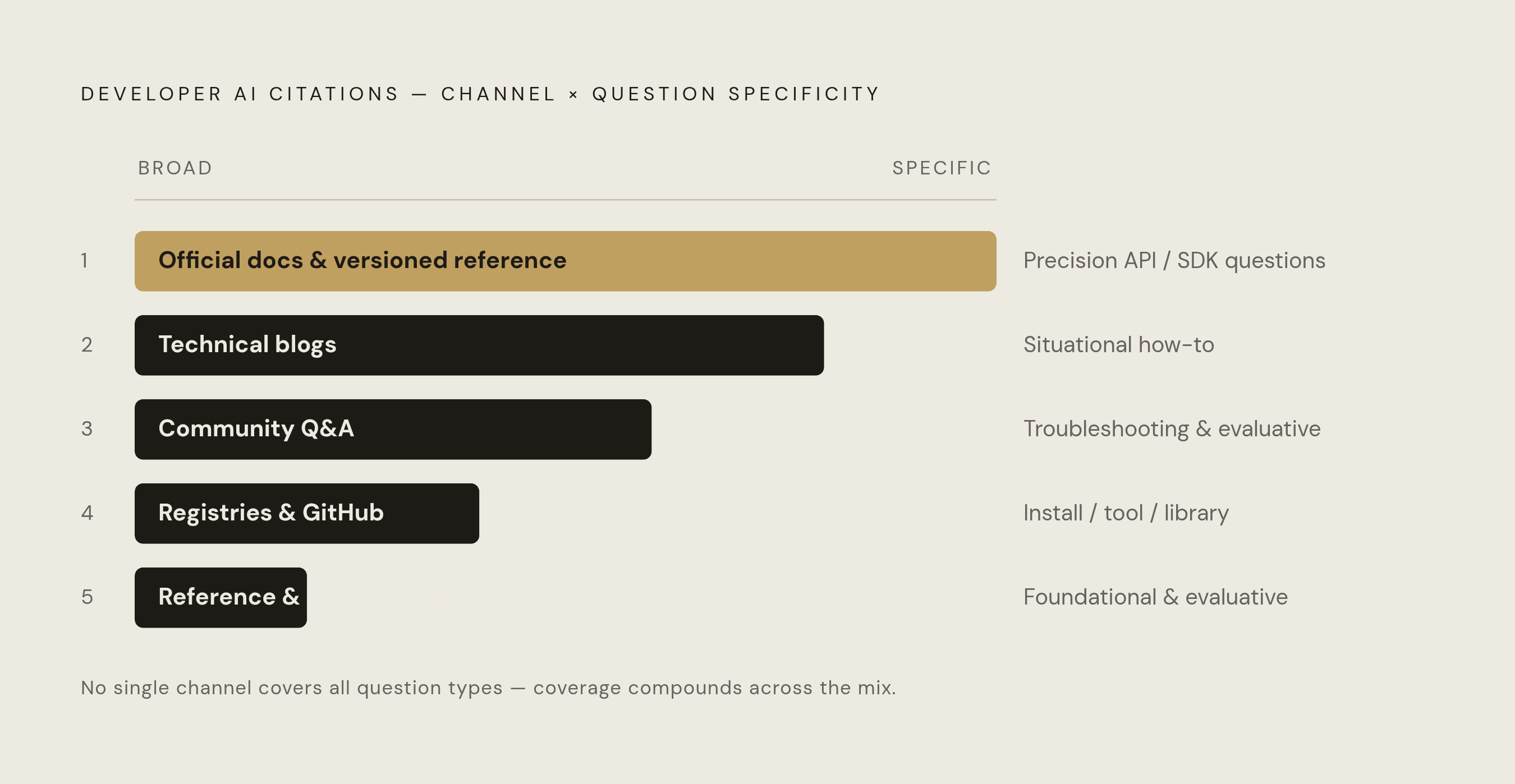
The mix therefore depends on which engines the audience uses and which questions bring a tool into consideration. Installation questions give package profiles a clear role, while troubleshooting can draw on documentation and Q&A. Evaluative questions call for a different balance. Channel selection should follow the query set, drawing on community discussions and structured comparisons for evaluative material.
For a developer brand, a useful starting mix is an owned documentation hub, a technical blog on an authoritative domain, maintained community participation, optimized registry and GitHub profiles, and consistent representation on structured comparison platforms. The balance should reflect the questions and engines that are relevant to the audience. Across that mix, repeated associations between the brand and the same technical topics create co-citation signals of category authority. Those connections give distribution a compounding effect that a single isolated source cannot provide.
Measuring which channels are actually generating citations, not just traffic
That compounding effect needs evidence. Traffic from traditional search does not show whether an AI engine cited a documentation page, mentioned a tool without a link, or drew on a community discussion. Those are different outcomes. A channel that attracts visits may not be the channel supplying AI answers, so traffic alone can direct effort toward the wrong source. Measurement must separate citation presence from what happens after a user clicks.
GA4 is an easy place to start tracking what happens after a click by filtering sessions from AI referrers. It can show when an AI answer produces a visit, but it misses citations that generate no click. Upstream tracking covers what that misses by recording whether a given prompt leads to brand mentions or source links on a given engine. Citation, brand mention, positive sentiment, and share of voice are separate measures. Keeping them distinct prevents a linked source from being treated as equivalent to a favorable recommendation.
The minimum useful record is specific to both prompt and engine. It includes whether the brand was cited, the cited URL, placement order, competitor names present, timestamp, model version, and locale. Those details make comparisons more meaningful. Dedicated AI visibility platforms can track citation presence and help link changes in it to changes in content or channels.
Microsoft's Bing AI Performance Dashboard, public since February 10, 2026, provides first-party data on citations and grounding queries. Microsoft notes that it shows a sample of actual citation activity, which limits what can be inferred from it. By observing which sources appear for which questions, developer brands can connect publishing choices to citation outcomes. That feedback is what turns distribution from a schedule of content releases into a strategy that can learn.