Measuring Local AI Mentions for Law Firms
A prompt-based tracking system shows if AI names your firm.

Measuring local AI mentions means checking whether a law firm shows up when people who might hire it ask AI systems for legal help in its market. Traditional search analytics cannot answer that question. A useful measurement system needs local prompts, platform-specific observations, and a regular review cycle that connects citations to decisions about content, directory profiles, and client acquisition.
Why law firms cannot rely on traditional analytics to track AI visibility
Strong Google rankings do not guarantee a place in an AI-generated shortlist. A prospective client can ask which attorney to call, read the answer, and never visit a firm’s website. That discovery session leaves no website visit to measure. Search Console cannot tell the firm whether it was recommended inside the answer, even where it provides related search-performance data. The gap is between being found and receiving a click.
Branded searches and direct traffic may rise as people learn about a firm through AI mentions, but neither shows which citation led to the visit. Google AI Overviews also appear on a large share of legal queries, especially searches phrased as questions before people contact an attorney, so the blind spot extends to how people choose a lawyer. Few law firms have taken up generative engine optimization, even in competitive practice areas, so measuring it directly gives firms a chance to learn before the work becomes routine.
What AI-generated legal answers actually look like, and why citation mechanics differ by platform
An AI legal answer may name firms, explain a legal process, and cite directories or professional associations to back up what it says. Those are different forms of visibility. A firm might supply the cited explanation without being recommended, or receive a recommendation supported by a third-party profile. Measurement has to distinguish the name in the answer from the source behind it.
The monitoring targets are ChatGPT, Perplexity, Gemini, Google AI Overviews, and Claude. Their retrieval paths differ. ChatGPT with browsing queries Bing, while Perplexity combines its continuously refreshed proprietary index with external search APIs and gives substantial weight to community sources. Gemini and AI Overviews use Google’s index, and structured-data signals play a larger part in what they retrieve. Claude adds another retrieval environment, so presence on one platform cannot stand in for presence across all five.
Legal directories and rating platforms account for the largest share of company mentions in AI legal answers, ahead of bar and professional associations at 20% and individual firms. Yet state bar associations appear in more individual AI answers than any single directory. Together, they show why a firm’s own domain is only part of the measurement target.
The five platforms to monitor and what each one requires from a tracking setup
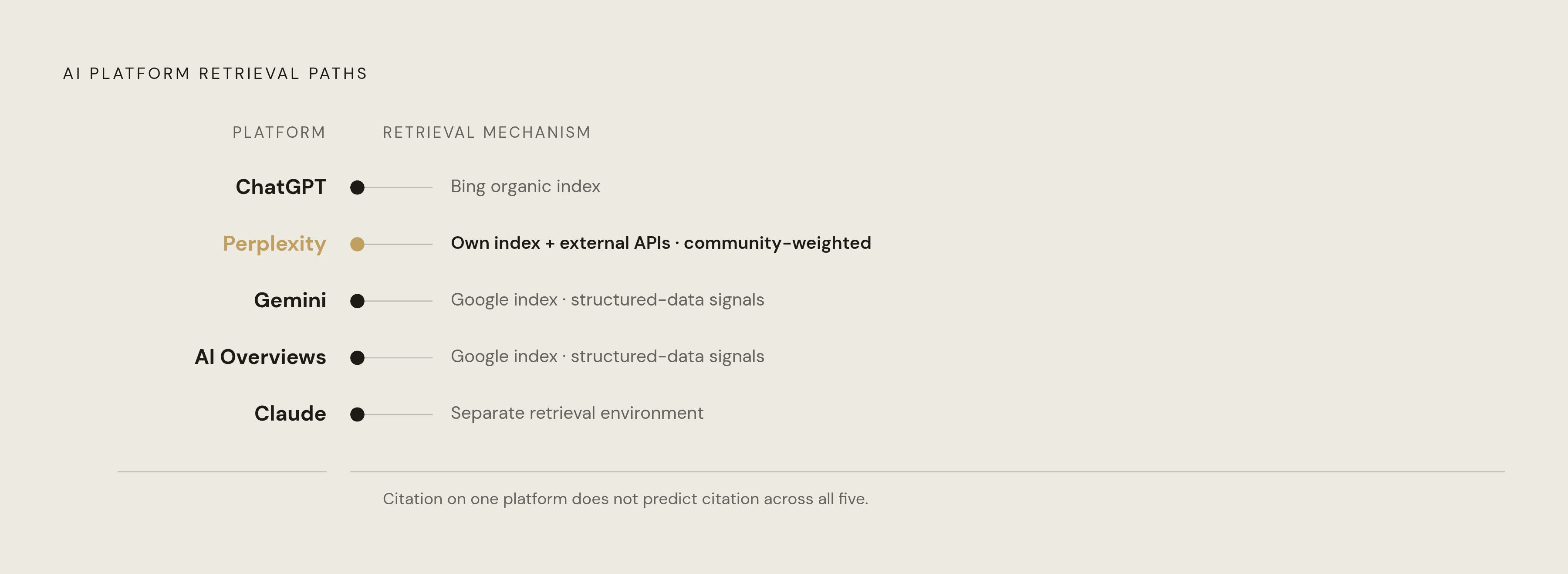
For ChatGPT, run queries with browsing enabled and record both the firms named and the sources cited. Its citations correlate strongly with Bing’s top organic results, making that search index relevant to interpreting gaps. Directory choice also has a platform-specific effect. Justia receives far more ChatGPT citations than FindLaw, so a tracking log that records only firm names would miss a useful explanation for unequal visibility.
Perplexity needs the same separation between mentions and sources. Its answers cite many more sources than ChatGPT’s, yet their cited domains overlap very little on the same legal question. That difference is itself useful evidence. Recording community forums as well as authoritative legal sources helps reveal which off-site pathways support a mention, rather than treating every citation as an endorsement of the firm’s website.
For Gemini, include general practice-area queries and local “in [city]” variants, because its retrieval draws on Google’s index and is influenced by structured data and Google Business Profile prominence. AI Overviews require a separate observation method. Checking search results by hand shows which firms appear in generated answers, while Search Console gives some impression and click data without showing which firms were named. Claude belongs in the standard query rotation even if citations are less frequent, so lower observed activity does not become an unmeasured gap.
How to build a prompt set that surfaces local citations, not generic ones
A generic “best lawyer” query mostly tests visibility among directories and national names. Local measurement needs a narrower question. Build a bank of 20–30 prompts per practice area around the conversational questions people ask before hiring, including their practice area, jurisdiction, and decision stage. “Who is the best divorce lawyer in [city]” tests a different citation set from a question without the city. Likewise, “how much does a car accident attorney cost in [state]” places the question in a specific legal market.
The bank needs several kinds of question because recommendation and source visibility are not interchangeable. Recommendation prompts such as “Which [practice area] attorneys in [city] should I consider?” test whether the firm is named. Procedural prompts such as “How long do I have to file a personal injury claim in [state]?” test whether its content becomes a source. Comparison prompts such as “What should I look for when hiring a [practice area] lawyer in [city]?” reveal which firms or directories support the answer.
What about prospects who want a professionally validated referral? Include prompts asking for bar-validated referrals, since state bar sources open a different citation pathway from consumer recommendations. Then run the same prompts across all five platforms in the same session. The shared query bank makes the differences interpretable. Without it, a firm could mistake a change in the question for a change in platform visibility.
The metrics that turn citation observations into a usable tracking system
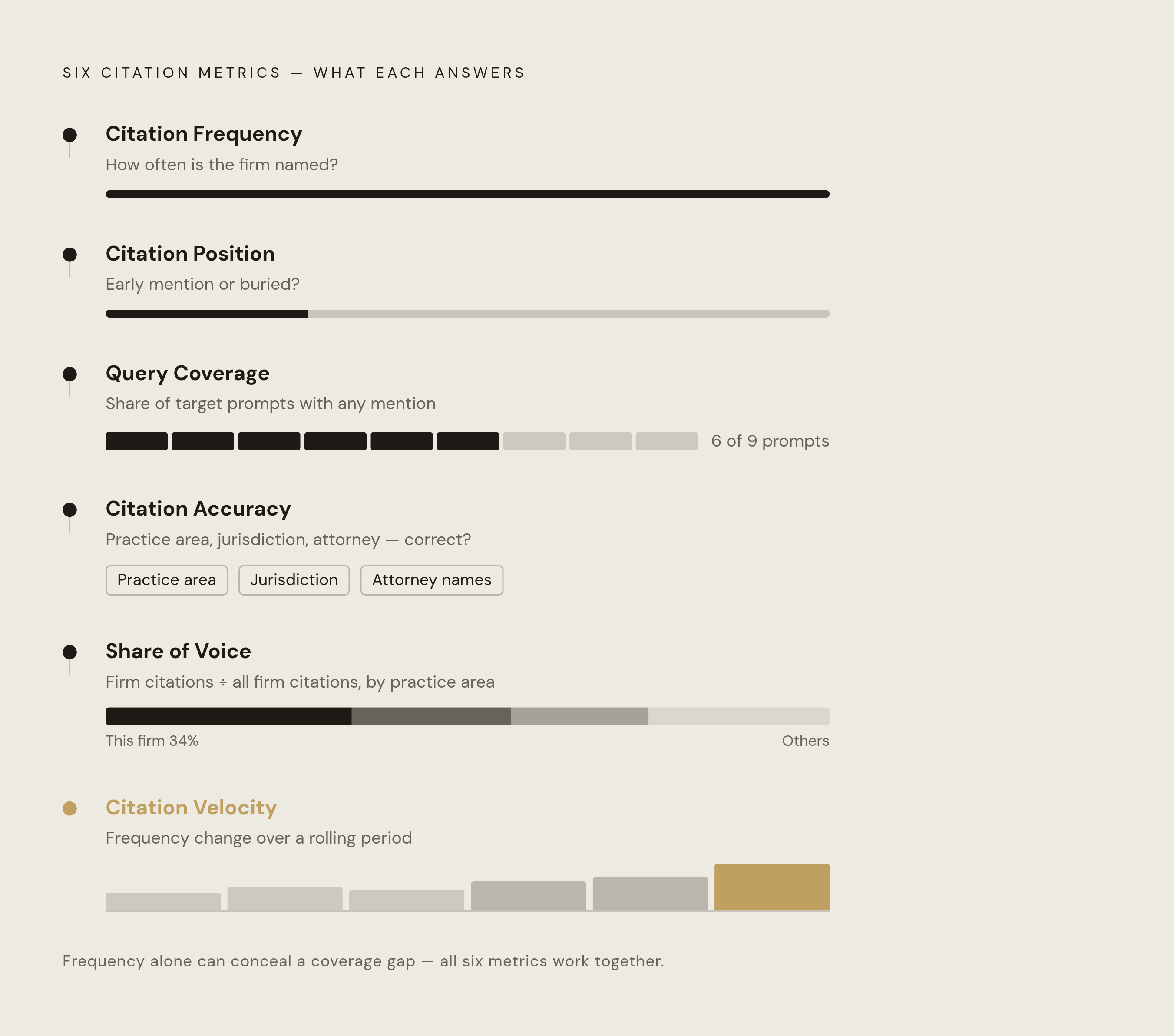
Citation frequency measures how often the firm is named across a defined prompt set, establishing the baseline for later comparisons. Citation position records where it appears in the response, distinguishing an early mention from a footnote or buried list item. Query coverage measures the share of target prompts on which the firm is cited at all. These metrics answer different questions. Repeated mentions on a few prompts can coexist with broad absence elsewhere, so frequency alone can conceal a coverage problem.
Citation accuracy records whether the answer gets the firm’s practice areas, jurisdiction, and attorney names right, making misleading descriptions visible in the tracking log. Share of voice by practice area measures the firm’s citations as a share of all firm citations in the defined prompt set, enabling competitive comparison. Source attribution records which domains appear beside or instead of the firm, exposing the directories, bar pages, news sites, or owned pages behind the answer. An increase is less useful if the descriptions are wrong or the source pathway remains unknown.
Citation velocity tracks how citation frequency changes over a rolling period for each practice area. It connects the tracking system to business priorities. A firm can gain visibility in a high-value practice area while its aggregate results move only modestly, which makes the breakdown more useful than a single overall score. Velocity is the bridge to downstream business impact, though citations still need to be considered against consultations and signed work.
Tools available for monitoring AI mentions, and what free methods can and cannot cover
The options range from manual observation to automated monitoring. Manual prompt testing is the most direct free method. Running the target questions each month takes time, but reading the answers helps explain in detail why citations appear or are missing. Search Console, branded search trends, and direct traffic give firms more evidence to use alongside that work. They can show signs that people are finding the firm, though they cannot show whether a given answer named it.
Paid tools reduce the labor of repeated observation. SE Visible tracks AI visibility across platforms, while LLMClicks tracks brand mentions and competitors. Finseo covers AI visibility, citations, and sentiment. Most tools of this kind cost roughly $200–$400/month, and retainers for specialist legal AI agencies cost much more. The distinction is not simply free versus paid, but how much query execution and recording the firm wants to automate.
AI platforms do not expose citation APIs, so monitoring tools run queries and parse the outputs rather than receiving a complete record of every citation event. Their coverage therefore depends on the questions supplied to them. The useful role of a tool is to make a well-designed measurement system easier to operate.
What the citation data reveals about which content and off-site signals are driving mentions
If Avvo, Martindale-Hubbell, or Justia appears instead of the firm’s website, directory profiles are doing more of the citation work than owned content. In that situation, improving those profiles offers a faster route than adding more website pages. The platform breakdown narrows the diagnosis further. Low ChatGPT presence, for example, calls for an audit of the firm’s Justia profile before a broad rewrite of its site.
When the firm’s own pages are cited, the way those pages are laid out gives another clue. The cited content tends to put direct answers in the first sentences of sections, use question-formatted headers, and include FAQ markup that matches how prospects ask questions. Local gaps deserve a separate check. LegalService, Attorney, FAQPage, Review, and LocalBusiness schema help connect a firm with a practice area and geography, so missing citations on local prompts warrant an audit of whether that markup is deployed consistently.
Accuracy problems point toward a different repair. Wrong practice areas, outdated locations, or hallucinated attorney names suggest inconsistent entity data across directories, making reconciliation of name, address, phone details, and firm facts the priority before producing more content. If citations plateau despite strong on-site material, the off-site footprint becomes the next question. Earned mentions in legal publications, local news, and bar association directories reinforce authority beyond the firm’s domain. These patterns guide an investigation rather than proving that every absent mention has the same cause.
How to run the measurement cycle on a cadence and use citation trends to make decisions
Run the full 20–30 prompt bank for each practice area across all five platforms at the same time each month. Keep the same prompt set so the results can be compared. Record frequency, position, coverage, source attribution, and accuracy for each platform in a simple tracking log, then use the results to follow practice-area share of voice and velocity. New hallucinations or factual errors deserve immediate attention because they actively mislead prospects. Fixing them should come before work whose only aim is to get more mentions.
Growth in a high-value practice area signals that content or directory investment is working and supports continuing that effort. If velocity stays flat or falls despite new content, find out why before making more. Source attribution can help show whether content is laid out in a way that makes extraction hard or the firm has a weak off-site footprint. A large Perplexity–ChatGPT gap also points toward different levers, including community-forum presence for Perplexity and Bing visibility and Justia profiles for ChatGPT.
Finally, compare citation trends with branded search, direct traffic, qualified consultations, and signed matters in the same practice area. The attribution path will often be incomplete. Those supporting signals can help infer a connection when AI discovery does not produce a tagged referral. The goal is not a high visibility score in isolation. Measurement is the feedback loop that makes investments in AI visibility legible and improvable, connecting what the platforms say about a firm with decisions about where its next effort should go.