BreadcrumbList and SiteLinksSearchBox Schema for Brand SERP Control
Breadcrumb and WebSite schema still declare your brand's structure to machines.

BreadcrumbList and the WebSite schema behind the former Sitelinks Search Box are tools for declaring a brand’s structure. Their lasting value is a machine-readable account of who the brand is and how its pages fit together. Brand SERP control starts with making those links clear, then checking whether search engines and AI answers get them right.
What BreadcrumbList and WebSite schema actually declare to a machine
The name “breadcrumb” undersells what the markup does. Its navigation metaphor points toward a person finding a way through a site, but the structured declaration addresses machines. BreadcrumbList describes where a page belongs within a hierarchy. That categorization is separate from the breadcrumb path a search engine might display beside a result. The distinction makes it possible to assess the data without confusing it with the presentation.
WebSite schema answers a different question about identity. It declares the canonical name of the brand’s web property, while Organization schema’s sameAs array links the site to the brand’s social-graph identities. Those links help Google match a domain to a knowledge-panel entity. Google discontinued the Sitelinks Search Box visual feature starting November 21, 2024, but neither WebSite schema nor ordinary sitelinks were affected.
Within a page, the visible HTML breadcrumb and the BreadcrumbList JSON-LD block are parallel systems. The HTML trail contributes links to the internal link graph, while the schema states the hierarchy explicitly. Neither substitutes fully for the other. A trail without schema leaves the relationship implicit, while schema without a matching trail makes a claim the visible page cannot substantiate. When a page genuinely belongs to two categories, multiple BreadcrumbList objects can preserve both relationships.
For implementation, the recommended format is JSON-LD placed in the <head>. This separates the declaration from the navigation component. It can survive front-end redesigns, be compared in version control, and avoid breaking when a developer refactors that component. That separation is useful only if both systems continue to describe the same structure.
Why the January 2025 mobile removal sharpened the structural argument rather than ending it
Google removed breadcrumb paths from mobile search results on January 23, 2025. The visible path now appears on desktop only. For audiences that mostly use mobile, that change made it much harder to sell breadcrumbs on the claim that a cleaner URL line leads to a better click-through rate. A forecast built on a mobile display that no longer exists cannot justify the work.
The small click-through lifts that circulate come from agency and vendor case studies. Those reports do not establish a general return that every brand can expect. Once the mobile display disappeared, the distinction between a case-specific result and a dependable benefit became harder to overlook. What, then, was left to justify the markup?
The hierarchy declaration remained available to machines. Crawlers and AI engines can read that structure whether or not a search result renders its path. Removing the visible breadcrumb did not remove the site’s internal links or its structured account of page relationships. It sharpened the case for keeping those relationships legible, although the display change alone does not prove that algorithms assigned the markup greater weight.
BreadcrumbList’s role is categorization, which can shape the queries for which a page surfaces. A page can also appear under different breadcrumb trails for different queries, reflecting its place in more than one context. The durable case is therefore not a prettier mobile listing, but an explicit hierarchy when the result no longer displays one.
The gap between deploying schema and deploying it correctly, and why it matters more now
A large share of sites with BreadcrumbList markup have broken or unvalidated implementations. If the value lies in declaring a hierarchy, the declaration must describe a structure that the page can demonstrate. Otherwise, the site is not clarifying its organization but presenting competing accounts of it. Incorrect markup can therefore undermine the very signal it was meant to strengthen.
Several common errors explain that gap. A schema path that differs from the visible breadcrumb gives a crawler a claim it cannot verify, while relative item URLs can break the chain. History-based paths create another problem because they use a visitor’s journey to describe a page’s fixed position. Faceted e-commerce paths can also cause validation errors when attributes are shown as a fixed part of the hierarchy. CMS generation introduces a quieter loss when it chooses one category for a page that legitimately belongs to two.
The practical response is a compact set of implementation checks. Visible breadcrumbs should follow fixed hierarchical logic across sessions, with depth capped at three to five levels. Every page with a visible breadcrumb should have matching BreadcrumbList JSON-LD using absolute URLs and the same path order. The final visible segment should not be clickable, and its item URL is optional in the final ListItem. Google’s Rich Results Test should be used after any template change.
Some AI systems extract primarily from visible HTML rather than hidden JSON-LD, so declared properties must also appear in the page’s visible content. Schema-content parity is the central constraint. A technically valid block cannot resolve a contradiction between its hierarchy and the navigation a system actually reads.
What the SiteLinksSearchBox deprecation did and did not change about brand entity control
The Sitelinks Search Box deprecation concerned a visual feature. Google said usage had dropped when it announced the removal, which was complete around November 27, 2024. The change did not affect rankings. Existing SearchAction markup does not need to be removed, and unsupported structured data does not trigger Search Console errors. There is no cleanup requirement simply because that feature ended.
Treating the event as the end of WebSite schema is a category mistake. A search box is an interface element, while a canonical site name is a declaration about a web property. WebSite still supplies naming information that feeds how the brand is displayed across Google surfaces. Removing it in response to the widget’s disappearance discards useful identity data for no corresponding benefit.
Organization schema supplies the company identity that complements that name. Without it, search and AI engines are left to infer who the company is from content rather than receiving that machine-readable statement. This matters more as attention turns to AI Overviews and assistant answers. Those answers need to represent an entity.
What does control mean in that setting? It means supplying a clear account of the brand. Brands that kept WebSite and Organization schema through the deprecation kept their entity signal intact. Brands that removed all WebSite markup hurt their knowledge-panel eligibility without getting back anything the discontinued feature had offered.
How AI crawlers use BreadcrumbList hierarchy to decide which page to cite
An AI answer engine may need to choose between several pages on the same site. Domain identity alone cannot settle that choice. BreadcrumbList provides context about where each page belongs, making hierarchy legible without requiring the system to infer everything from URL patterns or the link graph. That is the connection to generative engine optimization and answer engine optimization.
Structural clarity can support that choice, but “support” is the important limit. AI systems look beyond traditional domain authority metrics when they judge sources, and machine readability helps make the links clear. A well-formed hierarchy supplies a low-cost disambiguation signal. It does not prove that a page should be chosen for every question it could help answer. Nor does it turn a category relationship into a guarantee of citation.
Google’s guidance makes the caveat especially clear. No special schema markup is required to appear in AI Overviews or AI Mode. That leaves a genuine disagreement over how much weight practitioners should place on schema for AI visibility. Markup can help clarify a page’s role without being mandatory for inclusion.
The visible page remains part of that context. Systems that mainly extract HTML will not gain the intended benefit from a hierarchy asserted only in JSON-LD. Omitting the declaration gives up an available contextual signal, while contradicting the page weakens its usefulness. In a competitive citation landscape, that marginal clarity is worth distinguishing from promises of automatic visibility.
Why brand entity schema (Organization, WebSite, BreadcrumbList together) functions as a coherent architectural layer
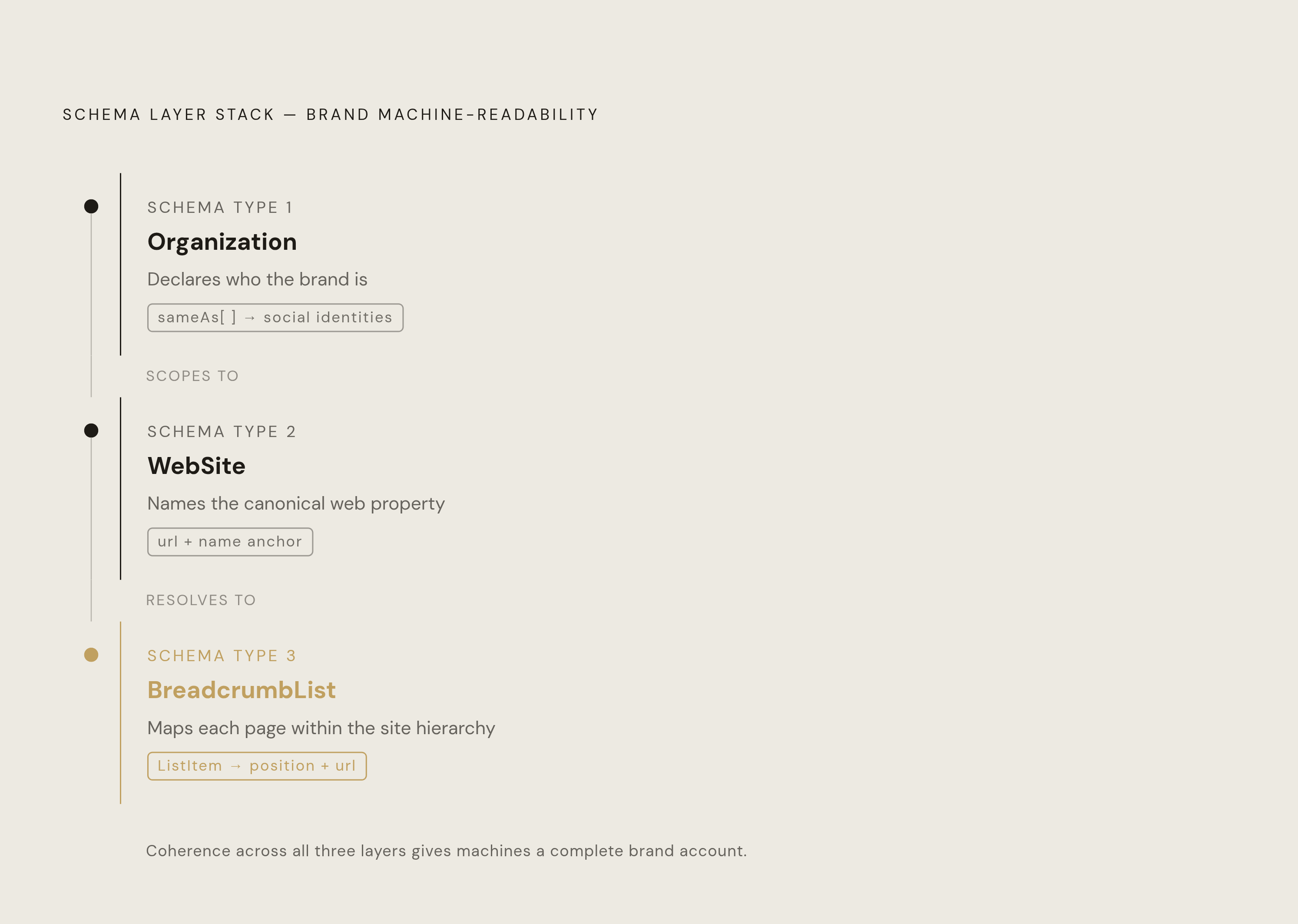
Organization declares who the brand is, WebSite identifies its web property, and BreadcrumbList explains how pages relate within it. Together, they form a machine-readable brand architecture. The advantage comes from agreement across those layers. A gap changes what the whole structure can communicate.
Consider correct Organization markup paired with sloppy breadcrumbs. The brand has supplied an identity but left its content structure unclear. The reverse leaves a different gap. Clean breadcrumbs without Organization schema describe a hierarchy without anchoring it to a named, verifiable entity. Neither implementation is useless, but each stops short of connecting the company to the organization of its knowledge.
The sameAs array provides another part of that connection. By linking the domain to the brand’s social-graph identities, it helps search and AI engines recognize an entity. BreadcrumbList then locates individual pages within that entity’s site. One type cannot simply replace another. Their coherence gives machines a more complete account at each level.
A brand-facts resource can extend the same architecture. At a stable, well-known path, human-readable and machine-parseable identity data gives AI models an authoritative reference when describing the company, reducing hallucination risk. It pairs with on-page schema. The brand’s identity, its web property, its hierarchy, and the visible facts that back up those declarations need to fit together. None of those jobs depends on a decorative search feature surviving.
How measuring AI citation exposure reveals whether the architecture is working
Valid schema proves less than many reporting systems take it to mean. It shows that an implementation meets a technical test, while determining whether AI answer engines cite the brand or describe it accurately requires its own measurement. Without that distinction, a team can complete every markup task and still lack evidence that its brand presence has improved.
AI share of voice offers a way to measure that exposure. It tracks the share of AI-generated answers that mention, cite, or recommend a brand across a defined set of category prompts. Brand-name questions and discovery questions test different things, so combining them can obscure a significant gap. A brand may appear frequently when explicitly named yet remain nearly invisible when people ask about its category.
That discovery gap is especially relevant to hierarchy. BreadcrumbList helps classify pages in the context of categories, which connects the implementation to the questions where recognition is not already supplied by the prompt. Results also need to be understood by platform. Only a small fraction of domains cited by ChatGPT are also cited by Perplexity, so presence in one cannot stand in for presence in the other.
Citation counts also cannot take the place of referral traffic. The relationship is not linear, so visits alone do not capture brand presence or accurate representation in answers. Measuring those outcomes creates a feedback loop between the declared architecture and what engines actually present. It replaces assumption with evidence. Brands that treat BreadcrumbList and WebSite as structural declarations, then measure their citation presence, can assess the work on that basis rather than hoping a cosmetic implementation is enough.