Negative Review Response Templates for SaaS Brands
AI systems now judge your review responses as marketing signals, not just customer service.
A public response to a negative review now performs two functions that were once separate: it addresses the individual reviewer, and it signals brand credibility to AI systems that summarize SaaS options for buyers who never visit a review page. The templates that dominate most guides were built for the first job alone. That is why they now underperform.
The shift is not speculative. A fast-growing share of B2B buyers now begin product research inside an AI chatbot, not a search engine, which means the review thread and the brand's response in it feed what those systems say about the brand before a buyer ever visits the vendor's website. Three years ago, a neglected review thread cost a brand one dissatisfied customer and a few dozen readers. In 2026, the same thread is raw material for a comparative answer delivered to thousands of anonymous researchers.
How AI answer engines now read public review responses as brand signals
The mechanism is behavioral, not merely textual. AI systems ingest response patterns, and a brand that addresses criticism transparently and specifically reads differently in training data than one that ignores complaints or responds with form language. The distinction a human reviewer makes between a genuine acknowledgment and a corporate deflection is the same distinction an AI summarizer weights when it decides whether a brand belongs in a comparative answer.
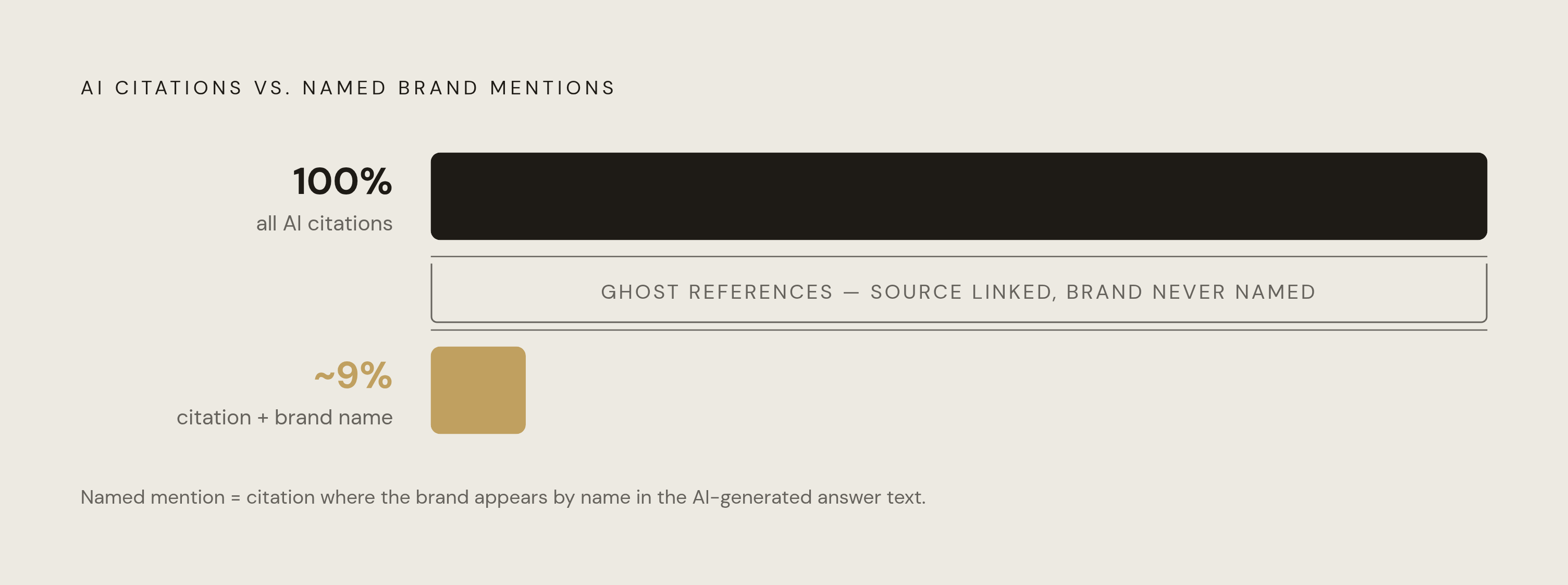
The specific risk is the gap between citation and named-brand mention. Research on AI citation behavior shows that a large majority of AI citations are ghost references, where the source URL is linked but the brand name never appears in the answer text. Only a small fraction of appearances produce both a citation and a recognizable brand name mention, and review-response quality is one of the signals that closes that gap. A response that names a specific remediation becomes evidence a system can surface when asked which vendor has the best customer support. A response that says "we are looking into this" becomes nothing.
Third-party review platforms rank near the top of the content surfaces B2B SaaS marketers believe most influence AI visibility. G2, Capterra, and Google sit second only to PR and earned media, with 41% of B2B SaaS marketers surveyed in 2026 citing them. The implication is uncomfortable for teams that treat review responses as a customer service chore: the response lives next to the review that AI systems already treat as signal, and it is judged by the same standards.
What the two-audience problem means for how a response should be structured
A response written to de-escalate the reviewer alone will fail the AI-legibility test. A response written for keyword density alone will fail the human empathy test. The structure must satisfy both at once, and the four-part pattern that works maps cleanly onto the signals each audience reads.
The first move is acknowledgment in the reviewer's own terms. "Sorry your table was not ready at eight despite the booking" signals to AI systems that the brand reads and processes individual complaints. "Sorry you had a bad experience" signals nothing, to either audience. AI systems parsing sentiment need a clear ownership signal, not a defensive hedge or a blanket corporate apology. The third move is one concrete change. Vague promises to "do better" are the most common reason a response reads as insincere to human readers and as low-information to AI systems. A specific remediation is both more credible and more citable. The fourth move is to take resolution off the platform, and offer a direct named contact. Negotiating in public extends the thread and increases the visible surface area of conflict.
The reframe that makes this structure teachable is the audience question. The response is written for the next several hundred people who read the thread while deciding whether to buy. The original reviewer has mostly decided. That orientation prevents the most common failure mode, which is writing to win the exchange rather than to present the evidence a skeptical researcher would need.
Generative engine optimization research points in the same direction. Precise, specific language, clear acknowledgment of facts, and evidence of a concrete action taken are the signals both a skeptical human reader and an AI summarizer weight positively. The structure is not a compromise between two audiences. It is the single set of moves that both audiences read as credible.
Templates for the complaint types that dominate SaaS reviews in 2026
The templates that matter map to the complaint categories that actually appear most often in SaaS reviews, not the generic scenarios most guides cover. Each example below is built on the four-part structure, with the structural moves labeled. Template 1: Support response time. The highest-volume complaint category in the dataset demands a fast, specific response. The opening names the particular delay the reviewer described, not the category of problem. Example: "You waited four days for an acknowledgment on a critical workflow ticket. That is a failure on our side, full stop." The second sentence owns the failure directly. Hedging through volume language, such as "our team was experiencing higher than usual volume," reads as an excuse to both audiences. The third names the concrete remedy: a direct escalation path, a named contact, or a specific change to the SLA. "We are looking into this" does none of that. The legibility note is direct: responses that name a specific remediation action are more likely to be surfaced when an AI is asked "which project management SaaS has the best customer support?" The response becomes evidence.
Template 2: Pricing or perceived value complaints. The second-highest category, especially acute for mid-market buyers, requires addressing the comparison directly. If the reviewer said a competitor does the same thing for less, the response names what differentiates the product rather than pretending the comparison was not made. Listing features the reviewer did not ask about is the defensive posture to avoid. Where a recent price change is driving the reviews, the response should acknowledge the change directly. Silence on a known issue suppresses brand-mention signal.
Template 3: Onboarding friction. This category carries the strongest churn correlation in the dataset. Reviews that mention onboarding difficulty are 3.2 times as likely to include language indicating the reviewer has left or is planning to leave. A slow or absent response here is disproportionately costly. The remediation must name a specific resource: a named onboarding guide, a named CSM contact, or a specific session type. Vague offers of "additional support" do not register as concrete remediation to either audience.
The goal is de-escalation before explanation. Lead with empathy that validates the specific experience, then transition to action. This is the template most likely to prompt a reviewer to update their rating, since many customers are more likely to revise a negative review when they receive a prompt, respectful reply that acknowledges their concern.
Template 5: The factually disputed review. When the reviewer's account is partly or fully incorrect, the correct move is not to win the argument publicly. Correct the record briefly, offer a direct contact, and stop. Report only fake, malicious, or guideline-violating reviews for removal. Respond professionally to all genuine negative feedback. Disputing a genuine complaint in public damages brand signal more than the original review.
Personalization applies to every template. Swap in the reviewer's name and at least one specific detail from their account. A template pasted verbatim reads as a template, and future customers can tell.
How AI-assisted drafting and human review should work together at scale
SaaS brands at scale cannot hand-write every response, but the answer is a pipeline with a human gate, not full automation. The risk of full automation is not only a quality problem. A review response that reads as machine-generated suppresses exactly the human-perspective signal that both readers and AI summarizers weight positively. The signal the reviewer and the AI system are looking for is evidence that a person read the complaint, and automated language destroys it.
The operational trend supports this reading. Overall review response rates jumped significantly between 2023 and 2024, and manual responses rose in parallel. The direction is toward more responses and more personalized ones, not toward full automation replacing human judgment. The failure case is documented: a marketing agency that went all-in on bulk automated content production saw a 79% crash in organic traffic for its main keywords. The same pattern applies to templated review responses at scale, where generic automated posts lose the human signal that both search and AI answer engines reward.
The pipeline is straightforward: draft with AI assistance, using templates as a scaffold. Then human review for tone, accuracy, and brand voice. Then publish. The human gate is not optional for negative reviews specifically. Without it, an AI-drafted response may attribute the wrong fix to the wrong complaint, or invent a contact that does not exist. Both errors compound the original review problem, turning one dissatisfied customer into a visible record of brand carelessness.
Measuring whether review responses are actually improving AI brand visibility
Publishing well-structured responses is necessary but not sufficient. The citation gap between appearing in an AI answer and being named in it is large and platform-specific, so brands must measure whether responses actually move the needle on AI brand mentions. Assuming improvement because the responses read well is how a strategy becomes a ritual.
Standard analytics cannot capture most of this signal. Only a small fraction of AI mentions include clickable citation links that show up in GA4. The majority of brand recommendations and comparisons in AI-generated answers are invisible to standard analytics. Perplexity is the exception, where every citation is clickable and, when clicked, appears in referral traffic. But relying on one platform's referral data is not a measurement strategy.
Volatility is the core measurement challenge. The same brand can see citation volumes differ by a very large multiple between different AI platforms, and single-prompt rank position is not a stable signal. Measure mention rate across repeated runs instead. The practical cadence is to run structured prompt sets against the AI platforms that matter most to the buyer's research journey, track mention rate rather than single-run rank, and compare against the review-response publication timeline. That comparison is the evidence base for adjusting template strategy.
This is the discipline the whole argument points toward. AI visibility should be instrumented and iterated on, not assumed. Templates provide the structure, the pipeline provides the human signal, and measurement closes the loop. A brand that does all three has turned review responses from a customer service obligation into a durable visibility asset. One that stops at publishing good responses has done the visible work without learning whether it worked.