Net Promoter Score vs Online Review Ratings as Reputation Proxies
NPS measures internal health while reviews shape how AI systems present your brand to buyers.

Net Promoter Score and online review ratings get treated as interchangeable proxies for reputation, and that habit produces bad decisions because the two metrics were built to do different jobs. NPS is a single-question survey instrument, introduced by Fred Reichheld in a 2003 Harvard Business Review article and co-developed with Bain & Company and Satmetrix, that asks customers how likely they are to recommend a brand to a friend or colleague. The responses sort into three groups: Promoters, who answer 9 or 10; Passives, who answer 7 or 8; and Detractors, who answer 0 through 6. The score itself is the gap between the Promoter and Detractor percentages, with Passives deliberately left out of the calculation entirely, and the broader Net Promoter System around that number describes how an organization closes the loop with customers and ties their feedback to operational change. Online review ratings serve a different function: public, voluntary star-and-text signals posted on platforms like Google, G2, Yelp, TrustRadius, and Capterra, visible to anyone who looks and, increasingly, legible to machines that never show a human face.
The structural gap: private diagnostic vs. public signal
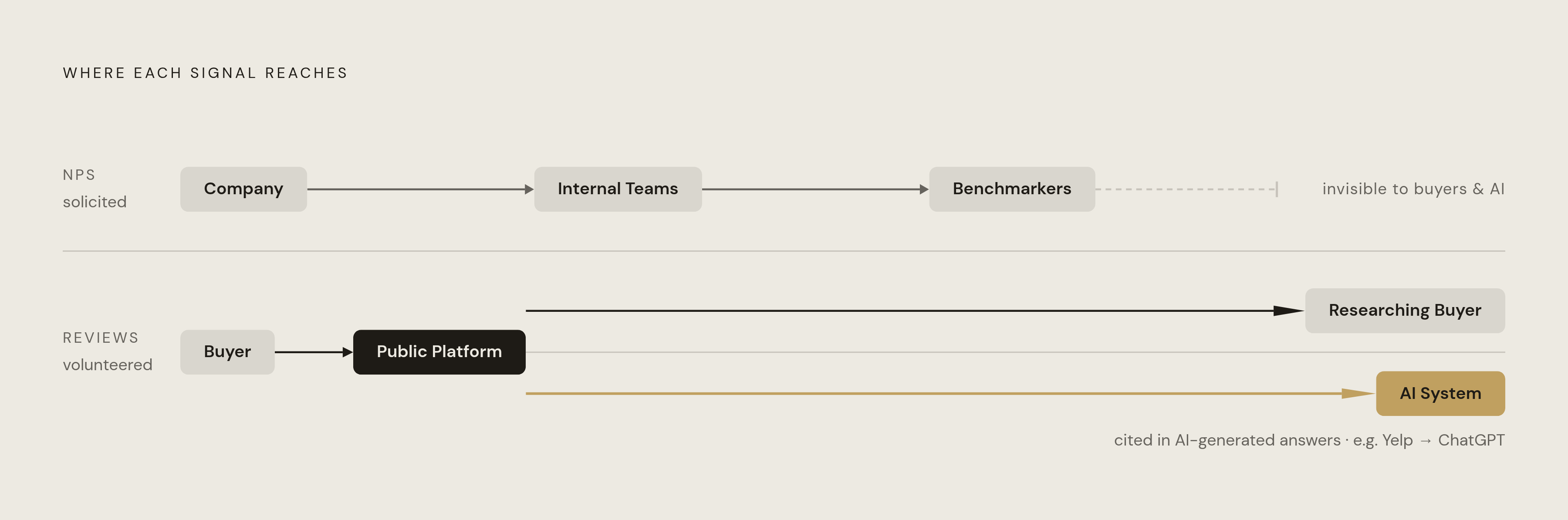
What separates NPS from review ratings is not primarily what each one measures but who gets to see the result. NPS is a closed, solicited signal: a company asks the question, collects the answer, and keeps the resulting number for internal teams and, in aggregate, industry benchmarkers. A buyer researching a product does not encounter a brand's NPS in the ordinary course of shopping, and even in the rare case where the number appears, it arrives without the context needed to interpret it. Review ratings work the opposite way. They are open and volunteered, available to any buyer at any stage of research, and now available to any AI system trained on or querying public web data. That asymmetry means NPS produces no externally citable signal. It stays invisible to the systems that now mediate brand discovery, but reviews sit directly inside them.
Both metrics carry their own sampling distortions, just in different directions. NPS surveys tend to reach a self-selected slice of customers, the delighted and the furious, but the quietly disengaged middle rarely bothers to respond. Those Passives are satisfied without being enthusiastic, which makes them vulnerable to a competitor's next offer, and they are among the least likely segments to complete a survey. Reviews skew toward strong sentiment too, they remain vulnerable to manipulation, and they accumulate unevenly across categories and platform types, so raw review counts are not a clean read either. Neither instrument delivers a pure signal on its own. The structural fact to hold onto is that they fail toward different audiences: NPS fails quietly inside the company, and reviews fail publicly, where competitors and AI systems alike can see the gaps.
Where NPS breaks down as a reputation proxy
A brand can carry a high NPS while sitting on serious, undetected reputation risk, because the metric's design filters out the very signals that would expose the risk. The invisible-middle problem is visible here: customers who are unhappy but don't bother complaining simply don't show up in NPS data. They churn silently, so the score stays intact, and the customer base erodes under a number that still looks healthy on a dashboard. NPS alone also can't explain why a customer felt a certain way or how hard their journey actually was, so you can't shape customer experience strategy on it without open-ended follow-up data layered in.
Benchmarking against other companies adds another complication. Average NPS varies widely by sector, so a score that signals strong health in one industry can signal mediocrity in another, and an absolute number means little without that context. Relational NPS, which measures the overall relationship a customer has with a brand, and transactional NPS, which measures a single interaction, are different instruments measuring different things, and folding them into one combined score is a category error that produces a number neither measure actually supports. Employee NPS tends to move in step with customer NPS, which gives eNPS some value as an early warning for customer experience degradation before it shows up in the customer-facing number, but that early warning is still internal and still invisible to anyone outside the company.
The sharpest failure mode appears in a specific, realistic scenario: a brand whose customers are genuinely happy, NPS high, churn low, where almost nobody leaves a public review. In that situation, the AI systems that now mediate discovery have nothing authoritative to cite in the brand's favor. A corpus of public reviews gives those systems concrete material to reference and name; NPS gives them nothing at all, because NPS was never built to be read by anyone outside the company that collected it. That gap is what turns review presence itself into a visibility problem, one that Letterstory's instrumentation work treats as a distinct discipline from traditional customer experience measurement, separate from anything an internal NPS program can diagnose.
Online review ratings as a machine-readable training signal
By 2026, public review corpora no longer just worked as a destination buyers navigate on their own; they became a query and retrieval layer that AI systems buy direct access to. That shift changes what a review rating actually is, compared to even two years earlier. The clearest documented case is the Yelp deal with OpenAI: Yelp licensed its reviews, ratings, photos, and business information to OpenAI, giving ChatGPT a source of real-time local recommendation data. The significance of that arrangement isn't that an AI system uses reviews somewhere in its responses. A major AI company paid directly for the right to use them in real time, as a feed.
AI-generated review summaries now precede the individual reviews themselves in a meaningful share of consumer research journeys, and plenty of buyers stop at the summary without reading a single underlying review. That changes what a cluster of negative reviews can do to a brand. It stops influencing only the individual buyers who happen to read it and starts feeding a synthesized AI narrative, something like "users frequently report slow customer support," that reads as authoritative, comprehensive, and durable across many conversations at once. That narrative can also lag the facts on the ground. A brand might fix the underlying problem and collect a wave of new, positive reviews, and the old negative pattern can still persist in AI-generated answers for months, because the AI's training data updates on its own schedule rather than the brand's.
Review platforms have lost substantial organic traffic from traditional search, yet they remain heavily cited in Google AI Overviews for commercial queries, with citation rates varying significantly across different AI platforms. A third-party review profile on one of those platforms materially increases a brand's chances of being cited. Review ratings carry weight precisely because they are public and machine-readable: AI systems trained on web data can cite them directly inside an answer, something NPS simply cannot do. That structural asymmetry is why review visibility now outweighs an internal diagnostic: it is the signal that shapes how buyers and AI systems perceive a brand before a human ever reads the underlying text.
How AI systems decide which brands to name
AI answer engines don't rank brands the way a search engine ranks pages. They cite brands the way an editor cites sources, and the factors that earn that citation are largely invisible to classic SEO thinking. Brand mentions correlate with AI visibility far more strongly than backlinks do, and the gap between the two signals is substantial, so the off-page link-building work that dominates traditional SEO strategy only partially predicts whether an AI system will name a brand.
AI citations skew heavily toward off-site sources. A brand is far more likely to get cited through a third-party page than through its own domain, and for broad category queries, the large majority of citations originate somewhere other than the brand's own site. The presence that earns citation comes from showing up consistently across third-party contexts: Reddit threads, YouTube videos, industry publications, review sites, LinkedIn posts. A brand that exists only on its own domain gets effectively filtered out of that conversation. Organic, non-paid media accounts for the overwhelming share of AI citations, and earned media, meaning third-party editorial coverage a brand didn't buy or publish itself, drives most of what these systems surface in response to a query.
A minority of AI-cited pages also rank in the organic top ten search results, which confirms that AI visibility runs as a genuinely separate contest from search ranking. The default state for most brands is invisibility: the vast majority of brands analyzed across multiple AI platforms have zero mentions in AI search results. Getting cited isn't an edge case reserved for a handful of dominant players; it's a distinct, learnable set of mechanics that most brands simply haven't engaged with yet.
The trust problem that limits both metrics
Neither NPS nor review ratings delivers a clean signal on its own, and the honest response to that fact is not to discount reviews as a category. AI systems are building their own filters for authenticity, and that development puts brands with genuine review depth in a structurally stronger position than brands that try to game the count. A substantial share of online reviews lack authenticity, and most UK shoppers believe they've read a fake review at some point, so consumer trust in online reviews falls well short of unanimous. Those are real limits on reviews as a reputation proxy, and no honest account of the subject should skip past them.
NPS carries its own authenticity ceiling, just a quieter one. Because the survey is solicited and kept private, a company can manage it through survey timing, through cherry-picking which customers receive it, or by inflating response rates among customers already known to be satisfied. Handled that way, the score becomes a vanity metric management can point to. In both cases, the better benchmark is a brand's own performance over time rather than any single absolute number: consistent, data-driven progress tells a company more than where its score lands at one moment.
Consumers have grown skeptical of AI-summarized sentiment specifically, undermining trust in AI-generated content built from review data. That skepticism creates an opening for brands that maintain verifiable, attributed, detailed review corpora to stand apart from brands whose reviews read as generic or manufactured. Volume of reviews matters less than the kind of review a brand accumulates. Detailed, attributed, specific feedback from verified purchasers is what both human readers and AI systems are learning to prefer over a large pile of thin, five-word ratings.
Visibility Where Discovery Happens
Brands should use NPS as the internal diagnostic it was designed to be and treat public review presence as the externally facing signal that shapes AI-mediated discovery. NPS, used correctly, functions as a private early-warning system for customer experience problems, a segmentation tool for identifying which promoters are worth activating as advocates, and a trend line for measuring whether operational changes are working. It was never built to answer the question an outside buyer, or an AI system, is actually asking.
Public review presence, used correctly, is a corpus of attributed, specific, verified feedback spread across the platforms AI systems actually query, among them G2, Capterra, Trustpilot, and Google, giving those systems a positive, retrievable narrative to cite back to a buyer. Brands that neglect that work run into what amounts to a phantom-presence problem: content that names the brand in context on third-party sources, rather than on the brand's own domain, is now a first-class content strategy, because that third-party layer is what AI systems actually read when they decide who to cite. When a brand is both mentioned and cited as a source, it becomes materially more likely to resurface in later AI responses, and that compounding effect is what makes early investment in review and earned-media presence durable.
One company's experience offers a useful illustration of the causal direction here, and it runs opposite to what most companies assume. Review management came first: the chain worked with a customer-experience management platform to monitor and respond to reviews and customer feedback systematically across its locations, treating the public-facing conversation as the thing to manage directly. The NPS gain followed from that work, not the other way around. Most companies assume a strong internal score is what eventually produces good public sentiment. The sequence runs the other direction: managing the public, machine-readable signal first is what moved the private diagnostic number afterward.
The sharpest version of the stakes here returns to the scenario raised earlier, a brand with happy customers and strong NPS but almost no public reviews. AI systems have no authoritative material to cite positively about that brand, but a visible corpus of reviews gives them something concrete to point to, which NPS can't. That makes review visibility, not the internal score, the thing actually standing between a satisfied customer base and a buyer who finds that satisfaction reflected back in an AI-generated answer.
Measuring AI citation for a feedback loop
None of this strategy holds together without a way to measure whether it's working. A plan that spans NPS and AI citation only functions if the AI-visibility half gets instrumented, because an unmeasured claim like "the brand is working on generative engine optimization" is just as untestable as a raw NPS figure presented without industry context. If a number has no baseline, in either direction, it tells a company nothing about whether it's actually making progress.
Letterstory was built specifically to close that gap. It runs standing watchers that draft content the moment something relevant happens in a brand's category, a measurement layer that tracks whether ChatGPT, Claude, Gemini, and Perplexity actually name and cite a given brand, and phantom sites and client blogs that publish on a steady cadence to build the third-party citation layer AI systems read from. Its multi-stage AI pipelines pair automated drafting with human review, so the material that earns citation is also good enough to publish under the brand's own name. Every piece of that capability is reachable through an API, so teams can wire the measurement and publishing layer directly into their own existing stack.
The gap between a metric designed for internal operational decisions and one designed to be cited externally is where NPS and review ratings diverge most sharply, and a brand's measurement strategy has to split to match that gap. NPS compresses loyalty into a single number trended quietly inside a company. Review ratings are public, voluntary signals, and AI systems now consume them directly as a feed, so buyers consult them before they ever pick up the phone. A brand that instruments only one half of that picture is flying on half the instrument panel, trusting a number it cannot cross-check against what the rest of the world, human or machine, actually sees.